
Potential Energy: Stored Energy in a System
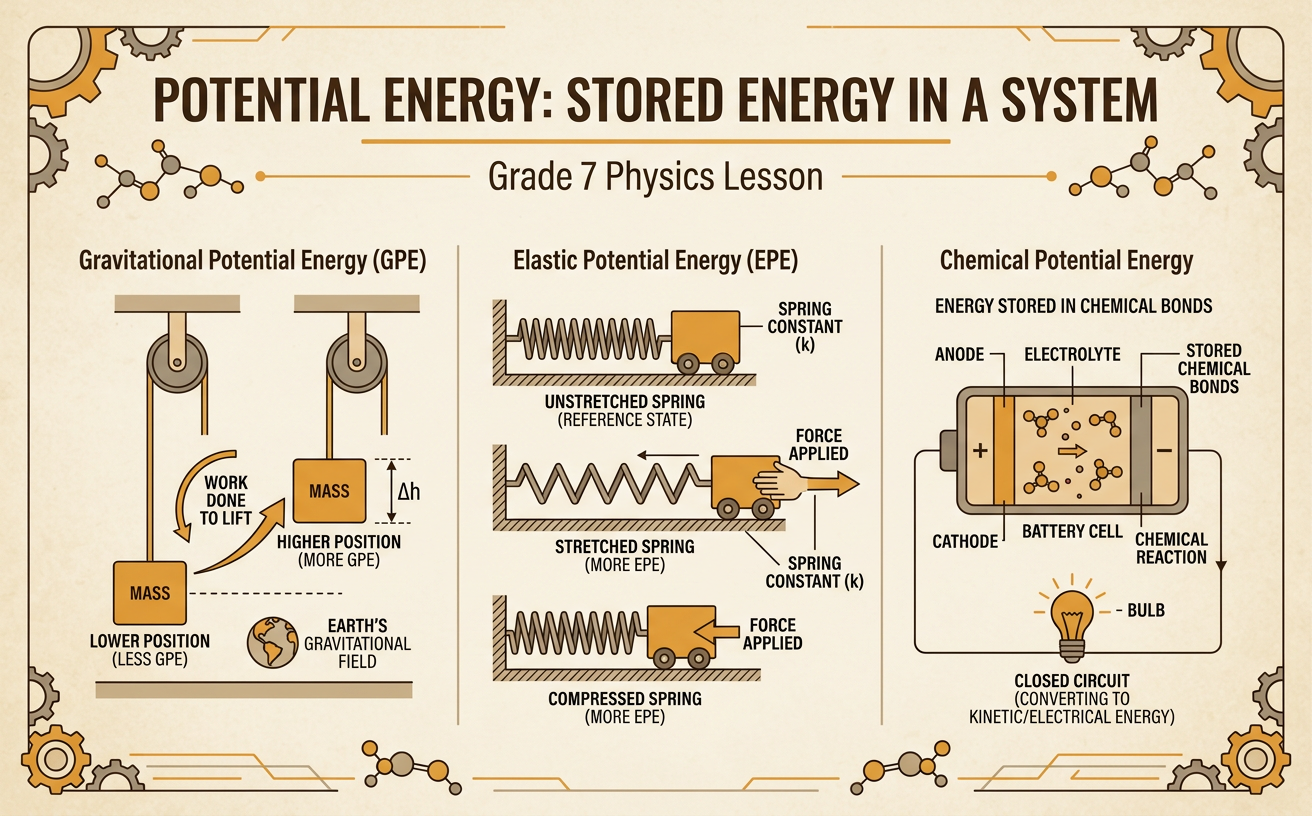
Students use models and evidence to explain how changing the positions or arrangements of interacting objects changes the potential energy stored in a system.
Illustrations are auto-generated and may be placeholders. They can be refreshed to match the narration.
What Is Potential Energy?
Potential energy is energy stored in a system because of the positions or arrangements of interacting objects. A system is the group of objects being studied. For example, consider a book and Earth as one system. When the book is lifted from the floor to a shelf, the distance between the book and Earth changes, so the system stores more gravitational potential energy. The energy did not appear from nowhere. A person transferred energy to the system by lifting the book. If the book falls, stored energy can be transformed into motion energy and then into sound and thermal energy when the book lands. Potential energy belongs to the system of interacting objects, not to the book alone. Scientists choose a reference level, such as the floor, from which to compare heights and potential energies.

Objects, Position, and Stored Energy
Potential energy changes when the positions of interacting objects change. In a gravitational system, separating an object farther from Earth’s surface usually increases stored energy. Imagine two identical toy cars at the tops of ramps. Car A starts 20 centimeters above the floor, while Car B starts 40 centimeters above the floor. Because the cars have equal mass, the car at the greater height has more gravitational potential energy relative to the floor. When released, Car B can transfer more energy into motion and may travel farther after leaving the ramp. Position also matters in other systems. Pushing like poles of two magnets closer together changes the magnetic potential energy because the magnets repel. Evidence of stored energy appears when the objects are released and begin moving, showing that their arrangement can produce a change.

Modeling Gravitational and Elastic Systems
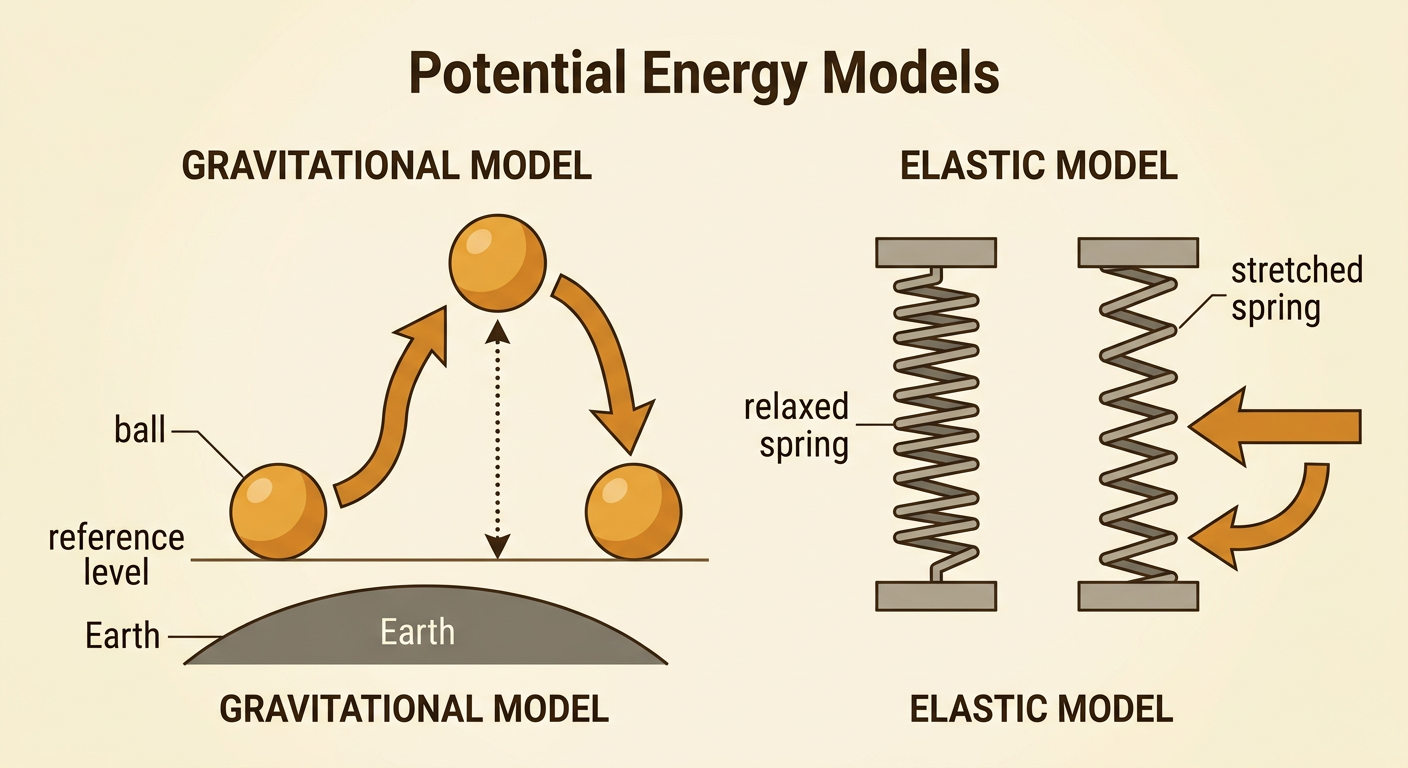
A scientific model highlights important parts of a system and shows how they interact. For a ball held above Earth, a gravitational model includes the ball, Earth, their relative position, and a chosen reference level. Raising the ball increases the system’s gravitational potential energy. An elastic model can show a spring and the objects attached to it. A spring at its relaxed length stores less elastic potential energy than the same spring when stretched or compressed. For example, pulling back a toy launcher stretches its spring. The person does work, transferring energy into the spring system. When released, the spring returns toward its relaxed shape and transfers energy to the toy. Arrows, measurements, and before-and-after drawings make the model testable. The model should not suggest that energy is created; it should show energy entering, being stored, and later changing form or transferring.
Interpreting Height and Energy Data
Data can provide evidence for a model. Suppose a 1-kilogram object has 10 joules of gravitational potential energy at 1 meter, 20 joules at 2 meters, 30 joules at 3 meters, and 40 joules at 4 meters, using the floor as the reference level and rounding gravitational field strength to 10 newtons per kilogram. Each time height increases by 1 meter, energy increases by 10 joules. The ratio of energy to height is constant: 10 joules per meter. Therefore, potential energy and height have a proportional relationship when mass and gravitational field strength stay constant. A graph of energy versus height forms a straight line through the origin. Doubling the height doubles the potential energy, but only under these controlled conditions. A more massive object would produce a steeper line because it gains more energy for the same height increase.

Energy Storage in Everyday Technologies
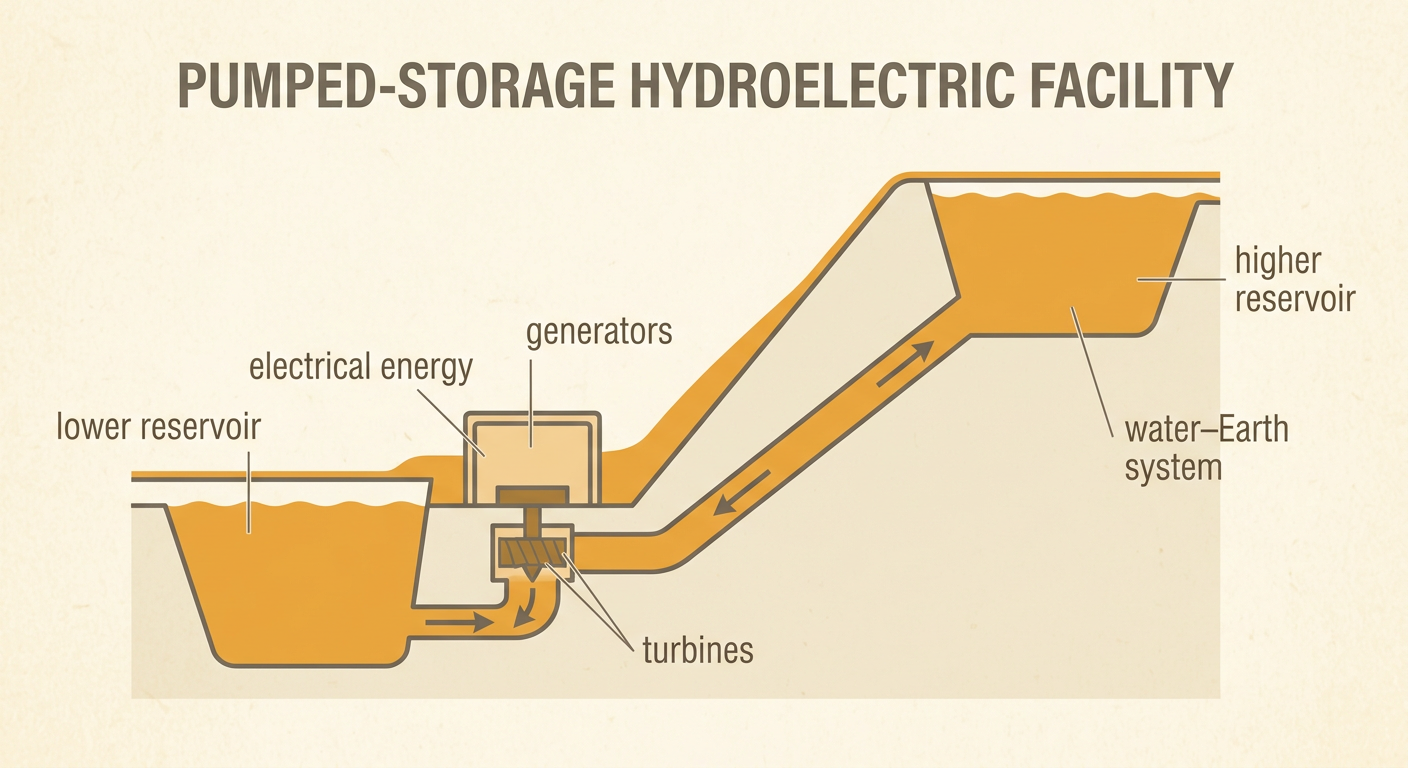
Many technologies store energy by changing the arrangement of a system. A pumped-storage hydroelectric facility uses extra electrical energy to pump water from a lower reservoir to a higher reservoir. This increases the gravitational potential energy of the water–Earth system. When electricity is needed, water flows downhill through turbines, and generators produce electrical energy. Benefits include storing large amounts of energy, responding quickly to changes in demand, and supporting wind or solar power when sunlight or wind is unavailable. Costs can include construction expense, flooded land, altered habitats, water loss, and effects on nearby communities. Engineers, governments, and residents must compare these benefits and costs when choosing a site. Other examples include compressed springs and elevated weights, but each solution differs in capacity, location needs, safety, price, and environmental impact. A good decision uses scientific evidence and considers who receives the benefits or bears the costs.
Quick Model-and-Evidence Check
Test your understanding with a model of two identical balls. Ball A is held 1 meter above the floor, and Ball B is held 3 meters above the floor. Define each ball and Earth as a system, and use the floor as the reference level. Draw both arrangements, label the heights, and use an energy bar to show that Ball B’s system has three times as much gravitational potential energy as Ball A’s system. Your claim should state that increasing height increases stored gravitational potential energy. Your evidence is the 3-to-1 height ratio for equal masses under the same gravity. Your reasoning should explain that potential energy is proportional to height when mass and gravity are constant. Then predict what happens when Ball B is released: stored energy decreases as motion energy increases. The total energy is transferred or transformed rather than created or destroyed.
