Powder Detectives: Identifying Materials by Their Properties
Students observe and measure safe household powders to identify each material using properties such as color, texture, solubility, and response to vinegar.

Illustrations are auto-generated and may be placeholders. They can be refreshed to match the narration.
The Mystery Powder Challenge
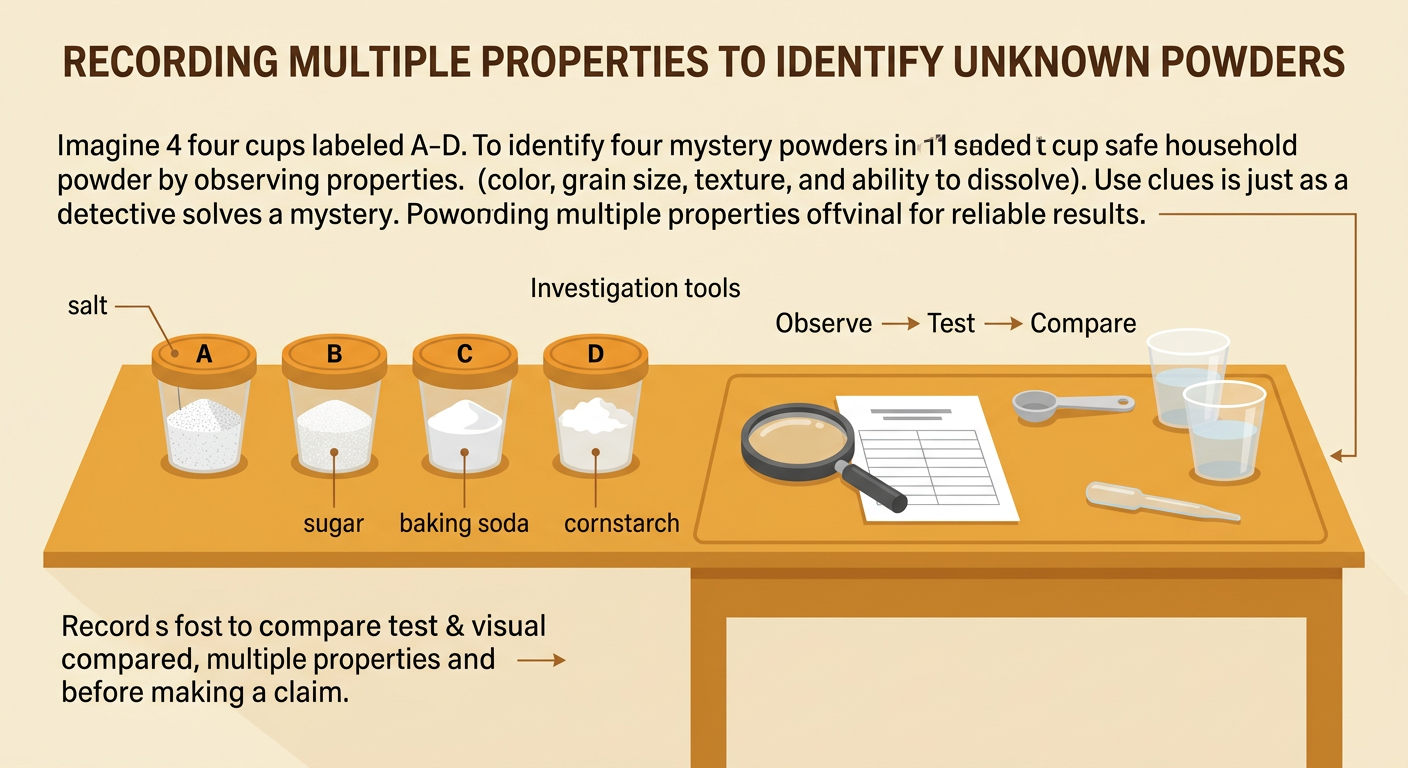
Imagine four cups labeled A, B, C, and D. Each holds a safe household powder: salt, sugar, baking soda, or cornstarch. Your job is to identify each powder without tasting it. Scientists identify materials by studying properties that can be observed or measured. A property is a feature of a material, such as color, grain size, texture, or ability to dissolve in water. You will record several clues because one clue may not be enough. For example, salt and sugar are both white and grainy, so color alone cannot separate them. However, comparing grain shape, solubility, and response to vinegar provides stronger evidence. Work with your group, share observations, and listen to different ideas before making a claim about each mystery powder.
Safety and Testing Rules
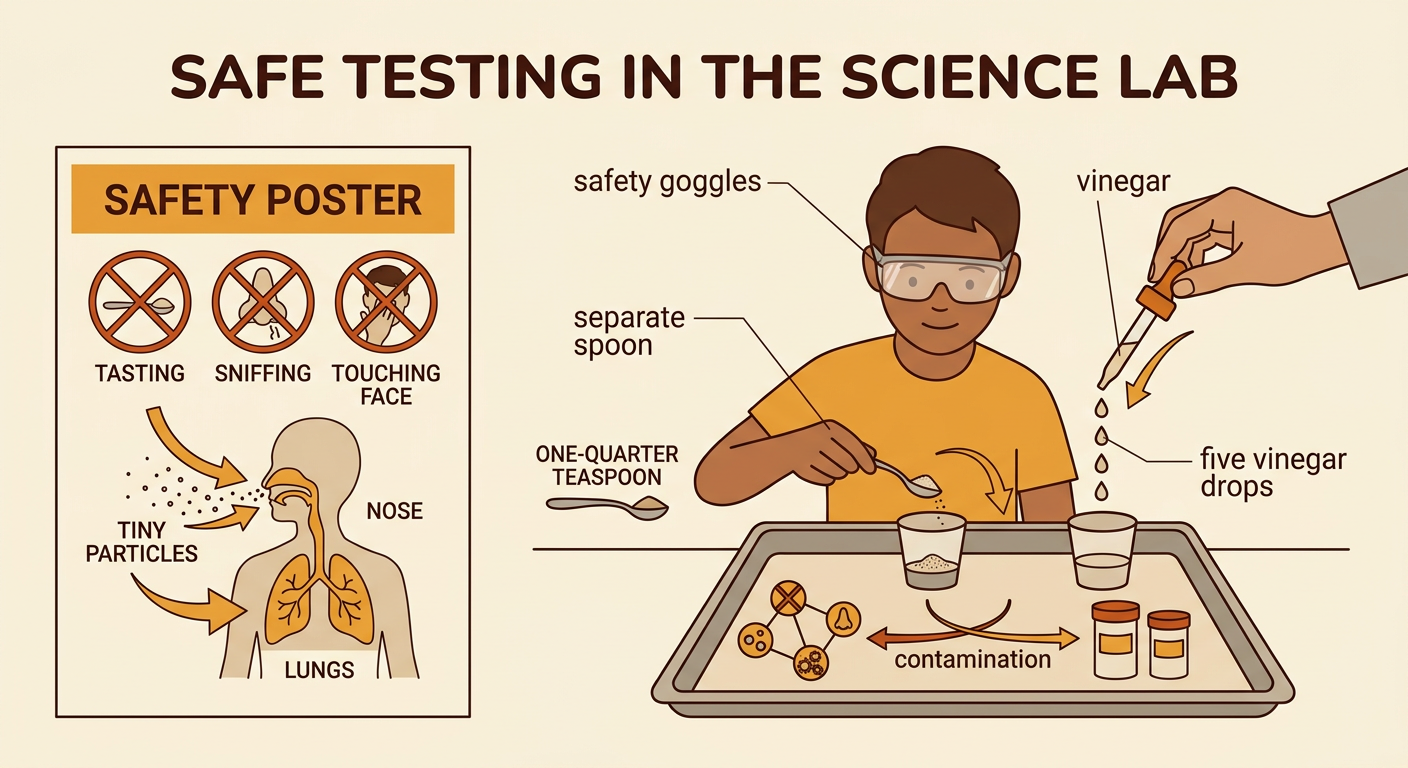
Safe scientists follow the same rules during every test. Wear safety goggles and keep powders away from your eyes, mouth, and nose. Never taste a mystery material, even if you think it is food. Do not sniff powders because tiny particles can enter your nose or lungs. Use only the small amounts and tools your teacher provides. Keep a separate spoon or craft stick for each powder so the samples do not mix. When using vinegar, add only the assigned number of drops and keep the cup on the table. For example, if the directions say to test one-quarter teaspoon of powder with five drops of vinegar, do not add more. Report spills immediately, wash your hands after testing, and follow your teacher’s cleanup directions.
Observe and Measure Properties
Begin with tests that do not change the powders. Place a small sample of each powder on a separate dark card so white grains are easy to see. Observe color, grain shape, grain size, and texture with a hand lens. Describe what you see with precise words such as fine, powdery, grainy, shiny, dull, or clumpy. Do not touch samples with bare fingers; use a craft stick to move them gently. Measure the same amount of each material, such as one level one-quarter teaspoon, so later tests are fair. You can also measure mass in grams if a classroom balance is available. For example, sugar may appear as larger, sparkly crystals, while cornstarch looks very fine and dull. Record measurements with units, because a number without a unit is incomplete.

Test Solubility and Vinegar Response
Solubility describes how well a material dissolves in a liquid. Put equal amounts of each powder into separate clear cups, add the same amount of room-temperature water, and stir each cup the same number of times. A dissolved powder seems to disappear and forms an even mixture. Salt and sugar dissolve in enough water, while cornstarch makes a cloudy mixture and may settle. Next, place fresh samples in clean cups for the vinegar test. Add the same number of vinegar drops to each sample. Baking soda produces many bubbles because a gas forms during a chemical reaction. This bubbling is called fizzing. Do not confuse fizzing with a few air bubbles caused by stirring. Record whether each sample dissolves, stays cloudy, settles, or fizzes strongly. Use fresh tools to prevent mixed results.

Compare Evidence and Identify Powders
After testing, compare all the evidence instead of relying on one result. Make a table with one row for each mystery powder and one column for each property. Then look for a pattern that matches a known material. For example, a fine white powder that does not dissolve well in water and does not fizz with vinegar is likely cornstarch. A powder that fizzes strongly with vinegar is likely baking soda. Salt and sugar may both dissolve, so use crystal appearance and teacher-provided reference samples to tell them apart. In your group, take turns explaining your claim. A strong explanation names the powder and connects it to several observations: “I think Sample B is baking soda because it was fine, dissolved in water, and fizzed strongly with vinegar.” If evidence conflicts, repeat the test rather than guessing.

Choosing Materials for a Purpose
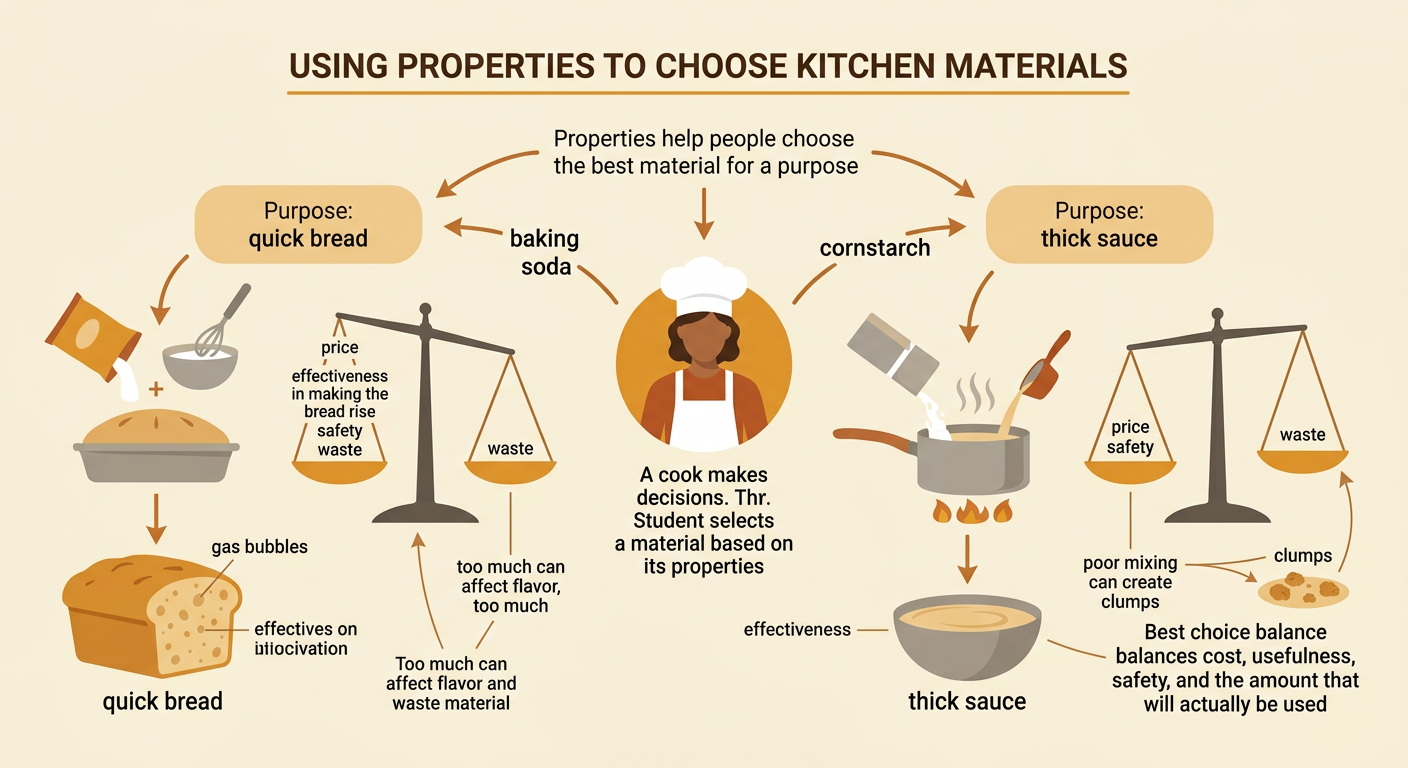
Properties help people choose the best material for a job, but every choice can have benefits and costs. Suppose a cook needs a powder to make quick bread rise. Baking soda is useful because it reacts with an acid and forms gas bubbles, but using too much can affect flavor and wastes material. Suppose a person needs to thicken a sauce. Cornstarch is helpful because it forms a thick mixture when prepared and heated correctly, but it may clump if mixed poorly. Salt and sugar dissolve easily, yet they have different purposes and should not be chosen only because they look alike. Compare price, amount needed, safety, waste, and how well each material works. For example, buying a larger box may cost less per ounce, but it is not a benefit if the extra material is never used and becomes waste.