
Predicting Element Properties with Periodic Trends
Students use periodic-table position and valence-electron patterns to predict atomic radius, ionization energy, electronegativity, and chemical behavior.

Illustrations are auto-generated and may be placeholders. They can be refreshed to match the narration.
How the Periodic Table Is Organized
The periodic table is arranged by increasing atomic number, the number of protons in an atom. Each horizontal row is a period, and each vertical column is a group. Elements in the same group often have similar chemical properties because their outer-electron patterns are similar. Metals occupy most of the left and center, nonmetals are mainly on the right, and metalloids lie along a stair-step boundary. The table developed as more elements were discovered, measurements became more accurate, and scientists sought to explain recurring behavior. In 1869, Dmitri Mendeleev arranged elements largely by atomic mass and left gaps for undiscovered elements. Later, Henry Moseley used atomic number to correct inconsistencies and establish the modern order. For example, sodium and potassium align in Group 1, helping predict that both are reactive metals.

Valence Electrons and Chemical Families
Valence electrons are the electrons in an atom’s outermost occupied energy level. They strongly influence how an element bonds and reacts. For main-group elements, the group provides a useful pattern: Group 1 atoms have one valence electron, Group 2 atoms have two, Group 17 atoms have seven, and Group 18 atoms usually have eight. Helium is an exception because its only energy level is full with two electrons. Elements often gain, lose, or share electrons to reach a stable outer level. For example, sodium has one valence electron and tends to lose it, forming Na+. Chlorine has seven valence electrons and tends to gain one, forming Cl−. Their attraction produces ionic sodium chloride. Transition metals can have more complicated electron and charge patterns, so group-based predictions are less exact for them.

Atomic Radius Trends
Atomic radius is a measure of an atom’s size. In general, atomic radius increases down a group because each new period adds an occupied energy level farther from the nucleus. Inner electrons also shield outer electrons from some nuclear attraction. For example, potassium is larger than sodium, and sodium is larger than lithium. Across a period from left to right, atomic radius generally decreases. The number of protons increases while added electrons enter the same main energy level, so the stronger effective nuclear attraction pulls the electron cloud closer. In Period 3, sodium is therefore larger than chlorine. These are overall trends, and precise measured values may contain small variations. To interpret a graph of radius versus atomic number, look for a general decrease across each period followed by a sharp increase when the next period begins.

Ionization Energy and Electronegativity
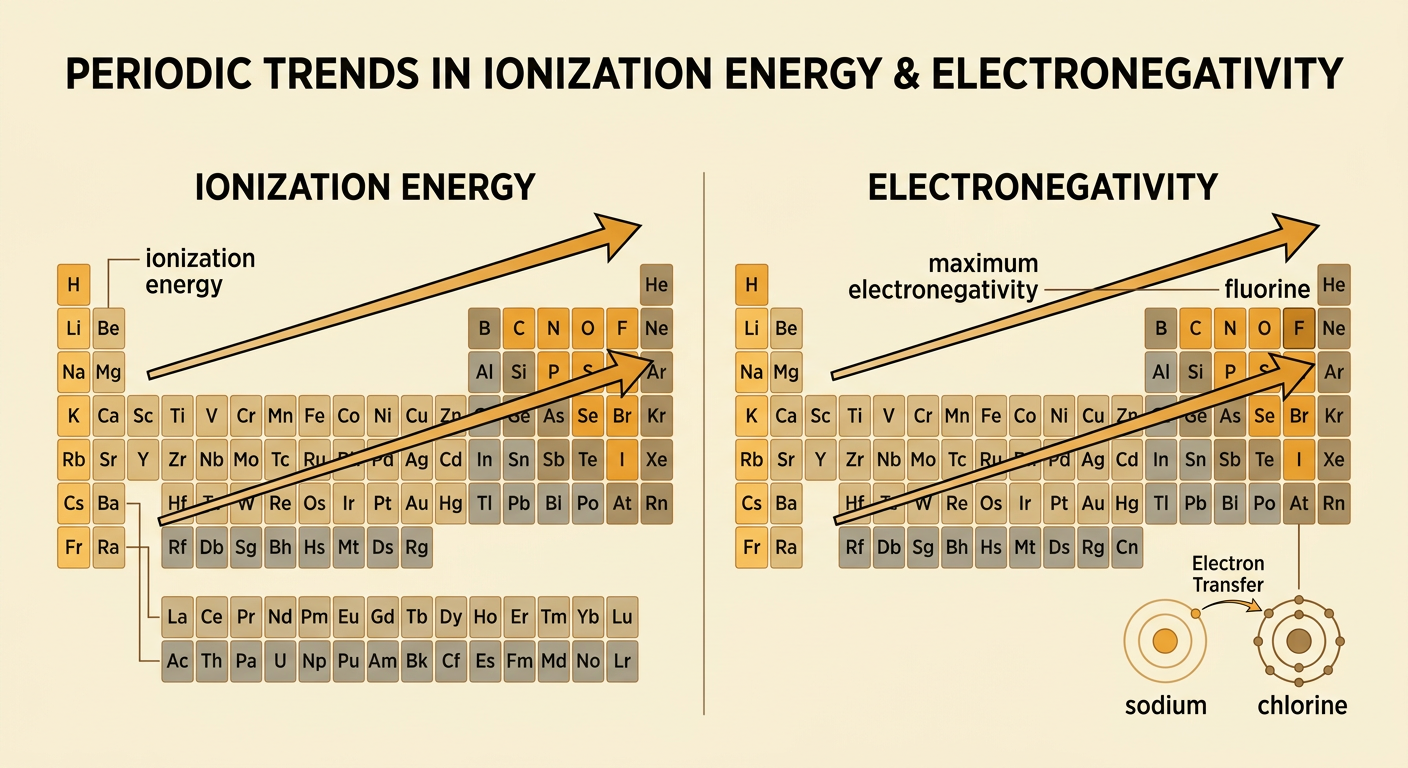
Ionization energy is the energy required to remove an electron from a gaseous atom. It generally increases from left to right across a period because increasing nuclear attraction holds electrons more tightly. It generally decreases down a group because outer electrons are farther from the nucleus and more shielded. Electronegativity describes how strongly an atom attracts shared electrons in a chemical bond. It also generally increases across a period and decreases down a group. Fluorine has the highest electronegativity, while noble gases are often omitted from electronegativity comparisons because they rarely form bonds. For example, sodium has a lower ionization energy and electronegativity than chlorine. Sodium therefore loses an electron relatively easily, while chlorine strongly attracts an electron. A graph across Period 3 would show a general rise in both properties, although ionization-energy data include a few small exceptions caused by electron arrangements.
Predicting and Comparing Element Properties
To compare elements, first locate their periods and groups, then apply valence-electron and periodic trends. Elements in the same period have the same number of occupied main energy levels, while elements in the same main group have similar valence-electron counts. Consider magnesium and sulfur, both in Period 3. Magnesium is farther left, so it generally has a larger atomic radius, lower ionization energy, and lower electronegativity than sulfur. Magnesium has two valence electrons and commonly loses both to form Mg2+. Sulfur has six valence electrons and can gain two to form S2− or share electrons in covalent bonds. Thus, magnesium behaves as a reactive metal, while sulfur behaves as a nonmetal. When they react, their ions can form magnesium sulfide, MgS. Predictions describe relative behavior; measured tables and graphs can then be used to check magnitudes and identify exceptions.
