Predicting Inherited Traits with Punnett Squares
Students use Punnett squares and genetics vocabulary to predict offspring genotypes and phenotypes, explain how mutations can introduce new alleles, and distinguish dominance from whether a trait provides an environmental advantage.
Illustrations are auto-generated and may be placeholders. They can be refreshed to match the narration.
Genes, Alleles, and Mutations
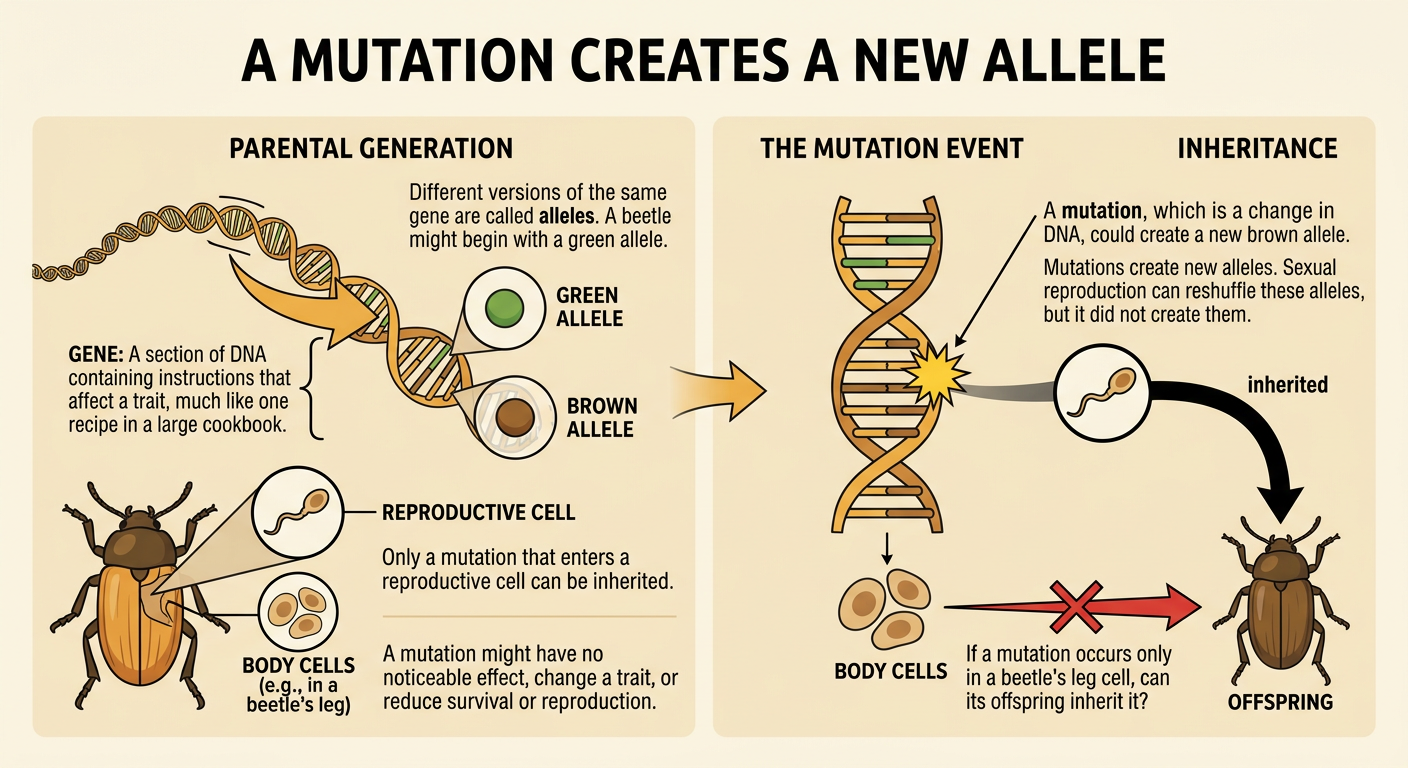
Genes are sections of DNA that contain instructions affecting an organism’s traits. Different versions of the same gene are called alleles. In sexually reproducing organisms, an offspring usually receives one allele for a gene from each parent. Genetic variation results partly from receiving different combinations of parental alleles. Mutations are changes in DNA sequences that can create new alleles. A mutation may have no noticeable effect, change a trait, or reduce an organism’s ability to survive or reproduce. Only mutations that enter reproductive cells can be passed to offspring. For example, imagine a mutation in a beetle pigment gene that produces a new brown-color allele instead of the original green-color allele. Sexual reproduction can then reshuffle the green and brown alleles into new combinations, but it does not create those alleles.
Dominant and Recessive Alleles
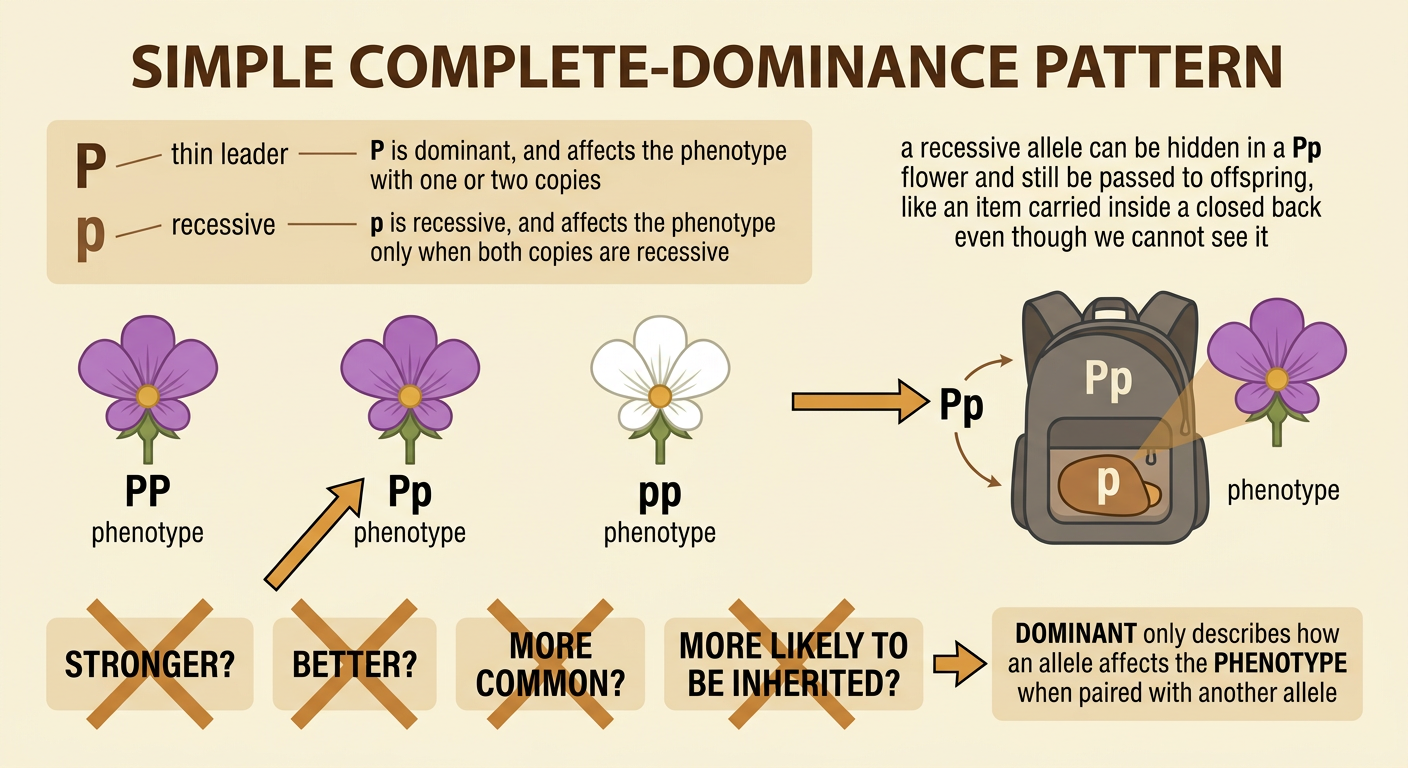
A dominant allele is expressed in the phenotype when an individual has one or two copies of it. A recessive allele is expressed only when the individual has two recessive copies, assuming a simple complete-dominance pattern. Scientists usually represent a dominant allele with a capital letter and a recessive allele with the matching lowercase letter. In a fictional flower species, P could represent purple petals and p could represent white petals. Plants with PP or Pp genotypes have purple petals, while plants with pp have white petals. Dominant does not mean stronger, better, more common, or more likely to be inherited. It describes how alleles interact to affect phenotype. A recessive allele can remain hidden in a heterozygous individual and still be passed to offspring. Some real traits follow more complex inheritance patterns.
Homozygous and Heterozygous Genotypes
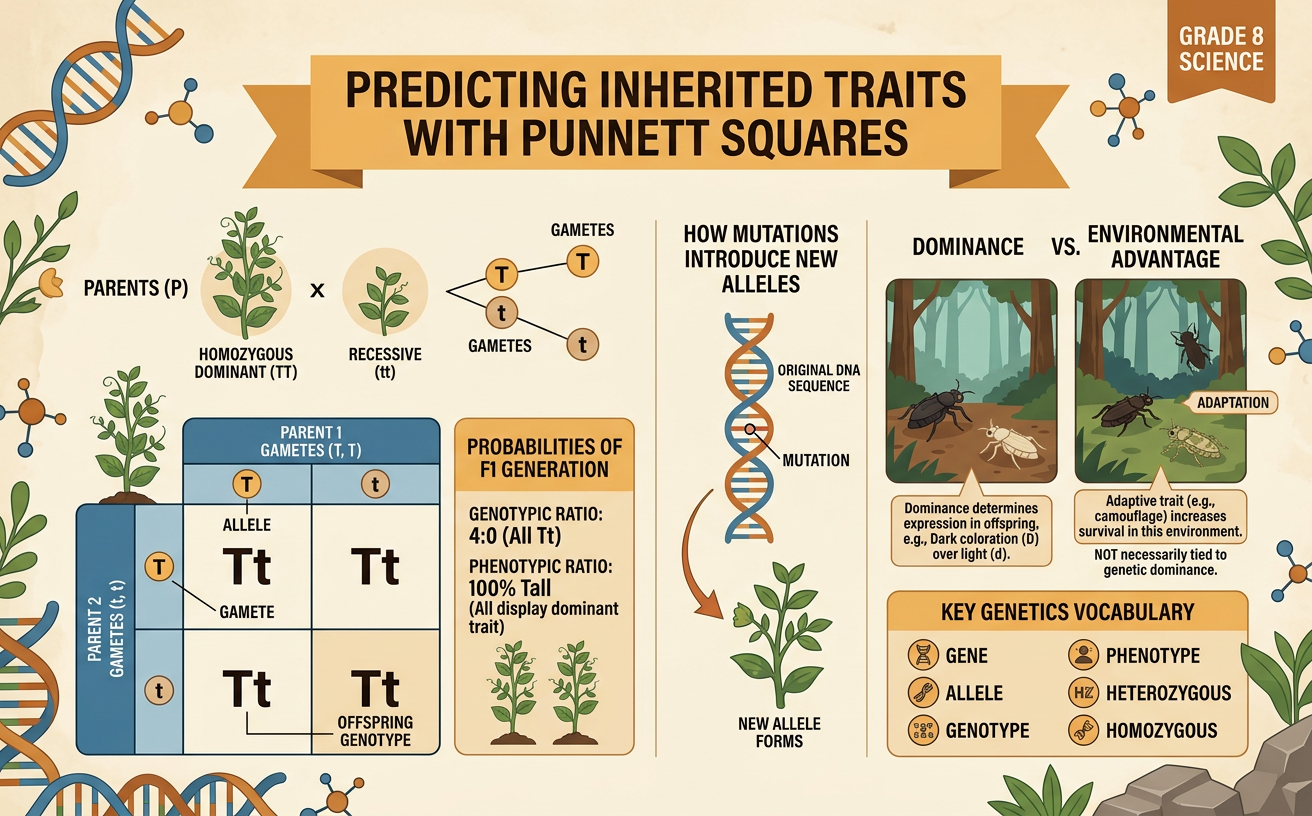
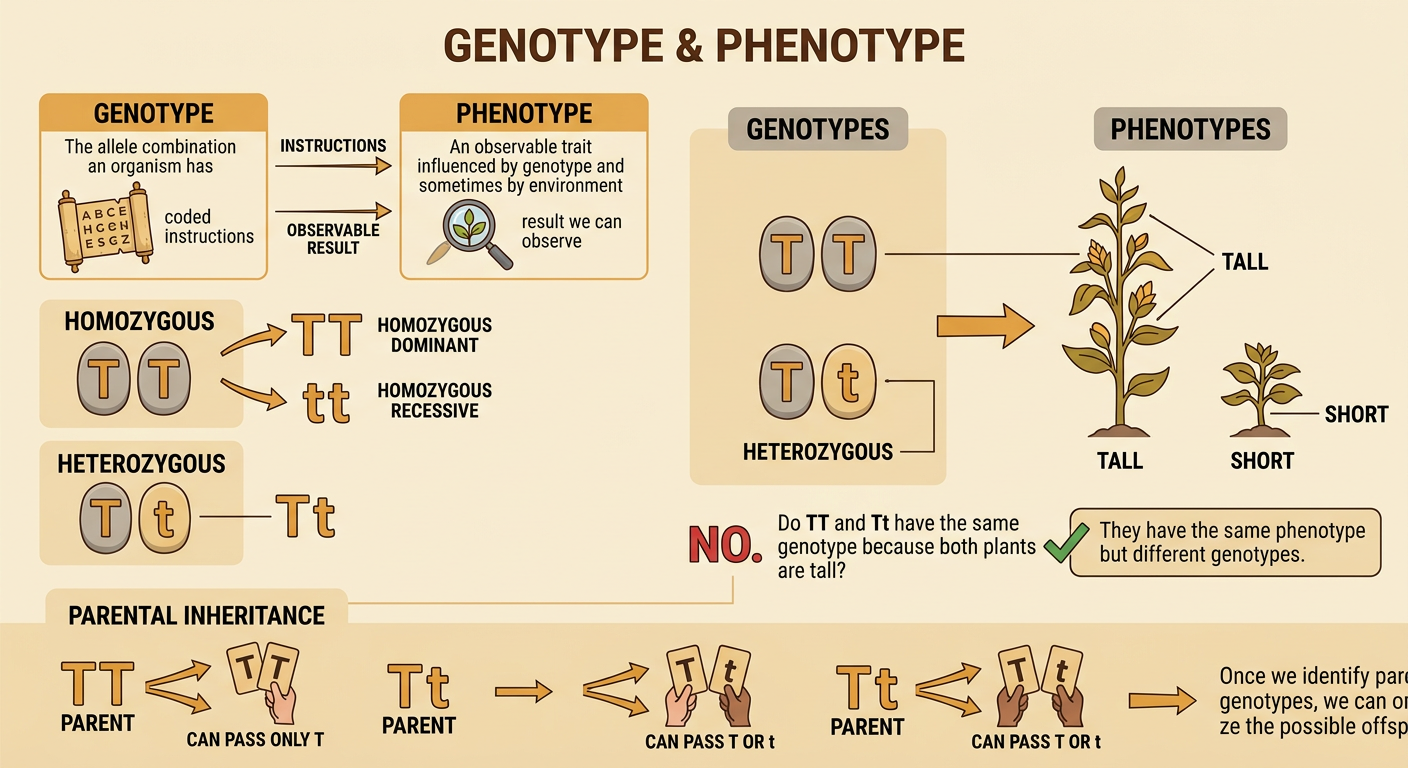
A genotype is the allele combination an organism has for a gene. A phenotype is an observable trait influenced by that genotype and sometimes by the environment. An individual is homozygous when both alleles are the same and heterozygous when the alleles differ. Using a fictional plant-height gene, TT is homozygous dominant, Tt is heterozygous, and tt is homozygous recessive. If T is completely dominant and produces tall plants, both TT and Tt plants are tall, while tt plants are short. Although TT and Tt have the same phenotype, their genotypes differ. This difference matters during reproduction because a TT parent can pass only T, while a Tt parent can pass either T or t. Correctly identifying genotypes helps predict the allele combinations possible in offspring.
Building a Punnett Square
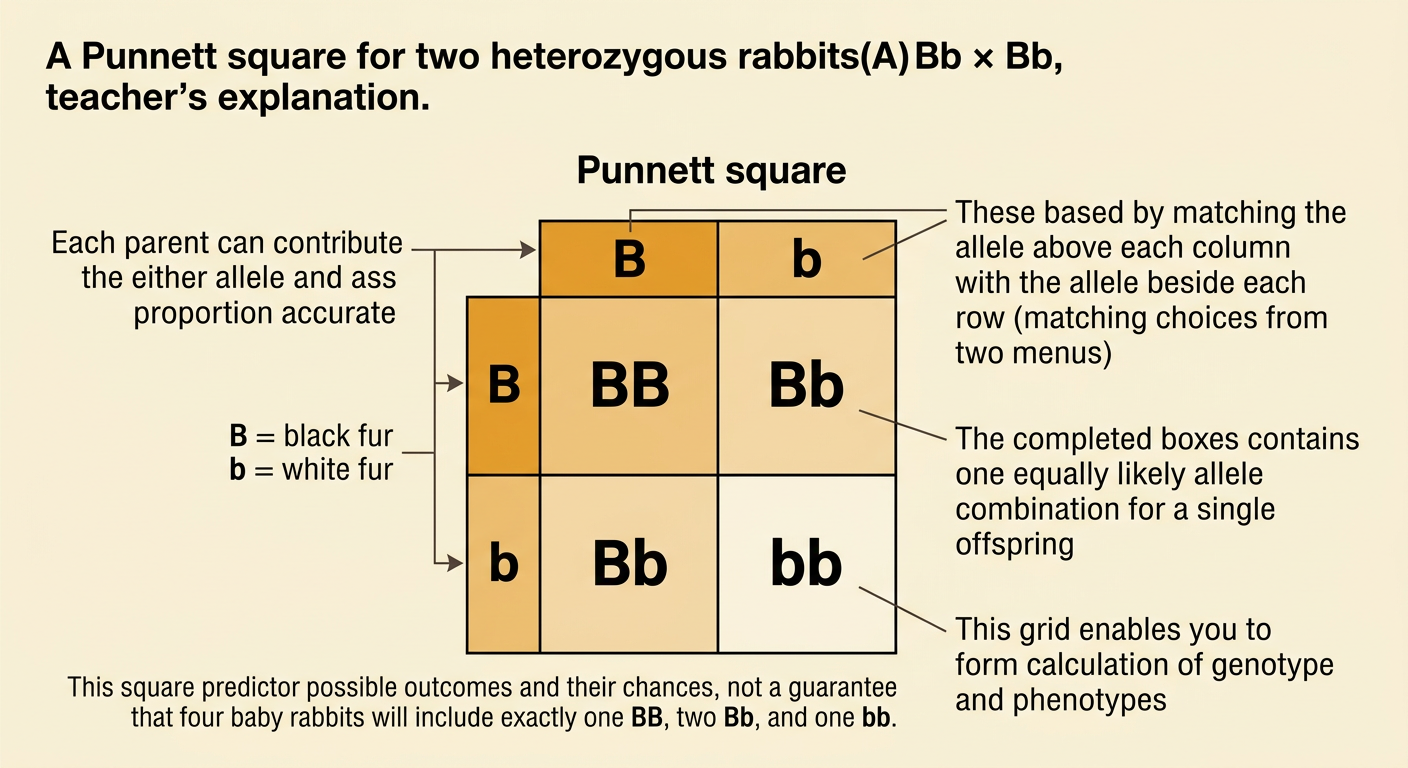
A Punnett square is a model used to organize the possible allele combinations from two parents. First, write the parents’ genotypes. For a cross between two heterozygous rabbits, use Bb × Bb, where B represents black fur and b represents white fur in this simplified example. Next, draw a two-by-two grid. Place one parent’s possible alleles, B and b, across the top. Place the other parent’s possible alleles, B and b, along the left side. Complete each box by combining the allele above its column with the allele beside its row. The four boxes contain BB, Bb, Bb, and bb. Each box represents one equally likely combination for a single offspring. The square predicts possible outcomes; it does not guarantee that four actual offspring will include each outcome shown.
Predicting Genotype and Phenotype Probabilities
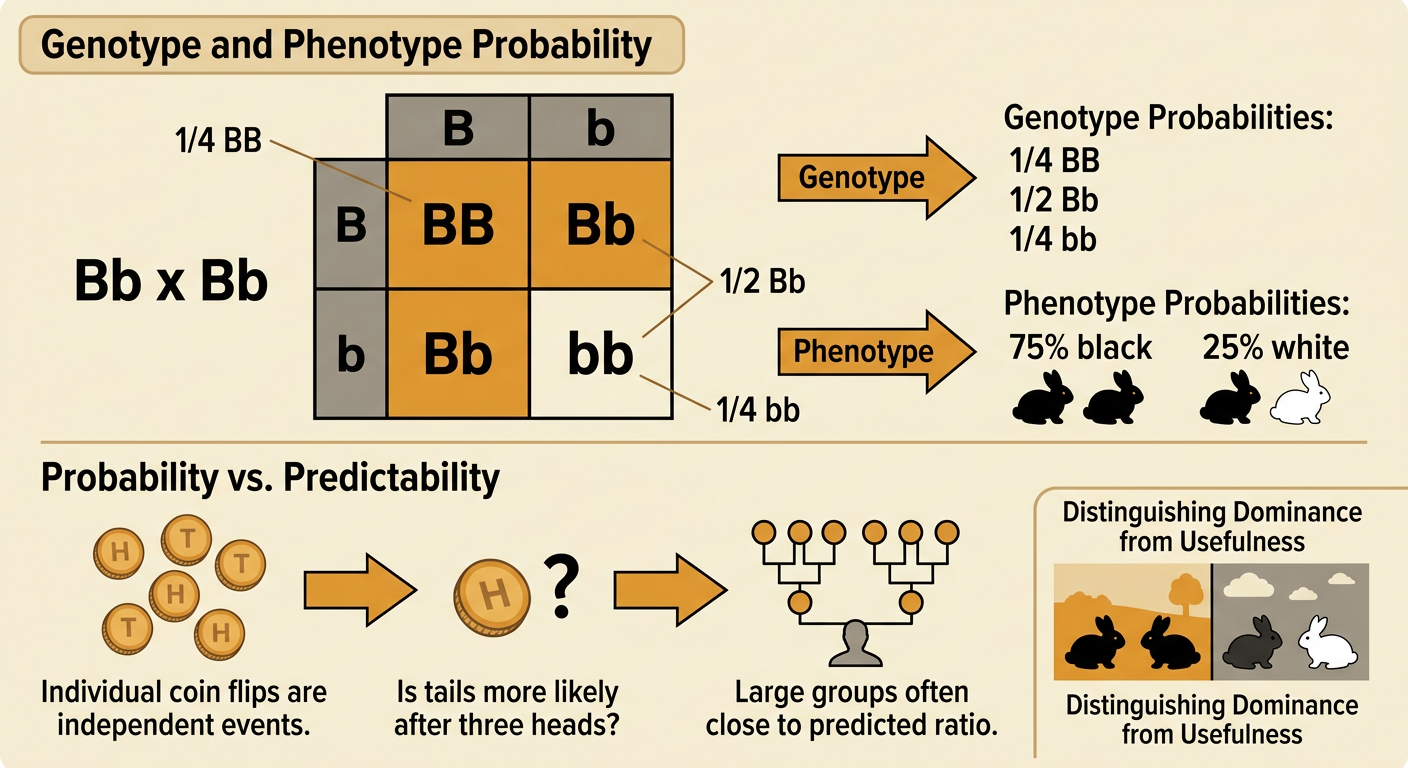
Probabilities come from counting how many Punnett square boxes show each outcome and dividing by the total number of equally likely boxes. In the Bb × Bb rabbit cross, one of four boxes is BB, two are Bb, and one is bb. The genotype probabilities are therefore 1/4 BB, 2/4 or 1/2 Bb, and 1/4 bb. If B is completely dominant for black fur, BB and Bb both produce black fur. The phenotype probabilities are 3/4 black and 1/4 white, or 75% and 25%. These values describe the expected pattern across many offspring. Each birth is an independent event, so earlier outcomes do not change the probability for the next offspring. A small family may not match the predicted ratio, while results from many offspring usually approach it more closely.
Trait Advantage Depends on the Environment
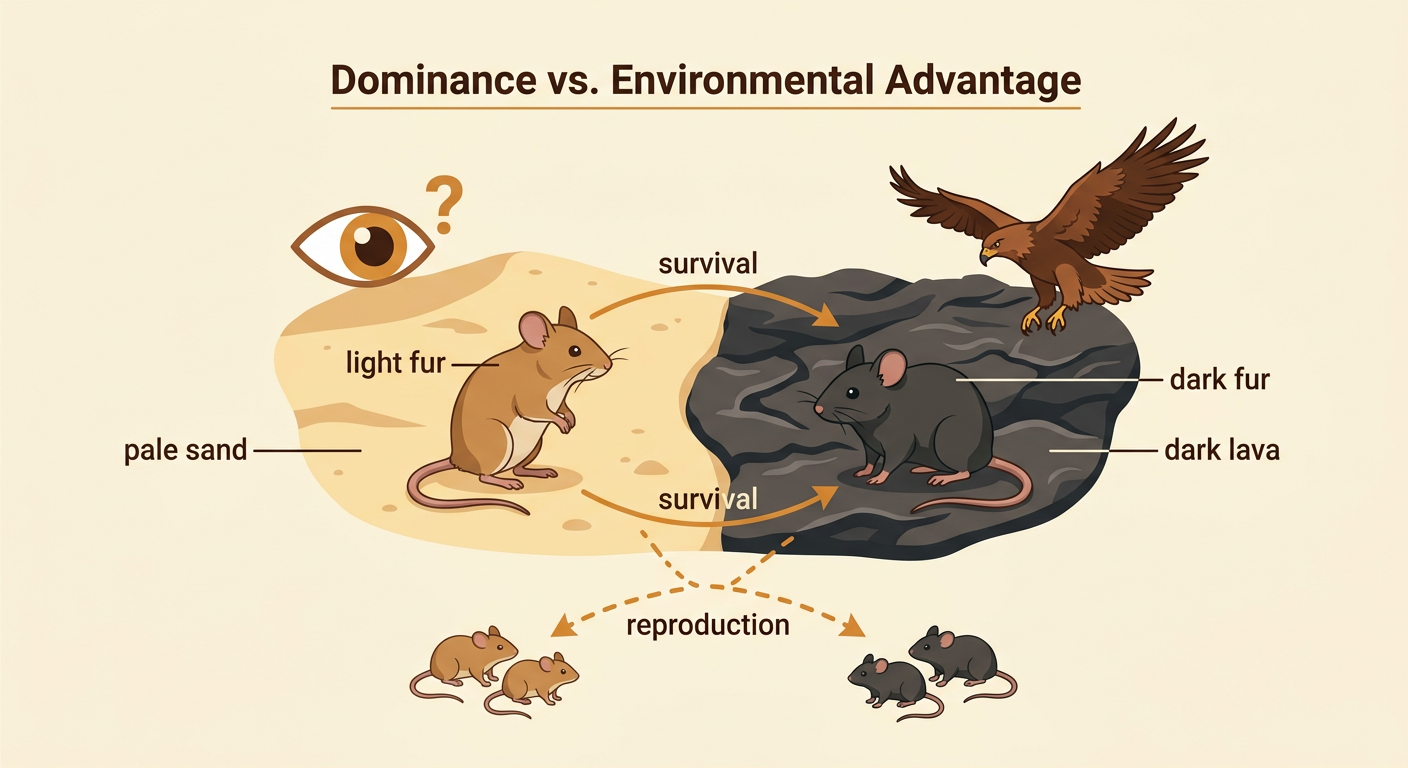
Dominance and environmental advantage are different ideas. Dominance describes how alleles affect phenotype, while an advantage increases an organism’s chances of surviving and reproducing in a particular environment. Consider mice with inherited light or dark fur. On pale sand, light mice may be harder for predators to see, so they may survive and produce more offspring. On dark lava, dark mice may have the advantage instead. If fur color is inherited, the allele associated with better camouflage can become more common over many generations. A dominant allele is not automatically advantageous, and a recessive allele can be advantageous when the environment favors its phenotype. Evidence for this explanation could include fur-color frequencies, background color, predation data, and changes across generations. A strong scientific argument connects that evidence to differential survival and reproduction rather than simply labeling one allele dominant.