
Program a Pedestrian Signal with Loops
Students create and test a repeating sequence of commands that models a safe pedestrian crossing signal.
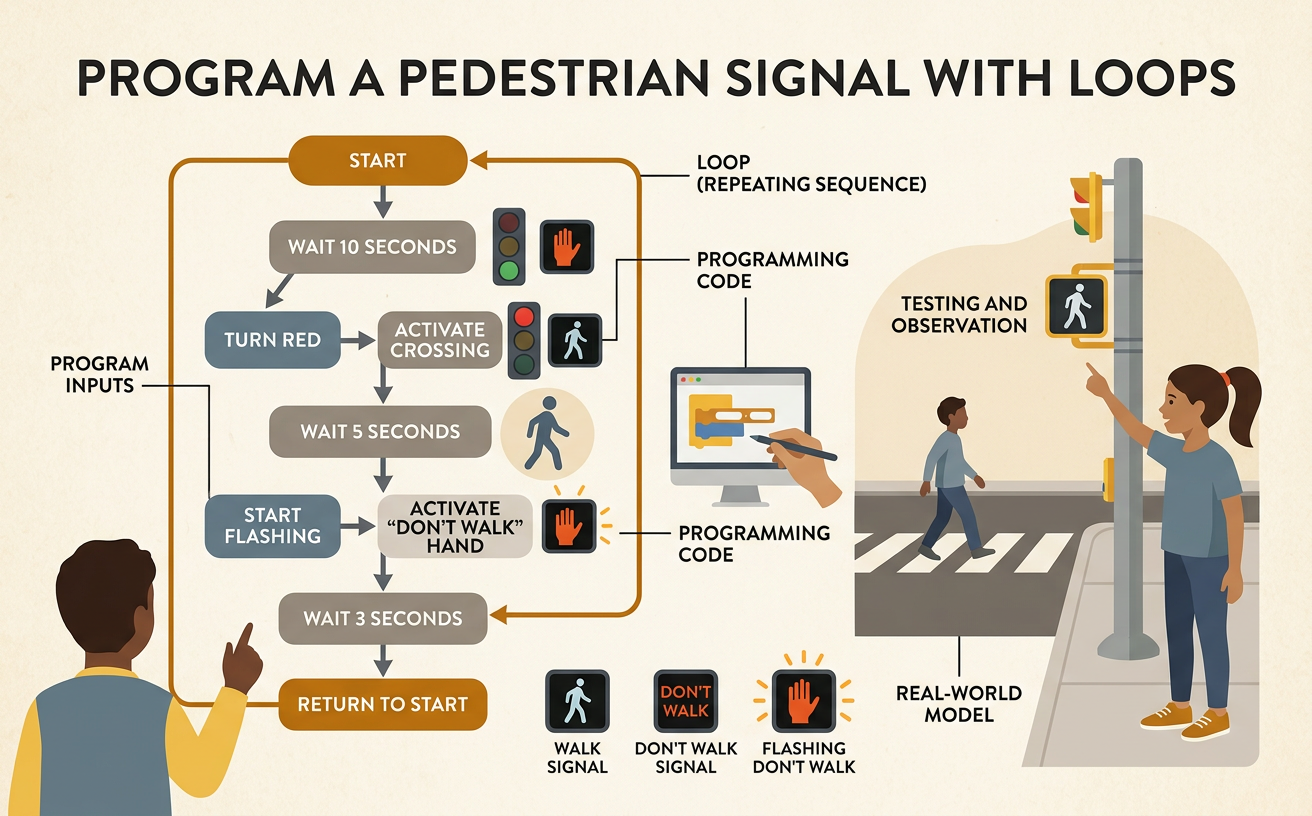
Illustrations are auto-generated and may be placeholders. They can be refreshed to match the narration.
Observe the Signal Pattern
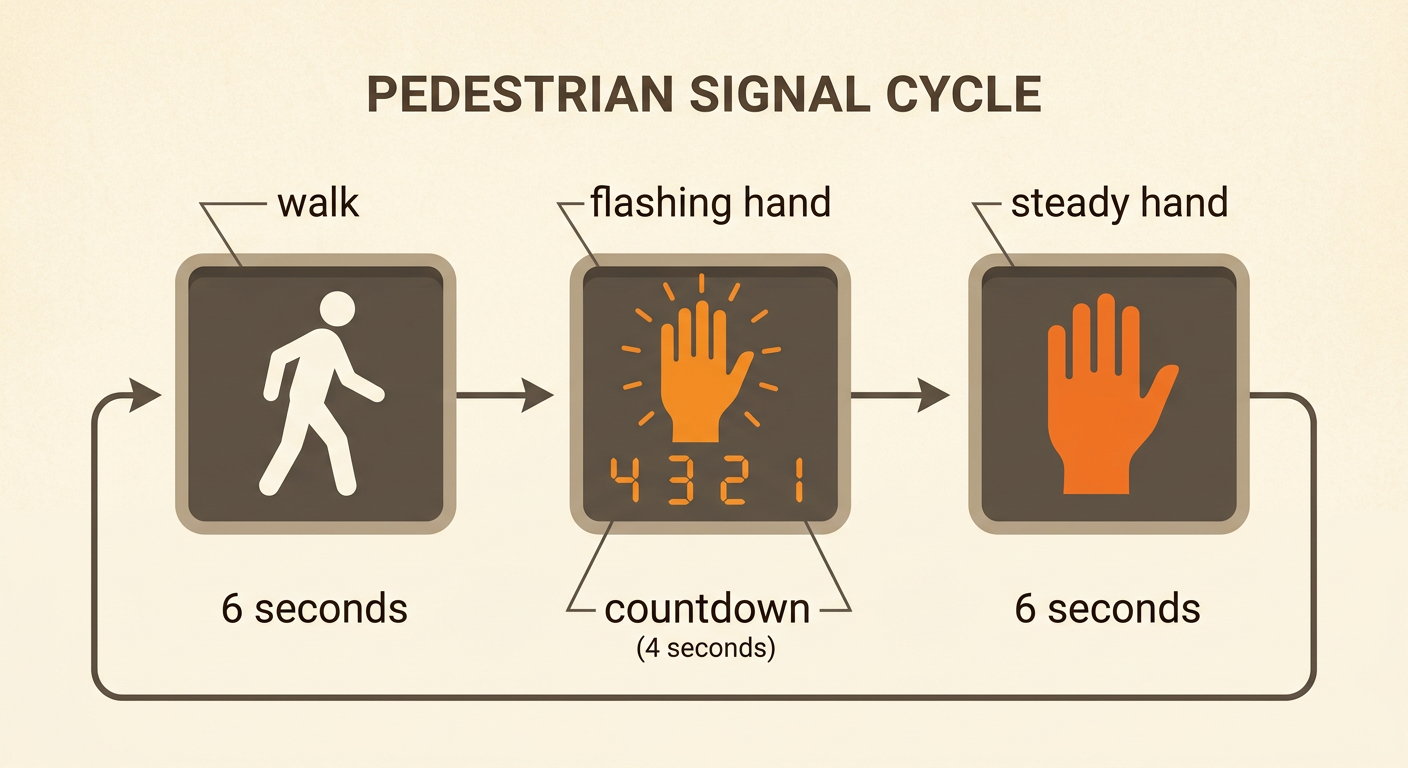
A pedestrian signal uses lights, symbols, and sometimes a countdown to tell people when to cross. Watch one full cycle before trying to program it. In our model, the white walking person appears for 6 seconds. Next, an orange hand flashes for 4 seconds while the countdown changes from 4 to 1. Finally, a steady orange hand appears for 6 seconds. Then the same cycle begins again. The walking person means people may begin crossing after checking for traffic. The flashing hand means people already crossing should finish, but others should not start. The steady hand means wait. Record the order, color, symbol, and time for each phase. These observations will help you find the repeating pattern.
Identify the Repeating Steps
A pattern is an ordered set of elements that follows a rule. The repeating unit is the smallest complete group of steps that occurs again and again. For this signal, the unit is walk, flashing hand with countdown, and steady hand. The times are part of the pattern too: 6 seconds, 4 seconds, and 6 seconds. If the cycle repeats three times, the phases are walk, flash, wait, walk, flash, wait, walk, flash, wait. You can predict that the next phase will be walk. Compare observations with a partner. If one person writes only walk and wait, ask whether a safety phase is missing. Working together helps the group identify every step and place the steps in the correct order.

Build the Command Sequence
Now turn each phase into precise commands a computer can follow. A command tells the program to perform one action. Begin by turning on the walk symbol and turning off the hand. Wait 6 seconds. Then turn off the walk symbol and flash the hand while showing 4, 3, 2, and 1, one number each second. After the countdown, keep the hand on steadily and wait 6 seconds. At every phase change, make sure the old symbol turns off before the new one turns on. Otherwise, both symbols could appear together and give confusing instructions. Arrange command cards in order, then read them aloud with your group. A classmate can act like the computer and perform exactly what each card says.

Add a Loop
Writing the same commands many times makes a program long and harder to change. A loop tells the computer to repeat a group of commands. Place the entire signal sequence inside a repeat-forever loop: show walk for 6 seconds, flash the hand and count down for 4 seconds, and show the steady hand for 6 seconds. When the computer reaches the end, it returns to the first command. One cycle lasts 16 seconds because 6 plus 4 plus 6 equals 16. After 32 seconds, the loop has completed two cycles. Check the loop boundary carefully. If only the countdown is inside the loop, the countdown will repeat, but the signal will never return to walk. The loop must surround the full repeating unit.

Test and Debug the Signal
Testing checks whether the program meets its goals. Run the signal and use a table to record each symbol, its time, and what happens next. The design criteria are a clear order, correct timing, no conflicting symbols, and continuous repetition. A constraint might be that the model has only two lights or must complete a cycle in 16 seconds. Suppose testing shows the walk symbol stays on while the hand flashes. This bug could confuse a pedestrian. Debug the program by adding a command that turns off the walk symbol before the flashing hand begins. Test again after every change. Compare two possible fixes with your group and choose the one that meets all criteria within the constraints. Explain your evidence, listen to other ideas, and revise when needed.

Discuss Safety Rules
Pedestrian signals support traffic laws and community safety rules. These rules organize how drivers, cyclists, and walkers share intersections. A walk symbol does not guarantee that every vehicle has stopped, so pedestrians should still look left, right, and left again and watch for turning vehicles. People should not begin crossing when the hand is flashing or steady. Rules affect society by making behavior more predictable and reducing danger. People can also work together to improve rules and signal designs. For example, a community may request a longer crossing time near a school so children and people with disabilities have enough time. Discuss the proposal respectfully: What safety problem does it address? Who would benefit? What traffic constraints must engineers consider? Use evidence from signal tests to explain whether the change should be made.
