Quoting Accurately to Support Inferences
Students use accurate quotations and details from a literary text to explain explicit ideas and support logical inferences.

Illustrations are auto-generated and may be placeholders. They can be refreshed to match the narration.
Explicit Evidence and Inferences
Explicit evidence states an idea directly in the text. An inference is a logical idea you form by combining text evidence with what you already know. Read this example: “Maya pulled her hood tight and hurried beneath the awnings. Water streamed along the curb.” The text explicitly says that Maya pulled her hood tight and that water flowed by the curb. You can infer that it was raining, even though the author never says, “It was raining.” The details about the hood, awnings, and flowing water support that inference. Strong readers keep explicit ideas separate from inferences. They ask, “What does the text say?” and then, “What reasonable idea can I figure out?” An inference must fit the evidence. It should not be based only on a guess or personal opinion.

Finding Relevant Textual Evidence
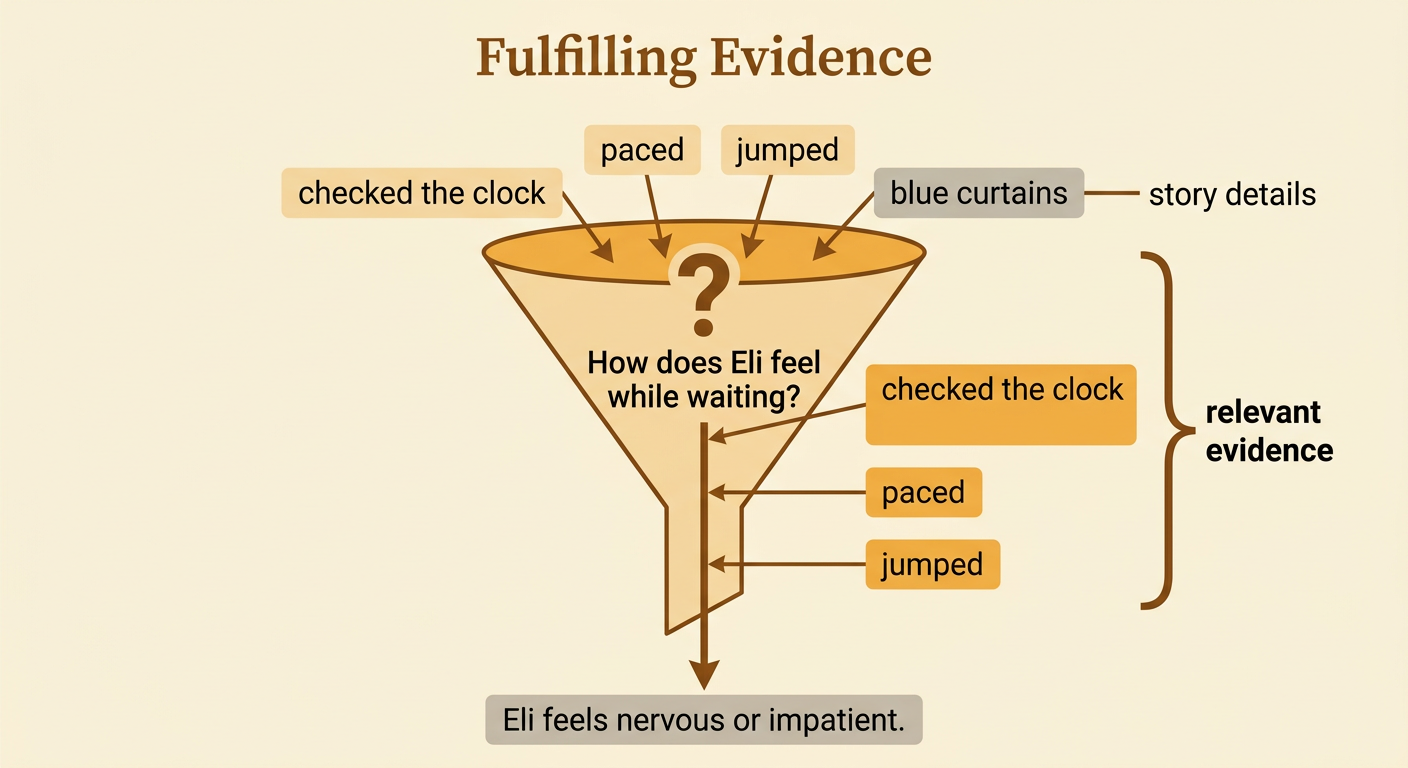
Relevant textual evidence is a detail that directly helps answer a question or support an idea. Begin by identifying the important words in the question. Then reread the text and look for actions, dialogue, descriptions, or events connected to those words. Suppose a story says, “Eli checked the clock again. He paced beside the window and jumped when headlights crossed the wall.” If the question asks how Eli feels while waiting, his actions are relevant. Checking the clock, pacing, and jumping suggest that he feels nervous or impatient. A sentence describing the blue curtains would not help answer the question, so it is not relevant evidence. Choose the strongest evidence rather than copying a large section. The best evidence is specific, clearly connected to the question, and strong enough to support your explanation.
Quoting the Text Accurately
To quote accurately, copy the author’s exact words and place quotation marks around them. Do not change the wording, spelling, or order of the words. Introduce the quotation so readers know where it comes from. For example, the text says, “Lena tucked the injured bird inside her scarf and carried it home.” An accurate response might state: The author shows Lena’s kindness when “Lena tucked the injured bird inside her scarf and carried it home.” Compare your quotation with the original sentence word by word. Include only the part needed to support your point. If you copy the sentence as “Lena put the bird in her scarf,” you have changed the author’s words, so it is a paraphrase rather than a quotation. Accurate quotations allow readers to check your explanation against the text.

Connecting Evidence to an Inference
A quotation does not explain itself. After quoting, tell how the evidence supports your inference. A complete response often has three parts: an inference, accurate evidence, and reasoning that connects them. Read this example: “Noah placed the torn photograph in a box, closed the lid, and pushed it beneath his bed.” You might write: Noah probably wants to avoid a painful memory. The text says he “closed the lid, and pushed it beneath his bed.” Hiding the photograph where he will not see it suggests that looking at it may upset him. The final sentence is the reasoning, or bridge, between the quotation and the inference. Use phrases such as “This shows,” “This suggests,” or “This matters because” to make the connection clear. Make sure your reasoning follows logically from the quoted detail.

Independent Evidence Check
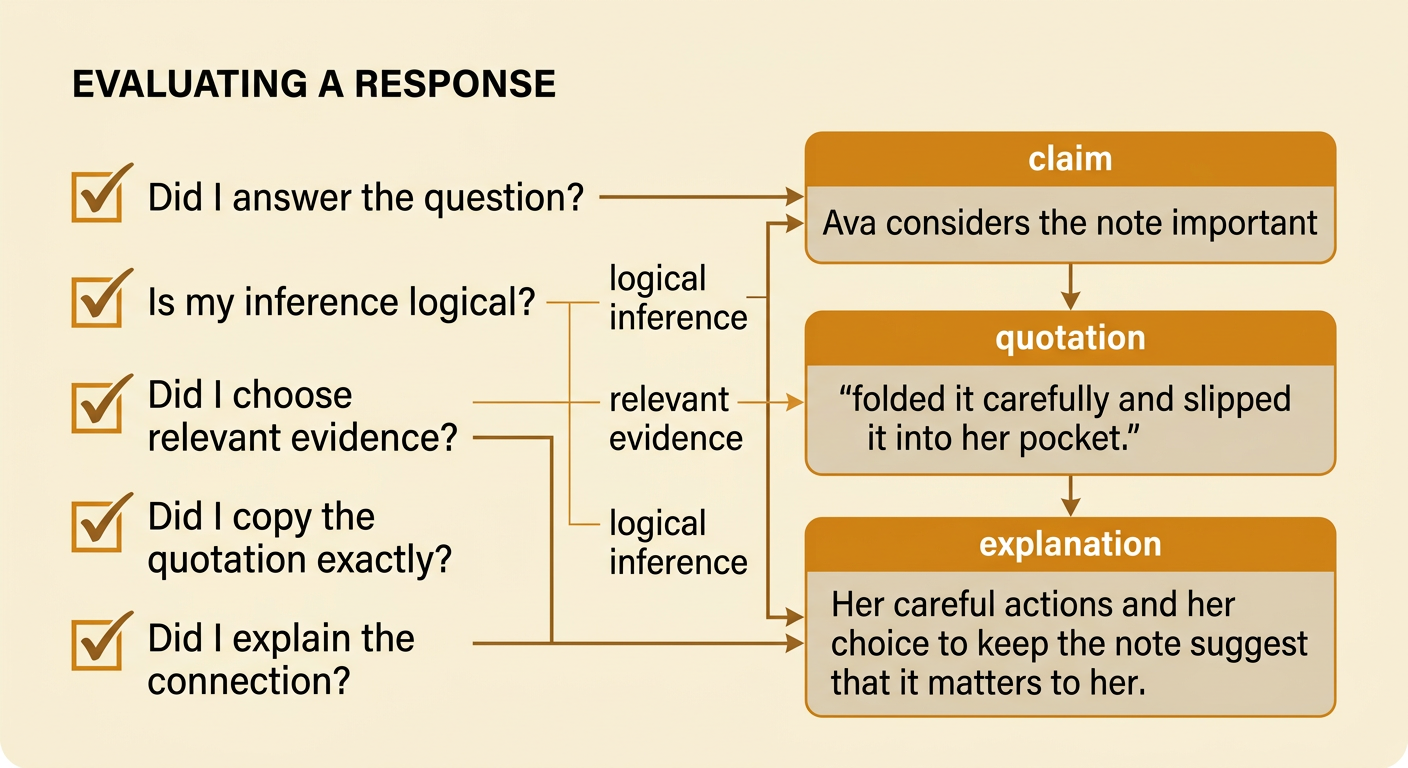
Before finishing a response, check that your claim, quotation, and explanation work together. Ask five questions: Did I answer the question? Is my inference logical? Did I choose relevant evidence? Did I copy the quotation exactly? Did I explain the connection? Suppose the text states, “Ava reread the note three times, then folded it carefully and slipped it into her pocket.” A strong response could say: Ava considers the note important. The text says she “folded it carefully and slipped it into her pocket.” Her careful actions and decision to keep the note suggest that it matters to her. Check the quotation against the original: the words match exactly. Check the reasoning: it explains why the actions support the inference. If any part is missing or unclear, revise it before submitting your work.