
Quoting Text Evidence to Support Inferences
Students use details and accurate quotations from a literary text to make and support logical inferences.

Illustrations are auto-generated and may be placeholders. They can be refreshed to match the narration.
Explicit Details and Inferences
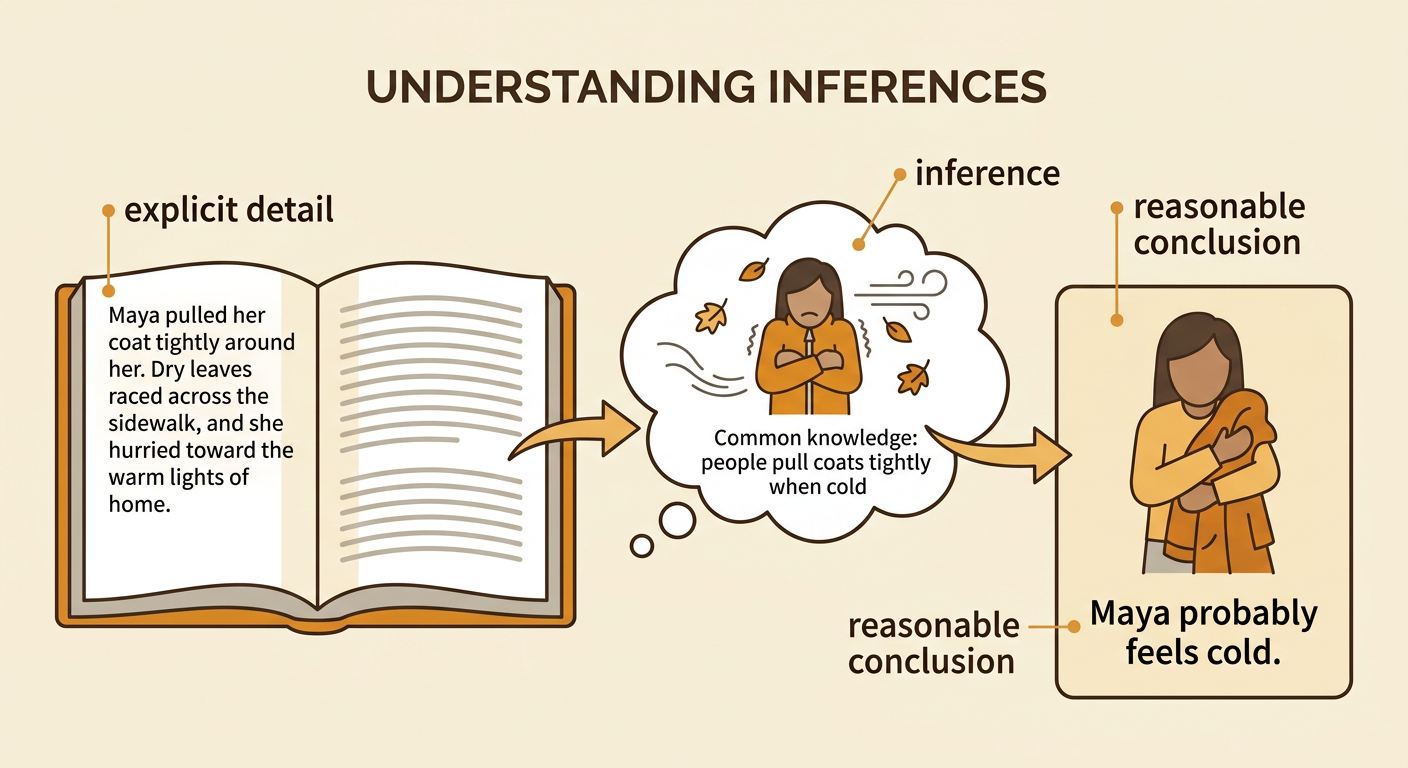
An explicit detail is information the author states directly. An inference is a logical idea you form by combining text details with what you already know. Read this example: “Maya pulled her coat tightly around her. Dry leaves raced across the sidewalk, and she hurried toward the warm lights of home.” The text explicitly says that Maya pulls her coat tightly and hurries home. It does not directly say that Maya feels cold. However, readers know that people often pull coats close when they are cold. The racing leaves may also suggest chilly, windy weather. Therefore, a logical inference is that Maya feels cold. Strong inferences are based on specific details, not guesses. Ask yourself, “What does the text say, what do I know, and what reasonable conclusion can I draw?”
Finding Relevant Text Evidence
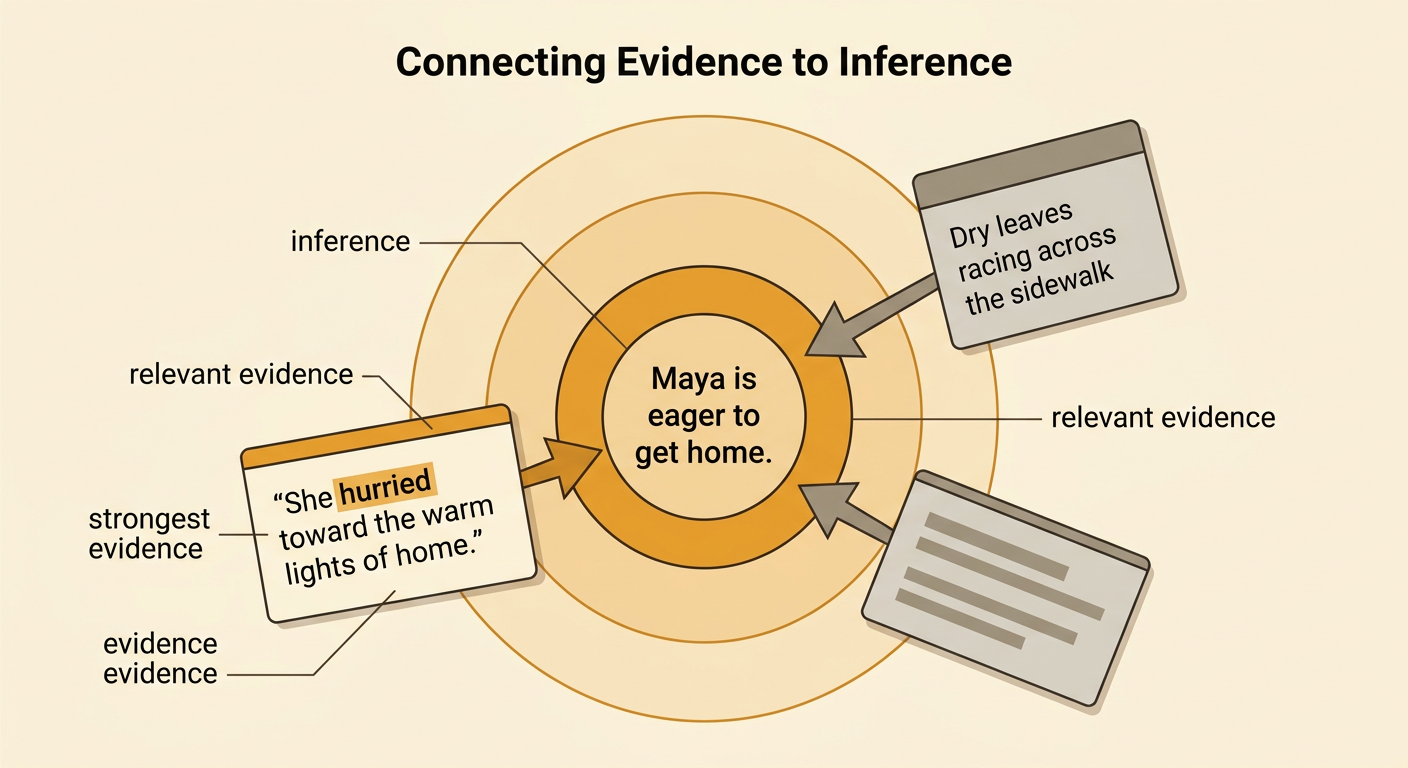
Text evidence is a detail or quotation that supports an answer or inference. Relevant evidence connects directly to the idea you are explaining. Suppose you infer that Maya is eager to get home. The quotation “she hurried toward the warm lights of home” supports that inference because the word “hurried” shows that she is moving quickly toward home. The detail about dry leaves racing across the sidewalk describes the setting, but it does not strongly show that Maya wants to arrive home. To find relevant evidence, first state your inference. Then reread the nearby sentences and look for actions, dialogue, thoughts, or descriptions that support it. Test each detail by asking, “Does this help prove my inference?” Choose the strongest evidence rather than copying every detail in the passage.
Quoting the Text Accurately
To quote accurately, copy the author’s exact words and place quotation marks around them. Do not change spelling, word order, or important punctuation. If the text says, “Maya pulled her coat tightly around her,” an accurate quotation uses those exact words. Writing “Maya wrapped her jacket around herself” gives a similar idea, but it is not an accurate quotation because the words were changed. Introduce a quotation with a phrase such as “The text states” or “The author writes.” For example: The author writes, “Maya pulled her coat tightly around her.” After copying, compare your quotation with the original one word at a time. Include only the part you need, but make sure the shortened quotation still keeps the author’s meaning clear.

Explaining How Evidence Supports an Inference
Evidence does not speak for itself. After quoting, explain how the quotation connects to your inference. A strong response has three parts: the inference, the evidence, and the reasoning. For example: Maya probably feels cold. The text states, “Maya pulled her coat tightly around her.” People often pull a coat close to hold in warmth, so this action suggests that she is cold. The final sentence is important because it explains why the evidence supports the inference. Avoid writing only, “This proves she is cold.” Instead, name the clue in the quotation and explain what it shows. Useful connecting phrases include “This suggests,” “This shows,” and “Because of this detail.” Your explanation should form a clear bridge between the author’s exact words and your logical conclusion.

Independent Evidence Check
Before finishing, check that your response includes a logical inference, an accurate quotation, and a clear explanation. Read this example: “Jon looked at the dark clouds. He tucked the soccer ball under his arm and ran toward the porch.” A reasonable inference is that Jon expects rain. Relevant evidence is, “He tucked the soccer ball under his arm and ran toward the porch.” This action suggests that he wants to protect himself or the ball before rain begins. Now check the response. Does the inference make sense? Is the quotation copied exactly? Does the evidence relate directly to the inference? Does the explanation show how they connect? If any answer is no, revise. You may need to choose stronger evidence, correct the quotation, or add reasoning. A final check makes your response accurate and convincing.
