
Radioactive Decay, Half-Life, and Nuclear Stability
Students model how unstable nuclei undergo radioactive decay, interpret half-life as an exponential pattern, and consider the benefits and risks of radioactive materials.
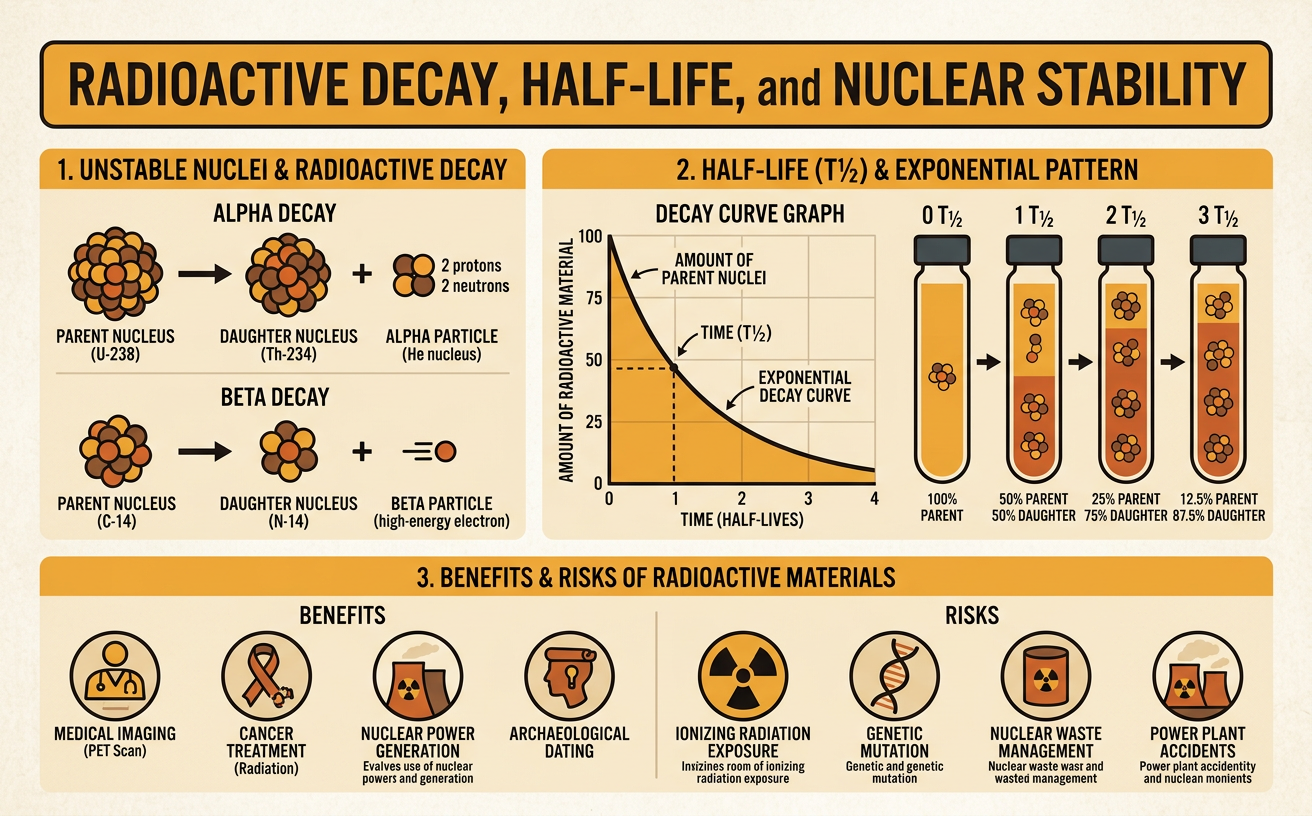
Illustrations are auto-generated and may be placeholders. They can be refreshed to match the narration.
Stable and Unstable Nuclei
An atomic nucleus contains positively charged protons and neutral neutrons. The strong nuclear force attracts these particles at very short distances, while electrical repulsion pushes protons apart. A nucleus is stable when these forces and its neutron-to-proton ratio create a lasting arrangement. An unstable nucleus, called a radioisotope, changes spontaneously through radioactive decay. This change produces a different nucleus and releases energy as radiation. For example, carbon-12, with 6 protons and 6 neutrons, is stable. Carbon-14, with 6 protons and 8 neutrons, is unstable and eventually decays. Scientists cannot predict when one particular carbon-14 nucleus will decay, but they can predict how a large group will behave. Nuclear stability depends on nuclear composition, not on chemical bonds or ordinary changes such as melting and burning.

Alpha, Beta, and Gamma Radiation
Unstable nuclei can emit alpha particles, beta particles, or gamma rays. An alpha particle contains two protons and two neutrons, so alpha decay lowers the atomic number by 2 and the mass number by 4. In beta-minus decay, a neutron changes into a proton while an electron is emitted; the atomic number rises by 1, but the mass number stays the same. Gamma radiation is high-energy electromagnetic radiation. Gamma emission releases energy without changing the numbers of protons or neutrons. For example, uranium-238 emits an alpha particle and becomes thorium-234. These forms of radiation also differ in penetration. Paper can stop many alpha particles, thin aluminum can stop many beta particles, and thick lead or concrete is used to reduce gamma exposure. Penetration does not alone determine risk; dose, distance, exposure time, and whether material enters the body also matter.

Modeling Nuclear Decay Equations
A nuclear equation tracks mass number and atomic number during decay. The mass number, written at the upper left of an element symbol, equals protons plus neutrons. The atomic number, written at the lower left, equals protons. Both totals must balance across the equation. In alpha decay, uranium-238 becomes thorium-234 plus helium-4: uranium-238 → thorium-234 + helium-4. The mass numbers balance because 238 = 234 + 4, and the atomic numbers balance because 92 = 90 + 2. In beta-minus decay, carbon-14 becomes nitrogen-14 plus an electron: carbon-14 → nitrogen-14 + electron. The mass number remains 14, while the atomic number changes from 6 to 7 because a neutron becomes a proton. Energy is also released, even when a simplified classroom equation does not display every emitted particle or energy term.

Half-Life as an Exponential Pattern
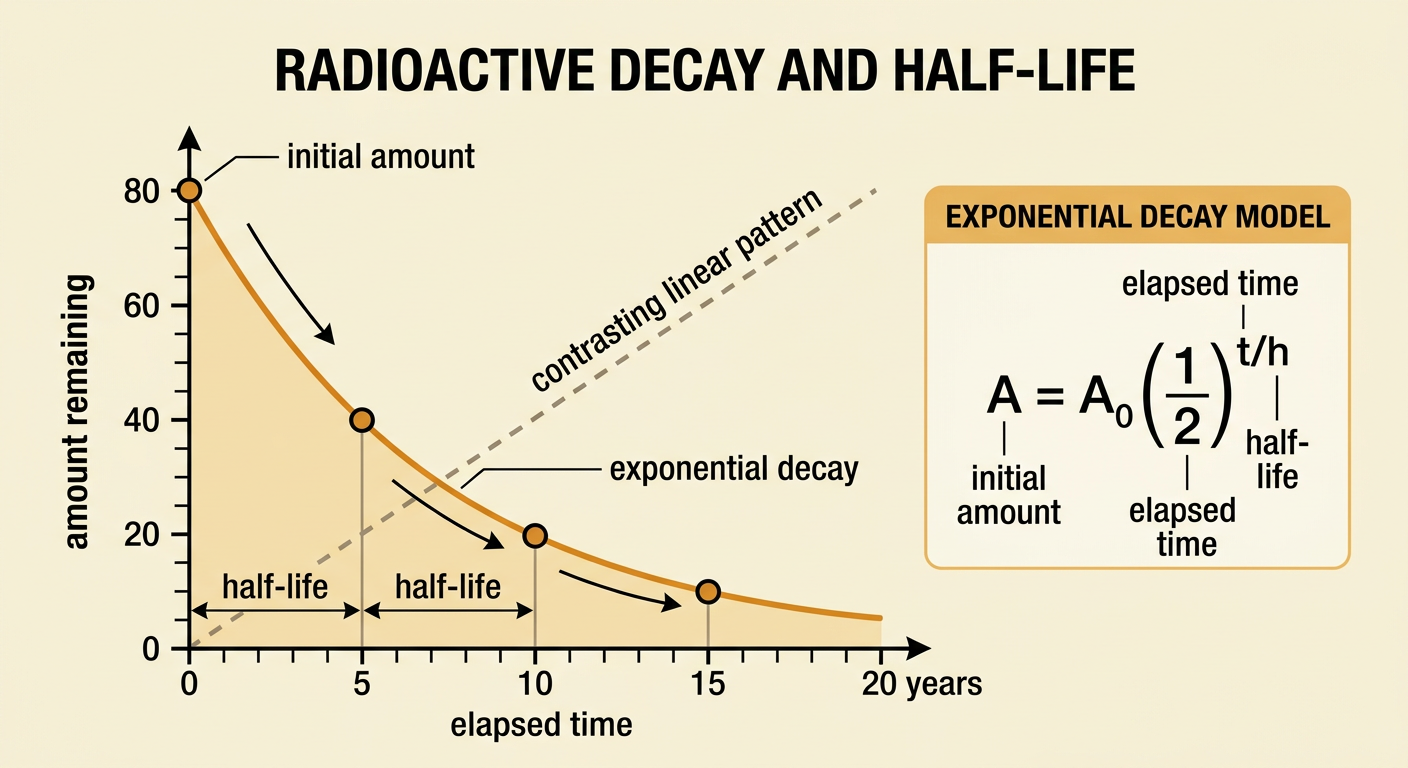
Half-life is the time required for half the radioactive nuclei in a sample to decay. After each half-life, the same fraction, not the same amount, remains. Suppose a sample begins with 80 milligrams of a radioisotope whose half-life is 5 years. After 5 years, 40 milligrams remain; after 10 years, 20 milligrams remain; and after 15 years, 10 milligrams remain. This is exponential decay because the quantity is repeatedly multiplied by one-half. A model is A = A₀(1/2)^(t/h), where A₀ is the initial amount, t is elapsed time, and h is the half-life. The graph curves downward and approaches zero without reaching it in the mathematical model. A linear model would subtract an equal amount during every time interval, so it would not represent radioactive decay accurately.
Benefits, Risks, and Public Policy
Radioactive materials can benefit society when they are carefully controlled. Hospitals use radioisotopes to image organs and treat some cancers, and smoke detectors may use a tiny amount of americium-241 to detect smoke. Radiation can also damage cells, raise cancer risk, contaminate land or water, and create waste that remains hazardous for long periods. Public policy sets rules for licensing, worker protection, transportation, storage, disposal, and emergency response. For example, a policy requiring secure containers and monitored long-term storage for nuclear waste intends to prevent human exposure and environmental release. Possible unintended outcomes include high costs, transportation risks, and unequal burdens on communities near storage sites. Evaluating such a policy requires comparing evidence about radiation dose, probability of accidents, costs, benefits, and fairness. A strong decision considers both intended protections and possible consequences rather than labeling radiation as entirely safe or entirely harmful.
