
Rational and Irrational Numbers
Students classify real numbers, connect fractions with decimal expansions, and estimate irrational numbers on a number line.
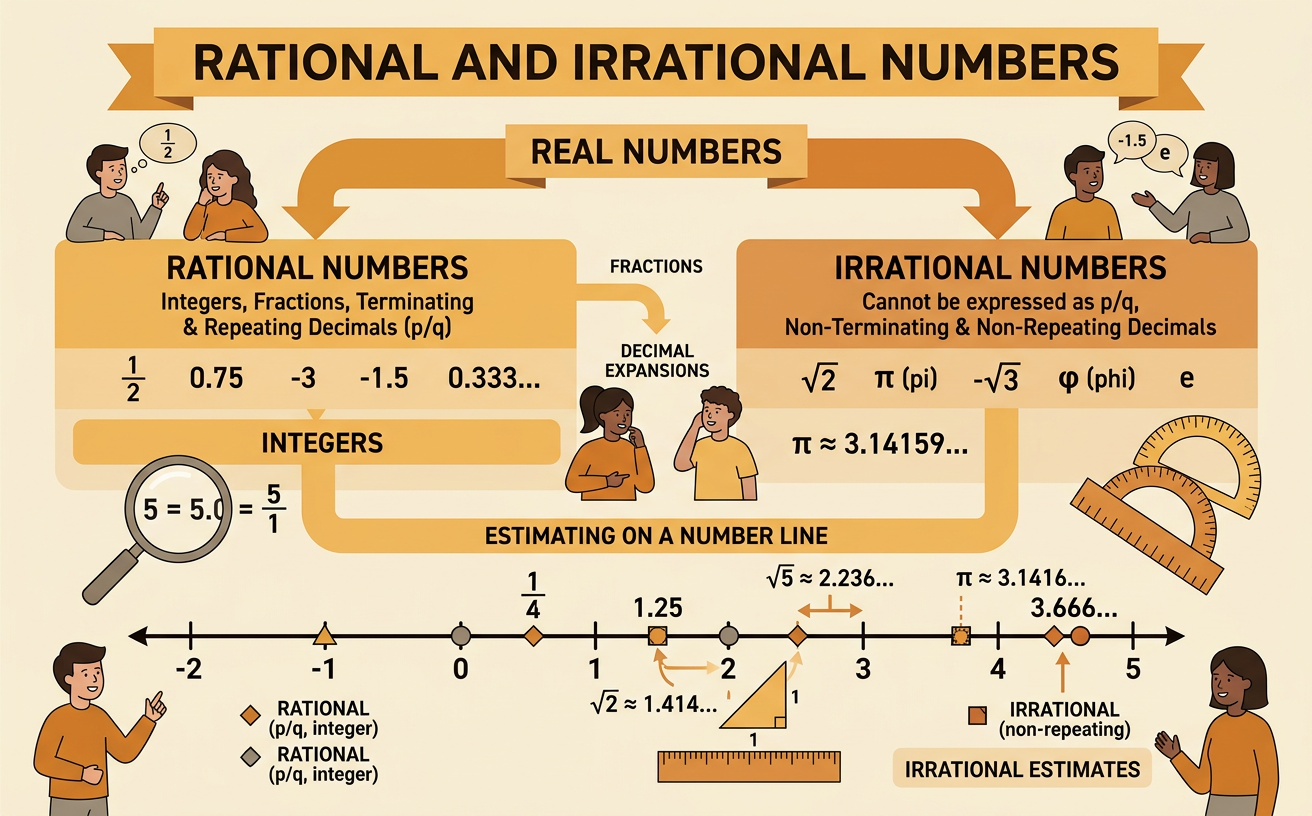
Illustrations are auto-generated and may be placeholders. They can be refreshed to match the narration.
The Real Number System
Real numbers include every number that can be placed on a number line. They are divided into rational and irrational numbers. A rational number can be written as a fraction a/b, where a and b are integers and b is not zero. Natural numbers, such as 1, 2, and 3, are inside the set of whole numbers. Whole numbers also include 0, and integers include whole numbers and their opposites. All integers are rational because each can be written over 1. For example, −5 equals −5/1. Irrational numbers cannot be written as ratios of integers. Examples include √2 and π. Together, the rational and irrational numbers make up the entire real number system.
Terminating and Repeating Decimals
Every rational number has a decimal expansion that either terminates or repeats. A terminating decimal ends after a finite number of digits. For example, 3/8 equals 0.375 because long division reaches a remainder of zero. A repeating decimal has a digit or block of digits that continues in the same pattern forever. For example, 2/11 equals 0.181818…, written as 0.18 with a bar over 18. Long division repeats when a remainder appears again, causing the same quotient digits to repeat. Terminating decimals are also rational because they can be written as fractions; for example, 0.375 equals 375/1000, which simplifies to 3/8. Thus, a decimal that terminates or repeats represents a rational number.
Recognizing Irrational Numbers
An irrational number cannot be written as a fraction of two integers. Its decimal expansion never terminates and never forms a repeating pattern. For example, √2 is approximately 1.41421356…, but its digits continue without repeating. The number π, approximately 3.14159265…, is also irrational. Be careful: not every square root is irrational. The square root of a perfect square is rational, so √49 equals 7. By contrast, √7 is irrational because 7 is not a perfect square. A decimal with an obvious repeating pattern, such as 0.272727…, is rational even though it does not terminate. To recognize an irrational number, look for a known irrational constant, a non-perfect-square root, or a nonterminating decimal with no repeating pattern.
Classifying Real Numbers
To classify a real number, begin with the most specific set it belongs to. For example, 6 is a natural number, a whole number, an integer, a rational number, and a real number. The number 0 is whole, integer, rational, and real, but it is not a natural number under the convention used here. The number −4 is an integer, rational, and real. The fraction 3/5 is rational and real but is not an integer. Always simplify expressions before classifying them: √49 equals 7, so it is natural, whole, integer, rational, and real. However, √7 cannot be simplified to an integer and is irrational. The number π is also irrational. Every real number is either rational or irrational, but it cannot be both.
Number-Line Estimation
Irrational numbers have exact locations on a number line even though their decimal expansions never end or repeat. To estimate √10, first compare nearby perfect squares. Since 3² = 9 and 4² = 16, √10 lies between 3 and 4. Test tenths: 3.1² = 9.61 and 3.2² = 10.24, so √10 lies between 3.1 and 3.2. For a closer estimate, test hundredths. Because 3.16² = 9.9856 and 3.17² = 10.0489, √10 lies between 3.16 and 3.17. Therefore, √10 is about 3.16 to the nearest hundredth. Place it slightly to the right of 3.16 on a number line. Squaring nearby positive decimals helps narrow the interval accurately.