
Reaction Rates and Catalysts
Students use collision theory to explain reaction speed and investigate how temperature, concentration, pressure, surface area, mixing, and catalysts affect reaction rates.
Illustrations are auto-generated and may be placeholders. They can be refreshed to match the narration.
Collision Theory
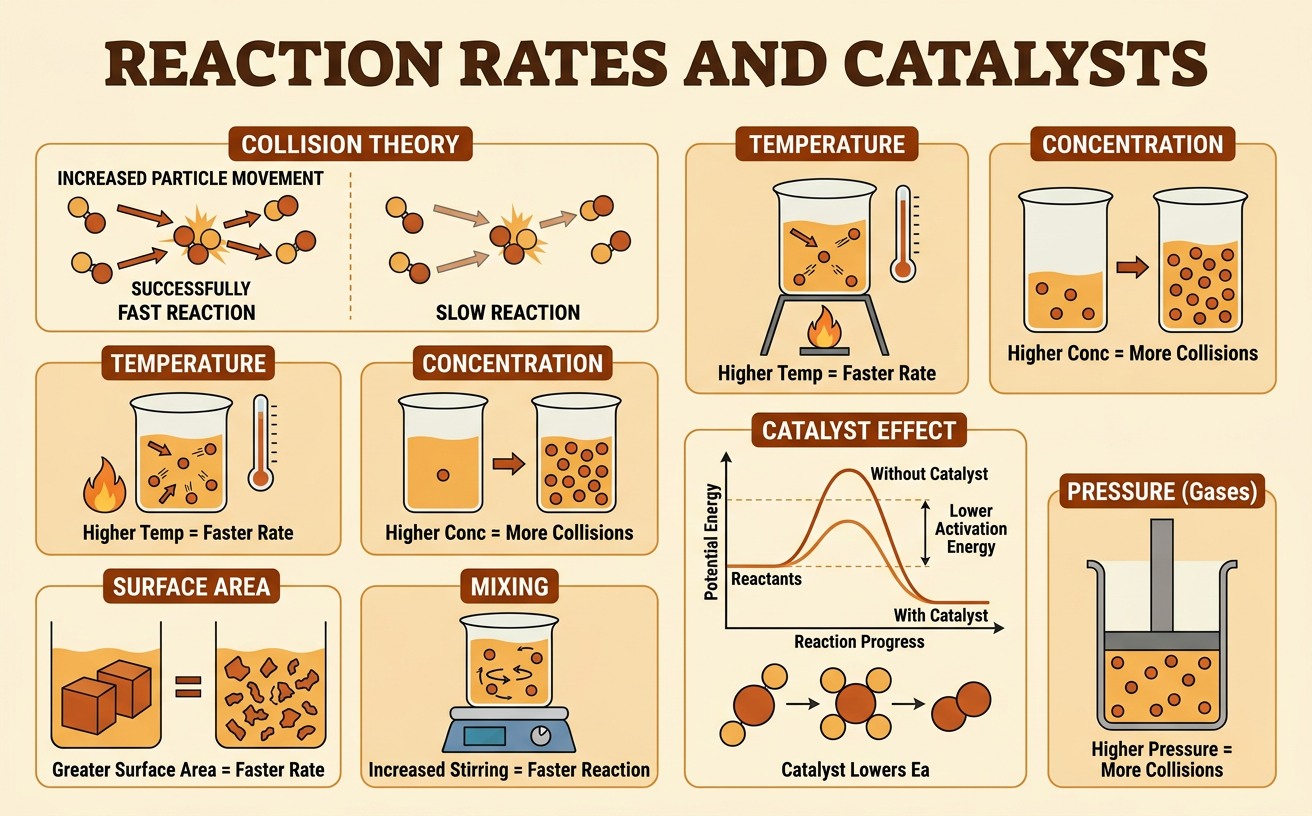
Reaction rate describes how quickly reactants are used or products are formed. For a reaction to occur, reactant particles must collide with enough energy and in a suitable orientation. This explanation is called collision theory. Many collisions do not lead to a reaction because the particles lack sufficient energy or strike in an ineffective arrangement. A glow stick illustrates differences in rate: its chemical reaction proceeds slowly at room temperature but more rapidly when the glow stick is placed in warm water. Scientists can measure rate by tracking a visible or measurable change over time, such as gas volume, mass, color, or temperature. Producing 40 milliliters of gas in 20 seconds indicates a faster average rate than producing the same volume in 80 seconds.
Concentration and Gas Pressure
Increasing reactant concentration usually increases reaction rate because more reactant particles occupy the same volume. The particles collide more frequently, creating more opportunities for successful collisions. For example, a piece of magnesium generally reacts faster in a more concentrated hydrochloric acid solution than in a more dilute solution. For gases, raising pressure by decreasing container volume pushes particles closer together and also increases collision frequency. Concentration or pressure does not guarantee that every collision will produce a reaction; the particles must still collide with enough energy and proper orientation. In a fair concentration experiment, students should keep the temperature, reactant amounts, surface area, and equipment constant. Only the selected concentration should change between trials.
Temperature and Particle Motion
Raising temperature usually speeds up a reaction. At higher temperature, particles have greater average kinetic energy, move faster, and collide more often. More importantly, a greater fraction of the collisions have enough energy to overcome the reaction's activation energy. Food spoils more slowly in a refrigerator because lower temperatures slow the chemical reactions and biological processes involved in spoilage. In an experiment, an effervescent tablet often reacts faster in warm water than in cold water. Students could measure the time required for bubbling to stop at several temperatures. The same tablet size and water volume should be used each time. Extremely high temperatures can introduce new effects, so conclusions should be limited to the tested temperature range.
Surface Area and Mixing
Increasing the surface area of a solid reactant exposes more particles to possible collisions and usually increases reaction rate. A crushed tablet reacts with water faster than an identical whole tablet because water can contact many more tablet particles at once. Sawdust also burns faster than a large block of wood, although dust can be dangerously combustible and should not be tested in class. Stirring can speed some reactions by continually bringing fresh reactant particles into contact. However, stirring does not change the chemical identity of the reactants. To test surface area fairly, students might compare equal-mass whole and crushed tablets in equal volumes of water at the same temperature. Reaction time can then be connected directly to the changed surface area.
Catalysts and Designing an Investigation
A catalyst increases reaction rate by providing a pathway with lower activation energy. It participates in the process but is regenerated, so it is not used up overall. Enzymes are biological catalysts that allow reactions in living things to proceed rapidly at moderate temperatures. Catalase, for example, speeds the breakdown of hydrogen peroxide into water and oxygen. Catalysts change how fast equilibrium is reached but do not change the overall amounts expected from a completed reaction. To investigate a catalyst, students could compare equal hydrogen peroxide samples with and without a safe source of catalase, such as yeast. They should measure foam height or oxygen production over the same time, control all other variables, repeat trials, and cite recorded data when stating whether the catalyst increased the rate.