Reaction Rates and Collision Theory
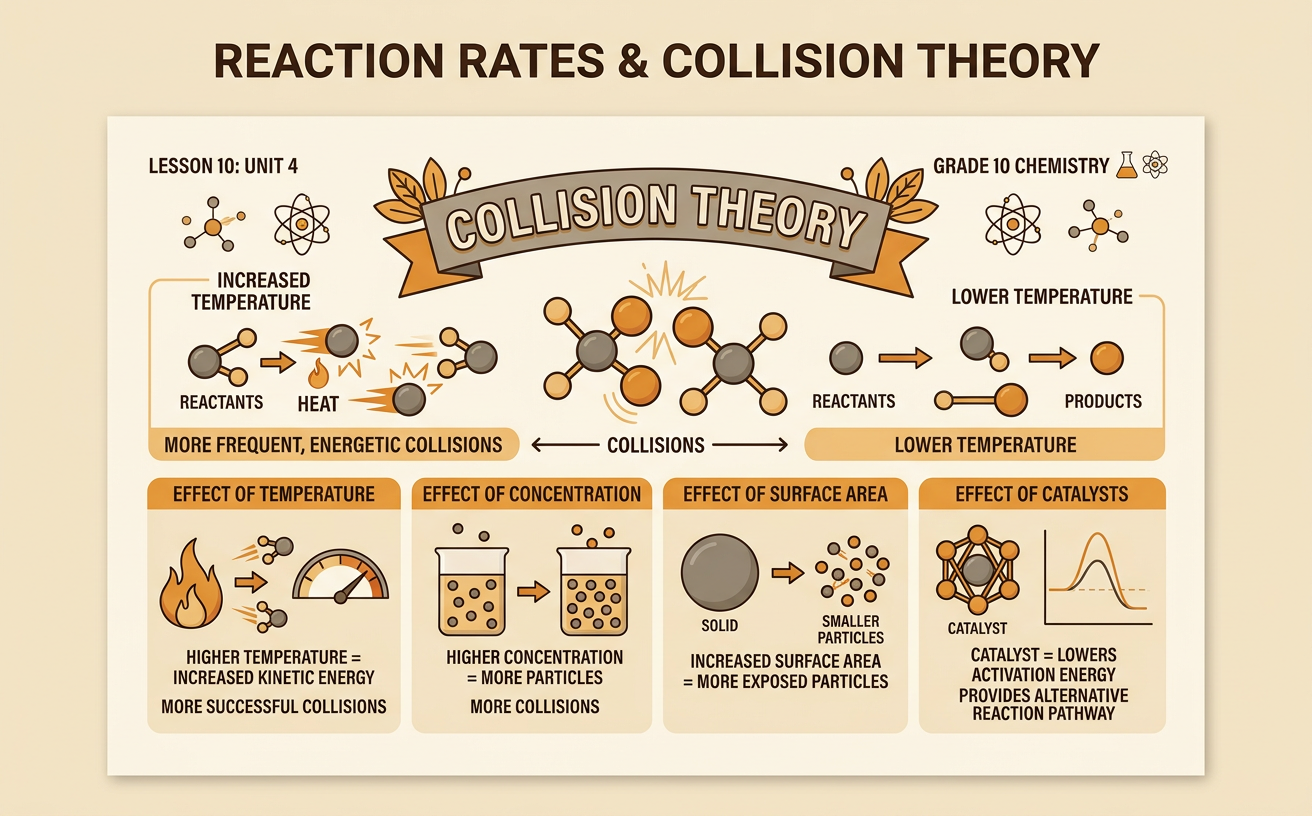
Students use collision theory to explain how temperature, concentration, surface area, and catalysts affect the rates of chemical reactions.
Illustrations are auto-generated and may be placeholders. They can be refreshed to match the narration.
Defining Reaction Rate
Reaction rate describes how quickly reactants are used up or products are formed. It can be calculated as the change in the amount or concentration of a substance divided by the time interval. Common units include moles per liter per second or grams per second. For example, when magnesium reacts with hydrochloric acid, hydrogen gas forms. If 30 milliliters of hydrogen forms in 15 seconds, the average gas-production rate is 2 milliliters per second. Rate can also be shown on a graph. A steeper slope means a faster reaction, while a flatter slope means a slower reaction. Rates often decrease over time because reactant particles are being consumed, leaving fewer particles available to collide. When the graph becomes horizontal, no additional measurable product is forming.

Effective Collisions and Activation Energy
Collision theory states that reacting particles must collide before their atoms can rearrange to form products. However, not every collision causes a reaction. An effective collision occurs only when particles collide with enough energy and with a suitable orientation. The minimum energy needed to begin a reaction is called activation energy. For example, hydrogen and oxygen molecules can remain together without immediately forming water because most collisions do not overcome the activation-energy barrier. A spark supplies energy that helps some collisions become effective, starting the reaction. On an energy diagram, reactants must move up to a high-energy transition state before becoming products. Collisions below the activation-energy threshold are unsuccessful, even if the particles strike one another. Therefore, reaction rate depends on both collision frequency and the proportion of collisions that are effective.

Effects of Temperature and Concentration
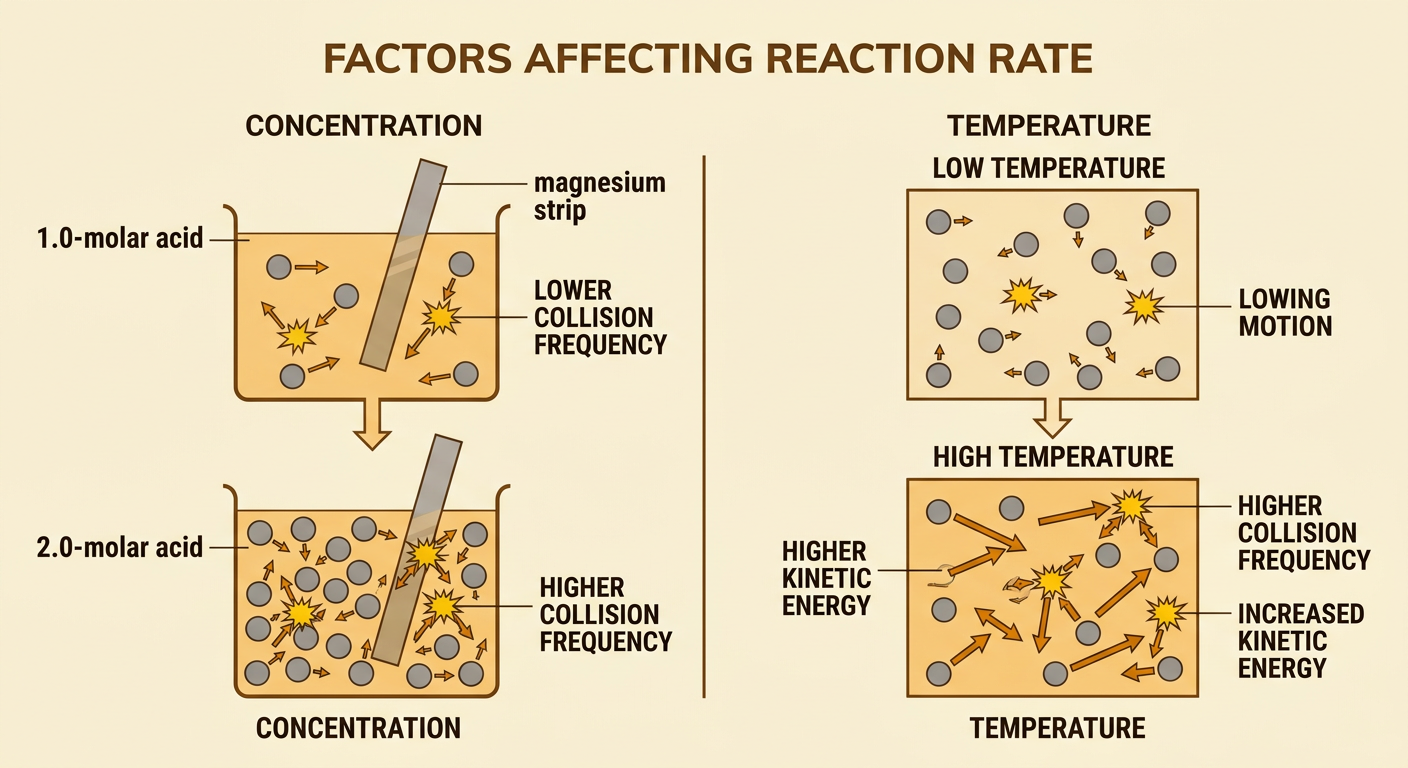
Increasing temperature usually increases reaction rate because particles move faster. They collide more frequently, and a larger fraction of the collisions have enough energy to overcome activation energy. Decreasing temperature has the opposite effect. Increasing the concentration of a dissolved reactant also speeds many reactions because more reactant particles occupy the same volume, causing collisions to occur more often. For example, a strip of magnesium generally produces hydrogen gas faster in 2.0-molar hydrochloric acid than in 1.0-molar hydrochloric acid when temperature and magnesium size are controlled. Warming the acid can increase the rate further. Temperature and concentration affect rate in different ways: concentration mainly changes collision frequency, while temperature changes both collision frequency and collision energy. A fair investigation changes only one factor at a time and keeps other conditions constant.
Surface Area and Catalysts
Surface area affects reactions involving a solid because only exposed particles can collide directly with other reactants. Breaking a solid into smaller pieces increases its total exposed surface area, so collisions occur at more locations. For example, powdered calcium carbonate reacts with hydrochloric acid faster than an equal mass of large calcium carbonate chips under the same conditions. A catalyst increases reaction rate in a different way. It provides an alternative reaction pathway with lower activation energy, allowing a greater fraction of collisions to be effective. Manganese dioxide, for example, speeds the decomposition of hydrogen peroxide into water and oxygen. A catalyst participates in reaction steps but is regenerated, so it is not used up overall. Catalysts do not change the identities of the final products or the total energy difference between reactants and products.

Interpreting Reaction-Rate Evidence
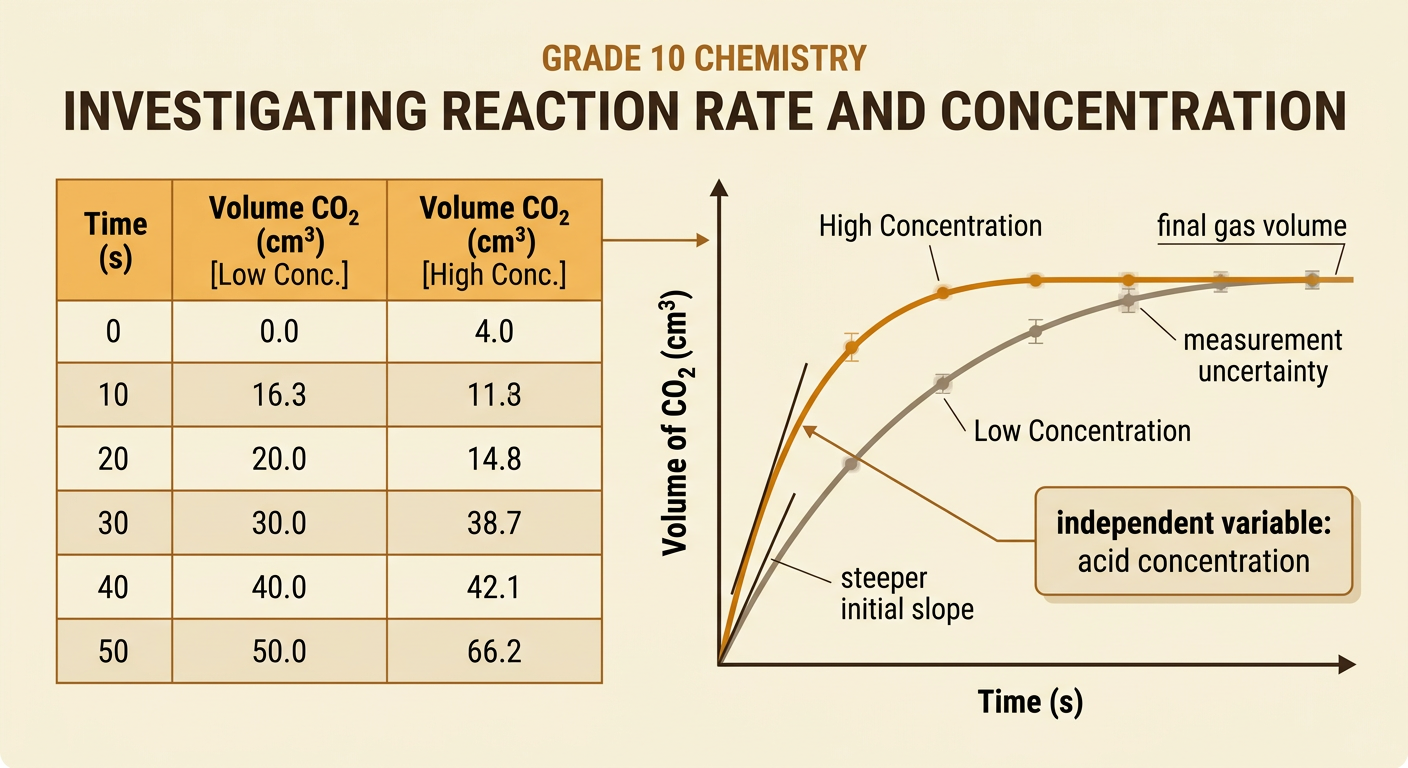
Reaction-rate conclusions should be based on measurements collected with a precise, repeatable procedure. Suppose students react equal masses of calcium carbonate with equal volumes of acid at two concentrations. They measure carbon dioxide volume every 10 seconds, record the values in a table, and graph gas volume against time. The trial with the steeper initial slope has the faster initial rate. If both trials eventually produce the same final gas volume, concentration changed how quickly the product formed but not the total amount produced. Students should identify the independent variable, control temperature and solid size, repeat trials, and consider measurement uncertainty. A sound explanation connects the evidence to collision theory: higher acid concentration produces more frequent reactant collisions. Similar reasoning can evaluate societal applications, such as catalysts in vehicle exhaust systems, while also considering evidence about effectiveness, cost, and environmental impact.