
Reaction Rates and Collision Theory
Students apply collision theory to explain how temperature, concentration, surface area, and catalysts affect reaction rates.
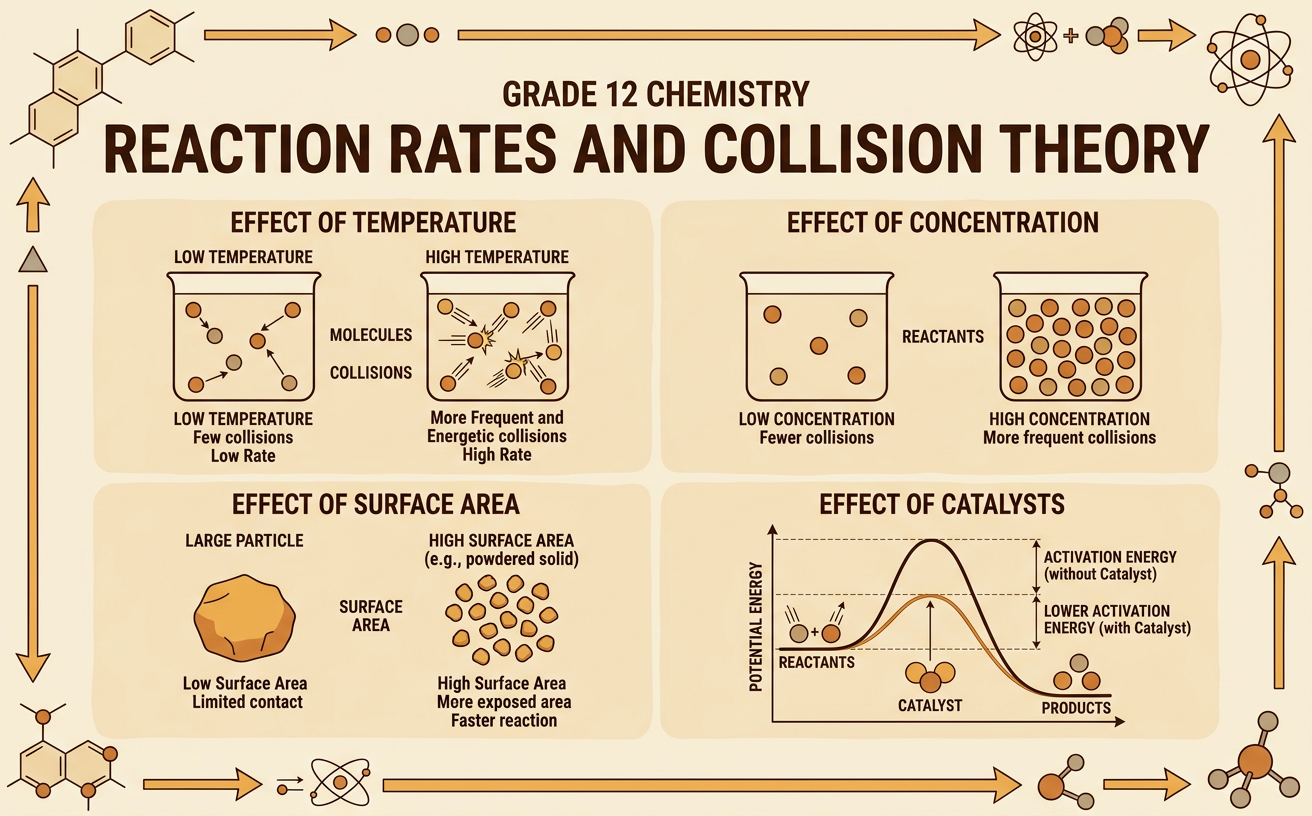
Illustrations are auto-generated and may be placeholders. They can be refreshed to match the narration.
Measuring Reaction Rate
Reaction rate describes how quickly reactants are consumed or products are formed. It is measured as the change in concentration divided by the elapsed time, commonly in moles per liter per second. Because reactant concentration decreases, its change is negative; a negative sign is used when reporting the reactant-based rate so that the rate value is positive. Product concentration increases, so its rate is positive directly. For example, when hydrogen peroxide decomposes into water and oxygen, students can collect the oxygen gas and measure its volume at regular time intervals. A steep slope on a graph of oxygen volume versus time indicates a fast rate. As hydrogen peroxide is used up, fewer reactant particles remain, so oxygen forms more slowly and the curve becomes less steep. Reaction rate can also be monitored through mass, pressure, color, or pH changes.
Collision Theory
Collision theory states that reacting particles must collide to form products, but not every collision causes a reaction. A collision is effective only if the particles have enough kinetic energy to overcome the activation energy and meet with a suitable orientation. Activation energy is the minimum energy needed to disrupt existing bonds and begin rearranging atoms. For example, hydrogen and iodine molecules can collide to form hydrogen iodide, but a low-energy collision may simply cause the molecules to bounce apart unchanged. Even an energetic collision can fail if the molecules approach in an orientation that does not allow the necessary bonds to break and form. Reaction rate therefore depends on the number of effective collisions per unit time, not merely the total number of collisions. Conditions that increase collision frequency or the fraction of collisions above the activation energy generally increase the reaction rate.
Temperature and Concentration
Increasing temperature raises the average kinetic energy of particles. They move faster, collide more often, and, most importantly, a larger fraction of collisions have energy equal to or greater than the activation energy. This produces more effective collisions per second and a faster reaction. For example, a magnesium strip reacts with hydrochloric acid more rapidly in a warm solution than in a cold solution of the same concentration. Increasing concentration also raises reaction rate because more reactant particles occupy the same volume, reducing their average separation and increasing collision frequency. Magnesium therefore reacts faster in 2.0 M hydrochloric acid than in 0.5 M hydrochloric acid at the same temperature. Temperature and concentration affect rate in different ways: temperature changes particle speed and the energy distribution, while concentration mainly changes the number of possible collisions. Evidence such as faster gas production supports these particle-level explanations.
Surface Area and Pressure
Surface area affects the rate of reactions involving a solid because collisions can occur only at exposed surfaces. Breaking a solid into smaller pieces increases its total surface area without changing its mass, allowing more reactant particles to collide at the same time. For example, powdered calcium carbonate reacts with hydrochloric acid faster than an equal mass of calcium carbonate chips, producing carbon dioxide more rapidly. Pressure mainly affects reactions involving gases. Compressing a gas into a smaller volume increases its particle concentration, so particles are closer together and collide more frequently. For example, increasing the pressure of gaseous reactants can increase the rate of ammonia formation from nitrogen and hydrogen when temperature and other conditions are controlled. Pressure has little direct effect on the concentration of solids and liquids because they are difficult to compress. In both cases, the faster rate results from more frequent contact between reacting particles.
Catalysts and Activation Energy
A catalyst increases reaction rate by providing an alternative reaction pathway with a lower activation energy. At the same temperature, lowering the activation energy allows a larger fraction of particle collisions to become effective. The catalyst participates in intermediate steps but is regenerated, so it is not consumed overall. It does not change the energies of the reactants or products, the overall energy change, or the equilibrium position. For example, manganese dioxide catalyzes the decomposition of hydrogen peroxide into water and oxygen, causing oxygen to form much faster without becoming a product. On a potential energy diagram, the catalyzed pathway has a lower peak than the uncatalyzed pathway, while both begin and end at the same energy levels. Enzymes are biological catalysts that often work by holding reactants in favorable orientations. Catalysts accelerate both forward and reverse reactions by lowering the activation energy for each pathway.