
Reaction Rates and Collision Theory
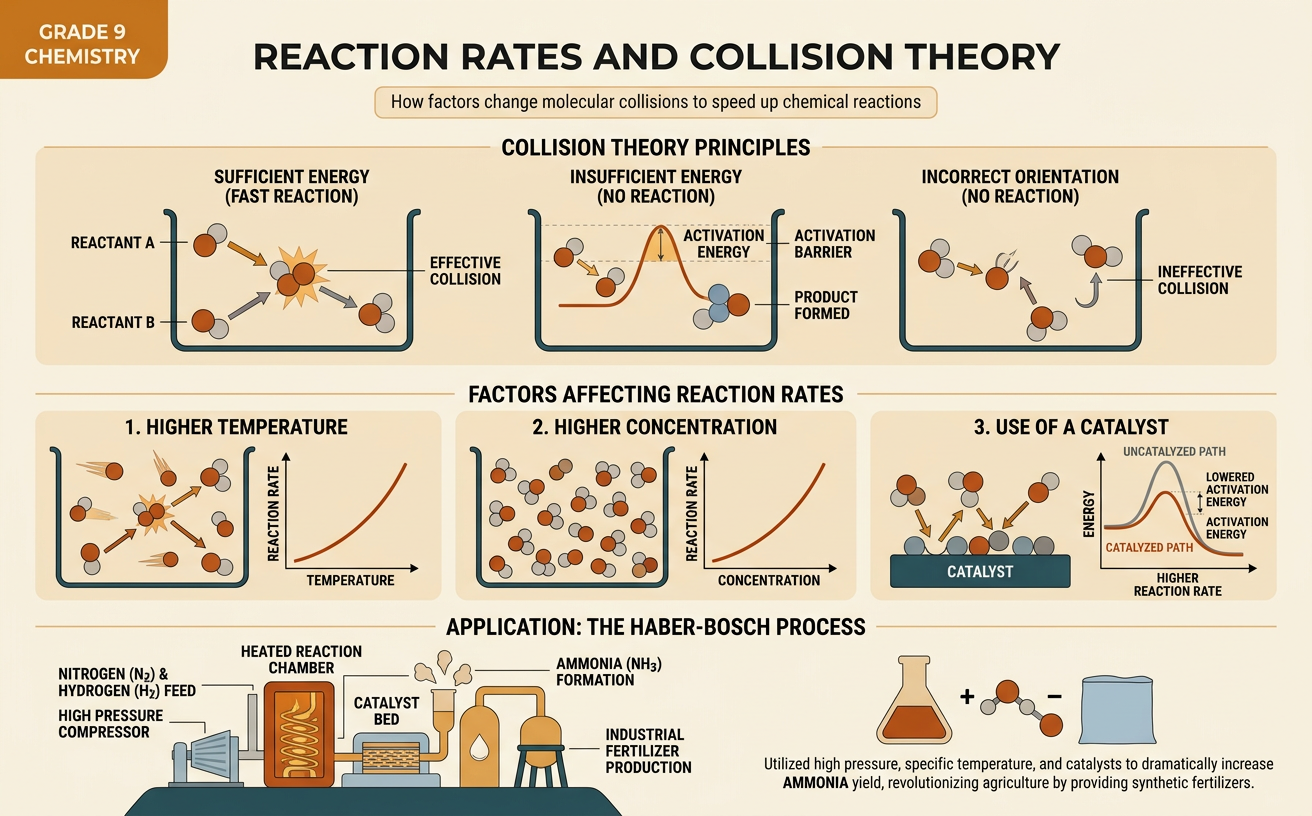
Students use collision theory to explain how temperature, concentration, and catalysts affect reaction rates, then connect these principles to the historical impact of the Haber-Bosch process.
Illustrations are auto-generated and may be placeholders. They can be refreshed to match the narration.
What Is Reaction Rate?
Reaction rate describes how quickly reactants are used up or products are formed during a chemical reaction. It can be measured as the change in concentration divided by the change in time. Common units include moles per liter per second. A fast reaction produces a large change in a short time, while a slow reaction produces a smaller change over the same interval. For example, an effervescent tablet reacts with water and releases carbon dioxide gas. Scientists can measure the gas volume every ten seconds to calculate the reaction rate. At first, gas may form rapidly because plenty of reactant particles are available. Later, the rate decreases as the reactants are consumed. Reaction rate is shown by the slope of a graph: a steeper slope represents a faster change.

Collision Theory
Collision theory explains reactions by examining how particles move and collide. For a reaction to occur, reactant particles must collide with enough energy to overcome the activation energy, which is the minimum energy needed to break or rearrange bonds. They must also collide in a suitable orientation so the correct atoms meet. A collision that satisfies both requirements is called an effective collision. Many collisions do not produce a reaction because the particles lack enough energy or strike in the wrong orientation. For example, carbon monoxide can react with nitrogen dioxide to form carbon dioxide and nitrogen monoxide. A productive collision requires the reactive ends of the molecules to meet correctly. Reaction rate increases when effective collisions occur more often, not simply when the total number of collisions increases.

Effects of Temperature and Concentration
Increasing temperature usually increases reaction rate because particles move faster. Collisions happen more often, and a larger fraction of particles have enough energy to overcome the activation energy. Increasing reactant concentration also raises the rate, but for a different reason. More particles occupy the same volume, so collisions occur more frequently. Consider magnesium ribbon reacting with hydrochloric acid. Magnesium disappears and hydrogen gas forms. Warmer acid produces hydrogen faster than cooler acid because its particles have greater average kinetic energy. More concentrated acid also increases the rate because more acid particles can collide with the magnesium surface each second. In a fair investigation, only one condition should change at a time. The amount and surface area of magnesium, acid volume, and measuring method should remain constant.

How Catalysts Work
A catalyst increases reaction rate by providing an alternative reaction pathway with a lower activation energy. Because the energy barrier is lower, a greater fraction of collisions can produce products at the same temperature. The catalyst participates in intermediate steps but is regenerated, so it is not consumed overall. A catalyst does not change the energy of the reactants or products, and it does not change the final equilibrium composition; it only helps the system reach equilibrium faster. For example, iron is used as a catalyst in the Haber-Bosch process, where nitrogen and hydrogen form ammonia. On the iron surface, gas molecules attach, their bonds are weakened, and atoms can rearrange more easily. Enzymes perform a similar catalytic role in living organisms by speeding up specific biochemical reactions.

Interpreting Reaction-Rate Graphs
Reaction-rate graphs help scientists compare how conditions affect a reaction over time. On a graph of product amount versus time, the slope represents the rate of product formation. A steep upward slope means the product is forming rapidly. A horizontal section means no additional product is forming, usually because a limiting reactant has been used up or equilibrium has been reached. For example, two equal samples of hydrogen peroxide may decompose with and without a catalyst. The catalyzed reaction curve rises more steeply and reaches its plateau sooner. If both samples begin with the same amount of hydrogen peroxide and decompose completely, both curves reach the same final oxygen amount. To compare average rates, select two points on a curve and divide the change in product amount by the elapsed time.

The Haber-Bosch Process and Society
The Haber-Bosch process combines nitrogen and hydrogen according to the reversible reaction nitrogen plus three hydrogen molecules forms two ammonia molecules. Developed by Fritz Haber and scaled for industry by Carl Bosch in the early twentieth century, the process uses an iron catalyst, high pressure, and a moderately high temperature. High pressure increases collisions and favors ammonia formation, while the chosen temperature balances reaction speed with ammonia yield. Synthetic ammonia made large-scale nitrogen fertilizer possible, helping farmers increase crop production and support a growing population. However, ammonia production requires substantial energy, often from fossil fuels, and contributes to carbon dioxide emissions. Excess fertilizer can also enter waterways and cause harmful algal blooms. Ammonia also enabled expanded explosives production, affecting warfare. Thus, one industrial chemical process produced connected agricultural, environmental, economic, and military effects.