
Reaction Rates, Collision Theory, and Catalysts
Students use collision theory and concentration-versus-time data to explain how temperature, concentration, surface area, and catalysts affect reaction rates, including the role of catalytic converters in reducing vehicle emissions.

Illustrations are auto-generated and may be placeholders. They can be refreshed to match the narration.
Defining Reaction Rate
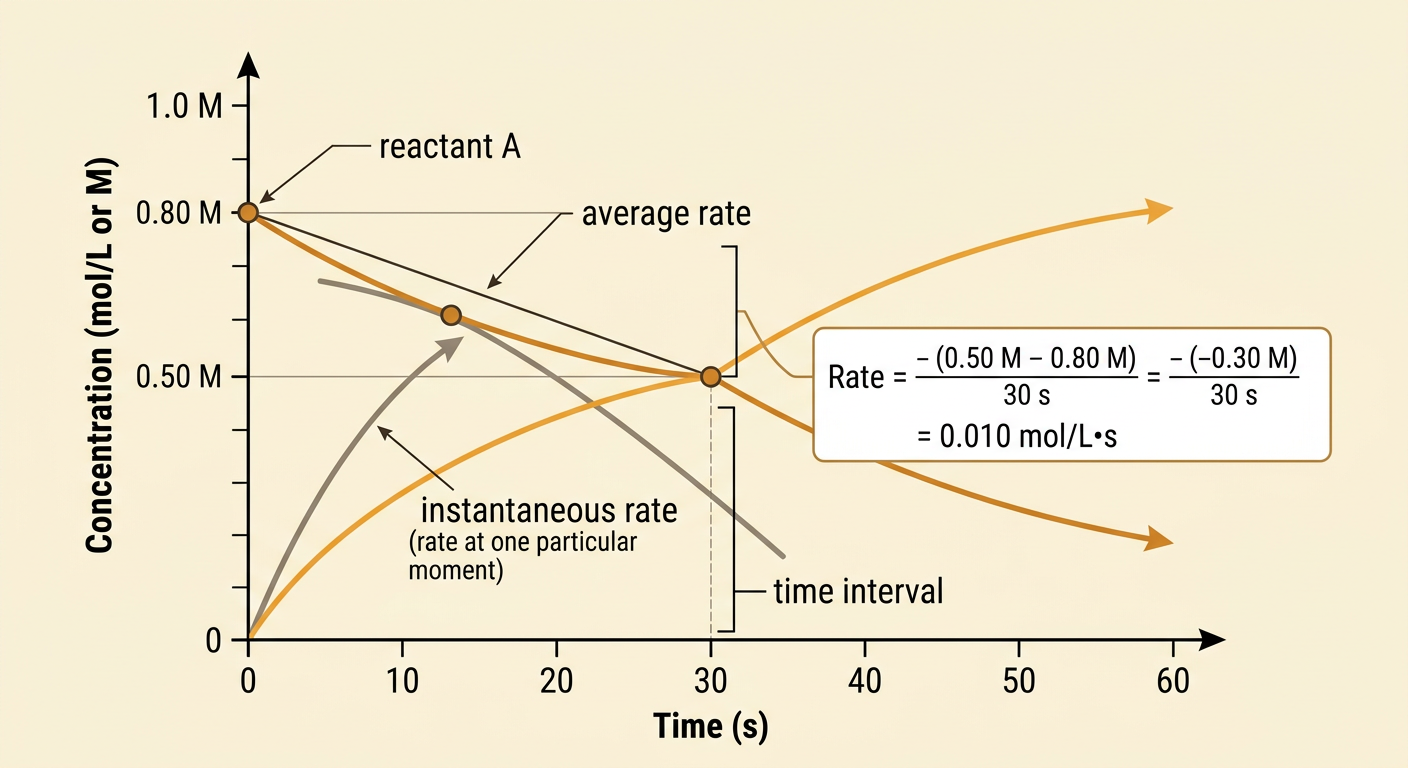
Reaction rate describes how quickly reactants are consumed or products are formed. It is measured as the change in concentration divided by the elapsed time, often in moles per liter per second. Because reactant concentration decreases, its change is negative; chemists usually report the rate of reactant disappearance as a positive value. For example, suppose the concentration of reactant A decreases from 0.80 molar to 0.50 molar in 30 seconds. The average rate of disappearance is negative 0.30 molar divided by 30 seconds, with the negative sign reversed, giving 0.010 molar per second. An instantaneous rate describes the rate at one particular moment, while an average rate covers a time interval. Reactions generally slow as reactants are used up because fewer reactant particles remain available to interact.
Collision Theory
Collision theory explains reactions by examining interactions among particles. Reactant particles must collide before their atoms can rearrange, but not every collision produces products. An effective collision requires enough kinetic energy to overcome the activation energy and an orientation that allows the correct bonds to break and form. Imagine two molecules approaching each other. If they collide slowly, they may bounce apart without reacting. If they collide with sufficient energy but the reactive parts face away from each other, the collision may also fail. When both energy and orientation are suitable, old bonds break and new bonds form. Reaction rate therefore depends on the number of effective collisions per second, not simply the total number of collisions. Conditions that increase collision frequency or the fraction of particles with sufficient energy generally increase reaction rate.

Factors Affecting Reaction Rate
Temperature, concentration, surface area, and catalysts can change reaction rate. Increasing temperature makes particles move faster, causing more frequent collisions and increasing the fraction that exceed the activation energy. Increasing reactant concentration places more particles in a given volume, so collisions occur more often. Increasing the surface area of a solid exposes more particles to other reactants. For example, a crushed antacid tablet reacts with water faster than an equal whole tablet because more tablet surface contacts the water at once. A catalyst speeds a reaction by providing a different pathway with lower activation energy. It does not increase reactant concentration and is not consumed overall. These factors affect rate in different ways: concentration and surface area mainly alter collision frequency, temperature changes both collision frequency and collision energy, and a catalyst increases the fraction of collisions that can successfully form products.

Interpreting Rate Data
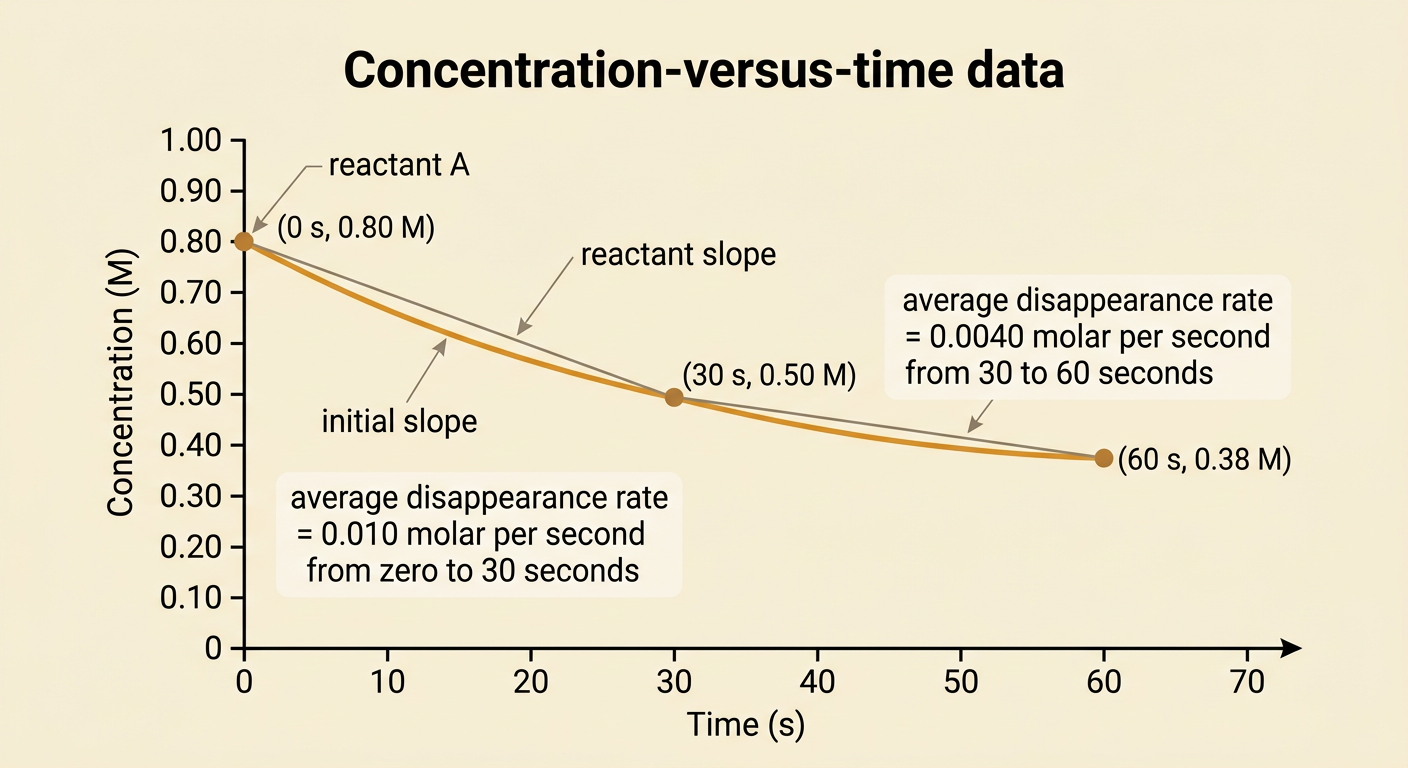
Concentration-versus-time data can be used to calculate and compare average reaction rates. Suppose reactant A has concentrations of 0.80 molar at 0 seconds, 0.50 molar at 30 seconds, and 0.38 molar at 60 seconds. From 0 to 30 seconds, its average rate of disappearance is 0.010 molar per second. From 30 to 60 seconds, the concentration decreases by 0.12 molar, so the average rate is 0.0040 molar per second. The smaller second rate shows that the reaction slowed. On a graph, the reactant curve is steep early and becomes flatter later. The slope for a reactant concentration is negative because concentration decreases, while the reported rate of disappearance is positive. When comparing experiments, a steeper initial slope indicates a faster initial reaction and can provide evidence that a changed condition affected the rate.
How Catalysts Lower Activation Energy
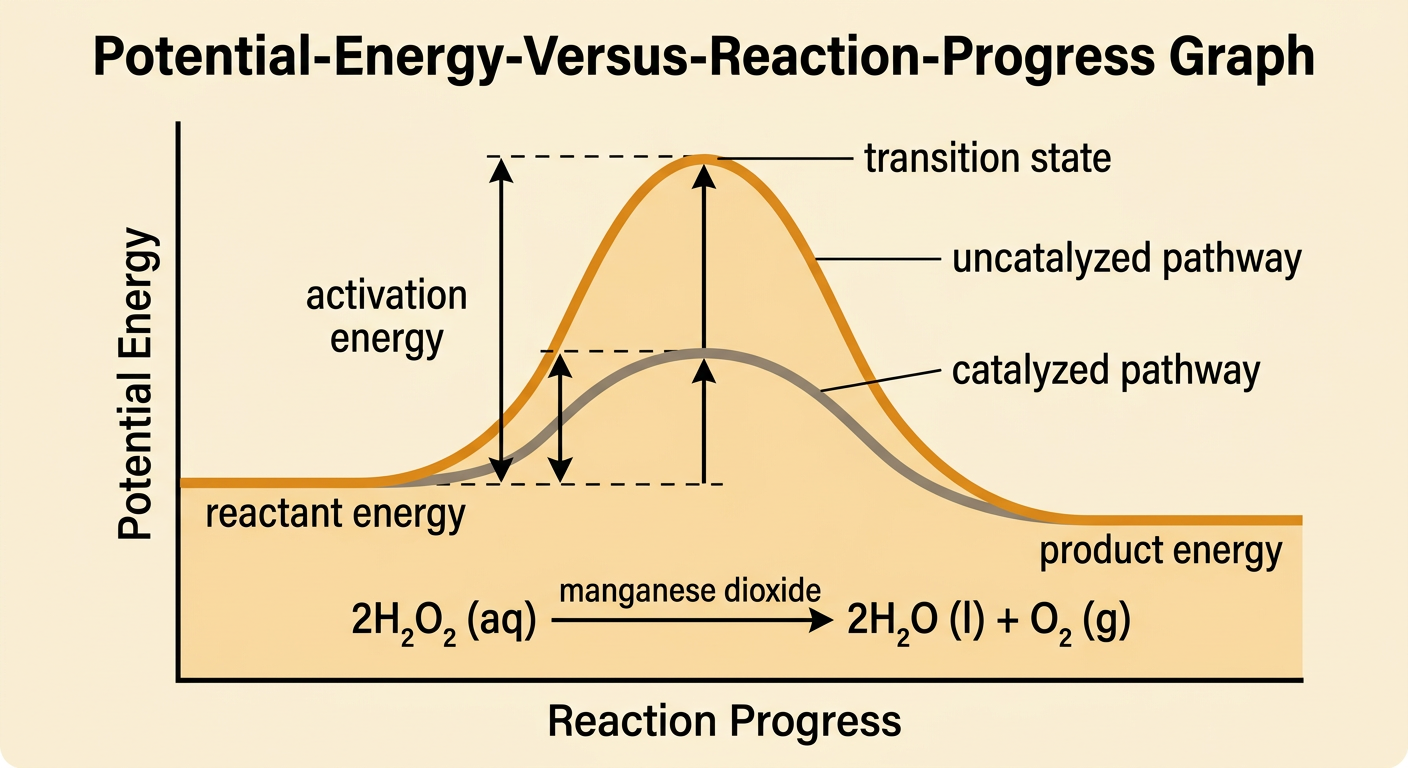
A catalyst increases reaction rate by providing an alternative reaction pathway with a lower activation energy. Activation energy is the minimum energy needed for reactants to reach the unstable transition state where bonds are breaking and forming. At the same temperature, lowering this barrier allows a larger fraction of particle collisions to become effective. For example, manganese dioxide catalyzes the decomposition of hydrogen peroxide into water and oxygen. It participates in intermediate steps but is regenerated, so it is not consumed overall. An energy diagram shows that catalyzed and uncatalyzed pathways begin at the same reactant energy and end at the same product energy. The catalyzed peak is lower, but the overall energy change remains the same. A catalyst changes the speed of a reaction, not the energies of the initial and final substances or the reaction’s equilibrium position.
Catalytic Converters and Emissions Policy
A three-way catalytic converter uses platinum-group metals to accelerate reactions that reduce harmful vehicle emissions. It oxidizes carbon monoxide to carbon dioxide, oxidizes unburned hydrocarbons to carbon dioxide and water, and reduces nitrogen oxides to nitrogen. For example, carbon monoxide molecules adsorb onto the catalyst surface, where they react more readily with oxygen. Emissions policies requiring converters and vehicle testing are intended to improve air quality and reduce health problems linked to smog and toxic gases. Evidence of lower carbon monoxide, hydrocarbon, and nitrogen oxide emissions supports these policies. However, consequences must also be evaluated. Converters add cost, require mining scarce metals, work poorly before warming up, and do not eliminate carbon dioxide emissions. Poor maintenance or converter theft can also reduce policy effectiveness. Policymakers can compare air-quality and health benefits with economic, environmental, and enforcement costs when revising standards.
