
Read Grade-Level Text Fluently
Students practice accurate, appropriately paced, and expressive oral reading while monitoring their own understanding.
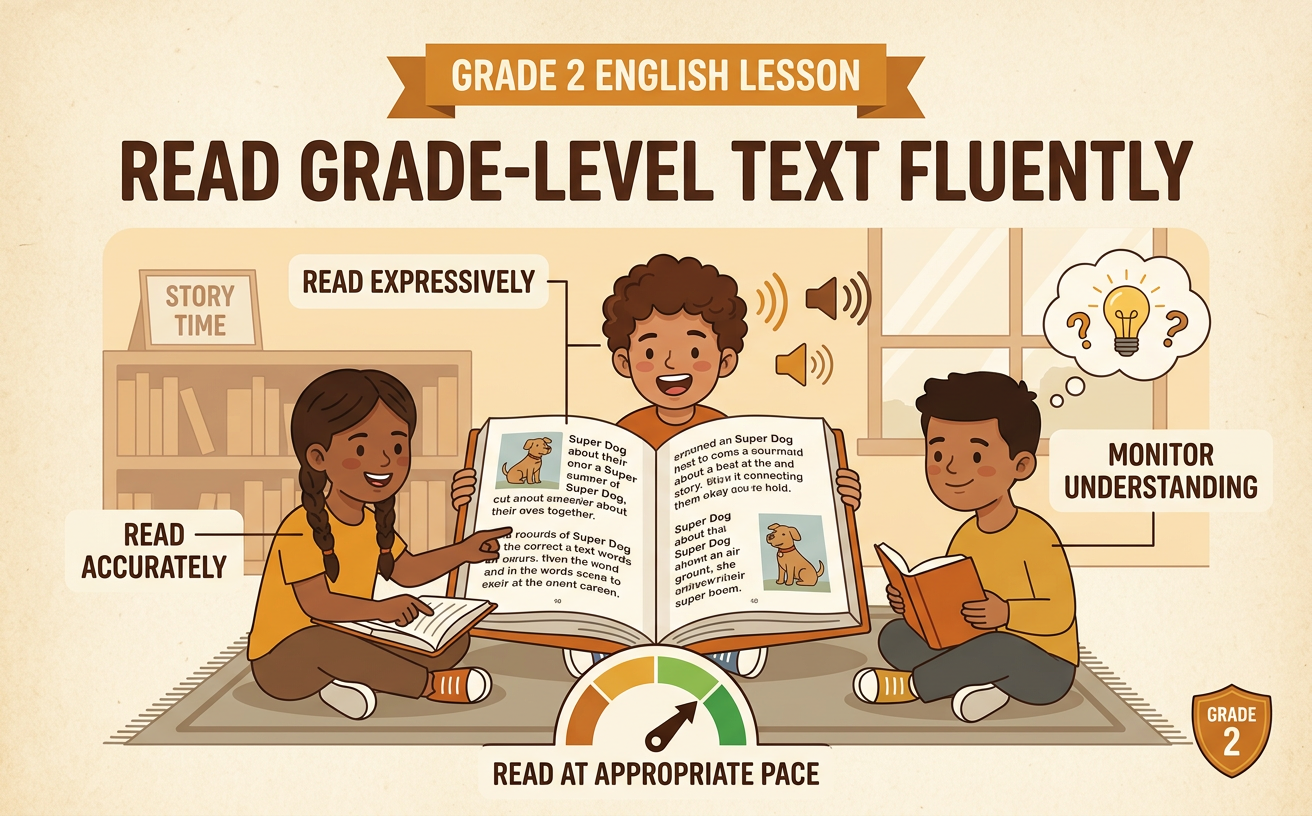
Illustrations are auto-generated and may be placeholders. They can be refreshed to match the narration.
Model Fluent Reading
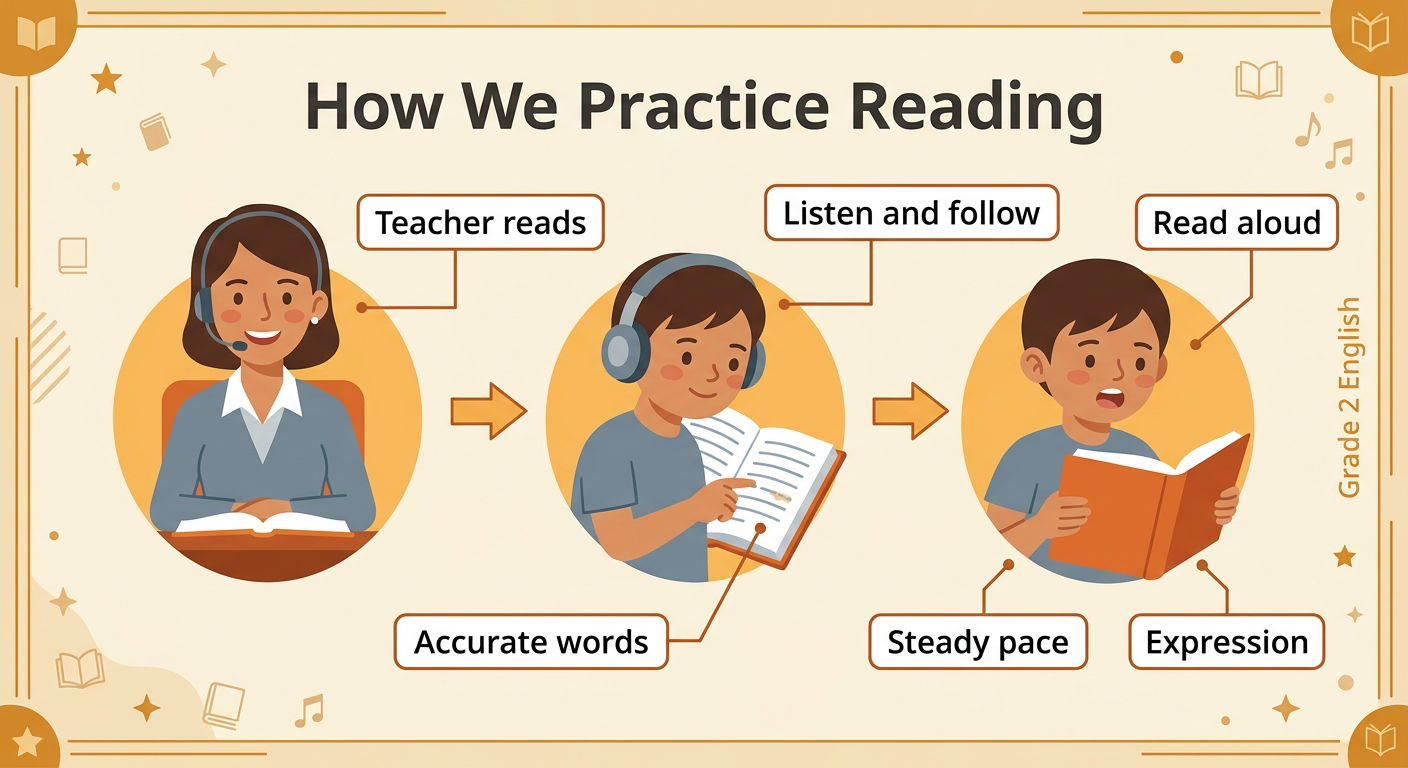
Fluent reading sounds like talking. A fluent reader says each word correctly, reads at a comfortable speed, and uses a voice that matches the meaning. First, listen while a teacher reads: “The small brown rabbit hopped across the yard. It stopped to nibble a green leaf.” Notice that the reader does not race or pause after every word. The words flow together in meaningful groups. The reader’s voice may sound lively when the rabbit hops and calm when it stops. Follow the words with your eyes as you listen. Then read the same sentences aloud. Try to match the reader’s accuracy, pace, and expression. Fluent reading helps you think about the rabbit and understand what is happening instead of using all your attention to figure out the words.
Practice Accurate Reading
Accurate reading means saying the words that are printed on the page. Look carefully at every letter and word. If a word is difficult, slow down and use its parts, the sentence, or a known spelling pattern. In the sentence “The bright star shone at night,” you might first read “shine” instead of “shone.” Stop when the sentence does not sound right. Look at the word again, notice the letters o and e, and correct it to “shone.” Then begin the sentence again so the meaning is clear. Do not skip small words such as the, at, or of. After reading, ask whether every sentence makes sense. Correcting a mistake is a good reading habit. It shows that you are paying attention to both the printed words and their meaning.
Use Punctuation for Expression
Punctuation marks help your voice show meaning. At a period, lower your voice slightly and make a full stop. At a comma, take a short pause because the sentence continues. A question mark tells you to use a questioning voice. An exclamation point tells you to show strong feeling or excitement. Read these examples aloud: “Did you find my red hat?” Let your voice rise as you ask the question. Next read, “I found it!” Use an excited voice, but do not shout. In “After lunch, we went outside,” pause briefly after lunch and continue smoothly. Quotation marks show the exact words a character says, so think about how that character might sound. Using punctuation makes oral reading easier to understand and helps listeners recognize questions, feelings, pauses, and complete thoughts.
Reread for Smoothness
Rereading helps your voice become smoother and more natural. The first time you read a passage, focus on figuring out the words and meaning. The second time, connect words into phrases instead of reading one word at a time. The third time, use a comfortable pace and expression. Try this sentence: “On a sunny morning, Mia packed a snack and walked to the pond.” During the first reading, you may pause at packed or pond. Check those words and keep going. During the second reading, group “On a sunny morning” and “walked to the pond” as phrases. During the third reading, make the whole sentence sound like you are telling someone about Mia’s morning. Rereading is not a race. The goal is to read accurately, smoothly, and with understanding.
Reflect on Understanding
Fluent reading should help you understand and remember the text. After reading, pause and ask yourself questions. What happened? Who or what was the text mostly about? Which details were important? For example, after reading “Lena filled a bowl with water and placed it by the thirsty puppy,” you might say, “Lena helped the puppy by giving it water.” That answer shows you understood the important action. If you cannot explain the sentence, reread it more slowly and look for clues. You can also picture the event in your mind. Then tell the main idea in your own words. Pay attention while you read, not only after you finish. If something stops making sense, pause, check the words, and reread. Understanding is the reason for reading accurately and fluently.