
Reading and Graphing Details About a Community Garden
Students read an informational passage about a community garden, answer questions using text evidence, organize plant data in a picture graph, and plan a simple investigation about plant needs.

Illustrations are auto-generated and may be placeholders. They can be refreshed to match the narration.
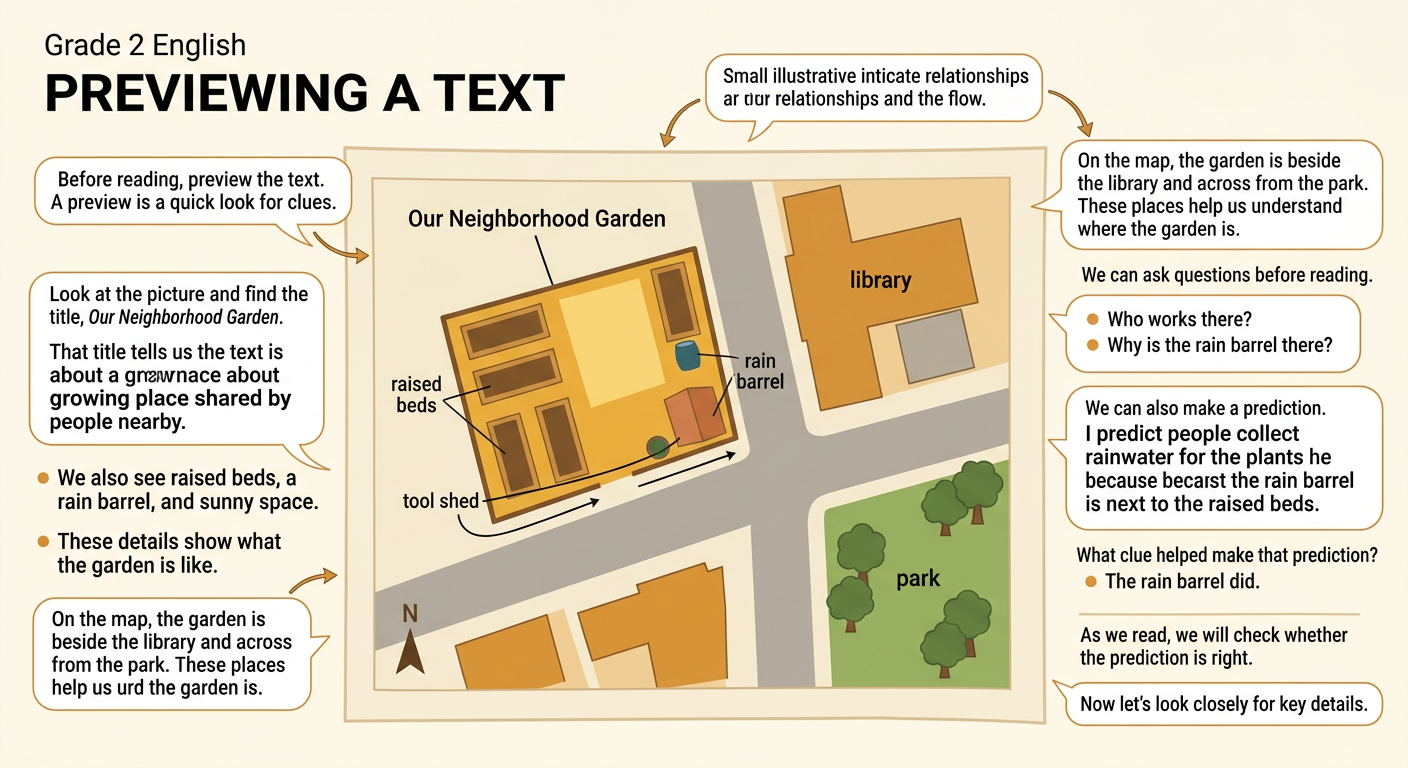
Preview the Garden Text
Before reading, look at the title, picture, map, and labels. These text features give clues about what you will learn. The title “Our Neighborhood Garden” tells you that the text is about a shared growing place. In the picture, raised beds, a rain barrel, and sunny open space show environmental characteristics of the garden. The map shows that the garden is beside the library and across from the park. Ask preview questions such as, “Who works in the garden?” and “Why is the rain barrel there?” Make a prediction using a clue. For example, you might say, “I predict neighbors collect rainwater for the plants because the picture shows a rain barrel next to the garden beds.” You will check your prediction as you read.
Read for Key Details
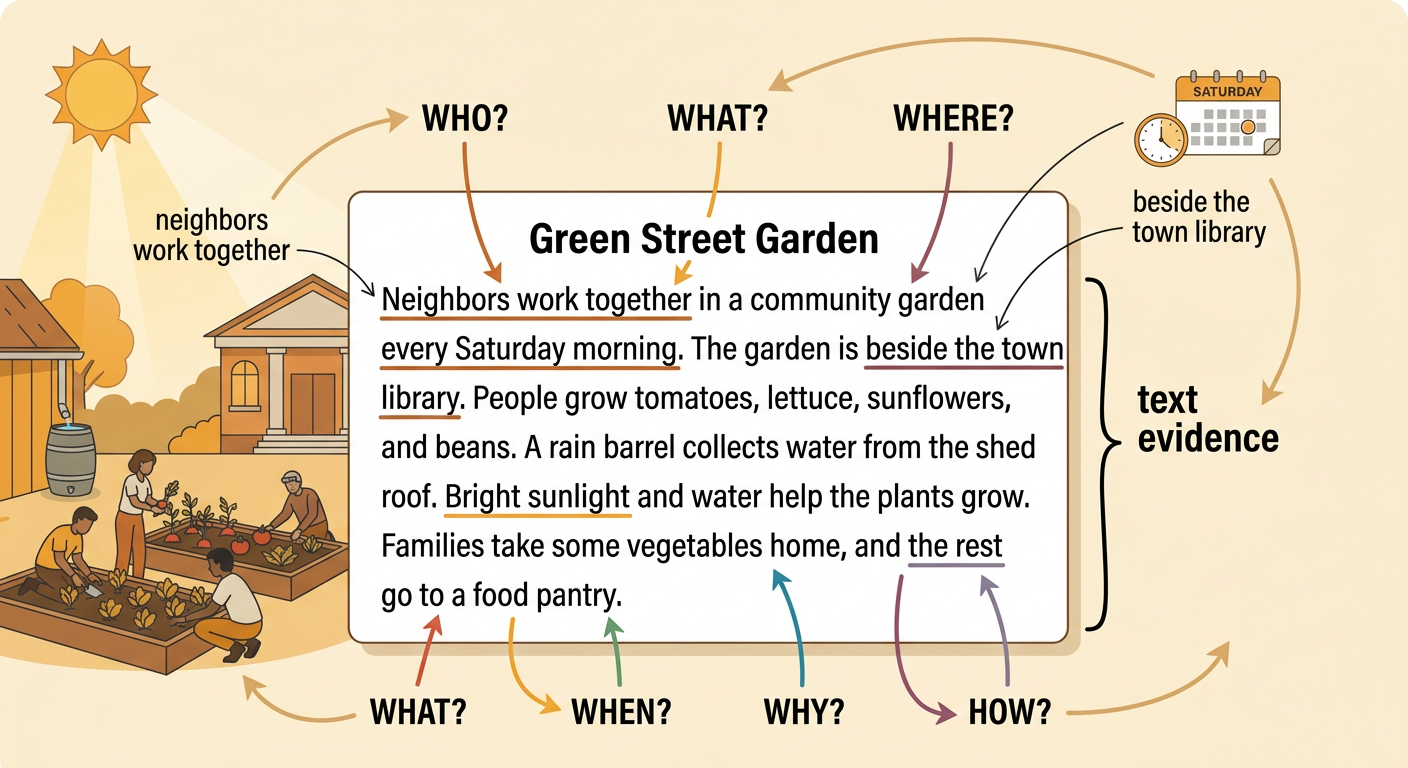
Read this short passage carefully: “The Green Street Garden is beside the town library. Every Saturday morning, neighbors work together there. They grow tomatoes, lettuce, sunflowers, and beans in raised beds. The garden has four tomato plants, three lettuce plants, two sunflower plants, and five bean plants. A rain barrel collects water from the shed roof. Most garden beds are in bright sunlight because plants need sunlight and water to grow. Families take home some vegetables, and gardeners give the rest to a food pantry.” As you read, notice details that tell who, what, where, when, why, and how. For example, the words “Every Saturday morning” tell when the neighbors work. The phrase “beside the town library” tells where the garden is located. These exact words are text evidence.
Ask and Answer Questions
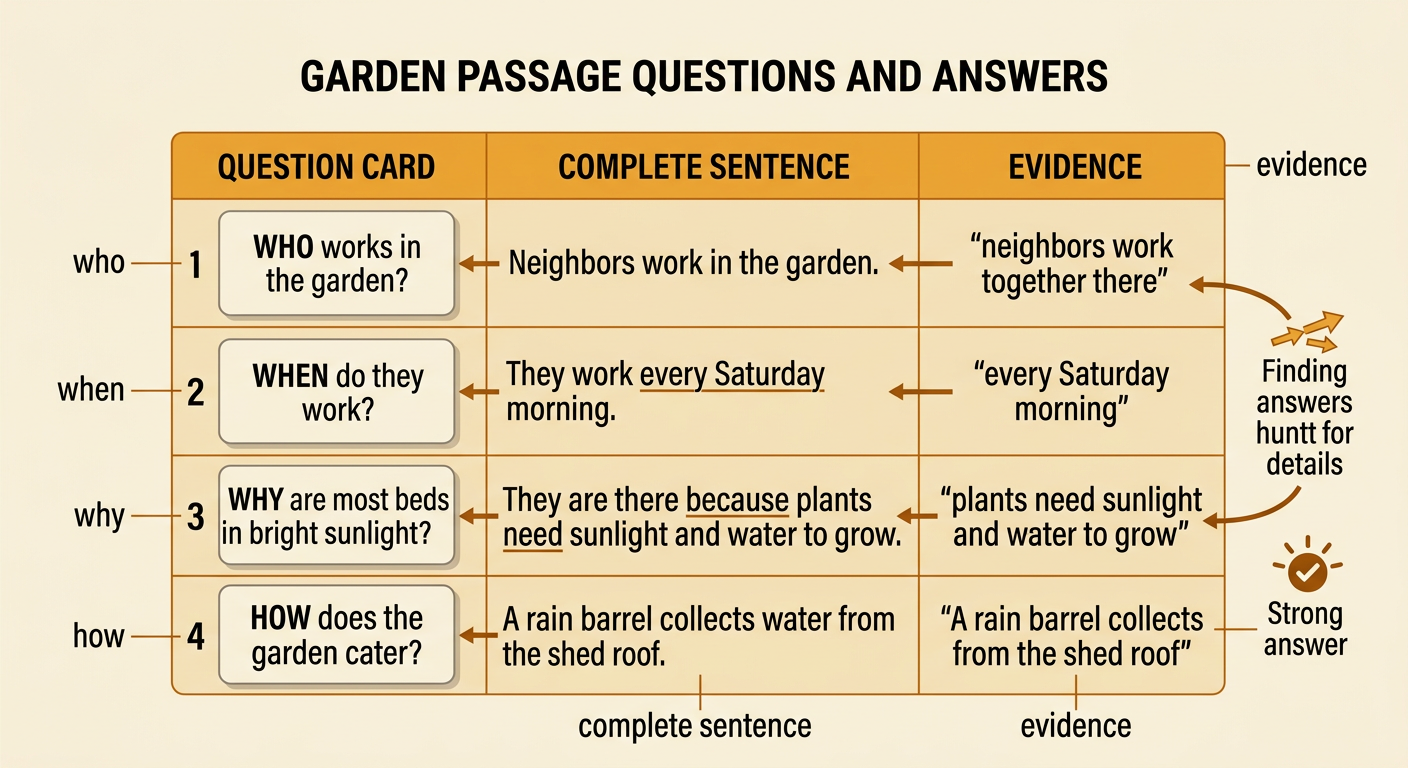
Good readers ask questions before, during, and after reading. Use question words to find important details. Ask, “Who works in the garden?” The answer is, “Neighbors work in the garden.” Support it with the passage’s words: “neighbors work together there.” Ask, “When do they work?” They work every Saturday morning. For a why question, ask, “Why are most beds in bright sunlight?” The text explains that plants need sunlight and water to grow. You can also ask how: “How does the garden collect water?” It collects water in a rain barrel connected to the shed roof. Each answer should match the passage, not just your own ideas. Reread the sentence that contains the evidence, then state the answer in a complete sentence.
Graph the Plant Information
A picture graph makes the garden numbers easy to compare. Use the plant data from the passage: four tomato plants, three lettuce plants, two sunflower plants, and five bean plants. Make four rows and label one row for each plant category. Use one leaf picture for each plant, so the key is “one leaf equals one plant.” Draw four leaves for tomatoes, three for lettuce, two for sunflowers, and five for beans. Then interpret the graph. Beans have the greatest number because five is more than the other amounts. Sunflowers have the least number. There are two more bean plants than lettuce plants because five minus three equals two. Always read the graph title, category labels, and key before answering a question.

Plan a Plant-Needs Investigation
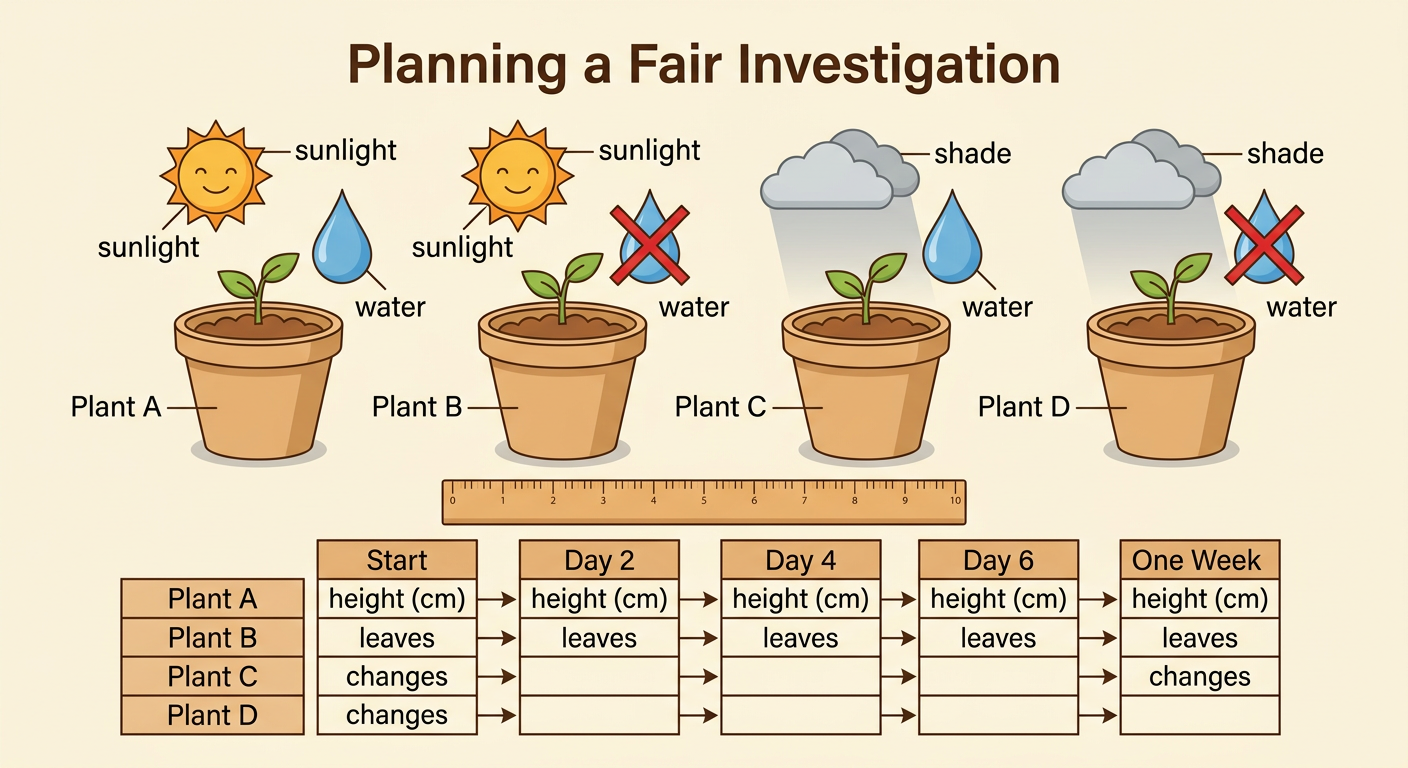
Plan a fair investigation to find out whether plants need sunlight and water to grow. Use four similar seedlings of the same kind in equal pots with the same soil. Put Plant A in sunlight and give it water. Put Plant B in sunlight but do not give it water. Give Plant C water but keep it away from sunlight. Give Plant D neither sunlight nor water. Keep other conditions, such as pot size and investigation length, the same. Predict what will happen. For example, “I predict Plant A will grow the most because it receives both sunlight and water.” Measure each plant’s height at the start and every two days for one week. Record height, leaf number, and visible changes in a table. An adult should help care for the seedlings after the investigation.
Share Evidence and Conclusions
After the investigation, use your observations as evidence. First, share the question and prediction. Next, show the table or graph of plant heights. Describe what happened without changing the recorded numbers. For example, suppose Plant A grew from 5 centimeters to 9 centimeters, Plant B stayed at 5 centimeters, Plant C grew to 6 centimeters, and Plant D stayed at 5 centimeters. You could conclude, “The plant with both sunlight and water grew the most. This evidence supports the idea that plants need sunlight and water to grow well.” Explain that one short investigation may not answer every question. Compare the results with details from the garden passage and picture graph. Listen to classmates, ask a question, and revise your conclusion if new evidence gives you a better explanation.
