
Reading the Fossil Record: Evidence of Life’s Changes
Students analyze fossil images, rock-layer data, and geographic patterns to identify evidence of the diversity, extinction, and change of organisms over time.

Illustrations are auto-generated and may be placeholders. They can be refreshed to match the narration.
What Fossils Can Tell Us
Fossils are preserved remains, impressions, or traces of organisms that lived long ago. Bones, shells, leaf impressions, footprints, and burrows can all become fossils. Scientists compare fossil structures with features of living organisms to infer how ancient organisms moved, ate, and survived. Fossils also reveal past diversity and environments. For example, finding many kinds of fossil shells in one rock layer shows that a diverse community once lived there. If those shells belonged to organisms that lived in shallow seas, the evidence suggests that the area was once underwater. The fossil record is incomplete because most organisms decay without becoming fossils, and some fossils are destroyed or remain undiscovered. Even so, many fossils collected from different places provide strong evidence that life on Earth has changed over time.

Reading Rock Layers
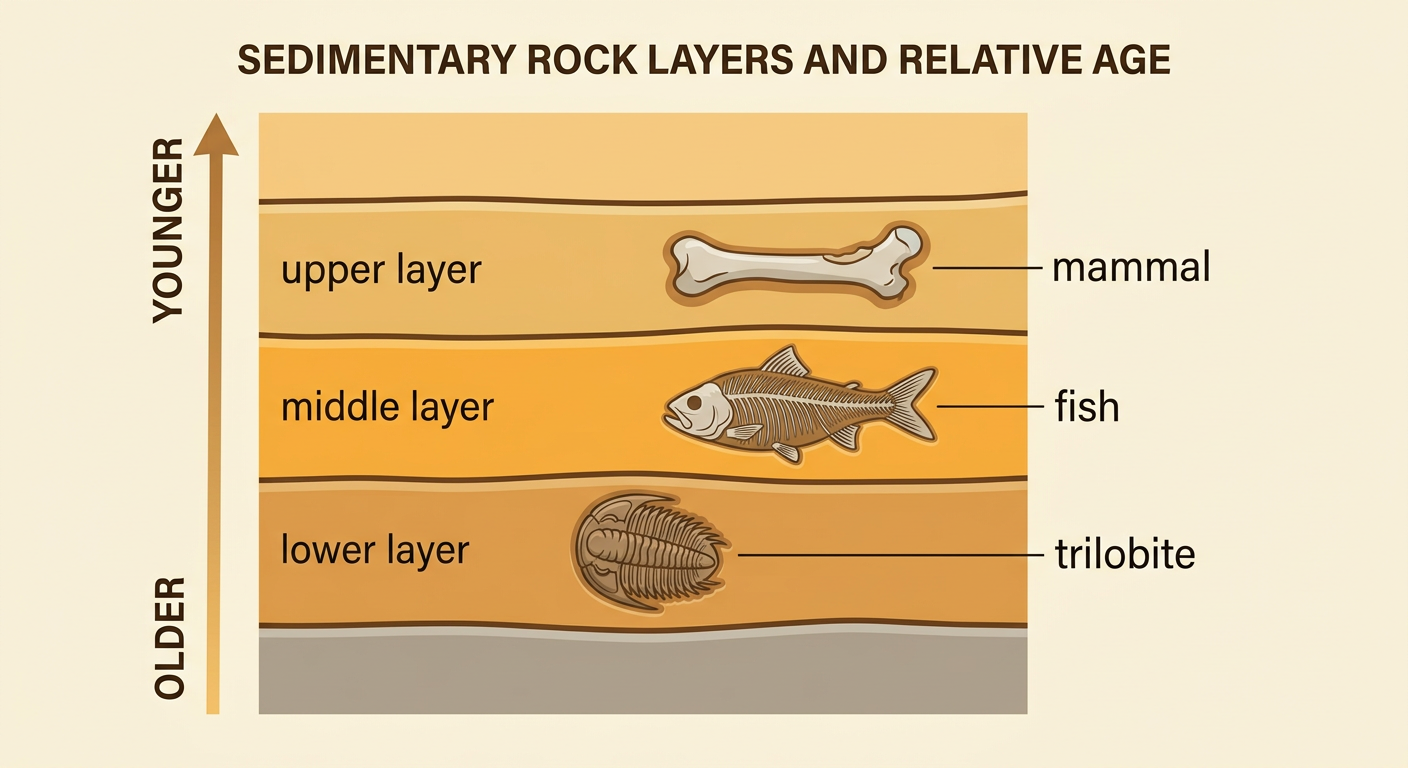
Sedimentary rocks often form when layers of sand, mud, or other sediments build up and harden. In an undisturbed sequence, lower layers are generally older than layers above them. This principle, called superposition, helps scientists determine relative age, or whether one fossil is older or younger than another. Imagine that a trilobite fossil is found in a low layer, a fish fossil in a middle layer, and a mammal fossil in a high layer. Scientists can conclude that the trilobite was buried before the fish and that the mammal was buried later. They cannot determine exact ages from layer position alone. Faults, folding, and erosion can disturb layers, so geologists study the full rock structure. Index fossils and radiometric dates from nearby rocks can provide additional age evidence.
Identifying Patterns Over Time
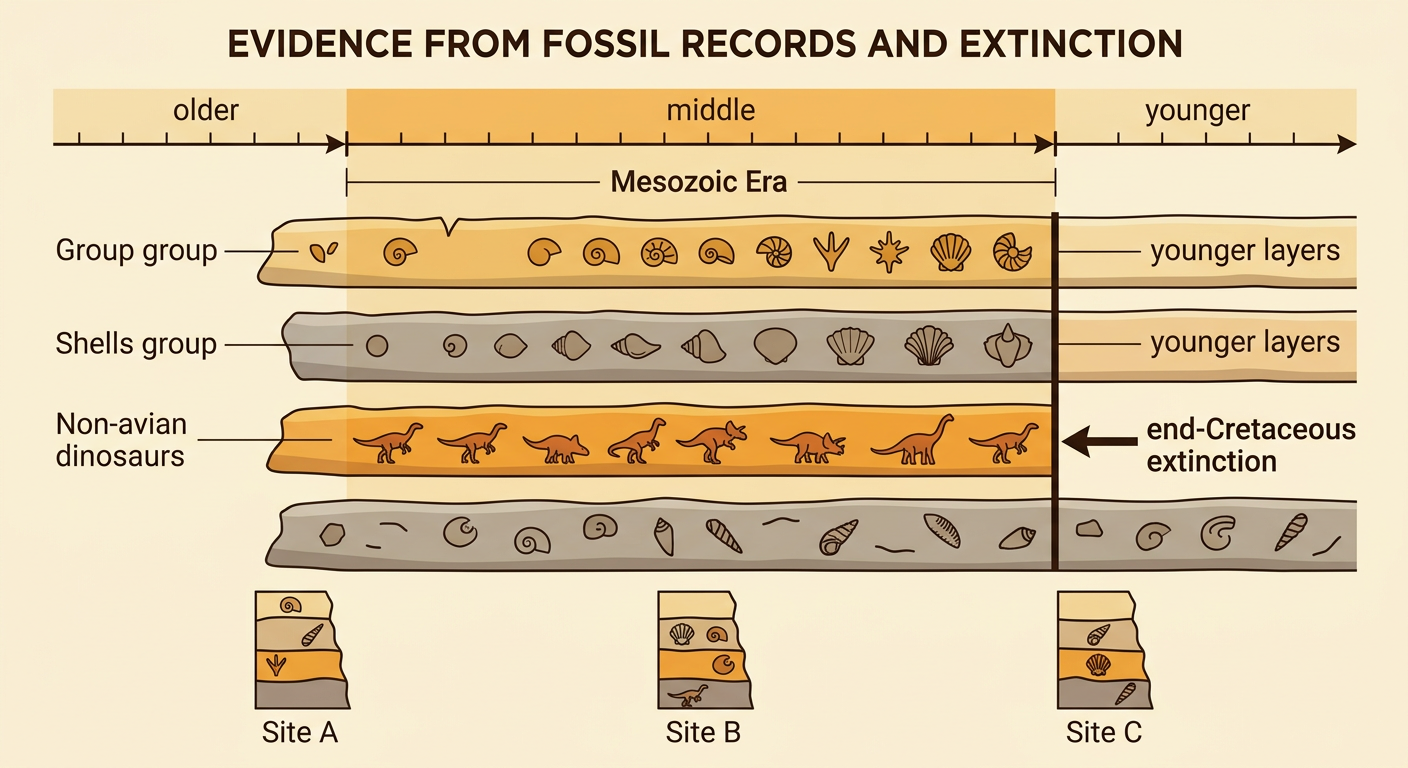
Scientists arrange fossils by relative or numerical age and look for patterns in when organisms appear, become diverse, change, or disappear. The first appearance of a fossil group shows that the group existed by that time. An increase in the number of fossil types can indicate growing diversity. If a fossil group is common in several older layers but absent from all younger layers, the pattern may provide evidence of extinction. For example, non-avian dinosaur fossils occur in many rock layers formed during the Mesozoic Era but are absent from layers formed after the end-Cretaceous extinction. Scientists compare this pattern with evidence from many locations rather than relying on one rock exposure. They also recognize that a missing fossil in one layer could result from poor preservation, erosion, or limited sampling rather than true extinction.
Mapping Fossil Evidence
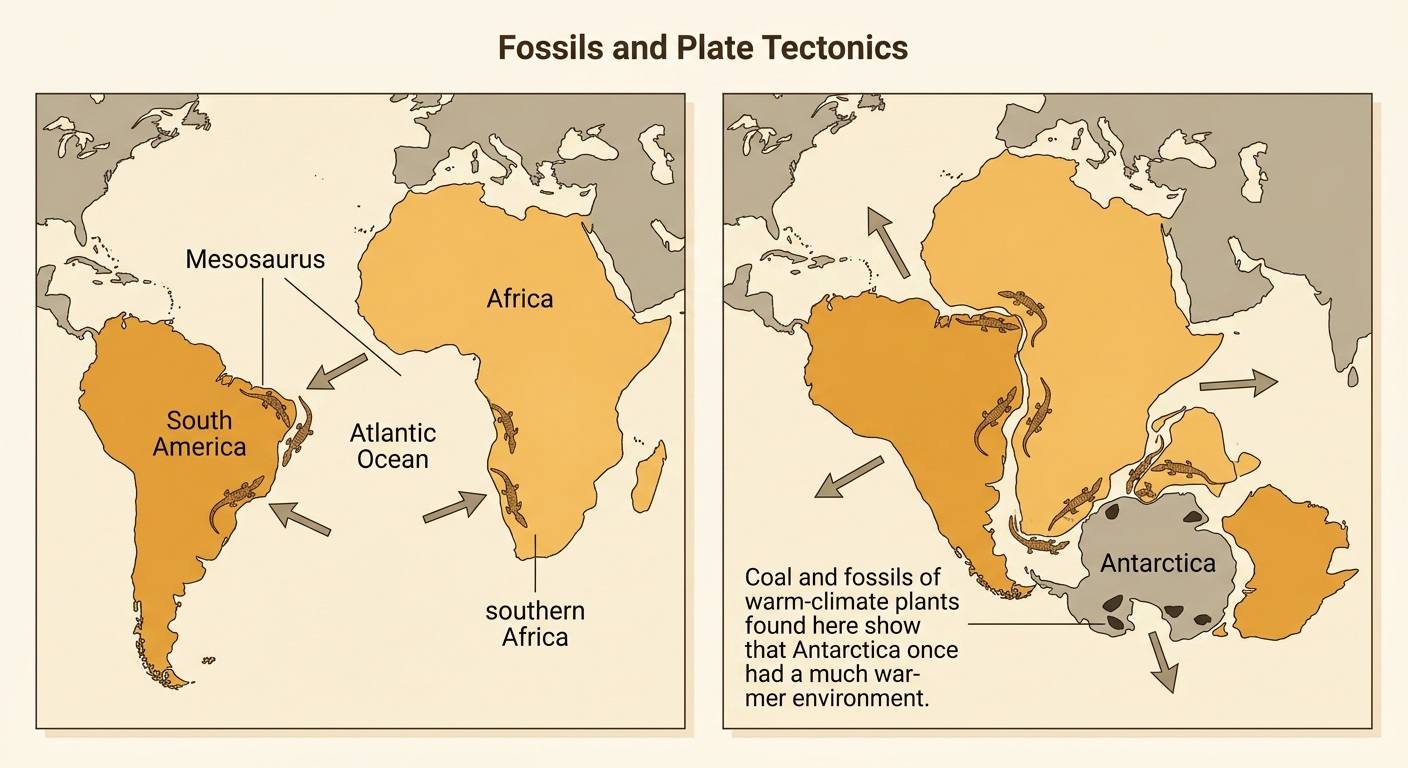
Maps show where fossils are found and help scientists connect locations with past environmental changes. Fossils of the same organism in regions now separated by oceans may indicate that the regions were once connected or that the organism could travel between them. For example, fossils of the land-dwelling reptile Mesosaurus have been found in both South America and southern Africa. Mesosaurus was unlikely to cross a wide saltwater ocean, so its distribution supports the idea that these continents were once joined. Fossil locations can also reveal climate change. Coal and fossils of warm-climate plants found in Antarctica indicate that the continent once had a much warmer environment. Scientists combine fossil maps with rock ages, rock types, and evidence of plate movement. A map shows geographic relationships, but several kinds of evidence are needed to explain them.
Drawing Evidence-Based Conclusions
An evidence-based conclusion states a claim, identifies relevant evidence, and explains how the evidence supports the claim. Suppose a text says that a region changed from a shallow sea to dry land. A rock-layer image shows marine shell fossils in lower layers, plant fossils in middle layers, and mammal footprints in upper layers. The fossil sequence supports the claim because the lower, older fossils represent marine life, while the upper, younger traces represent organisms living on land. Students should compare information from the text with images, maps, tables, simulations, or videos. If sources agree, they may strengthen the conclusion. If they differ, students should check dates, locations, sample sizes, and possible limits of each source. Strong conclusions avoid claiming more than the data show and may be revised when new evidence is discovered.
