Reading the Periodic Table: Atoms and Elements
Students use atomic numbers, chemical symbols, and atomic models to identify elements and explain how the periodic table organizes matter.

Illustrations are auto-generated and may be placeholders. They can be refreshed to match the narration.
What Is an Element?
An element is a pure substance made of only one kind of atom. Each element has a name, a chemical symbol, and a unique atomic number. For example, every atom of oxygen has 8 protons, so oxygen is element 8. Its chemical symbol is O. Elements cannot be broken into simpler substances by ordinary chemical reactions. However, atoms of different elements can join chemically to form compounds. Water is a compound made from hydrogen and oxygen atoms. Scientists have identified more than 100 elements and arranged them in the periodic table. Some elements, such as gold and oxygen, occur naturally as elements. Others are usually found combined with different elements in minerals, gases, or living things.

Anatomy of an Atom
An atom is the smallest unit of an element that keeps that element’s chemical properties. At its center is a tiny, dense nucleus containing protons and neutrons. Protons have a positive electric charge, neutrons have no charge, and electrons have a negative charge. Electrons occupy regions around the nucleus called electron clouds, which can be represented by energy levels in a simple model. A neutral atom has equal numbers of protons and electrons, so its positive and negative charges balance. For example, a neutral carbon atom has 6 protons and 6 electrons. A common carbon atom also has 6 neutrons. Most of an atom’s volume is the electron cloud, while nearly all of its mass is concentrated in the nucleus.

Reading an Element Square
Each square on the periodic table summarizes information about one element. Most element squares show the atomic number, chemical symbol, element name, and average atomic mass. Consider sodium. Its square lists atomic number 11, symbol Na, name sodium, and an average atomic mass of about 22.99 atomic mass units. The symbol may not always begin with the same letters as the English name because some symbols come from older names; Na comes from natrium. The atomic number is always a whole number because it counts protons. The average atomic mass is often a decimal because it reflects the weighted average of naturally occurring isotopes, which are atoms of the same element with different numbers of neutrons. Table designs vary, so use the labels or key provided with the table.

Using Atomic Number
The atomic number tells how many protons are in the nucleus of an atom. Because each element has a unique number of protons, the atomic number identifies the element. An atom with 1 proton is always hydrogen, and an atom with 8 protons is always oxygen. Changing the number of neutrons creates a different isotope, but it does not change the element. Changing the number of electrons creates a charged ion, but it also does not change the element. In a neutral atom, the number of electrons equals the atomic number. For example, atomic number 12 identifies magnesium. A neutral magnesium atom therefore has 12 protons and 12 electrons. Students can use this relationship to move between an abstract number in the periodic table and a physical model of an atom.

Building Simple Atomic Models
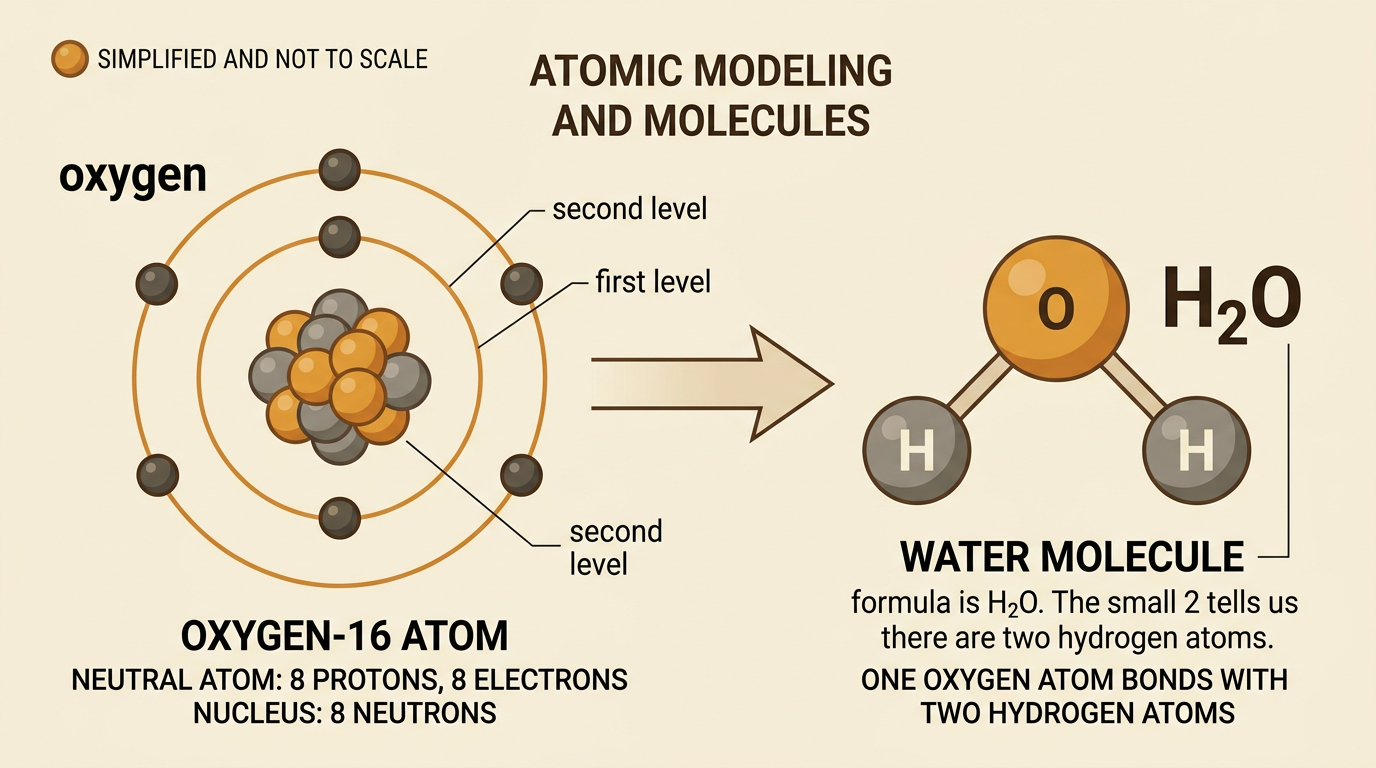
A model helps scientists represent parts of an atom that are too small to see directly. To build a simple model of a neutral atom, first use the periodic table to find its atomic number. That number gives both the proton count and, for a neutral atom, the electron count. For oxygen, atomic number 8 means 8 protons and 8 electrons. In a basic energy-level model, place 2 electrons in the first level and the remaining 6 in the second level. A common oxygen-16 model also includes 8 neutrons in the nucleus. Atomic models are useful but simplified: electrons do not travel in neat circular paths like planets. Models can also show molecules. In a water molecule, one oxygen atom is bonded to two hydrogen atoms, producing the formula H2O.
Elements as Global Resources
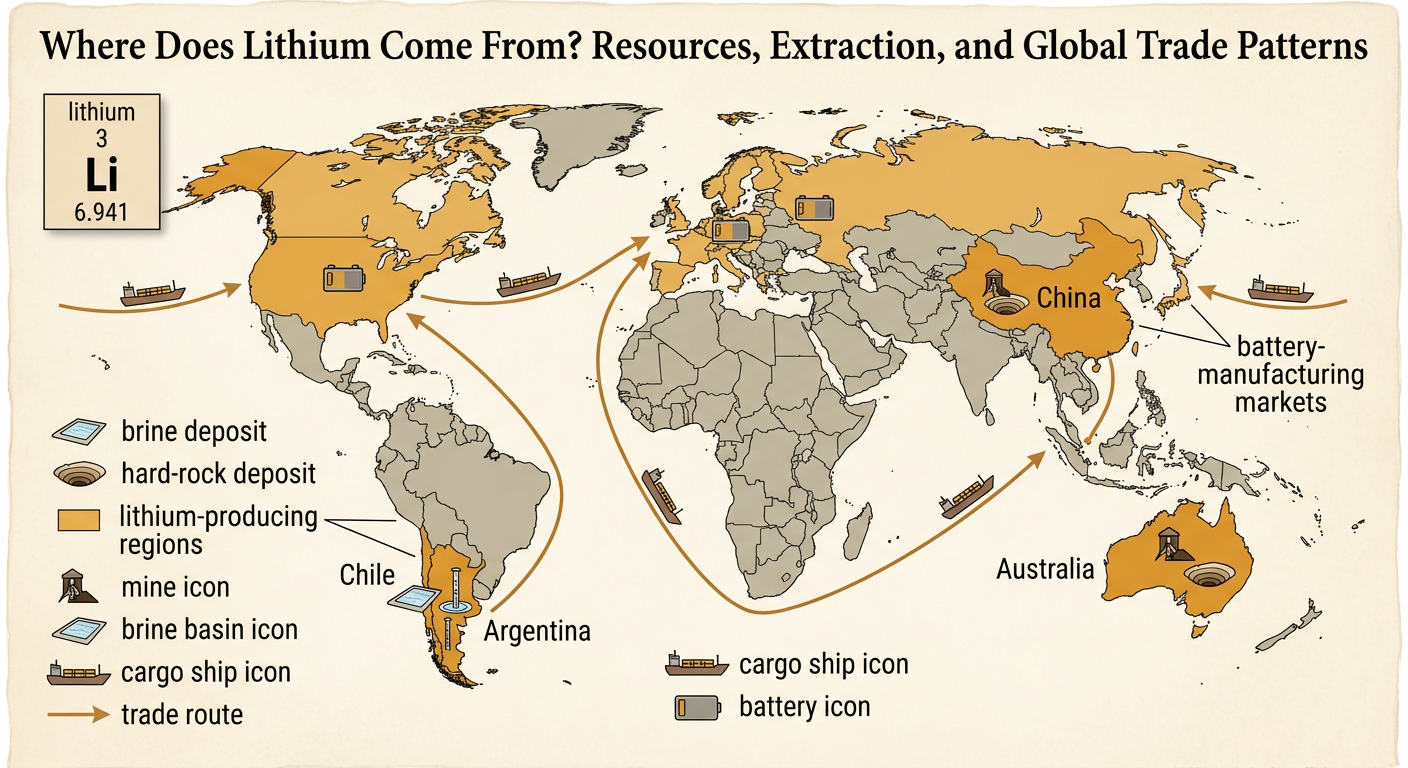
Elements are not distributed evenly across Earth, so their locations can influence production and world trade. Environmental characteristics such as rock type, past geologic activity, water access, and climate affect where useful deposits form and how easily they can be mined. Lithium, element 3, is used in many rechargeable batteries. Large lithium resources occur in mineral-rich brines and hard-rock deposits in particular regions. Countries with these resources may export lithium compounds, while countries that manufacture batteries may import them. The periodic table identifies lithium by its symbol, Li, and atomic number, but maps show where its resources and trade routes are located. Resource patterns can bring jobs and income, yet mining may also use water, change habitats, and create waste. Understanding both chemistry and geography helps people evaluate production choices and trade relationships.