
Reading, Writing, and Comparing Decimals to Thousandths
Students use place-value understanding to read, write, represent, and compare decimals through the thousandths place.
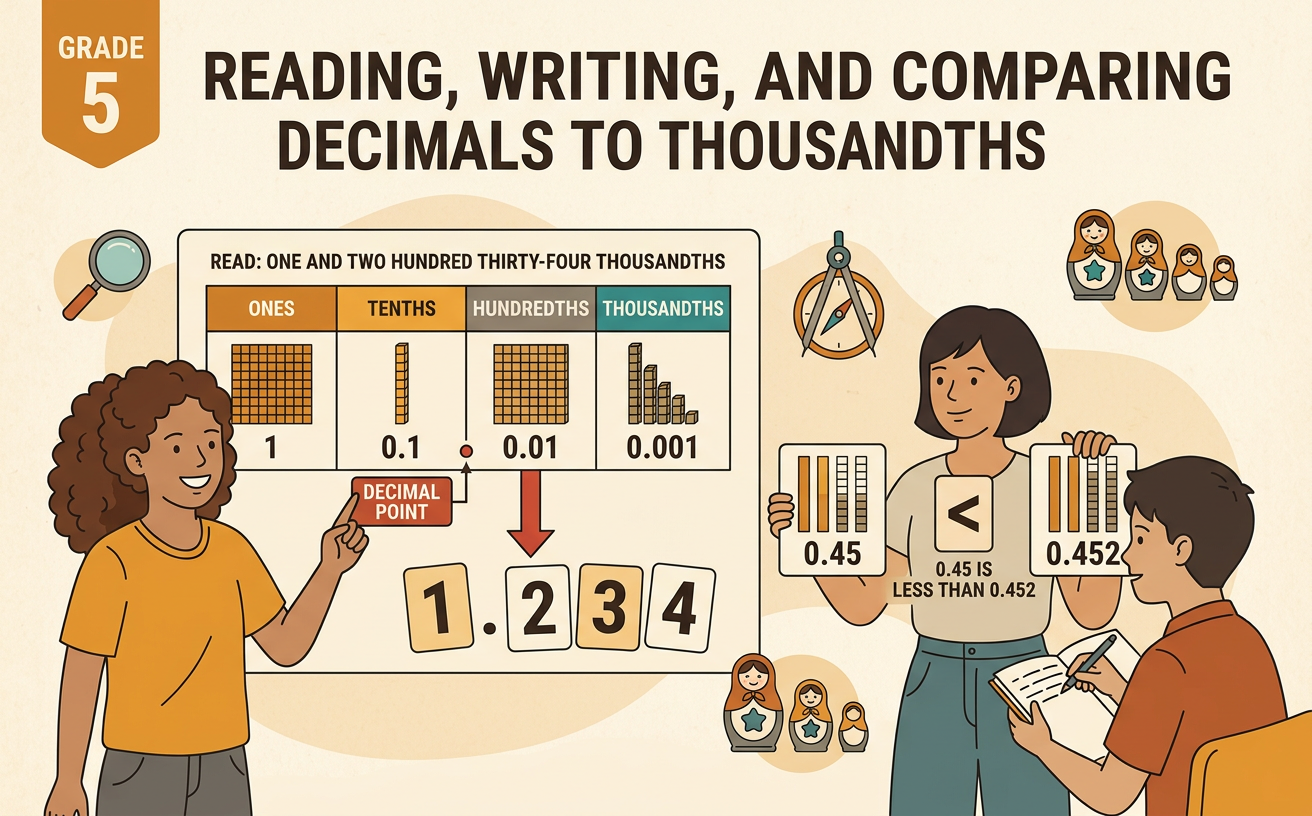
Illustrations are auto-generated and may be placeholders. They can be refreshed to match the narration.
Review Decimal Place Value
A decimal uses place value to show parts of one whole. The decimal point separates whole-number places from places smaller than one. Moving right from the decimal point, the first place is tenths, the second is hundredths, and the third is thousandths. In 4.372, the 4 means 4 ones, the 3 means 3 tenths, the 7 means 7 hundredths, and the 2 means 2 thousandths. Each place is ten times the value of the place to its right. A zero can hold a place even when that place has no value. For example, in 5.084, the zero shows that there are no tenths, while the 8 is in the hundredths place and the 4 is in the thousandths place.

Read and Write Decimals
Decimals can be written as base-ten numerals or number names. To read a decimal, read the whole-number part first, say “and” for the decimal point, and then name the decimal part according to its final place. The numeral 12.305 is read as “twelve and three hundred five thousandths.” The decimal part ends in the thousandths place, so its place-value name is thousandths. To write a decimal from words, place each digit in the correct column. “Seven and forty-two hundredths” is 7.42. It can also be written as 7.420 because adding a zero to the right of a decimal does not change its value. Be careful with placeholders: “nine and six thousandths” is 9.006, not 9.6.

Use Expanded Form
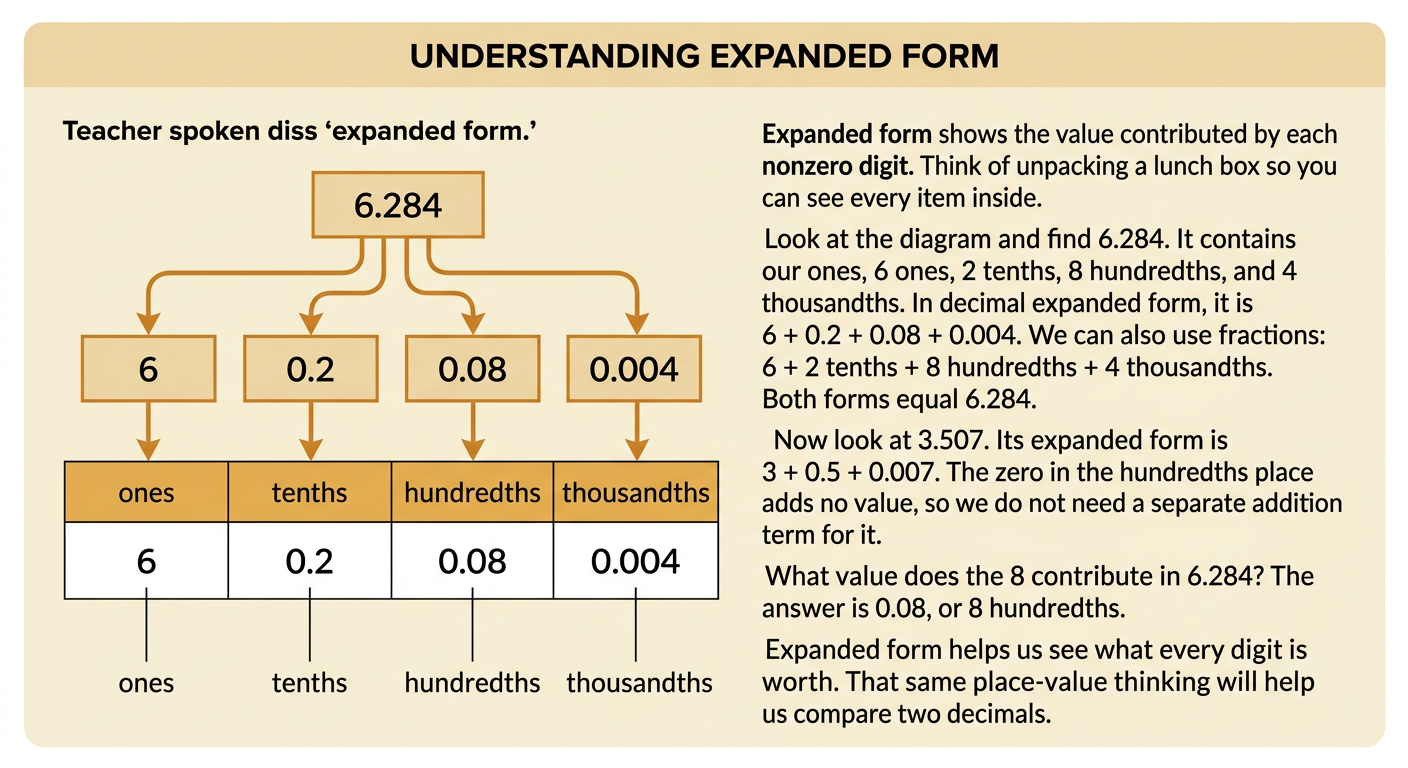
Expanded form shows the value contributed by every nonzero digit. To expand a decimal, multiply each digit by its place value or write each part as a decimal or fraction. For example, 6.284 has 6 ones, 2 tenths, 8 hundredths, and 4 thousandths. It can be written as 6 + 0.2 + 0.08 + 0.004. It can also be written as 6 + 2/10 + 8/100 + 4/1,000. Both forms have the same value as 6.284. Include zero placeholders when they help show position. For example, 3.507 equals 3 + 0.5 + 0.007 because the zero in the hundredths place adds no value. Expanded form makes the value of each digit easy to see.
Compare Decimals Digit by Digit
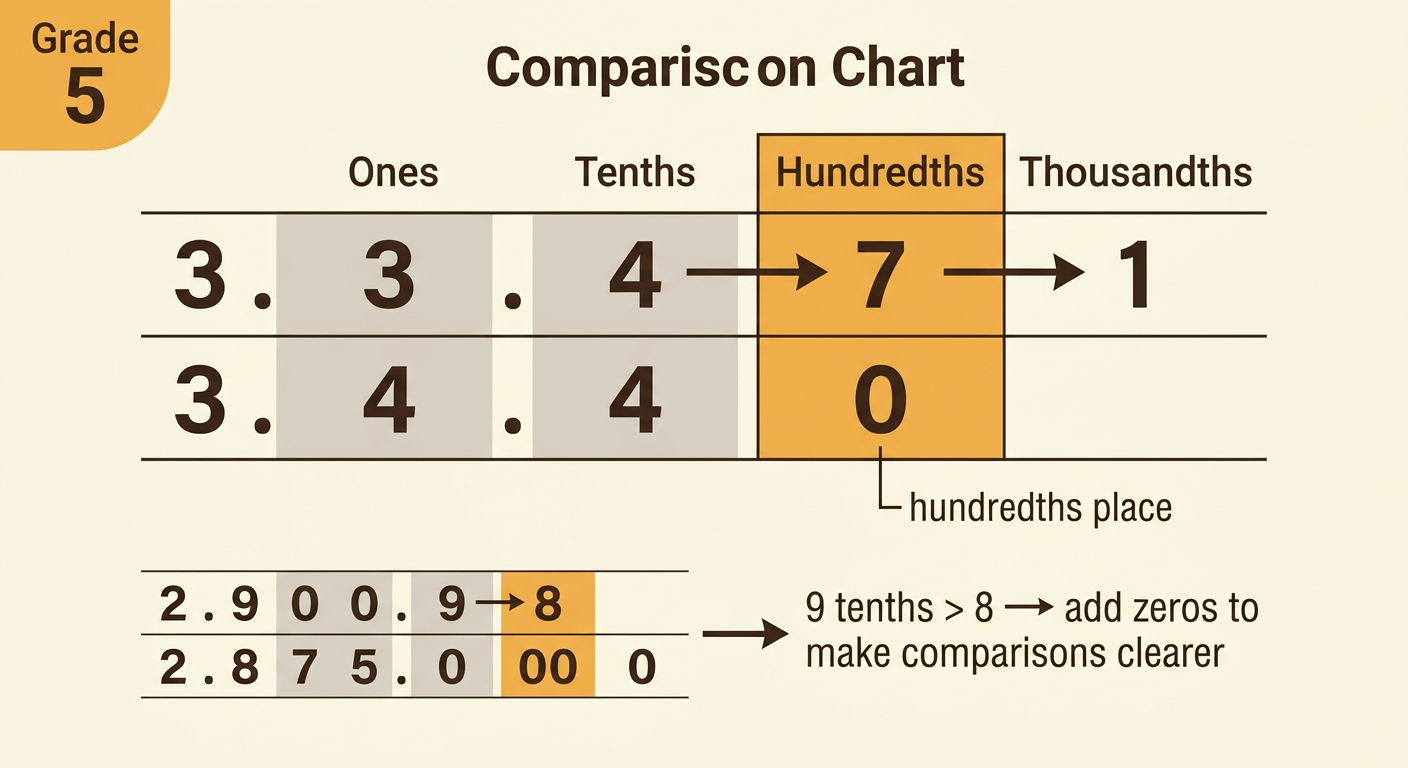
To compare decimals, line up their decimal points and compare digits from left to right. Begin with the greatest place value. The first place where the digits differ determines which number is greater. Compare 3.470 and 3.407. Both have 3 ones, so compare tenths. Both have 4 tenths, so compare hundredths. The first number has 7 hundredths, while the second has 0 hundredths. Because 7 hundredths is greater than 0 hundredths, 3.470 > 3.407. You may add zeros to the right so both decimals have the same number of places. For example, write 2.9 as 2.900 before comparing it with 2.875. Since 9 tenths is greater than 8 tenths, 2.900 > 2.875.
Practice with Comparison Symbols
Use > when the number on the left is greater, < when the number on the left is less, and = when both numbers have the same value. Think of the wide, open side of the comparison symbol as facing the greater number. Compare 0.625 and 0.652. The ones and tenths digits match, but the hundredths digits are different. Since 2 hundredths is less than 5 hundredths, 0.625 < 0.652. Now compare 4.8 and 4.800. Adding zeros to the right does not change a decimal’s value, so 4.8 = 4.800. Finally, 7.091 > 7.019 because the tenths digits match, but 9 hundredths is greater than 1 hundredth. Always compare place values, not just the number of digits.

Complete an Exit Check
Complete each item using what you learned. First, write 8.304 in words. Second, write “two and seventy-five thousandths” as a base-ten numeral. Third, write 5.619 in expanded form. Fourth, compare 6.408 and 6.48 using >, =, or <. Check your work after attempting every item. The answers are: 8.304 is “eight and three hundred four thousandths.” Two and seventy-five thousandths is 2.075 because the zero holds the tenths place. An expanded form of 5.619 is 5 + 0.6 + 0.01 + 0.009. For the comparison, rewrite 6.48 as 6.480. Both numbers have 6 ones and 4 tenths, but 0 hundredths is less than 8 hundredths. Therefore, 6.408 < 6.480.
