Reducing Urban Stormwater Runoff
Students analyze the relationship between impervious surface coverage and polluted runoff, then use evidence to recommend a community stormwater solution.
Illustrations are auto-generated and may be placeholders. They can be refreshed to match the narration.
How Urban Runoff Forms
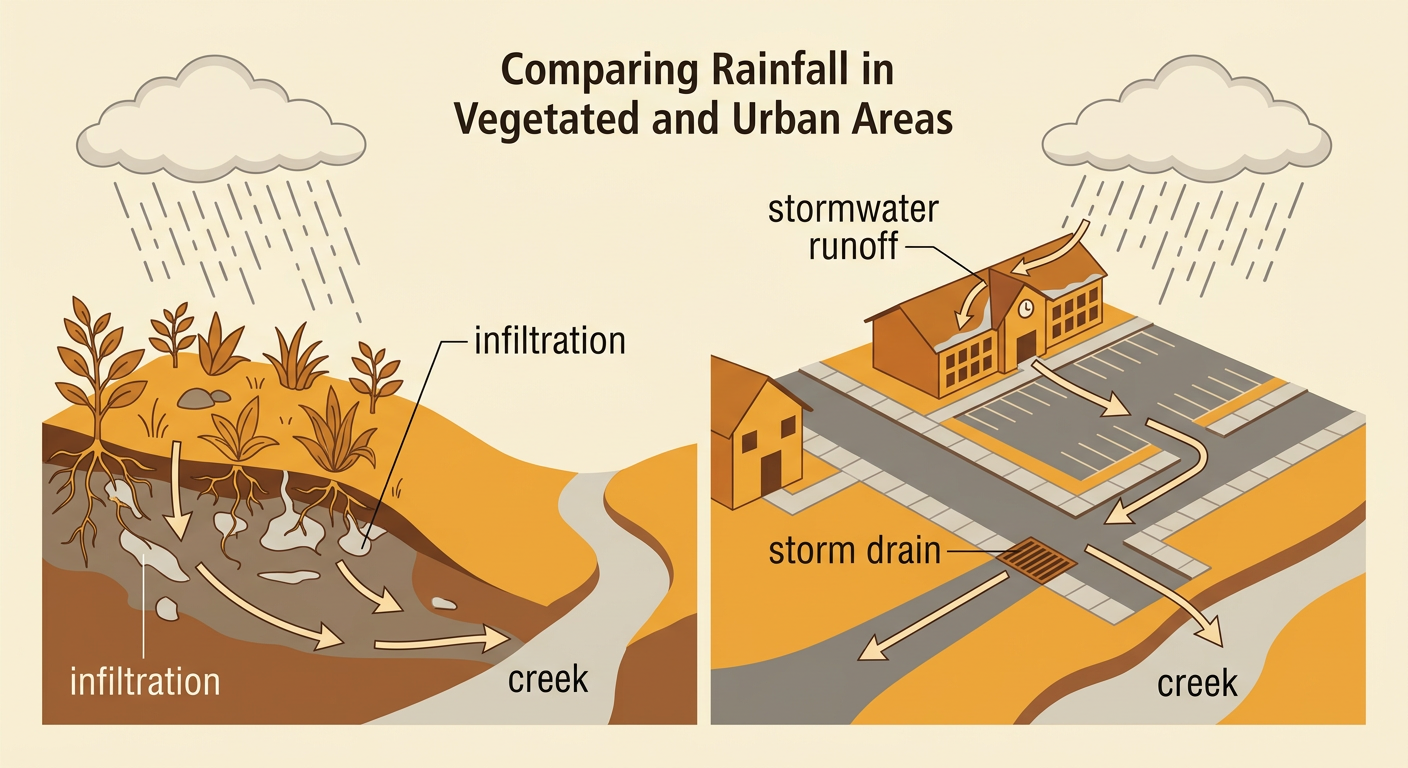
Stormwater runoff forms when rain or melting snow flows across land instead of soaking into soil. In a natural area, plants slow the water, roots create spaces for infiltration, and soil stores some water. In a city, roofs, streets, sidewalks, and parking lots block infiltration. Water moves quickly across these surfaces and enters storm drains, which often discharge into nearby streams without treatment. For example, during a heavy storm, rain falling on a school parking lot may flow to a curb, enter a storm drain, and reach a creek within minutes. The fast-moving water can increase stream erosion and raise flood risk. Urban development does not create more rain, but it changes where the water goes, how quickly it travels, and how much becomes surface runoff.
Impervious Surfaces and Pollutant Transport
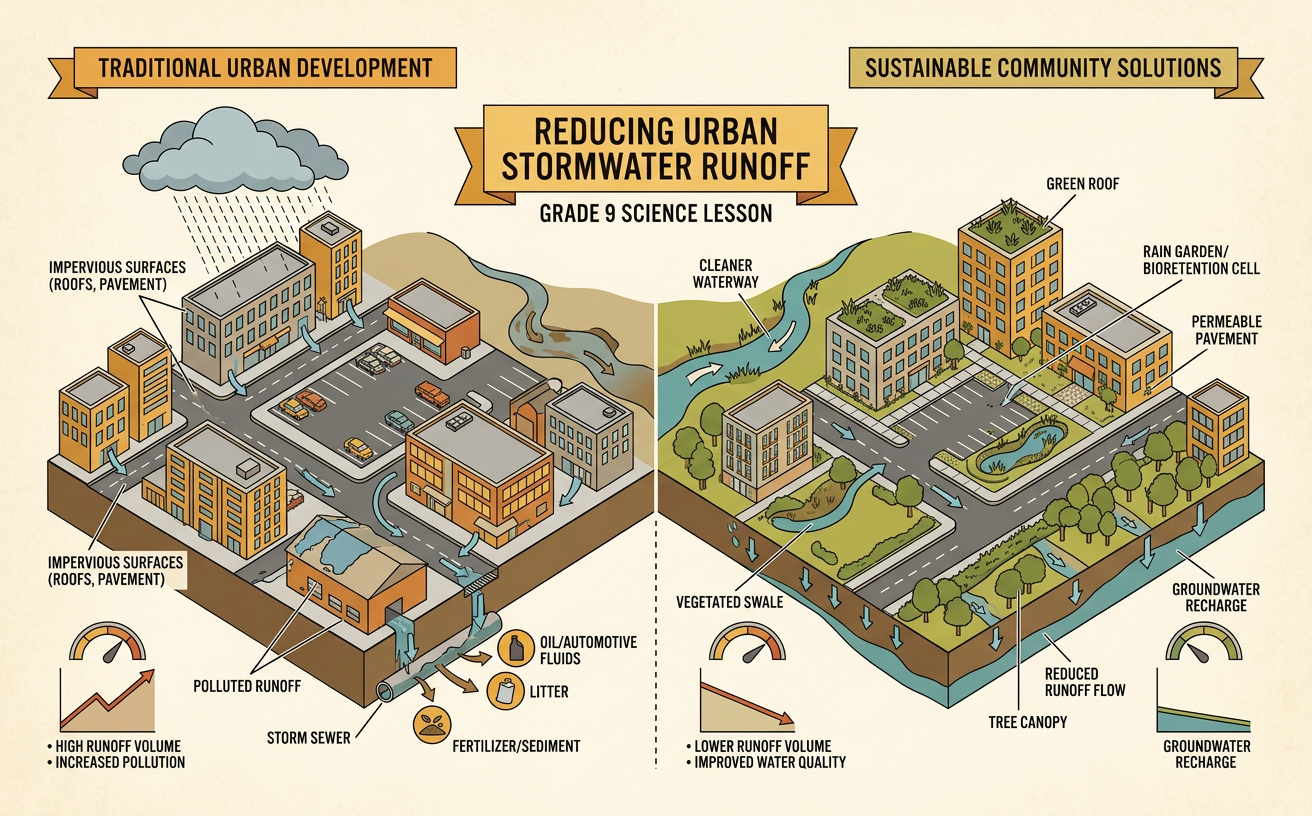
Impervious surfaces are materials that allow little or no water to pass through them. Asphalt, concrete, and most rooftops are common examples. As runoff travels over these surfaces, it can pick up motor oil, tire particles, road salt, fertilizers, pet waste, sediment, and litter. Storm drains then transport this mixture to rivers, lakes, or coastal waters. For example, oil that drips onto a shopping center parking lot may remain there until rain washes it into a drain. Nitrogen and phosphorus from lawn fertilizer can contribute to excessive algae growth, while bacteria from pet waste can make water unsafe for recreation. Communities with more impervious surface usually produce greater runoff volumes, creating more opportunities for pollutants to be transported. However, pollutant levels also depend on land use, maintenance, rainfall intensity, and pollution sources.

Analyzing Runoff Data
Paired quantitative data can reveal how impervious surface coverage relates to runoff. Consider five neighborhoods measured during similar storms. Impervious coverage values of 10%, 30%, 50%, 70%, and 90% correspond to runoff values of 12%, 28%, 47%, 66%, and 83% of rainfall. Plot each pair on a scatterplot, with impervious coverage on the horizontal axis and runoff percentage on the vertical axis. The points form a strong positive, nearly linear association: as impervious coverage increases, runoff also increases. A line of best fit can summarize the pattern and help estimate runoff for an unmeasured neighborhood. For example, a neighborhood with 60% impervious coverage would be expected to produce about 56% runoff. The data support the explanation that impervious surfaces increase runoff, but they do not prove that coverage is the only cause.

Comparing Stormwater Solutions
Stormwater solutions should be compared using evidence and community criteria. Rain gardens collect runoff and allow it to soak through planted soil. Permeable pavement lets water pass through openings into a stone layer below. Green roofs absorb some rainfall on buildings, while detention basins temporarily store water and release it slowly. Each solution has tradeoffs involving cost, space, maintenance, climate, and pollutant removal. For example, a school with a large parking lot but little unused land might replace selected parking spaces with permeable pavement. A rain garden may cost less and support wildlife, but it requires suitable soil and regular plant care. A detention basin can reduce peak flow from a large area, but it needs substantial space. A fair evaluation uses the same measures, such as runoff volume reduced, pollutants removed, installation cost, and long-term maintenance needs.

Making an Evidence-Based Recommendation
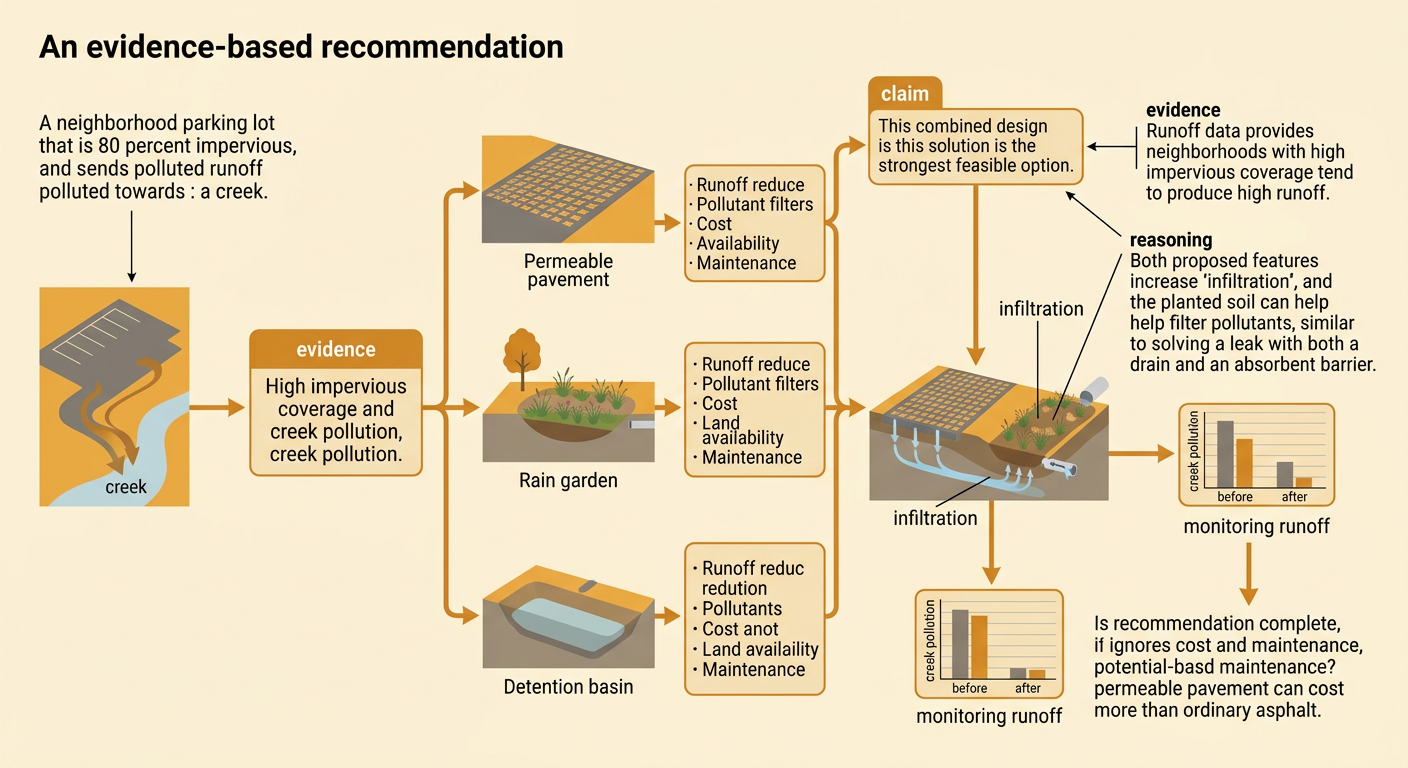
An evidence-based recommendation states a claim, supports it with relevant data, explains the reasoning, and acknowledges limitations and competing claims. Suppose a neighborhood parking lot is 80% impervious and sends polluted runoff toward a creek. A student team might recommend permeable pavement in frequently flooded sections plus a rain garden near the outlet. The runoff data show that high impervious coverage is associated with high runoff, while design evidence indicates that both solutions increase infiltration and can filter pollutants. The team should also address concerns: permeable pavement costs more than ordinary asphalt, rain gardens require maintenance, and neither solution prevents all runoff during extreme storms. A competing proposal for a detention basin might store more water, but available land may be insufficient. The final argument should identify the strongest feasible option, explain why alternatives are less suitable, and recommend monitoring runoff before and after construction.