
Relating Division to Multiplication
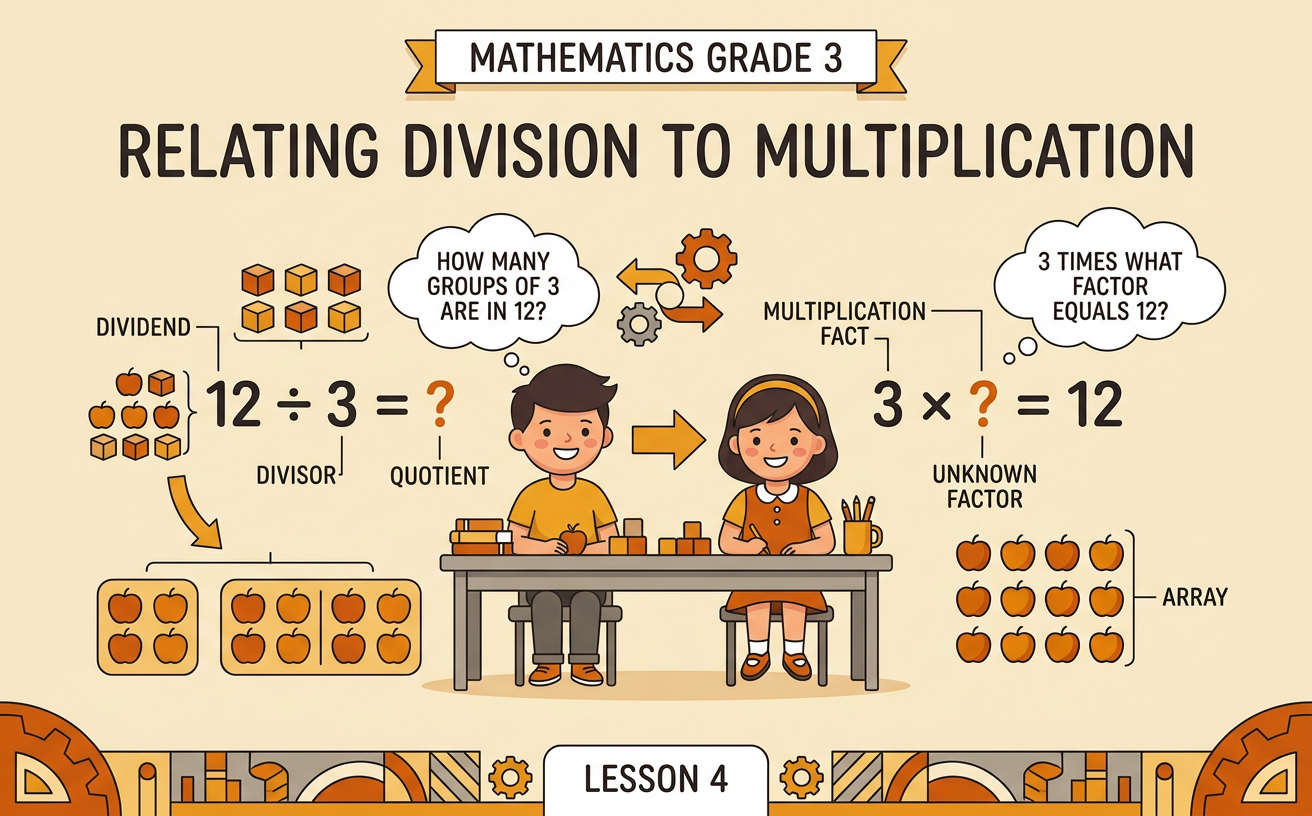
Students use multiplication facts to solve division problems by finding the unknown factor in a related multiplication equation.
Illustrations are auto-generated and may be placeholders. They can be refreshed to match the narration.
Review Related Operations
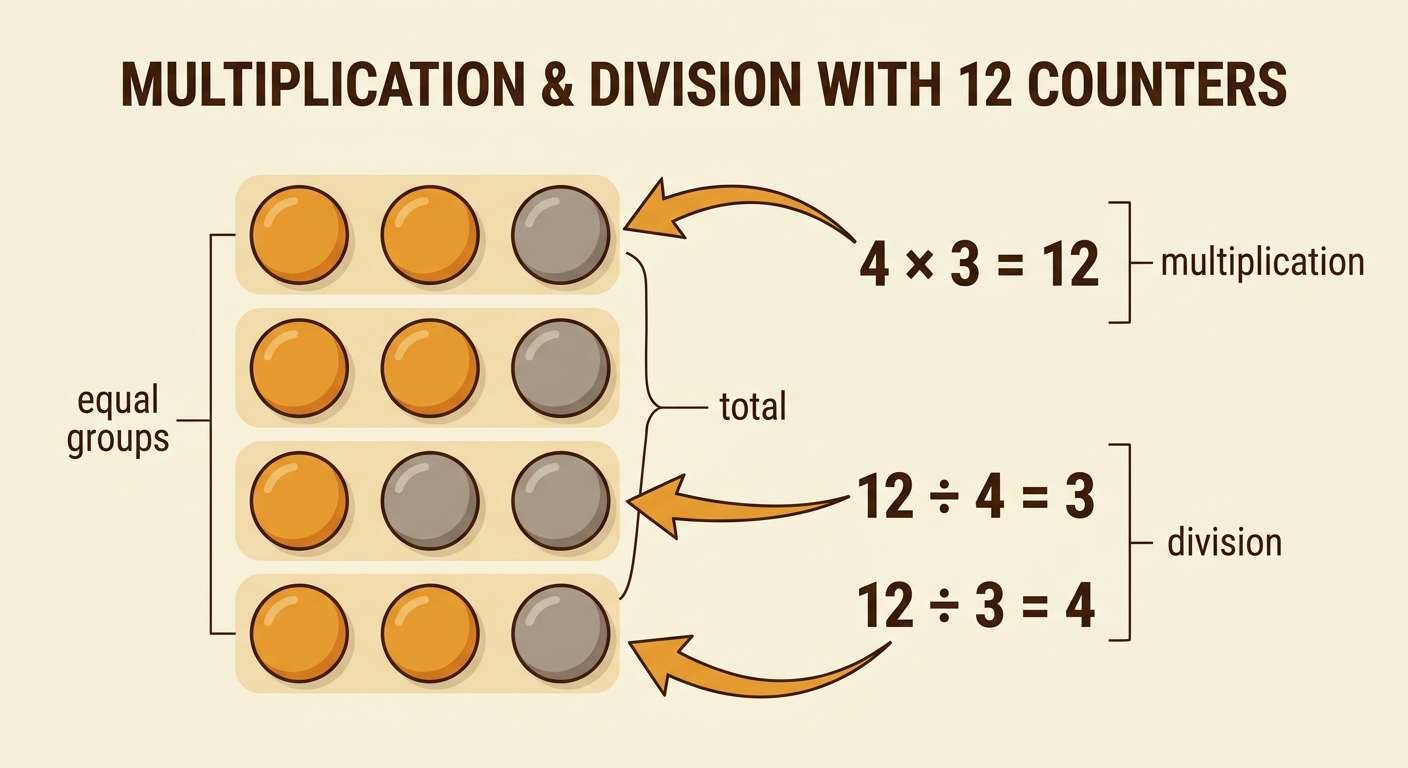
Multiplication joins equal groups to find a total. Division starts with a total and separates it into equal groups or finds how many equal groups can be made. Because these operations undo each other, they are called related operations. Suppose 12 counters are arranged in 4 equal groups with 3 counters in each group. The multiplication equation is 4 × 3 = 12. If the 12 counters are divided into 4 equal groups, each group has 3 counters, so 12 ÷ 4 = 3. If groups of 3 are made instead, there are 4 groups, so 12 ÷ 3 = 4. Each equation describes the same counters in a different way.
Build Fact Families
A fact family is a group of multiplication and division equations that use the same three numbers. Begin with 5, 6, and 30. Since 5 groups of 6 make 30, you can write 5 × 6 = 30. You can switch the factors and write 6 × 5 = 30. Then use the total, 30, to write two division equations: 30 ÷ 5 = 6 and 30 ÷ 6 = 5. These four equations form one fact family. Building fact families helps you remember that a division fact can be solved with a multiplication fact you already know. Always check that both multiplication equations have the same product and both division equations begin with that product.

Rewrite Division as Multiplication
You can rewrite a division equation as a multiplication equation with an unknown factor. Consider 28 ÷ 7 = ?. Ask, “Seven times what number equals 28?” Then write 7 × ? = 28. The divisor, 7, becomes a known factor. The quotient becomes the unknown factor, and 28 stays the total or product. Think of 28 objects separated into groups of 7. The unknown tells how many groups there are. Since 7 × 4 = 28, the missing factor is 4. Therefore, 28 ÷ 7 = 4. Rewriting division this way lets you use familiar multiplication facts instead of trying to divide without a plan.

Find the Unknown Factor
To solve a division problem, identify the total and the known factor. Then use multiplication facts to find the unknown factor. For 32 ÷ 8 = ?, rewrite the problem as 8 × ? = 32. Think through the multiples of 8: 8, 16, 24, 32. It takes 4 groups of 8 to reach 32, so the unknown factor is 4. This means 32 ÷ 8 = 4. Check the answer by multiplying the divisor and quotient: 8 × 4 = 32. The product matches the original total, so the answer is correct. You may use an array, equal groups, skip-counting, or a multiplication fact you remember to find the missing factor.

Practice and Explain
Solve each division problem by turning it into an unknown-factor multiplication equation. For 18 ÷ 3 = ?, ask, “Three times what equals 18?” Write 3 × ? = 18. Since 3 × 6 = 18, the quotient is 6. Next, try 35 ÷ 5 = ?. Rewrite it as 5 × ? = 35. Because 5 × 7 = 35, the quotient is 7. When you explain your thinking, name the related multiplication fact and show how it proves your answer. You might say, “I know 18 ÷ 3 = 6 because 3 groups of 6 make 18.” A clear explanation includes the division equation, the related multiplication equation, and a check that the product equals the total.
