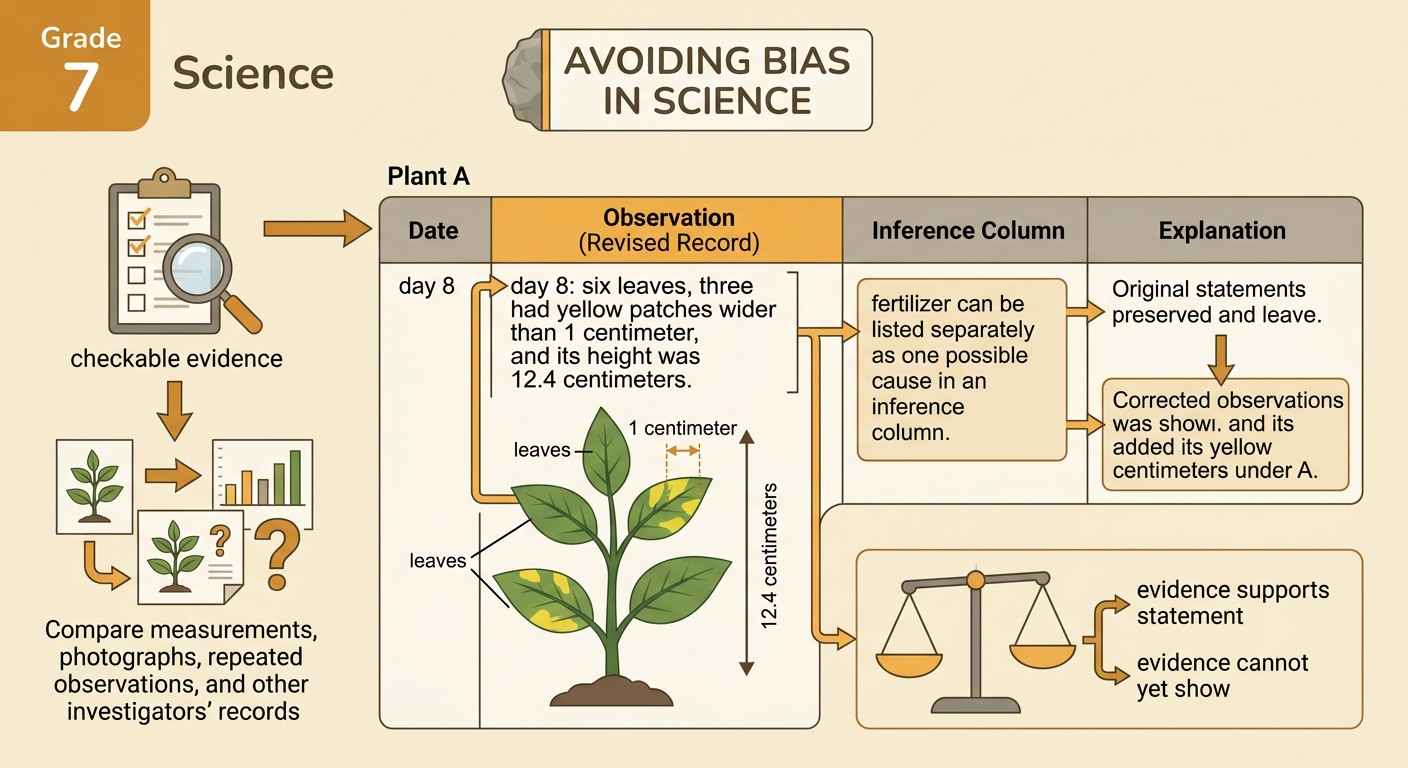
Reliable Observations: Separating Evidence from Inference
Students practice recording objective qualitative and quantitative observations, distinguishing observations from inferences, and using consistent protocols and repeated observations to improve reliability.
Illustrations are auto-generated and may be placeholders. They can be refreshed to match the narration.
Observation Versus Inference
An observation is information gathered directly with senses or tools. An inference is an explanation or conclusion built from observations and prior knowledge. Keep the two separate so another person can evaluate the evidence. Suppose you examine a sealed cup containing an ice cube. “The cube is 2.5 centimeters wide” and “liquid water covers the bottom of the cup” are observations. “The ice is melting because the room is warm” is an inference. That explanation may be reasonable, but the room temperature and cause of melting were not established by the two observations alone. Record what happened first. Then place possible explanations in a separate inference or conclusion column. Evidence can support an inference, but it does not automatically prove that only one explanation is correct.

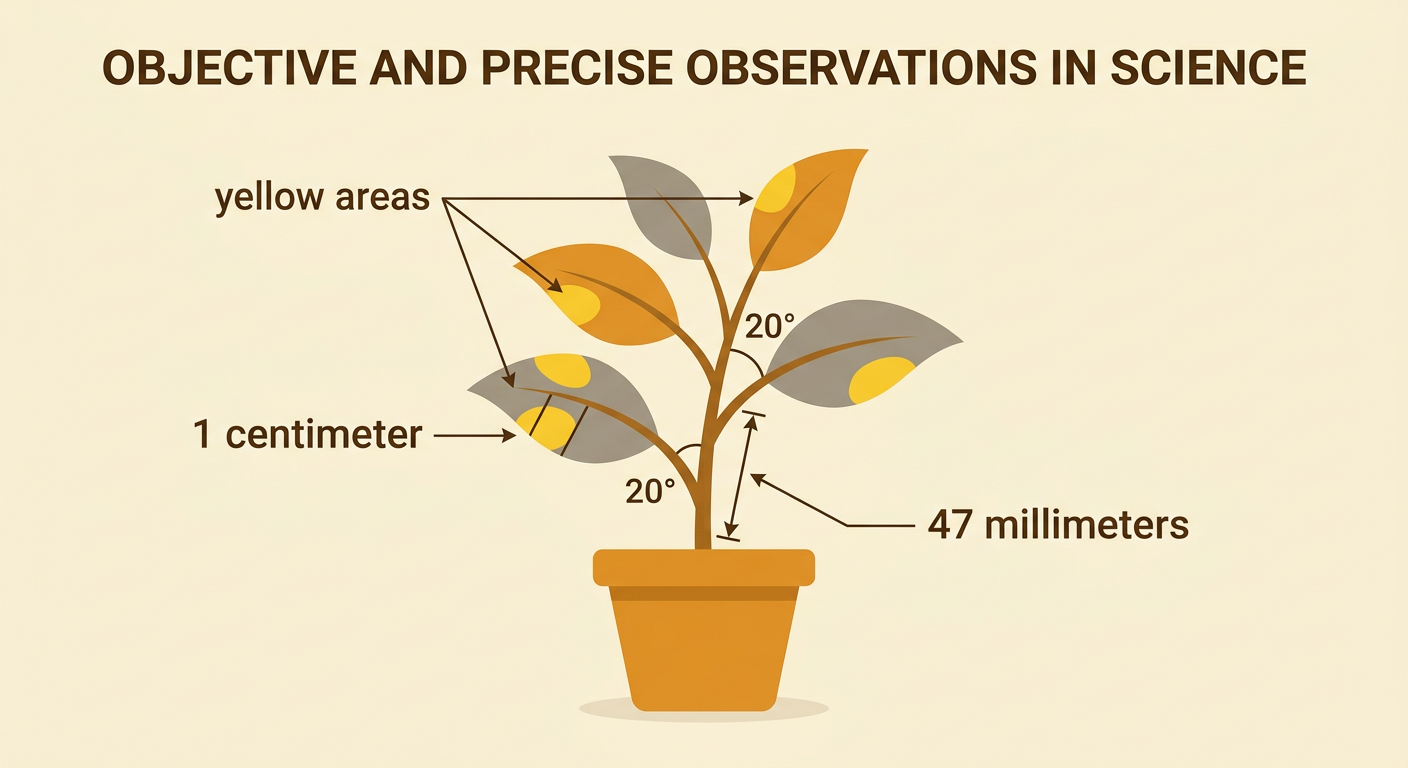
Objective and Precise Language
Objective language describes features that another observer can check. Precise language gives specific details instead of vague judgments. Avoid words such as “nice,” “bad,” “normal,” or “weird” because they depend on personal opinions or unstated expectations. For example, “The plant looks unhealthy” is subjective and imprecise. A stronger record states, “Three of the plant’s six leaves have yellow areas wider than 1 centimeter, and the stem is bent about 20 degrees from vertical.” Name the object, feature, measurement, unit, time, and conditions when they matter. Use instruments correctly and report only the precision they can measure. If a ruler is marked in millimeters, a leaf might be recorded as 47 millimeters long, not 47.328 millimeters. Precise wording allows other investigators to repeat and evaluate the observation.
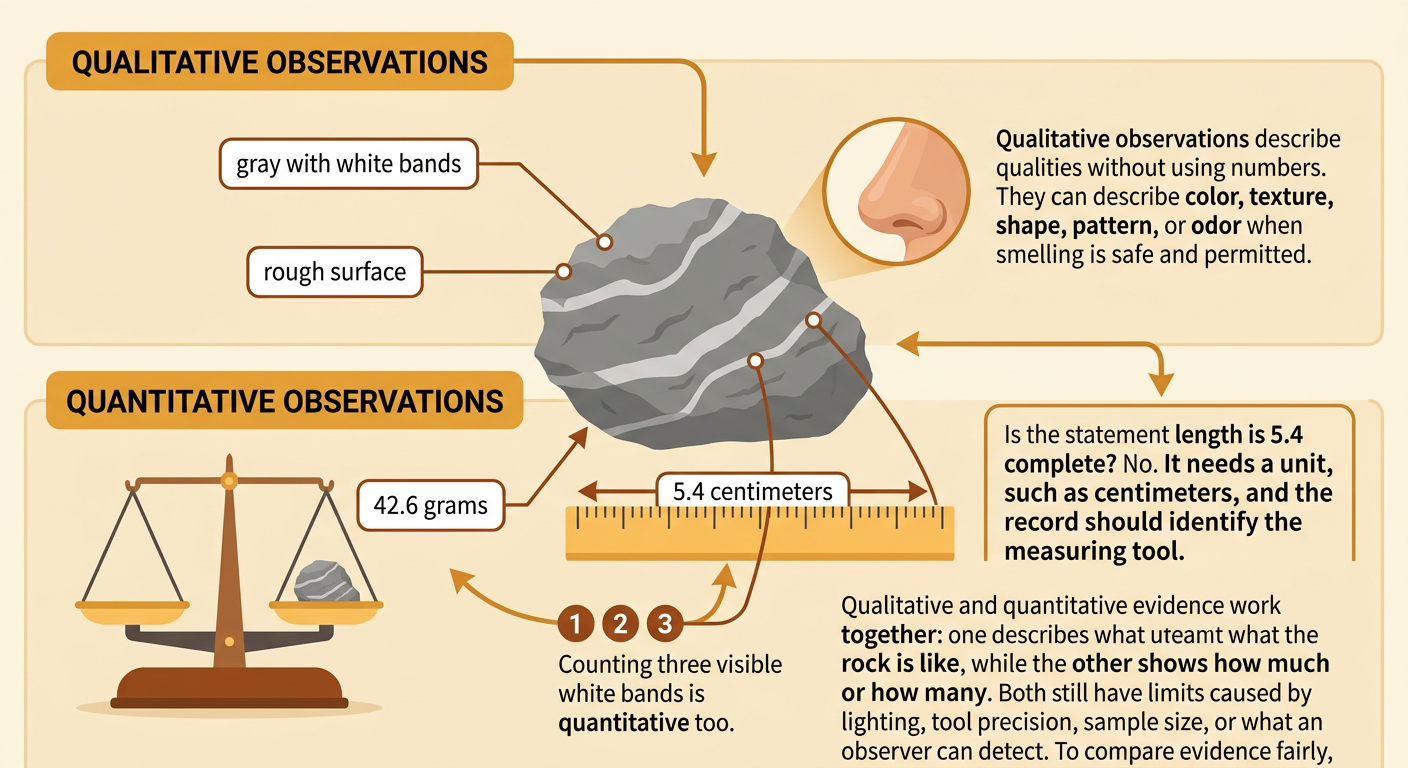
Qualitative and Quantitative Evidence
Qualitative observations describe qualities without expressing them as numbers, such as color, texture, shape, pattern, or odor when smelling is safe and permitted. Quantitative observations use numbers, measurements, counts, or times. Both types can provide useful evidence. For a rock sample, “gray with white bands” and “rough surface” are qualitative observations. “Mass: 42.6 grams,” “length: 5.4 centimeters,” and “three visible white bands” are quantitative observations. Always include appropriate units with measurements and identify the tool used. A number without a unit, such as “the length is 5.4,” is incomplete. Combining evidence types gives a fuller record than either type alone. However, descriptions and measurements still have limitations based on lighting, instrument precision, sample size, and the observer’s ability to detect a feature.
Using a Consistent Observation Protocol
An observation protocol is a fixed sequence of steps for collecting and recording evidence. Using the same materials, timing, tools, and measurement method helps make data comparable. For an investigation of cooling water with ice, a protocol might direct students to measure 100 milliliters of water, record its starting temperature, add 20.0 grams of ice, start a timer immediately, and record temperature every minute for 10 minutes. The thermometer bulb should stay in the water without touching the container’s bottom or sides. Each trial should use the same container and procedure. Complete at least three trials and record every result, including unexpected values. Changing the amount of ice or taking readings at different times would make comparisons less reliable. A written checklist helps investigators follow the multistep procedure precisely and identify any departures from the planned method.

Comparing Observers and Checking Reliability
Reliable data are consistent when an observation or measurement is repeated under the same conditions. Two observers can check reliability by recording independently and then comparing results. Imagine that students count oxygen bubbles released by an aquatic plant during one minute. Across three trials, Observer A counts 18, 21, and 19 bubbles, while Observer B counts 20, 20, and 19. Their results are close, but the difference in early trials suggests a possible limitation: two touching bubbles may be counted as one or two. The group should agree on a counting rule, repeat the trials, and, if possible, check a video recording. Close agreement improves confidence, but it does not prove accuracy; both observers could make the same mistake. Report disagreements, viewing difficulties, and instrument limits rather than hiding them.

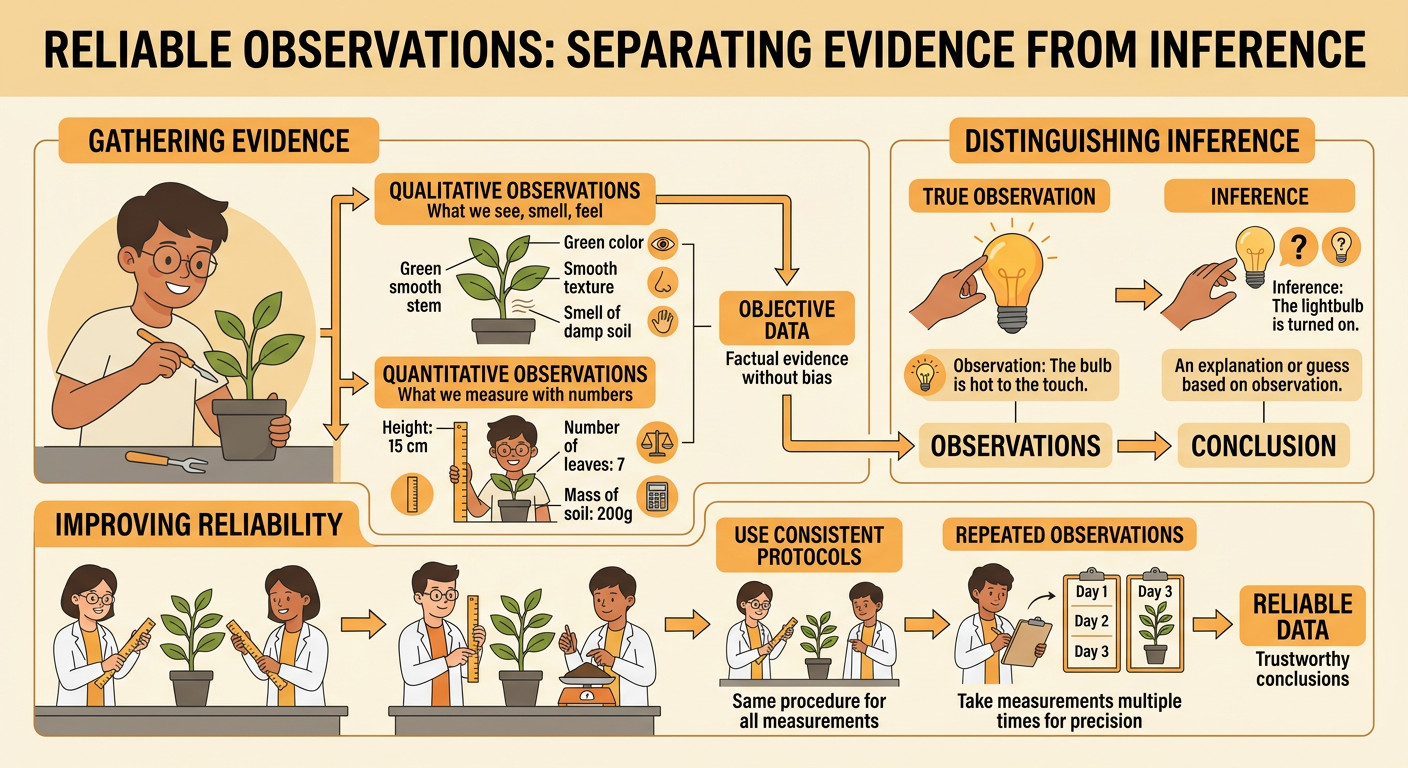
Revising Records to Reduce Bias
Bias can enter a record when expectations or opinions shape what an observer notices or writes. Revise biased statements by replacing judgments with checkable evidence, but preserve the original entry and note the correction. For example, “Fertilizer harmed Plant A, so it looks sick” assumes both a cause and a judgment. A revised record could state, “On day 8, Plant A had six leaves; three had yellow patches wider than 1 centimeter, and its height was 12.4 centimeters.” In a separate inference column, the student may write that fertilizer is one possible cause. However, one plant cannot establish that cause because water, light, pests, or natural variation could also affect its condition. Compare measurements, photographs, repeated observations, and records from other investigators. State what the evidence supports and what it cannot yet show.