
Repeat That! Code a Loop Dance
Students identify repeating movement patterns and use a repeat command to create a shorter, clearer program for a partner to perform.

Illustrations are auto-generated and may be placeholders. They can be refreshed to match the narration.
Spot the Repeating Pattern
A pattern is something that happens in the same order again and again. Look for a small group of movements that repeats. Imagine this dance: clap, stomp, clap, stomp, clap, stomp. The group “clap, stomp” appears three times. That group is the repeating part, or pattern unit. We can say, “Repeat clap, stomp three times.” Finding the pattern helps us describe the dance without naming every move. Try another dance: jump, turn, jump, turn. What repeats? “Jump, turn” repeats two times. Point to each complete group as you count. Be careful to keep the movements in the same order. If the order changes to turn, jump, it is a different pattern.

Act Out Movement Commands
A command tells a dancer to do one action. Movement commands can include clap, stomp, jump, turn, or freeze. Listen to one command at a time and do it safely. For example, follow these commands: clap, clap, turn, freeze. Perform them from left to right, just as you read words across a page. Each command must be clear so your partner knows what to do. A turn can mean one slow turn in place. A jump can mean one small jump with both feet. Ask questions if a command is not clear. Give everyone enough space, keep your hands to yourself, and wait for your turn. Careful listening and kind behavior help the whole group dance safely.

Build a Long Dance Program
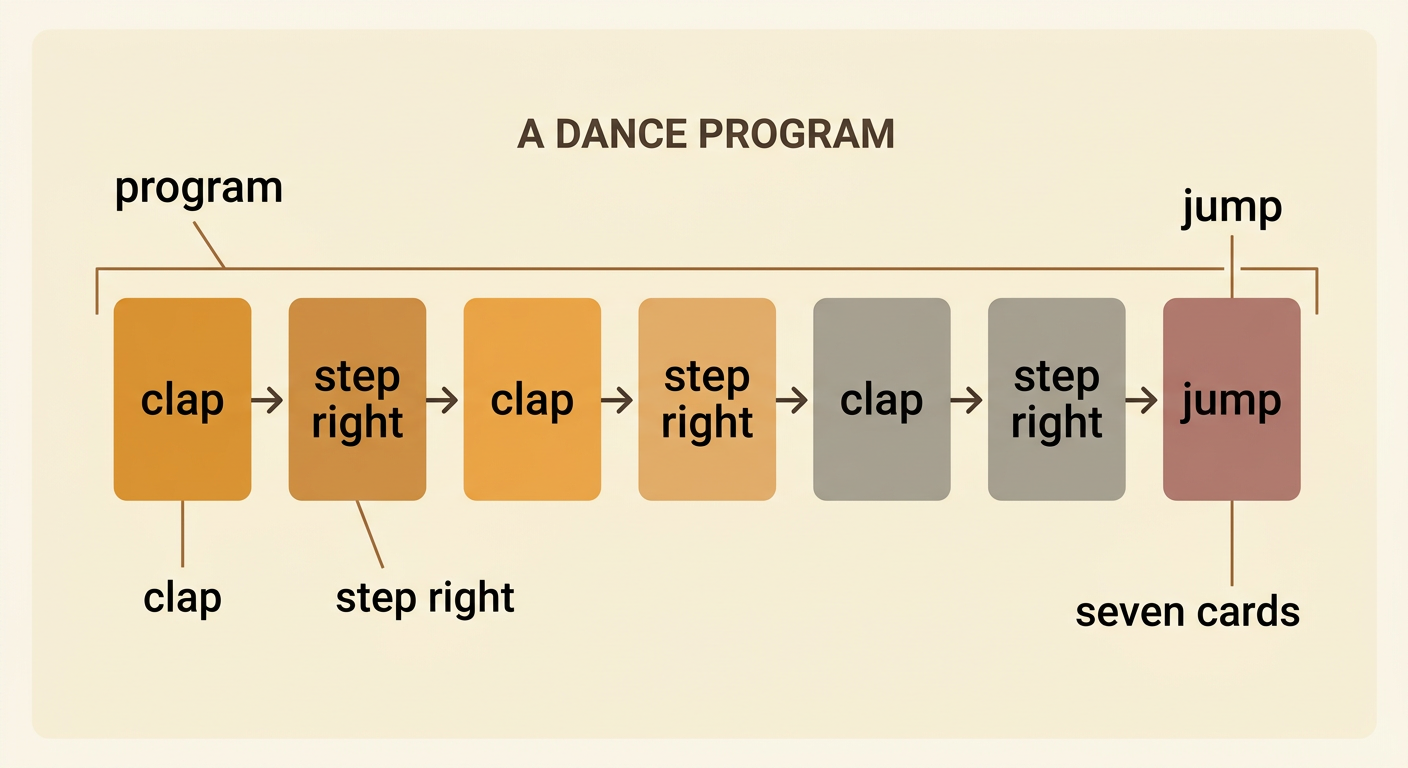
A program is an ordered list of commands. It tells a dancer exactly what to do. Build a program with command cards and place them from left to right. Try this dance: clap, step right, clap, step right, clap, step right, jump. Test the program by acting out every card. You may notice that “clap, step right” appears three times before the final jump. The long program works, but it uses many cards. Count the cards: there are seven. Check that no move is missing and that the order stays the same. If the dancer gets confused, ask what part was hard to follow. Your observations will help you find a way to make the program shorter and clearer.
Replace Repeated Steps with a Loop
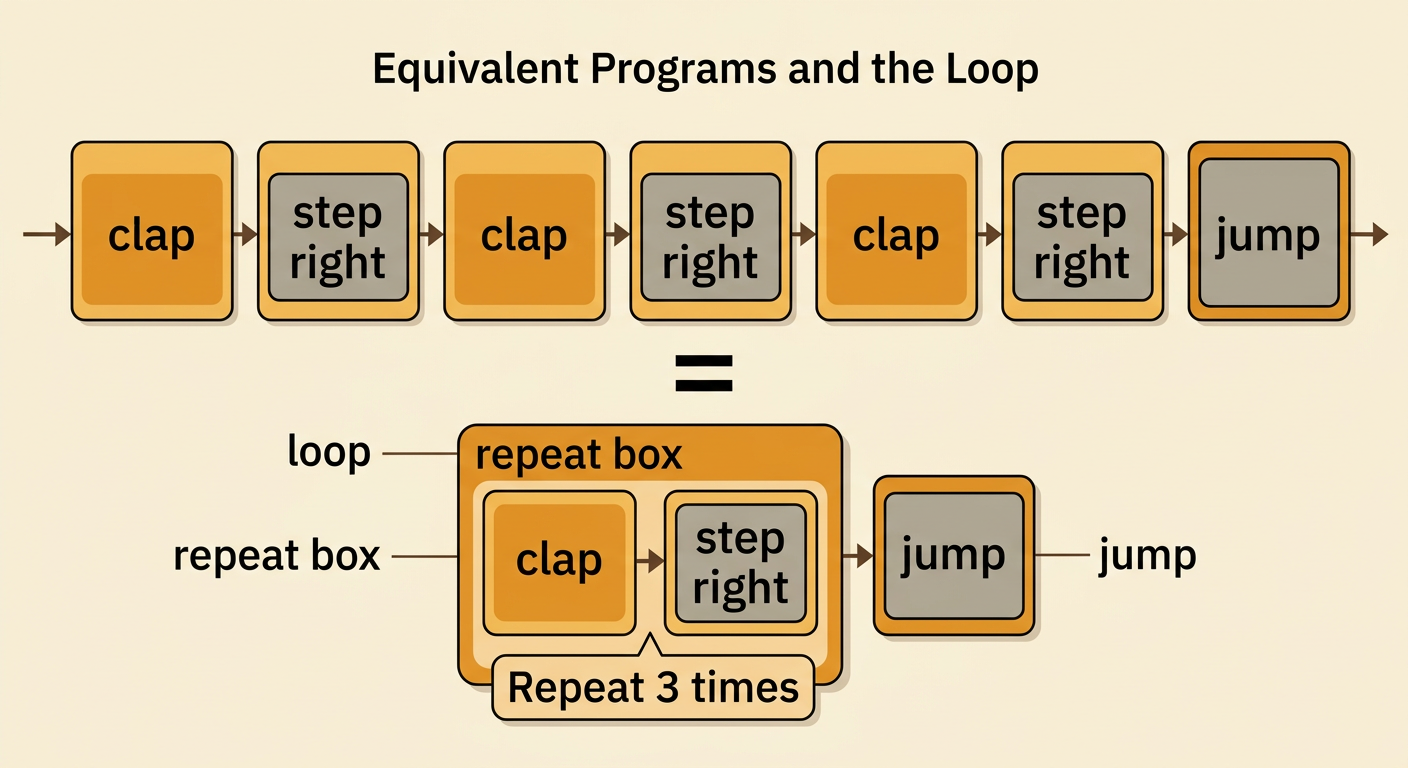
A loop is a command that repeats one or more steps. It can make a program shorter and easier to read. In the long dance, “clap, step right” appears three times. Put those two commands inside a repeat box and write “Repeat 3 times.” Then place “jump” after the box. The shorter program means: clap, step right, clap, step right, clap, step right, jump. It makes the same dance as the seven-card program, but it uses fewer instructions. The number on the repeat command matters. If it says two times, the dancer will do only two clap-step groups. Check the repeating group, count how many times it appears, and choose the correct repeat number.
Partner-Test and Improve
Work with a partner to test your loop dance. One person is the coder and points to the commands. The other person is the dancer and follows them. For example, test “Repeat two times: stomp, clap. Then freeze.” The dancer should do stomp, clap, stomp, clap, freeze. Watch closely and gather information. Did the dancer repeat the correct steps? Was the repeat number clear? Did the final move happen after the loop? If something goes wrong, talk kindly about the program, not the person. You might change the number, move a card, or explain a command more clearly. Then test again. Switch roles so both partners get a turn. Listening, sharing, and encouraging your partner are fair and helpful ways to work together.
