
Resource Availability and Population Change
Students analyze ecosystem data to explain how changes in food, water, and habitat affect organism populations and competition.

Illustrations are auto-generated and may be placeholders. They can be refreshed to match the narration.
Ecosystem Resources
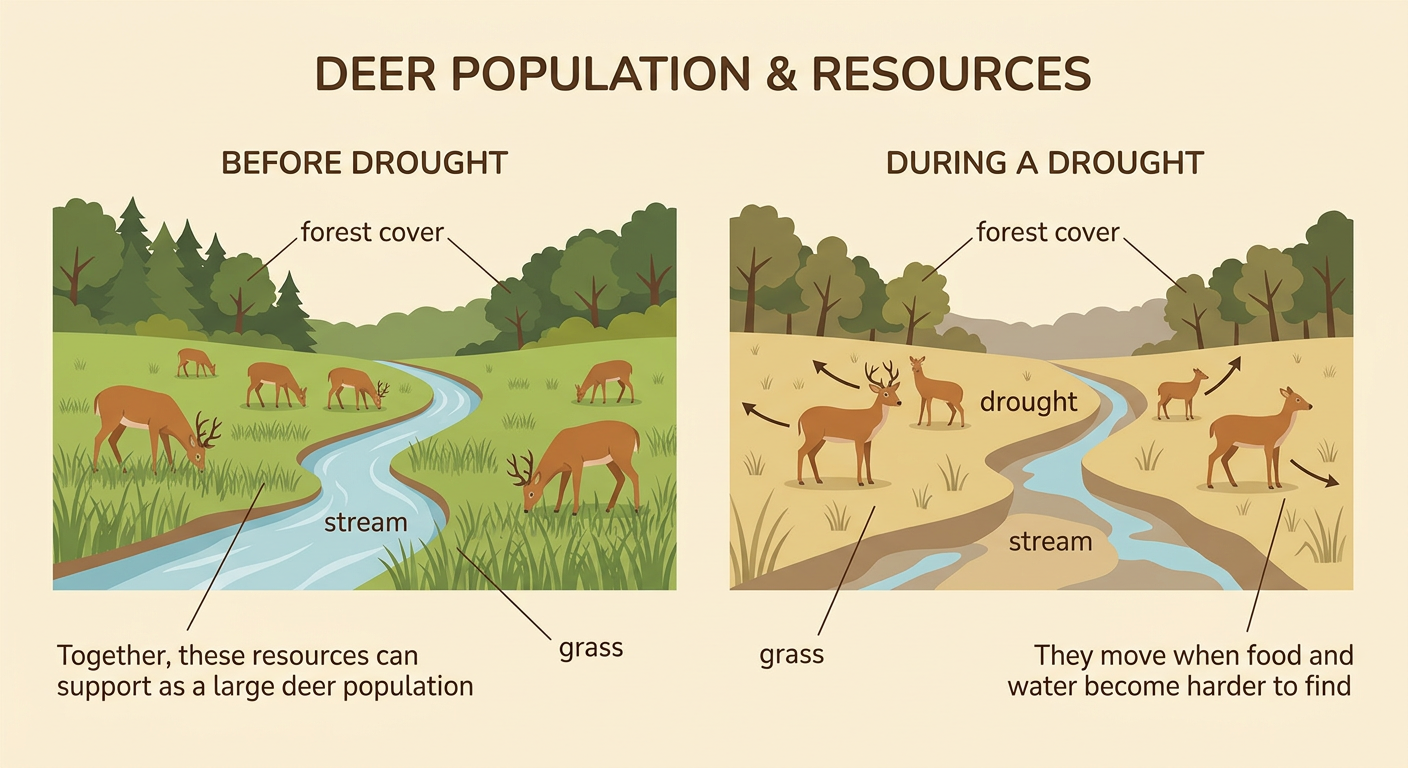
Every organism needs resources from its ecosystem. Animals need food, water, space, shelter, and suitable conditions for raising young. Plants need sunlight, water, carbon dioxide, nutrients, and space. The amount and location of these resources help determine where organisms live and how large their populations can become. For example, a meadow may support many deer when grasses, streams, and forest cover are available. During a drought, grass grows more slowly and streams may shrink. Deer may move to other areas, compete for the remaining food, or produce fewer surviving young. A change in one resource can also affect other populations. Fewer grasses may reduce grasshopper numbers, leaving less food for insect-eating birds. Resource distribution similarly influences where people establish farms, towns, and travel routes.
Limiting Factors
A limiting factor is any resource or condition that restricts the growth, size, or distribution of a population. Food, water, nesting sites, sunlight, nutrients, temperature, disease, and predators can all be limiting factors. The strongest limiting factor can change over time. In a pond, frogs may have plenty of insects to eat, but only a few shallow areas suitable for laying eggs. In that case, breeding habitat limits the frog population. If the pond later begins to dry, water may become the main limiting factor. Limiting factors do not always cause an immediate population decline. They may first slow reproduction, reduce survival, or cause organisms to move. Scientists identify a limiting factor by comparing resource measurements with population data rather than assuming that any environmental change caused the population response.

Reading Population Data
Scientists use tables, maps, and graphs to find patterns between resource availability and population size. First, read the title, axes, units, and key. Then compare how two quantities change over the same period. Suppose a grassland received 40 centimeters of rain in Year 1 and supported 120 rabbits. In Year 2, rainfall dropped to 20 centimeters, and the rabbit population fell to 90. Rainfall decreased by one-half, while the rabbit population decreased by one-fourth. The changes are related, but they are not proportional because the population did not decrease by the same fraction as rainfall. The pattern supports the idea that reduced water affected the rabbits, especially if plant growth also declined. However, one data pair is not enough to prove cause. Multiple years, repeated observations, and information about predators or disease provide stronger evidence.
Competition and Population Change
Competition occurs when organisms seek the same limited resource. Members of the same species may compete for mates, food, territory, or nesting sites. Different species may also compete if their needs overlap. For example, deer mice and seed-eating birds may both depend on grass seeds. After a dry season, fewer seeds may be produced. The animals then spend more time searching for food, and some may move to new locations. Survival and reproduction may decrease, causing one or both populations to shrink. Competition is usually strongest when population density is high and resources are scarce. It can also influence geographic distribution. Animals may leave crowded habitats, while people may move livestock, farms, or settlements toward dependable water and productive land. Competition does not mean organisms fight directly; simply using a resource can leave less for others.

Evidence-Based Ecosystem Explanation
A strong ecosystem explanation includes a claim, relevant evidence, and reasoning. The claim answers the question about population change. Evidence gives specific measurements or patterns, and reasoning connects those data to biological needs. Imagine that a wetland’s open-water area decreased from 20 hectares to 10 hectares after drainage. Over the same period, the number of nesting waterfowl decreased from 200 pairs to 120 pairs. A claim might state that reduced habitat contributed to the population decline. The evidence shows that habitat was cut in half while nesting pairs decreased by 40 percent. The reasoning explains that waterfowl need open water and nearby vegetation for food, shelter, and nesting. The quantities changed together, but not in direct proportion. A careful explanation should also consider other factors, such as hunting, disease, weather, or migration, and state whether the available data rule them out.
