
Resources and the New Imperialism
Students examine how demand for natural resources, industrial competition, and political power drove nineteenth-century imperialism and affected colonized societies.

Illustrations are auto-generated and may be placeholders. They can be refreshed to match the narration.
Industrial Demand for Resources
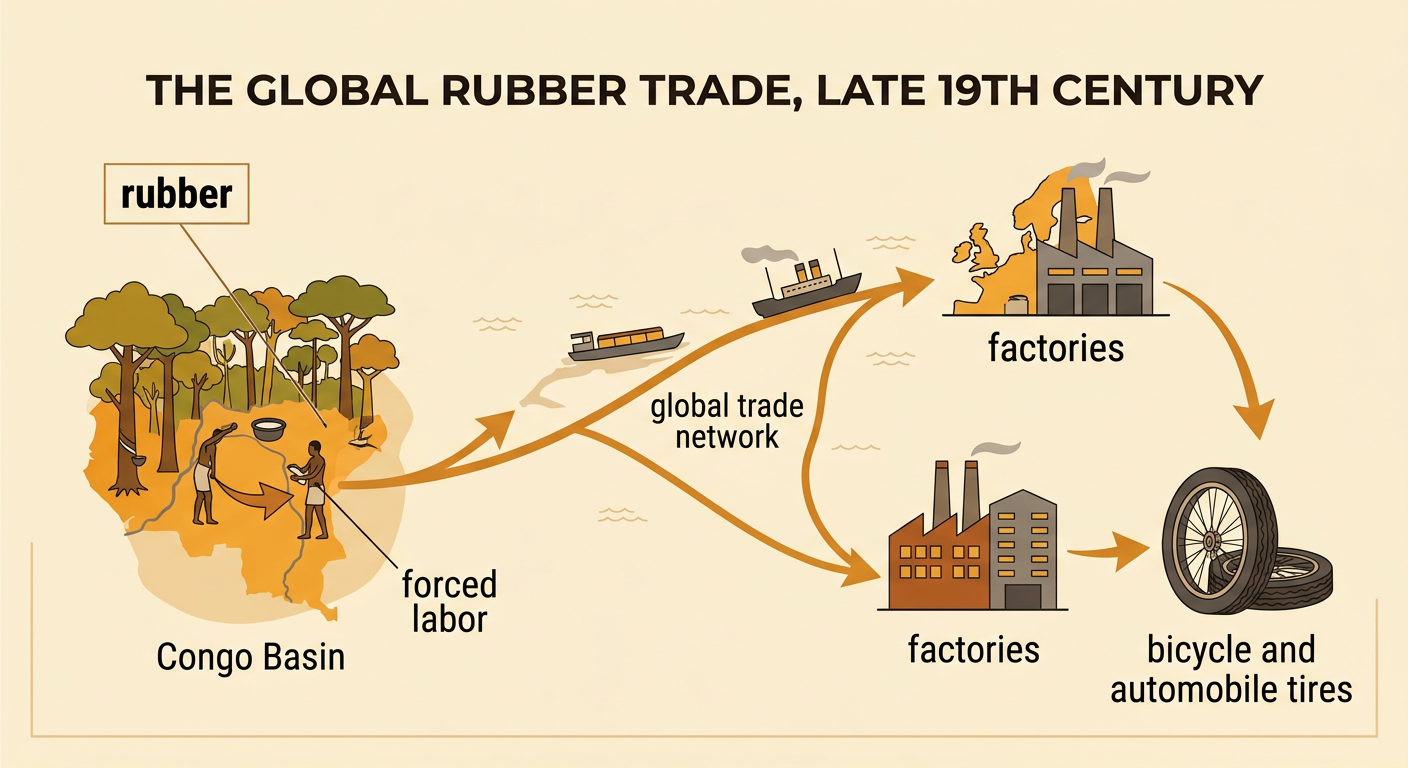
During the late nineteenth century, factories in Europe and the United States produced goods on a growing scale. Industrial economies required steady supplies of raw materials, including rubber, cotton, copper, palm oil, and tin. Because many of these resources were located outside Europe, business and political leaders sought greater control over the lands where they were produced. For example, rubber from the Congo Basin became valuable as demand increased for bicycle and automobile tires. King Leopold II of Belgium established personal control over the Congo Free State and imposed violent labor systems to extract rubber. Resource availability did not make imperialism inevitable, but it shaped where empires expanded and what colonial governments demanded from local people. Industrial demand connected distant mines, farms, and forests to factories and consumers through global trade networks.
Motives for Imperial Expansion
Imperial expansion had multiple, overlapping causes. Industrial states sought raw materials and markets, but they also competed for military bases, shipping routes, territory, and international prestige. Nationalist leaders treated colonies as signs of power, while missionaries and other advocates claimed that Europeans had a duty to spread Christianity or European culture. Racist ideas such as Social Darwinism were used to portray conquest as natural or beneficial, even though colonized peoples had their own governments, economies, and cultures. Britain’s occupation of Egypt in 1882 illustrates these connected motives. Egypt produced cotton and controlled the Suez Canal, a vital route linking the Mediterranean Sea to the Indian Ocean and British-controlled India. Financial interests, strategic geography, and rivalry with other powers all influenced British action. No single motive fully explains the expansion.

Evidence from Maps and Primary Sources
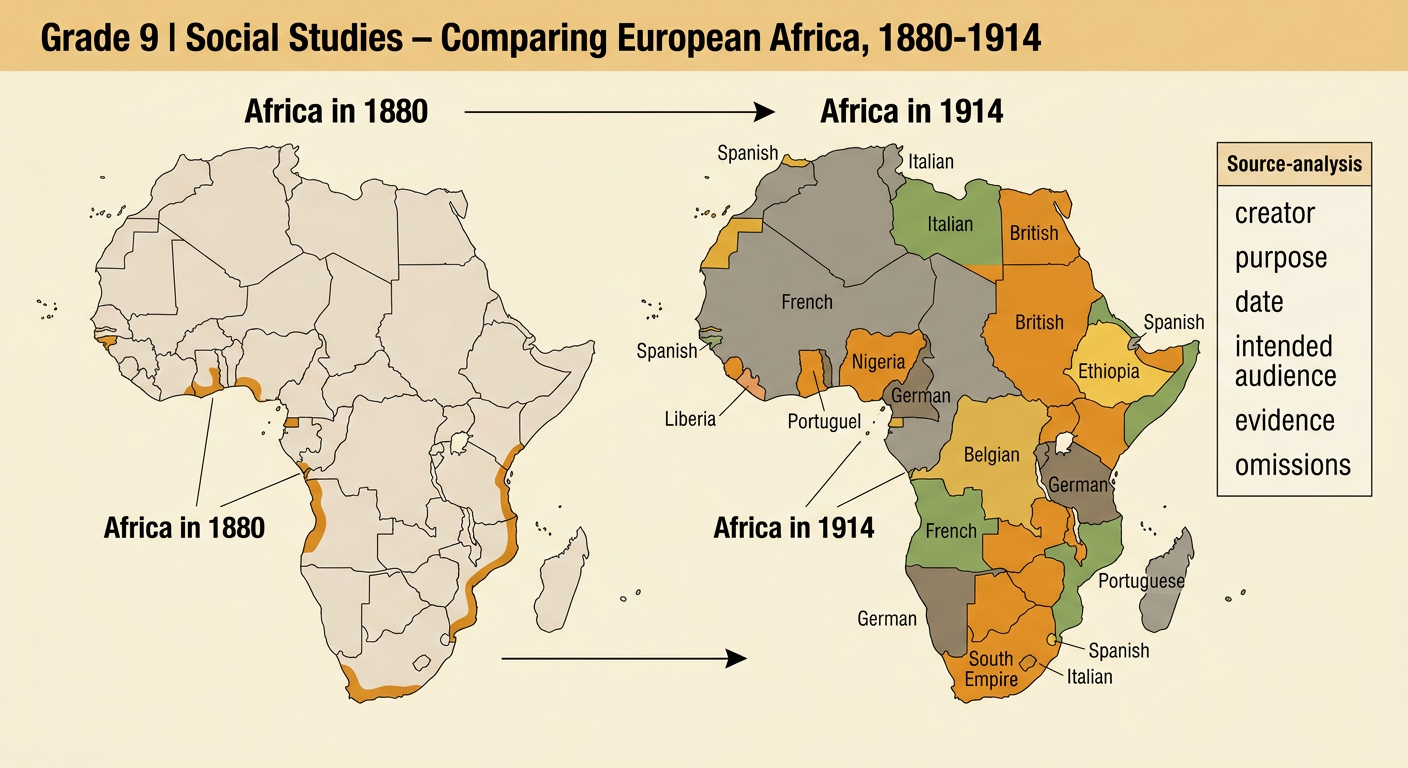
Historians compare maps and written sources to determine why imperial powers acted. A map of Africa in 1880 shows limited European territorial control, while a map from 1914 shows that nearly the entire continent had been divided among European empires, with Ethiopia and Liberia remaining independent. Maps reveal patterns, but they do not explain motives by themselves. A treaty, company report, political speech, or account by an African observer can provide additional evidence. For example, the 1885 General Act of the Berlin Conference discussed trade in the Congo Basin and rules for European claims, showing the importance of commerce and political competition. Students should identify the creator, date, purpose, and intended audience of each source. A strong analysis cites specific words, boundaries, or changes and also considers what each source leaves out.
Effects on Colonized Societies
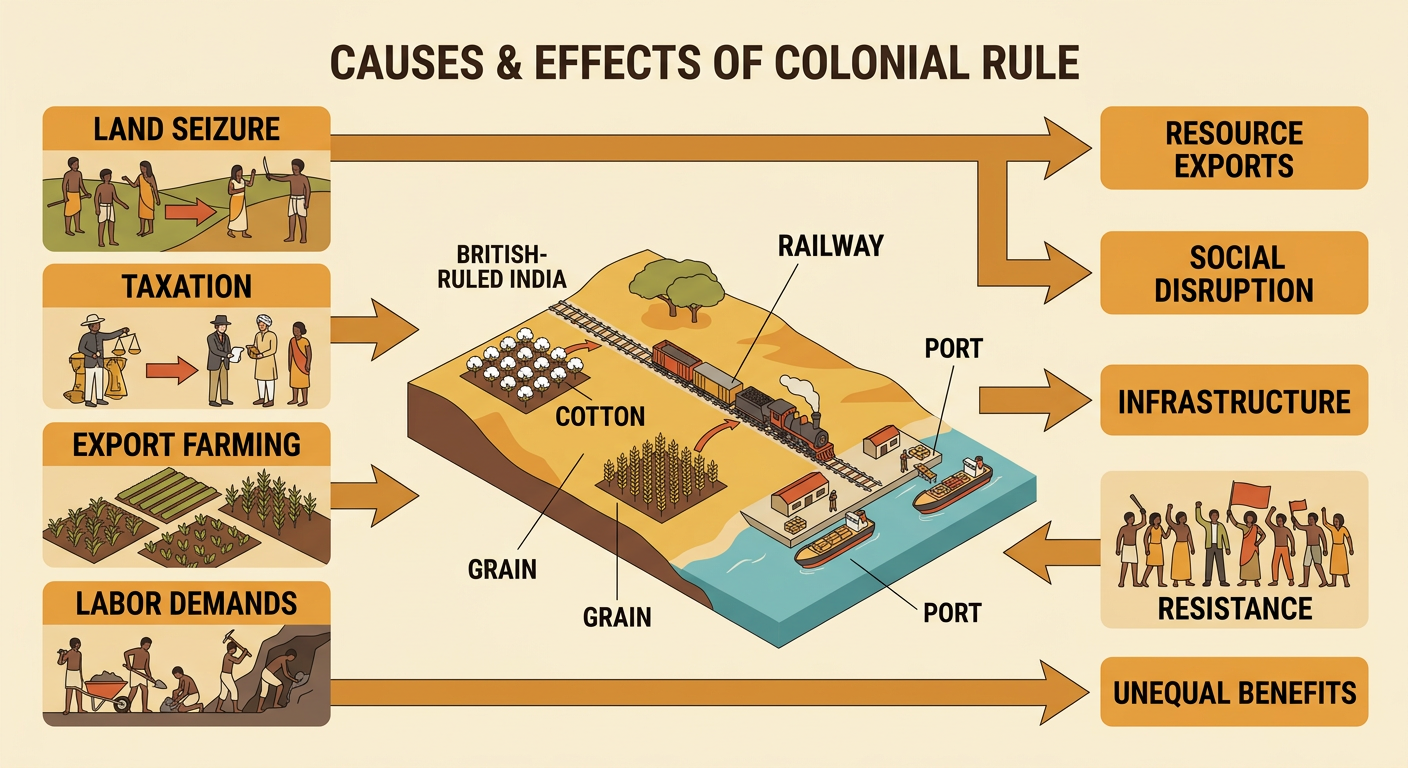
Imperial rule transformed colonized societies in unequal and often violent ways. Colonial governments seized land, redirected farming toward export crops, imposed taxes, and required people to work in mines, plantations, or construction projects. New railroads and ports moved resources efficiently, but they were often designed to connect extraction areas to the coast rather than to meet local needs. In British-ruled India, railway construction expanded trade and travel, yet the network also carried cotton, grain, and other goods to ports for imperial commerce. Colonial borders sometimes divided communities or forced different groups into one territory, contributing to later conflicts. People did not respond in only one way: they resisted through armed struggle, strikes, political organizations, cultural preservation, and negotiation. Some individuals also used new schools or transportation systems while challenging foreign control. Effects varied by location, social class, gender, and time period.
Constructing a Cause-and-Effect Claim
A historical claim should explain how several causes interacted and support that explanation with specific evidence. Begin with a focused statement, such as: Industrial demand for rubber encouraged Belgian control of the Congo, while political ambition and racist ideology helped justify a coercive labor system. Then cite evidence from at least two sources. A trade graph might show rising rubber exports, while testimony from Congo residents or investigators might describe hostage-taking, punishment, or forced collection. Explain the connection instead of merely listing facts: higher demand increased the value of rubber, and imperial control gave officials the power to compel production. Consider complexity by identifying another cause, a different perspective, or an unintended effect. Finally, evaluate the sources. A company report may minimize abuse, while eyewitness testimony may provide direct detail but reflect one person’s experience. The strongest conclusion matches the evidence without claiming more than the sources prove.
