
Retell Stories and Identify the Central Message
Students retell a story in sequence and explain the lesson or central message supported by its events.

Illustrations are auto-generated and may be placeholders. They can be refreshed to match the narration.
Review Beginning, Middle, and End
Stories usually have a beginning, a middle, and an end. The beginning introduces the characters and setting. It may also show the problem. The middle tells what the characters do as they try to solve the problem. The end explains how the problem is solved and what happens to the characters. Imagine a story about Mia losing her red mitten at the park. In the beginning, Mia notices that the mitten is missing. In the middle, she looks under a bench and beside the swings. In the end, she finds it near the slide and puts it back on. When you retell a story, share these parts in order. Include important events, but leave out small details that do not help explain what happened.

Read a Short Fable
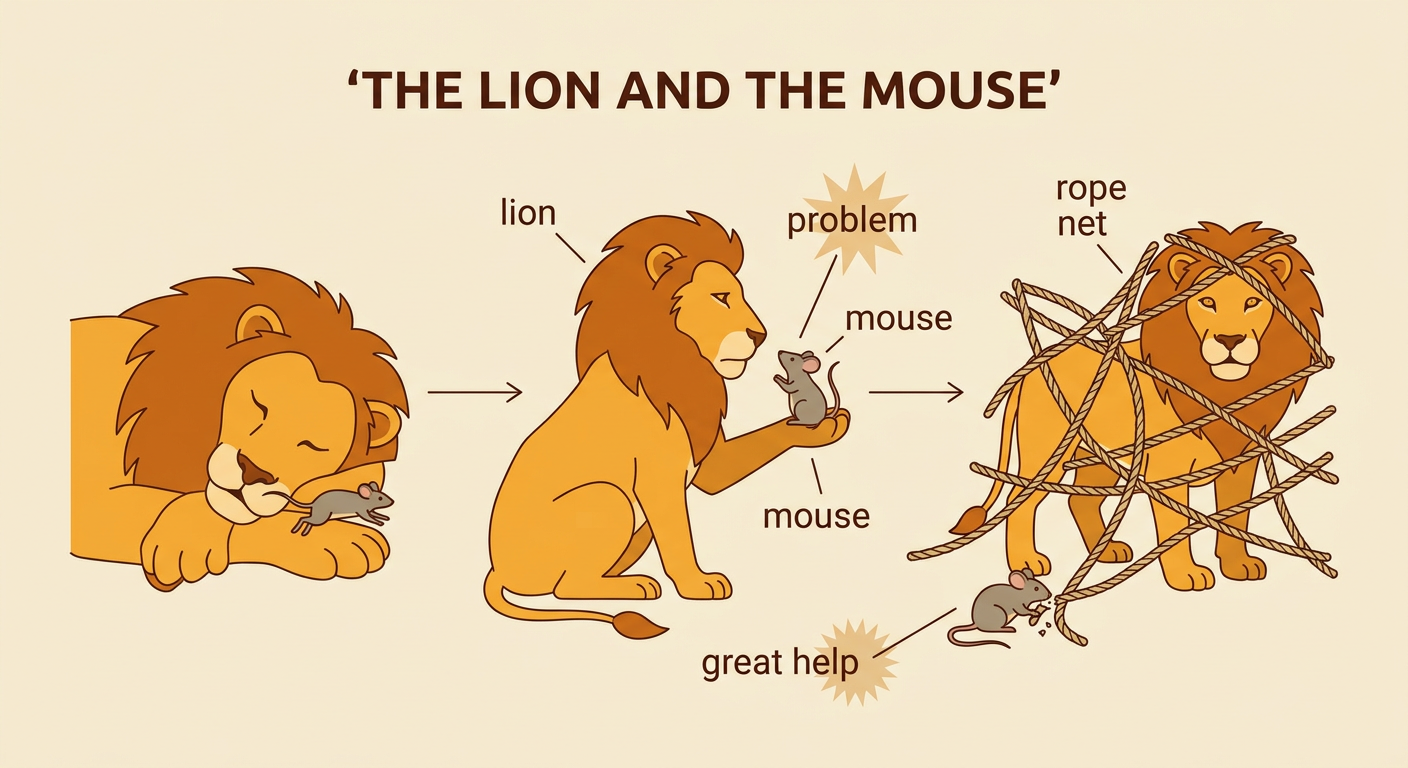
A fable is a short story that teaches a lesson, often through animals that speak or act like people. Read this fable connected to the ancient Greek storyteller Aesop. One day, a tiny mouse ran across a sleeping lion. The lion woke, caught the mouse, and prepared to eat it. The mouse begged to be released and promised to help the lion someday. The lion laughed because the mouse was so small, but he let it go. Later, hunters trapped the lion in a rope net. The lion roared for help. The mouse heard him, hurried to the net, and gnawed through the ropes. The lion escaped. The lion learned that a small friend can give great help. As you read, notice the characters, the problem, and the actions that solve it.
Sequence Important Events
To recount a story, put its important events in the order they happened. Ask what happened first, next, then, and finally. An important event changes the problem or helps solve it. In the fable, the mouse running across the lion is important because it brings the characters together. The lion releasing the mouse matters because his kind choice affects what happens later. Next, the lion is trapped in a net. Then the mouse hears the lion and gnaws the ropes. Finally, the lion escapes. A detail such as the time of day does not need to be included because it does not change the problem or solution. Use sequence words to make your recount clear: “First, the lion released the mouse. Later, the mouse helped the trapped lion. Finally, the lion was free.”

Identify the Central Message
The central message is the lesson or moral a story teaches. It is not just one event. It is an idea supported by the characters’ choices and what happens because of them. Ask, “What did the character learn?” and “What can readers learn?” In the fable, the lion believes the tiny mouse cannot help him. Still, he chooses to release the mouse. Later, the mouse saves the lion by chewing through the net. These events support the central message that even someone small can be a great help. They also show that kindness may be returned. A message such as “Lions live in forests” is not supported as a lesson. To explain your answer, name the message and give evidence: “The story teaches that everyone can help because the small mouse frees the powerful lion.”
Retell With a Partner
Retelling means telling the important parts of a story again in your own words. Work with a partner and take turns as speaker and listener. The speaker should name the title and characters, recount the events in order, and explain the central message. For example: “In The Lion and the Mouse, a lion catches a mouse but lets it go. Later, the lion becomes trapped in a net. The mouse chews the ropes, and the lion escapes. The lesson is that even someone small can be helpful.” The listener should check that the retell includes the beginning, middle, end, and lesson. Then the listener can ask a helpful question, such as, “Which event supports that lesson?” Switch roles so both partners practice. Speak clearly, listen carefully, and use story events as evidence.