
Retelling a Story and Finding Its Lesson
Students retell a short story in sequence and identify the central message or lesson using key details.
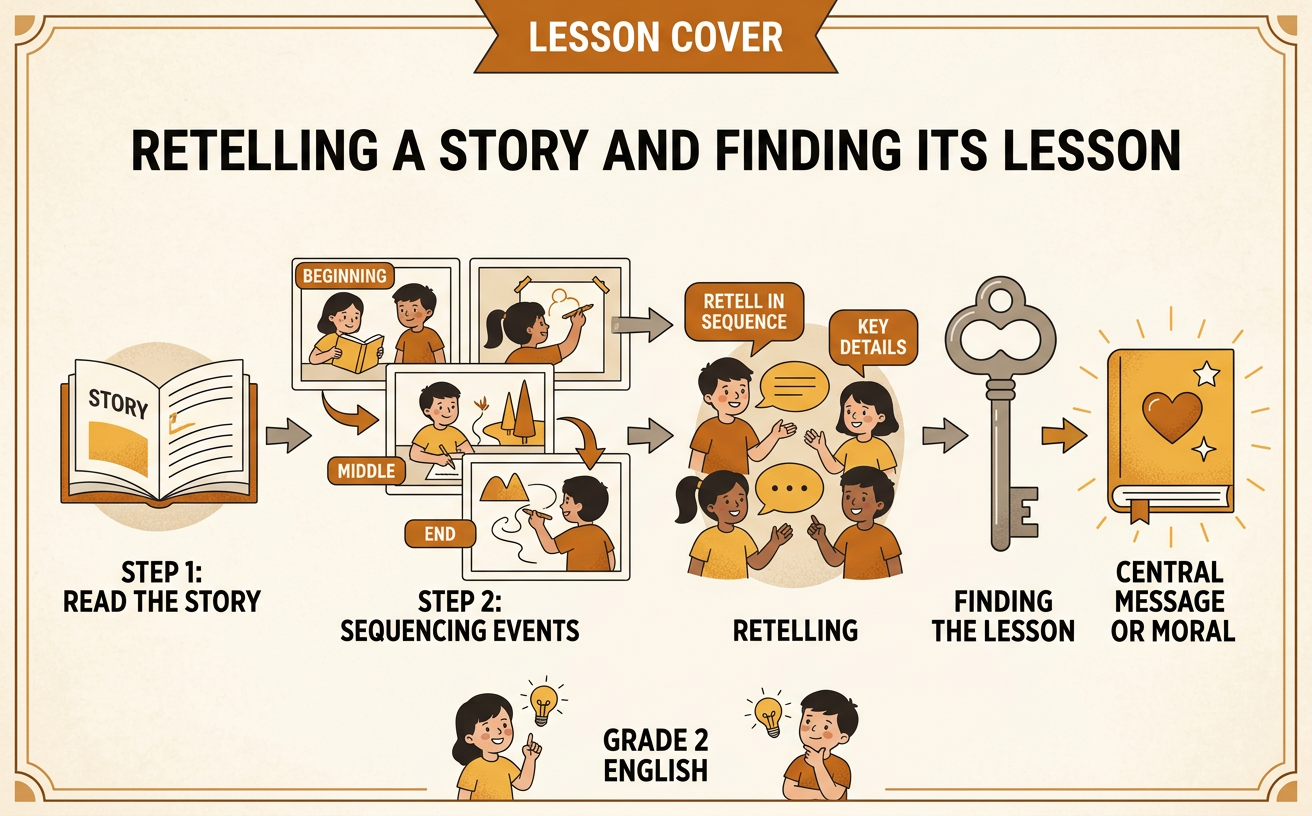
Illustrations are auto-generated and may be placeholders. They can be refreshed to match the narration.
Introduce Central Message
A story tells what characters do, but it can also teach an idea about life. This big idea is called the central message, lesson, or moral. Readers usually figure it out by noticing the characters’ choices, problems, and results. For example, imagine that Mia shares her crayons with Ben. Later, Ben helps Mia clean up spilled paper. The events show that kindness can lead to kindness in return. That idea is the central message. A central message should be written as a complete thought that could help many people, not only the story’s characters. “Mia and Ben use crayons” is a detail. “Helping others can inspire them to help you” is a lesson.
Read a Short Fable
Read this short fable. One warm afternoon, a lion slept beneath a tree. A tiny mouse ran across the lion’s paw and woke him. The angry lion caught the mouse. “Please let me go,” squeaked the mouse. “Someday I may help you.” The lion laughed because the mouse was so small, but he chose to release her. A few days later, hunters trapped the lion in a strong rope net. He roared for help. The mouse heard him and hurried over. She gnawed the ropes with her sharp teeth until the lion was free. The lion thanked her. He understood that even a small friend can give great help. As you read, notice the problem, the characters’ actions, and what happens because of those actions.

Retell Beginning, Middle, and End
To retell a story, explain the most important events in the order they happened. Use your own words and include the beginning, middle, and end. In the beginning of the fable, a mouse wakes a sleeping lion. The lion catches her but decides to let her go. In the middle, hunters trap the lion in a rope net, and he calls for help. In the end, the mouse chews through the ropes and frees the lion. A good retelling names the main characters, tells the problem, and explains the solution. It does not include every tiny detail. Sequence words such as first, next, then, and finally make the order clear. Try saying the retelling aloud without changing the order of events.

Identify Key Details
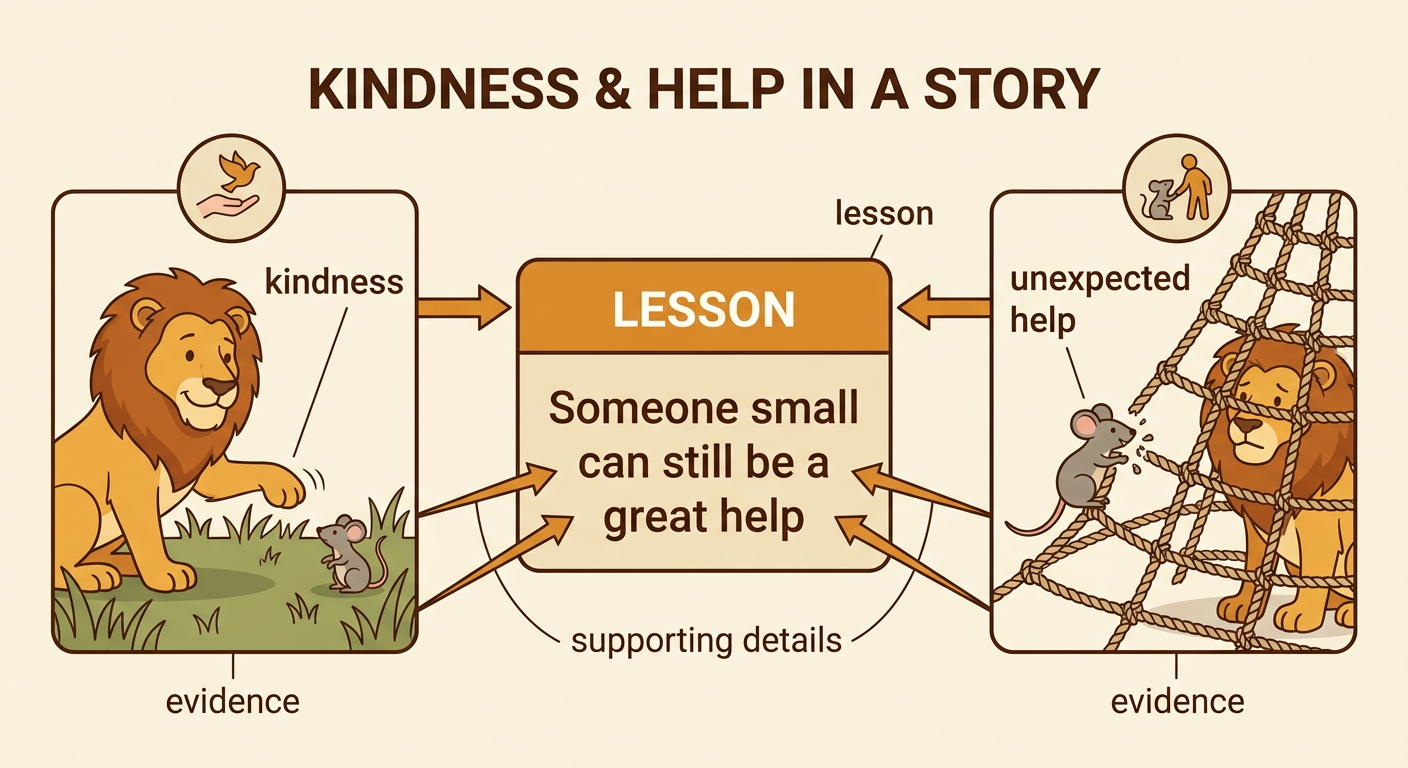
Key details are important parts of a story that help explain its central message. Ask these questions: What choice did a character make? What happened because of that choice? How did the character change or learn? In the fable, one key detail is that the lion releases the mouse instead of hurting her. Another key detail is that the mouse returns to help when the lion is trapped. A third key detail is that the small mouse can solve a problem the powerful lion cannot solve alone. These details matter because they show kindness being returned and help coming from an unexpected friend. The warm afternoon and the tree are setting details, but they do not strongly support the lesson. Choose details that connect actions to results.

Determine the Lesson
Now use the key details to determine the lesson. First, think about what the lion learns. He believes the tiny mouse cannot help him, but later she saves him. Next, connect the important actions: the lion shows mercy, and the mouse returns his kindness. A strong lesson is “Kindness can be repaid in unexpected ways.” Another supported lesson is “Someone small can still be a great help.” Both ideas fit the characters’ actions and the result. A weak answer would be “Lions should avoid nets.” That statement mentions the story, but it does not express a useful message about life. Check your lesson by asking, “Which key details prove this idea?” If you can name two or more supporting details, your lesson is probably well supported.
Share and Review
Share your retelling with a partner. Begin by naming the characters and setting. Then tell the important events in order using first, next, then, and finally. After your retelling, state the lesson and support it with key details. You might say, “The lesson is that kindness can be repaid. The lion lets the mouse go, and later the mouse frees the lion.” Your partner can listen for correct sequence, important details, and a lesson that matches the story. Then switch roles. Before finishing, review your work: Did you include the beginning, middle, and end? Did you leave out unimportant details? Did you explain the lesson in a complete sentence? Did you give evidence from the fable? Clear retellings and strong evidence show that you understand the story.
