
Retelling a Story in Order
Students identify characters, setting, and major events before retelling a story in sequence and stating its lesson.
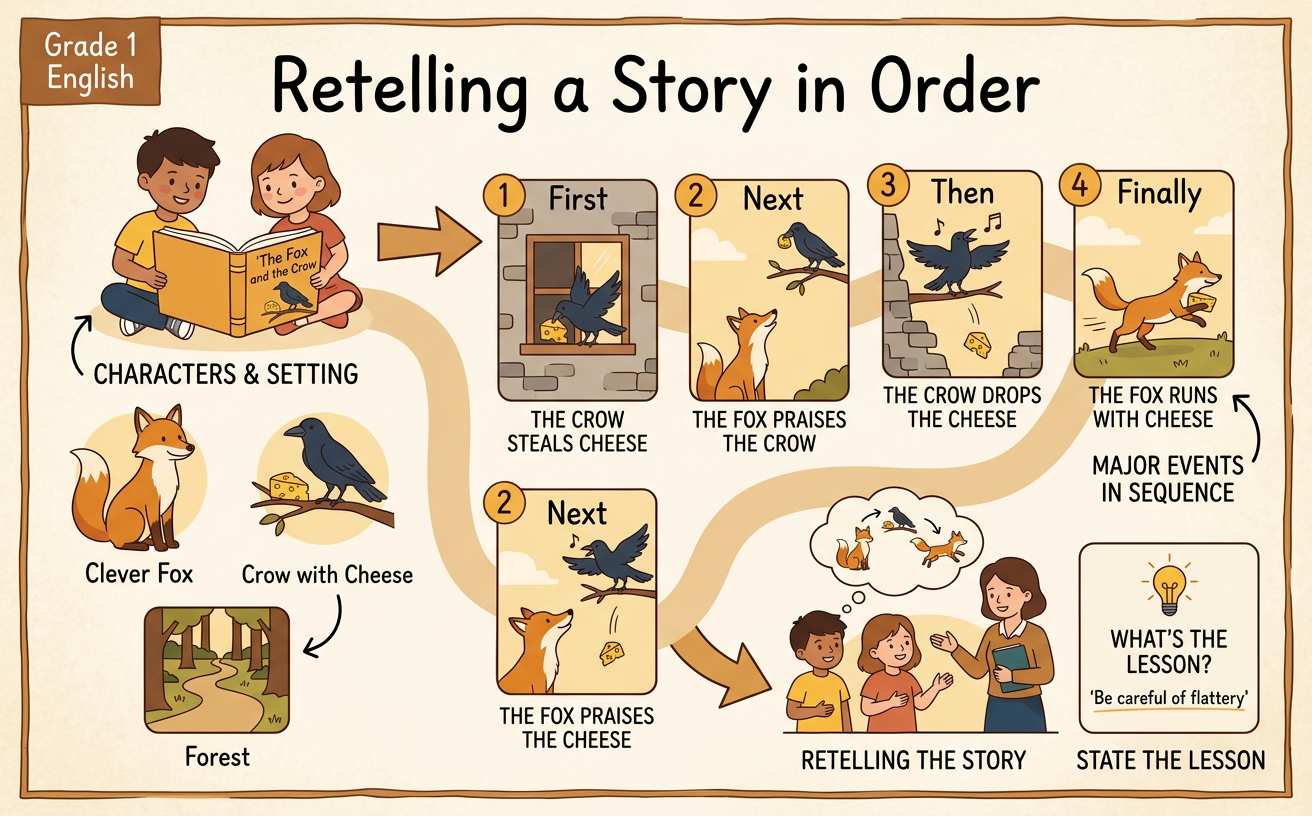
Illustrations are auto-generated and may be placeholders. They can be refreshed to match the narration.
Preview the Story
Before you read, preview the story. A preview is a quick look that helps you get ready to understand. Read the title and look closely at the cover and pictures. Ask yourself: Who might be in the story? Where might it happen? What might happen? In The Tortoise and the Hare, the title names two animals. A cover picture might show a tortoise and a hare near a path. You can predict that they may travel along the path. A prediction is a smart guess based on clues. Say, “I predict the tortoise and the hare will have a race.” Then read or listen to find out whether your prediction is correct. A preview helps you notice important details as the story begins.
Identify Characters and Setting
Characters are the people or animals who act in a story. The setting tells where and sometimes when the story happens. As you read, ask, “Who is doing something?” and “Where are the characters?” In The Tortoise and the Hare, the main characters are the tortoise and the hare. Other forest animals may watch the race. The setting is a path in the countryside during the day. Details in the words and pictures can help you identify the setting. Trees, grass, sunlight, and a marked path are setting clues. Do not confuse a character with part of the setting. The hare is a character because he talks, runs, and makes choices. A tree is part of the setting because it shows where the action happens.
Sequence Major Events
Major events are the most important things that happen in a story. Sequence means putting those events in the order they happened. Look for time-order words such as first, next, then, and last. Leave out small details that do not change the story. In The Tortoise and the Hare, first the hare laughs at the slow tortoise, and they agree to race. Next, the race begins, and the hare runs far ahead. Then, the hare stops to sleep while the tortoise keeps moving. Last, the tortoise reaches the finish line before the hare. You can place each event in a numbered box. Check the order by asking, “Could this event happen before the one ahead of it?” Correct sequence helps your listener follow and understand the story.
Retell Beginning, Middle, and End
To retell a story, tell the important parts again in your own words. Keep the events in the correct order and include key details. Organize your retelling into a beginning, middle, and end. The beginning introduces the characters, setting, and problem. For example, a proud hare challenges a tortoise to a race on a countryside path. The middle explains the characters’ main actions. The hare races ahead and takes a nap, but the tortoise keeps walking. The end tells how the problem is solved. The tortoise crosses the finish line first, and the surprised hare loses the race. Use sequence words to connect the parts. Do not copy every sentence or tell every tiny detail. A strong retelling is complete, clear, and easy for another person to follow.
Name the Story’s Lesson
The lesson, or central message, is the big idea the author wants readers to understand. Think about what the characters did, what happened because of their choices, and what a reader can learn. In The Tortoise and the Hare, the hare is fast, but he stops trying because he is too sure he will win. The tortoise is slow, but he keeps moving until he finishes the race. The tortoise wins because he does not give up. One lesson is, “Keep trying, even when a task is hard.” Another way to say it is, “Slow and steady work can lead to success.” Use events from the story to support the lesson. The lesson should fit the whole story, not just one small part.