
Reversible Changes Caused by Heating and Cooling
Students analyze temperature observations and evidence to explain how melting and freezing are reversible changes that do not create a new substance.
Illustrations are auto-generated and may be placeholders. They can be refreshed to match the narration.
Observe Melting and Freezing
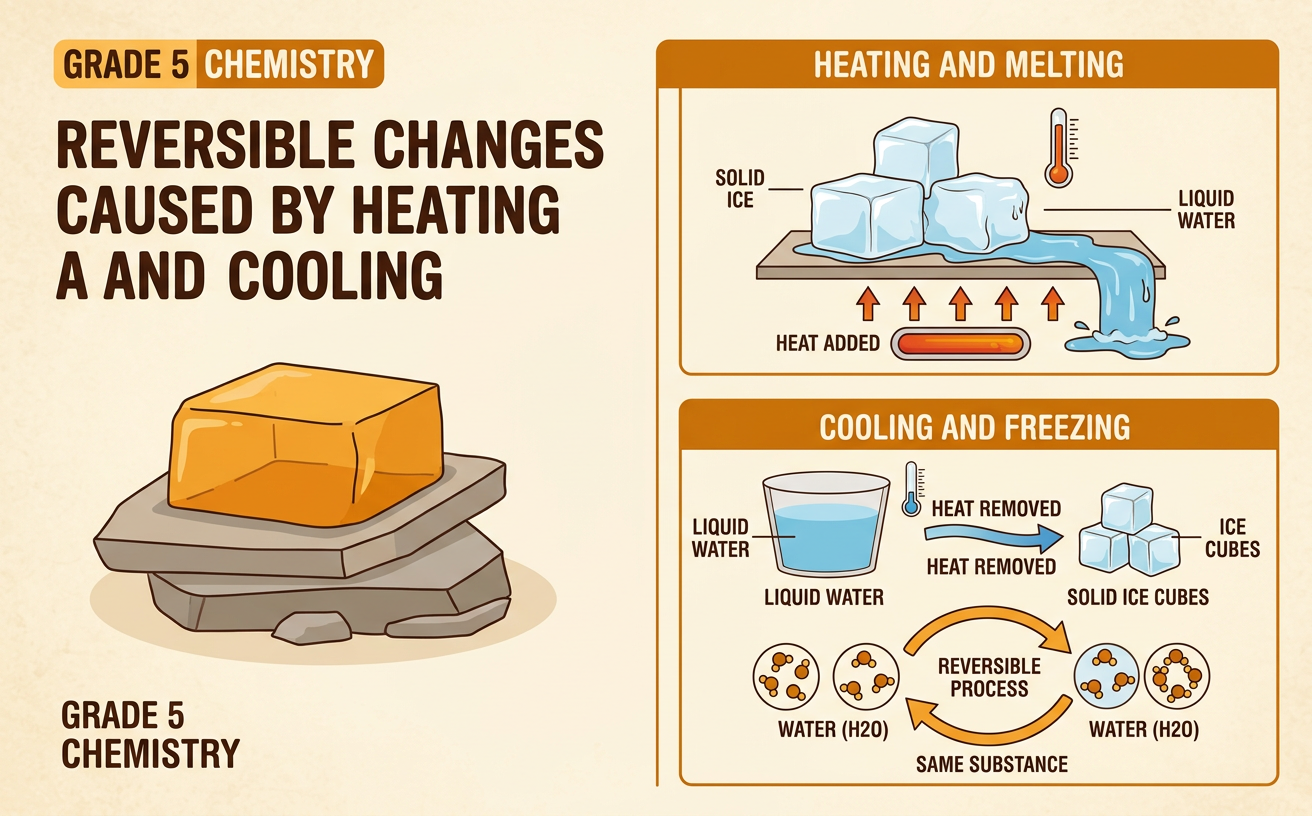
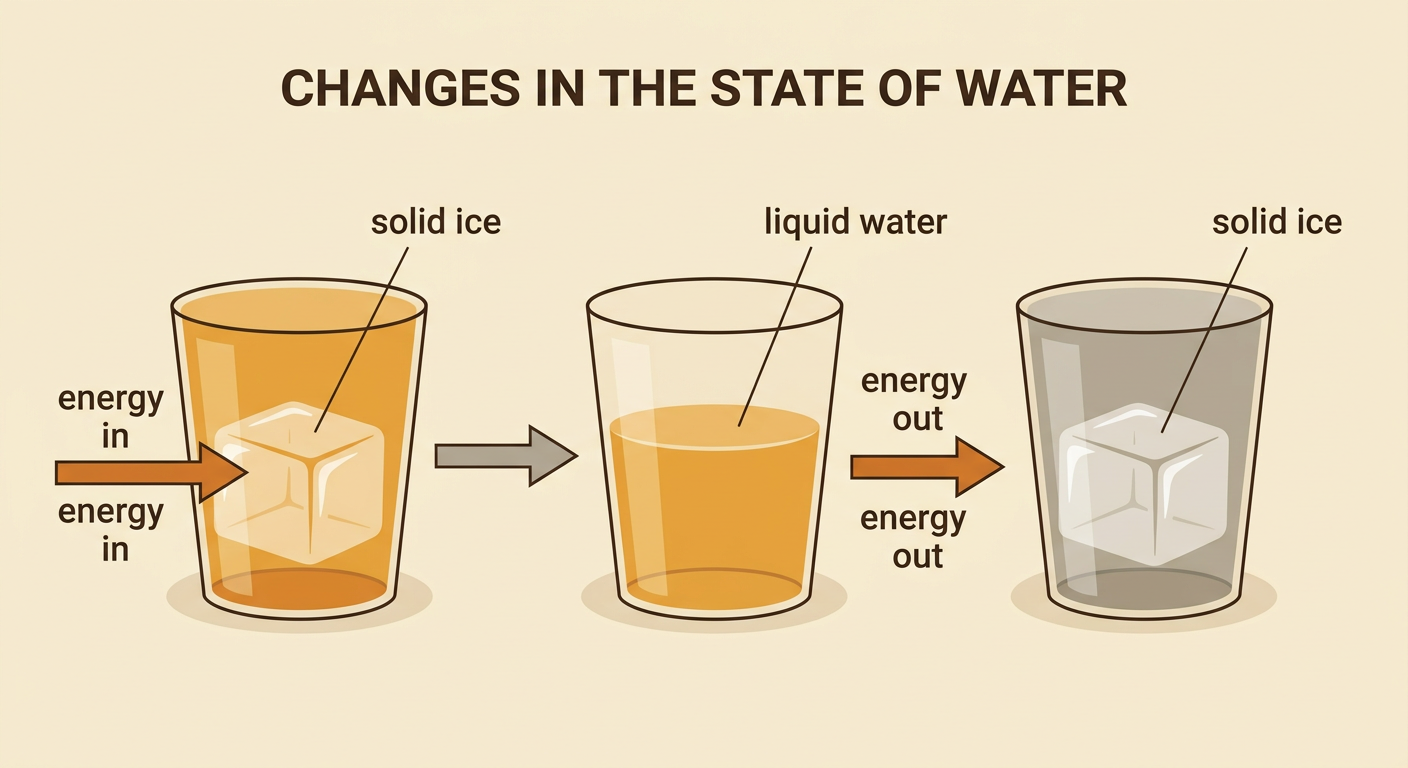
Heating and cooling can change the state of a substance. Place an ice cube in a clear cup at room temperature. Energy from the warmer surroundings moves into the ice, causing it to melt into liquid water. If the cup of water is placed in a freezer, energy moves out of the water. The water freezes and becomes solid ice again. Melting and freezing change how water looks, feels, and moves, but they do not make a new substance. The solid and liquid are both water. During an investigation, observe safely without tasting the materials. Record details such as the presence of solid pieces, drops of liquid water, and the time when each change occurs. These observations provide evidence about what heating and cooling do to water.
Record Temperature Data
Temperature measurements help show when melting and freezing occur. Use a thermometer with adult supervision, and measure in degrees Celsius. Suppose five groups cool equal amounts of water for the same length of time and record 4°C, 2°C, 2°C, 1°C, and 0°C. Organize these measurements on a line plot. Write temperatures along a number line and place one X above a temperature for each observation. The two X marks above 2°C show that two groups measured that temperature. The plot makes it easy to find the lowest temperature, the highest temperature, and repeated results. At normal classroom air pressure, pure water freezes near 0°C. Temperature data should be combined with observations because water may remain liquid until it reaches its freezing point.

Compare Before and After
To decide whether a new substance formed, compare the material before and after the change. Before melting, an ice cube is solid, keeps its shape, and is cold. After melting, the liquid water flows and takes the shape of its container. These properties changed because the state changed. However, both samples are colorless water and are made of the same substance. Cooling the liquid returns it to solid ice, providing more evidence that no new substance formed. For example, mark the water level in a covered cup before freezing, then compare the material after it freezes and melts again. The form may differ during the investigation, but the material is still water. Use observations from more than one stage instead of deciding from appearance alone.

Identify Reversible Changes
A reversible change can be undone so that the original substance and its earlier form can be obtained again. Melting and freezing are reversible changes. An ice pop that begins to melt can become solid again when it is returned to a freezer, although its shape may not be exactly the same. The substance can still change from solid to liquid and back to solid. Not every change caused by heating can be reversed. Heating raw egg white makes it firm and opaque, and cooling it does not turn it back into raw egg white. That evidence shows that the egg’s change is not reversible in the same way. To classify a change, ask whether reversing the heating or cooling restores the original kind of material. Repeating the process provides stronger evidence than observing only one step.

Make an Evidence-Based Claim
An evidence-based argument includes a claim, evidence, and reasoning. A strong claim is: Melting and freezing water are reversible changes that do not create a new substance. Support the claim with several sources of evidence. First, observations show that solid ice becomes liquid water when warmed. Second, temperature measurements show that pure water freezes near 0°C under normal classroom conditions. Third, cooling the liquid makes solid ice, and warming that ice produces liquid water again. In the reasoning, explain that returning the material to an earlier state shows reversibility. Also explain that the material remains water even though its state and properties change. Write complete sentences and connect each piece of evidence to the claim. A conclusion based on observations, measurements, and a before-and-after comparison is stronger than an unsupported opinion.
