
Right-Triangle Trigonometry
Students apply sine, cosine, and tangent ratios to find unknown side lengths and angles in right triangles.

Illustrations are auto-generated and may be placeholders. They can be refreshed to match the narration.
Naming Triangle Sides
A right triangle has one 90° angle and two acute angles. The side opposite the 90° angle is the hypotenuse, and it is always the longest side. The names of the other two sides depend on which acute angle you choose as the reference angle. The side directly across from the reference angle is the opposite side. The leg that touches the reference angle is the adjacent side. The hypotenuse also touches the reference angle, but it is never called the adjacent side. For example, consider a right triangle with legs of 6 and 8 units and a hypotenuse of 10 units. If angle θ is next to the 8-unit leg, then 8 is adjacent to θ, 6 is opposite θ, and 10 is the hypotenuse.
Sine, Cosine, and Tangent
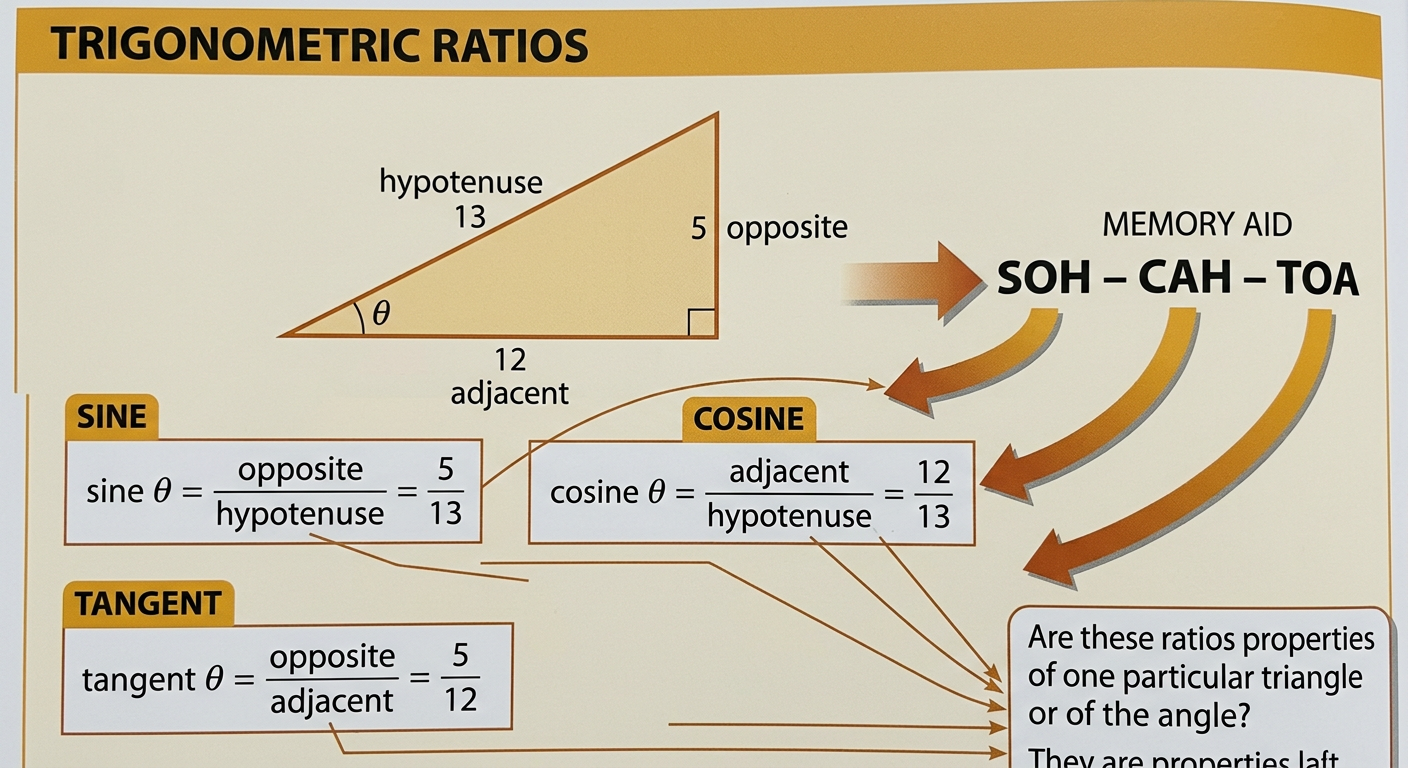
Sine, cosine, and tangent compare pairs of side lengths in a right triangle. For an acute angle θ, sine is opposite divided by hypotenuse, cosine is adjacent divided by hypotenuse, and tangent is opposite divided by adjacent. These relationships are often remembered as SOH-CAH-TOA. In a 5-12-13 right triangle, suppose the 5-unit side is opposite θ, the 12-unit side is adjacent to θ, and the 13-unit side is the hypotenuse. Then sin θ = 5/13, cos θ = 12/13, and tan θ = 5/12. Similar right triangles with the same acute angle have proportional corresponding sides, so these ratios stay constant even when the triangle changes size. This is why the trigonometric ratios are properties of the angle rather than of one particular triangle.
Choosing a Trigonometric Ratio
Choose a trigonometric ratio by identifying the known side or sides and the quantity you need to find. First label the triangle’s hypotenuse, opposite side, and adjacent side relative to the reference angle. Then select the ratio that includes the needed information. Use sine when the relevant sides are opposite and hypotenuse. Use cosine when they are adjacent and hypotenuse. Use tangent when they are opposite and adjacent. For example, suppose a right triangle has an opposite side of 7 units and an adjacent side of 10 units, and you need to find θ. Because neither value is the hypotenuse, tangent is the useful ratio: tan θ = 7/10. Sine or cosine would require the unknown hypotenuse, creating an unnecessary extra step.
Finding Missing Sides
To find a missing side, choose the ratio containing the known angle, the known side, and the unknown side. Write an equation, substitute the known values, and solve for the variable. Make sure a calculator is in degree mode when the angle is measured in degrees. For example, a right triangle has a 38° angle, an adjacent side of 12 units, and an unknown opposite side x. Tangent connects opposite and adjacent, so tan 38° = x/12. Multiply both sides by 12 to get x = 12 tan 38°. A calculator gives x ≈ 9.4 units. Keep several decimal places during the calculation and round only the final answer. The result is reasonable because the side opposite 38° should be shorter than the adjacent side.
Finding Missing Angles
To find a missing acute angle, form a trigonometric ratio from two known sides and then use an inverse trigonometric function. The inverse sine, inverse cosine, and inverse tangent undo the corresponding ratios. They may appear on a calculator as sin⁻¹, cos⁻¹, and tan⁻¹; these symbols mean inverse functions, not reciprocals. For example, suppose the side opposite θ is 8 units and the adjacent side is 15 units. Write tan θ = 8/15. Apply inverse tangent to both sides: θ = tan⁻¹(8/15). In degree mode, the calculator gives θ ≈ 28.1°. Because this is a right triangle, the other acute angle is about 61.9°, since the two acute angles must add to 90°. Include a degree symbol when reporting an angle measure.
Reasonableness Checks
Check a trigonometric answer by comparing it with the triangle’s visible and mathematical properties. The hypotenuse must be the longest side, all side lengths must be positive, and the two acute angles must total 90°. A larger acute angle should be opposite a longer leg. You can also test calculated side lengths with the Pythagorean theorem. For example, a right triangle with a 52° angle and a hypotenuse of 20 units has an adjacent side of 20 cos 52° ≈ 12.3 units and an opposite side of 20 sin 52° ≈ 15.8 units. Both legs are shorter than 20, and the side opposite 52° is longer than the adjacent leg because 52° is greater than 45°. Finally, 12.3² + 15.8² is approximately 20², allowing for rounding.