Rotational Motion, Torque, and Angular Momentum
Students connect linear and rotational quantities to explain how torque changes rotational motion and why angular momentum is conserved when external torque is negligible.

Illustrations are auto-generated and may be placeholders. They can be refreshed to match the narration.
Linear and Rotational Analogies
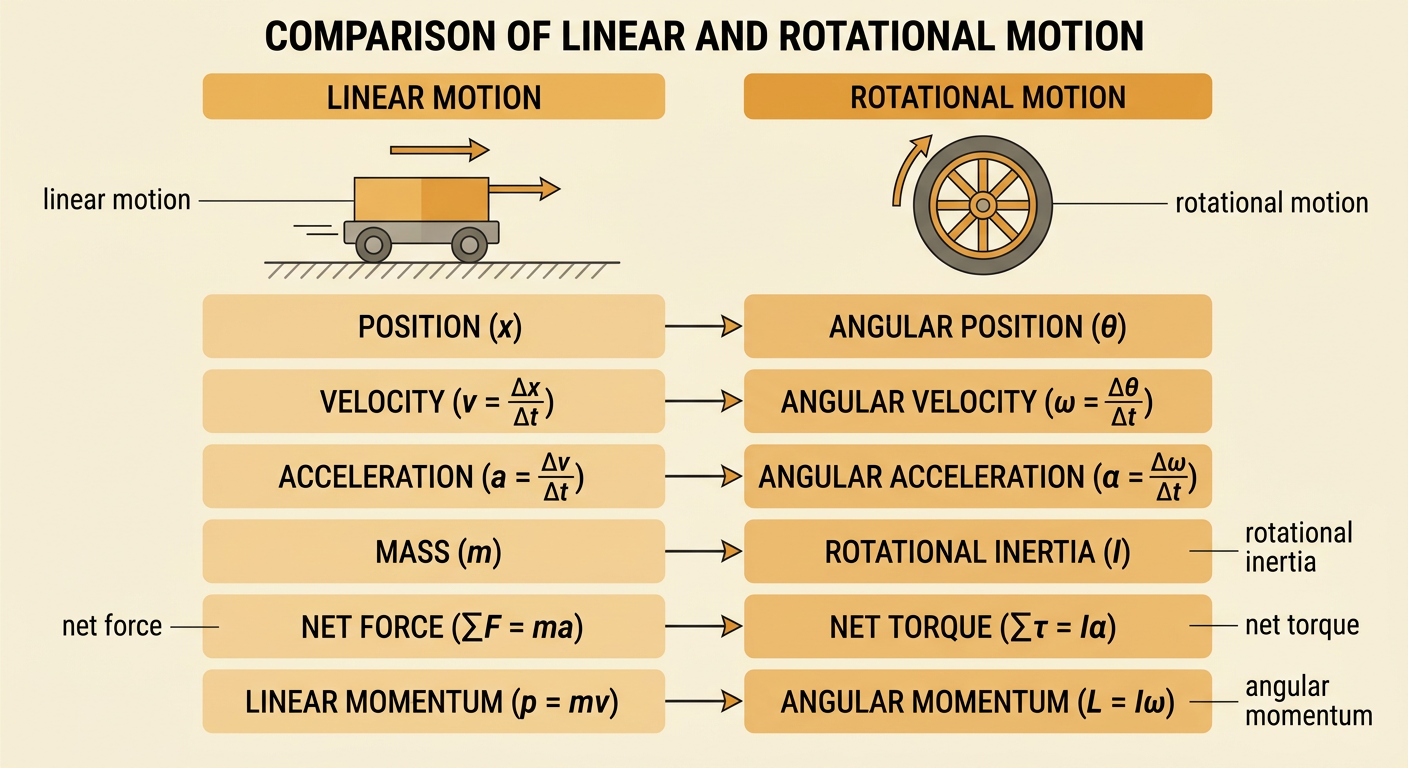
Rotational motion has quantities that parallel those used in linear motion. Linear position x corresponds to angular position θ, velocity v corresponds to angular velocity ω, and acceleration a corresponds to angular acceleration α. Mass measures resistance to linear acceleration, while rotational inertia I measures resistance to angular acceleration. Force F changes linear motion, and torque τ changes rotational motion. Linear momentum p = mv corresponds to angular momentum L = Iω for a rigid object rotating about a fixed axis. For example, pushing a cart with a net force accelerates it along a path. Applying a torque to a bicycle wheel causes its angular velocity to change. These analogies help transfer familiar reasoning from Fnet = ma to rotational systems, but rotational quantities also depend on the location of mass and the point where a force is applied.
Angular Position, Velocity, and Acceleration
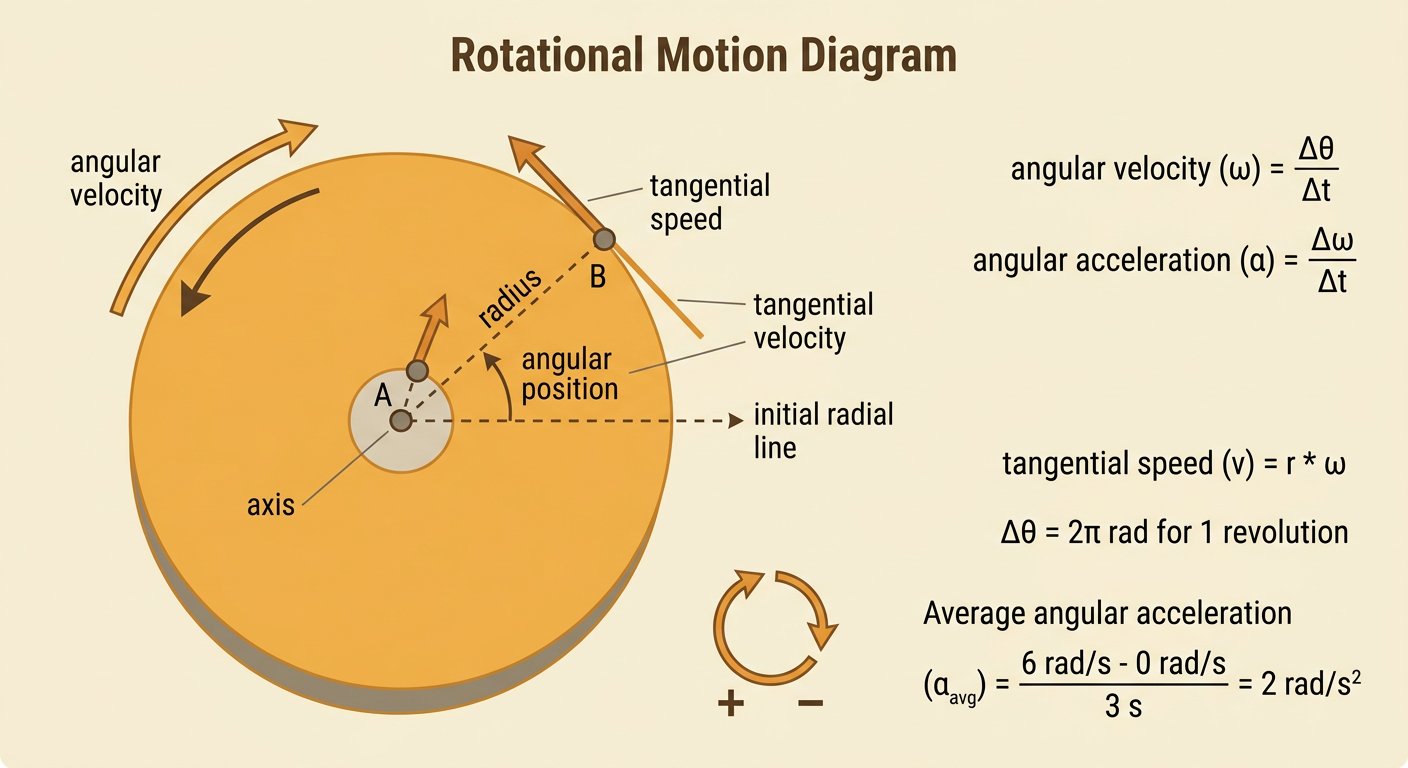
Angular position θ describes an object’s orientation relative to a reference line and is commonly measured in radians. One complete revolution equals 2π radians. Angular velocity is the rate of change of angular position, ω = Δθ/Δt, and angular acceleration is the rate of change of angular velocity, α = Δω/Δt. A sign convention identifies direction; counterclockwise is often positive and clockwise negative. For a point at distance r from the axis, arc length is s = rθ, tangential speed is v = rω, and tangential acceleration is at = rα. For example, a turntable starting from rest and reaching 6 radians per second in 3 seconds has an average angular acceleration of 2 radians per second squared. Points near its edge have greater tangential speed than points near its center, although all points share the same angular velocity.
Torque and Rotational Inertia
Torque measures how effectively a force causes rotation about an axis. Its magnitude is τ = rF sin φ, where r is the distance from the axis to the point of application and φ is the angle between the position vector and the force. Equivalently, τ = r⊥F, where r⊥ is the perpendicular lever arm. A force applied perpendicular to a lever produces maximum torque; a force directed toward the axis produces zero torque. Rotational inertia describes how mass is distributed relative to the axis: I = Σmr² for a collection of particles. For example, opening a door is easier when a perpendicular force is applied at the handle rather than near the hinges. The same force produces more torque at the handle because its lever arm is larger. Likewise, moving an object’s mass farther from its axis increases its rotational inertia.

Newton’s Second Law for Rotation
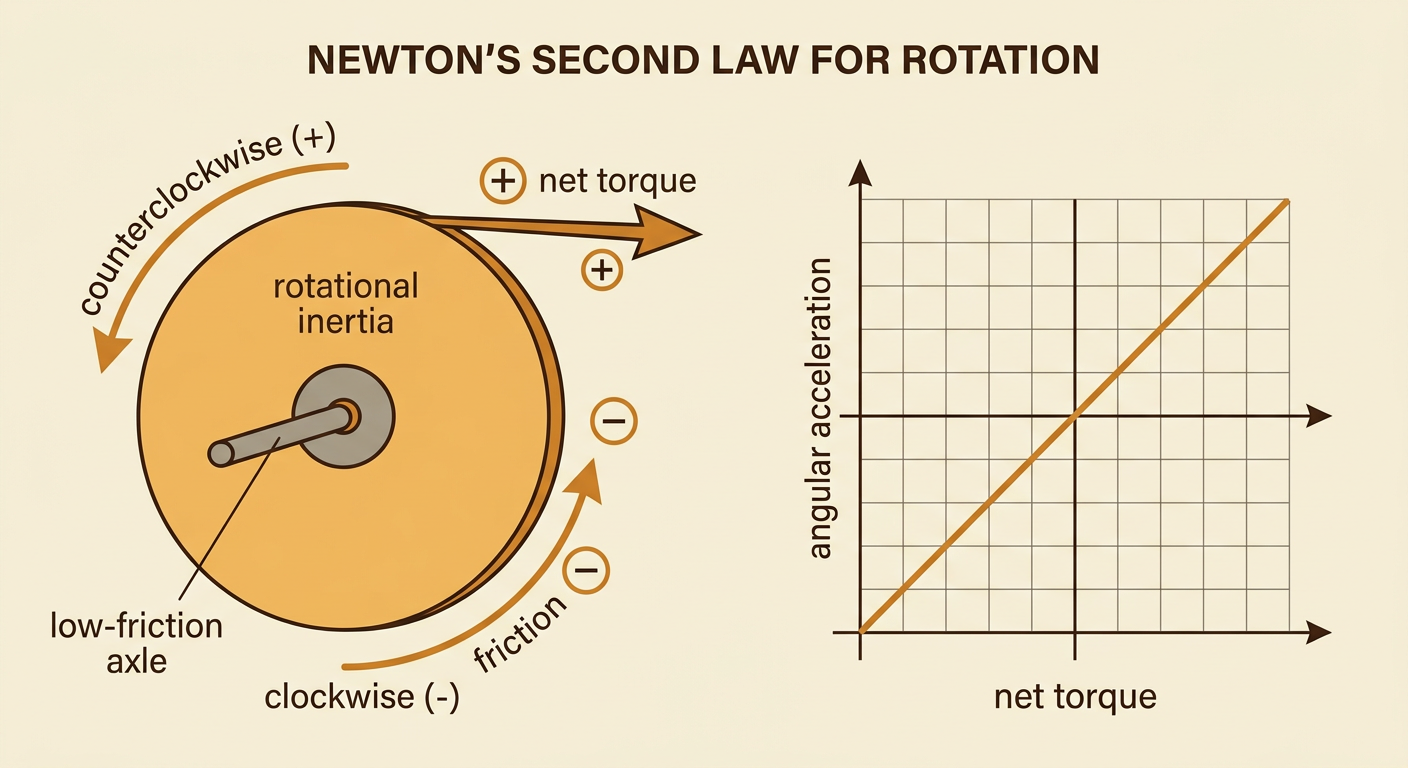
Newton’s second law for rotation states that the net external torque on an object equals its rotational inertia times its angular acceleration: τnet = Iα. This relationship parallels Fnet = ma. Angular acceleration increases when net torque increases and decreases when rotational inertia increases. Torques must be added with signs based on their rotational directions, such as positive for counterclockwise and negative for clockwise. Suppose a solid disk has rotational inertia 2.0 kilogram-meter squared and experiences a net torque of 6.0 newton-meters. Its angular acceleration is α = τnet/I = 3.0 radians per second squared. If friction supplies an opposing torque, it must be included when calculating the net torque. Experimental data can test the relationship by graphing angular acceleration against net torque while keeping rotational inertia constant; the result should be a straight line with slope 1/I.
Conservation of Angular Momentum
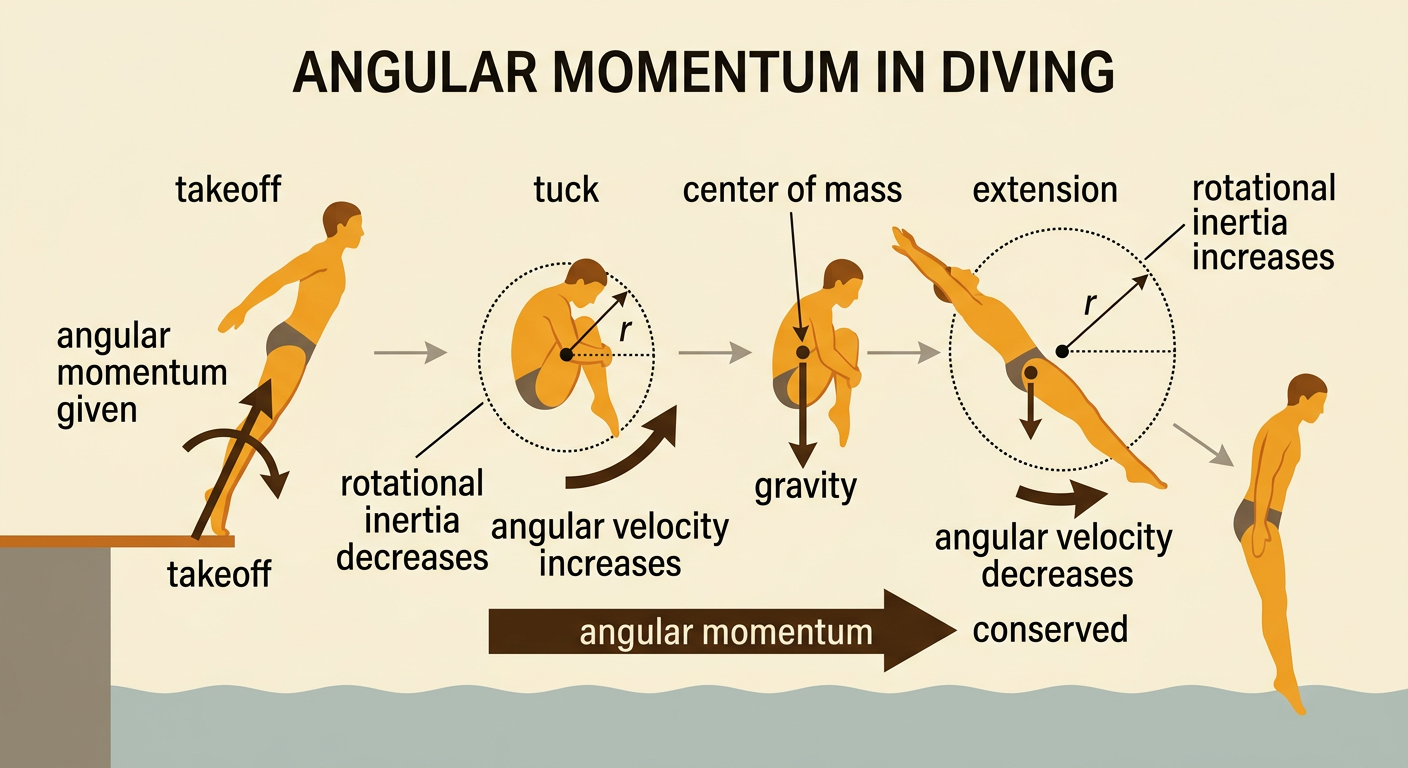
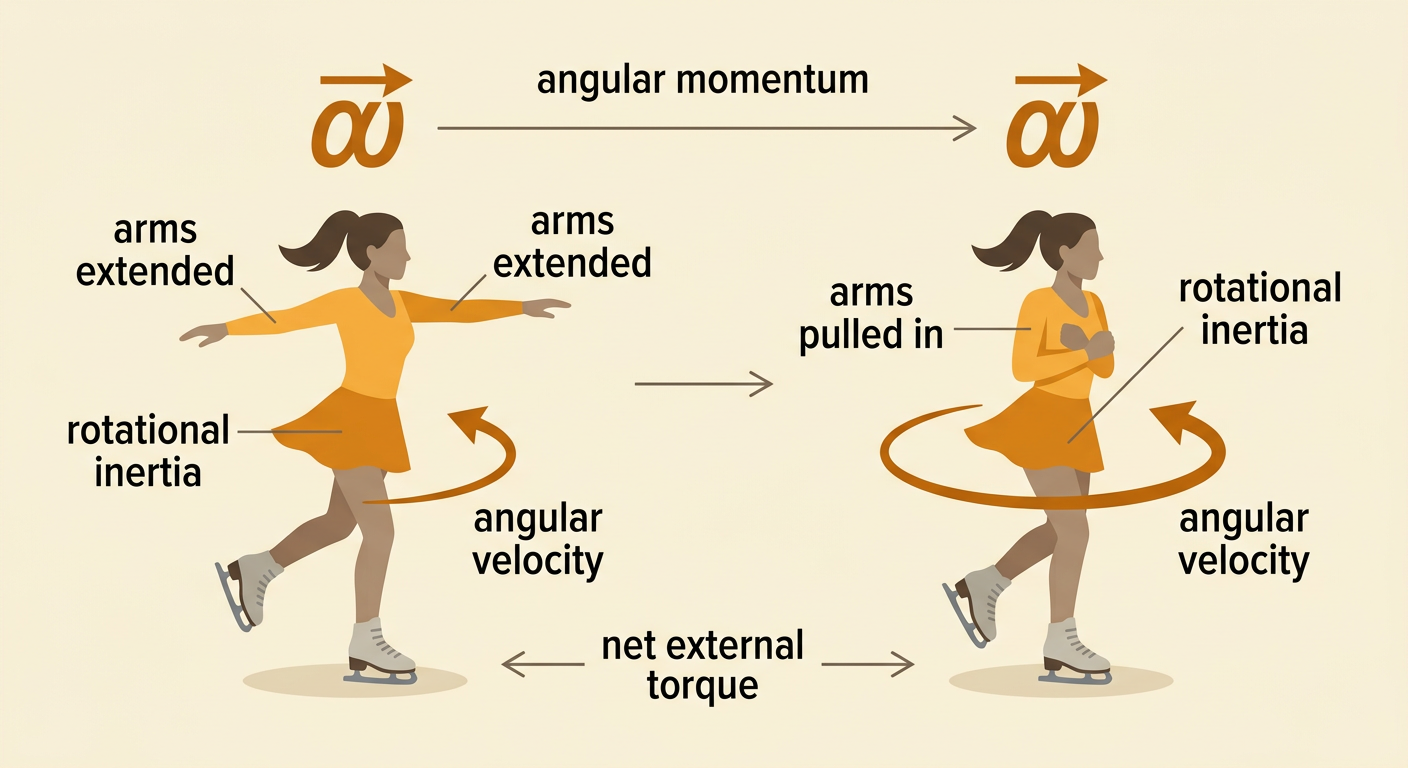
Angular momentum describes rotational motion. For a rigid object rotating about a fixed axis, L = Iω. A net external torque changes angular momentum according to τnet = ΔL/Δt. Therefore, when external torque is negligible, total angular momentum remains constant: Li = Lf. Internal forces may redistribute mass or transfer angular momentum between parts of a system, but they do not change the system’s total angular momentum. For example, a spinning skater who pulls in her arms decreases her rotational inertia. Because Iω stays constant, her angular velocity increases. If her rotational inertia is reduced to half its original value, her angular velocity doubles. Angular momentum is conserved only for the chosen system when the net external torque is approximately zero. Friction from the ice or air can eventually exert an external torque and slow the skater.
Applying Rotation to Real Systems
Analyzing a real rotating system begins by selecting the object or system, identifying the rotation axis, and drawing all external forces. Next, determine each force’s lever arm and direction, calculate the net torque, and use τnet = Iα to predict changes in angular velocity. If external torque is negligible during an interaction, use conservation of angular momentum instead. Consider a diver leaving a platform. During takeoff, the platform’s force provides torque that gives the diver angular momentum. While airborne, gravity acts approximately through the diver’s center of mass, so its torque about that point is small. The diver tucks to reduce rotational inertia and rotate faster, then extends before entering the water to increase rotational inertia and rotate more slowly. Video frames, measured times, and body-position estimates can provide evidence for a quantitative explanation connecting torque, rotational inertia, angular acceleration, and angular momentum.