Round Multi-Digit Whole Numbers
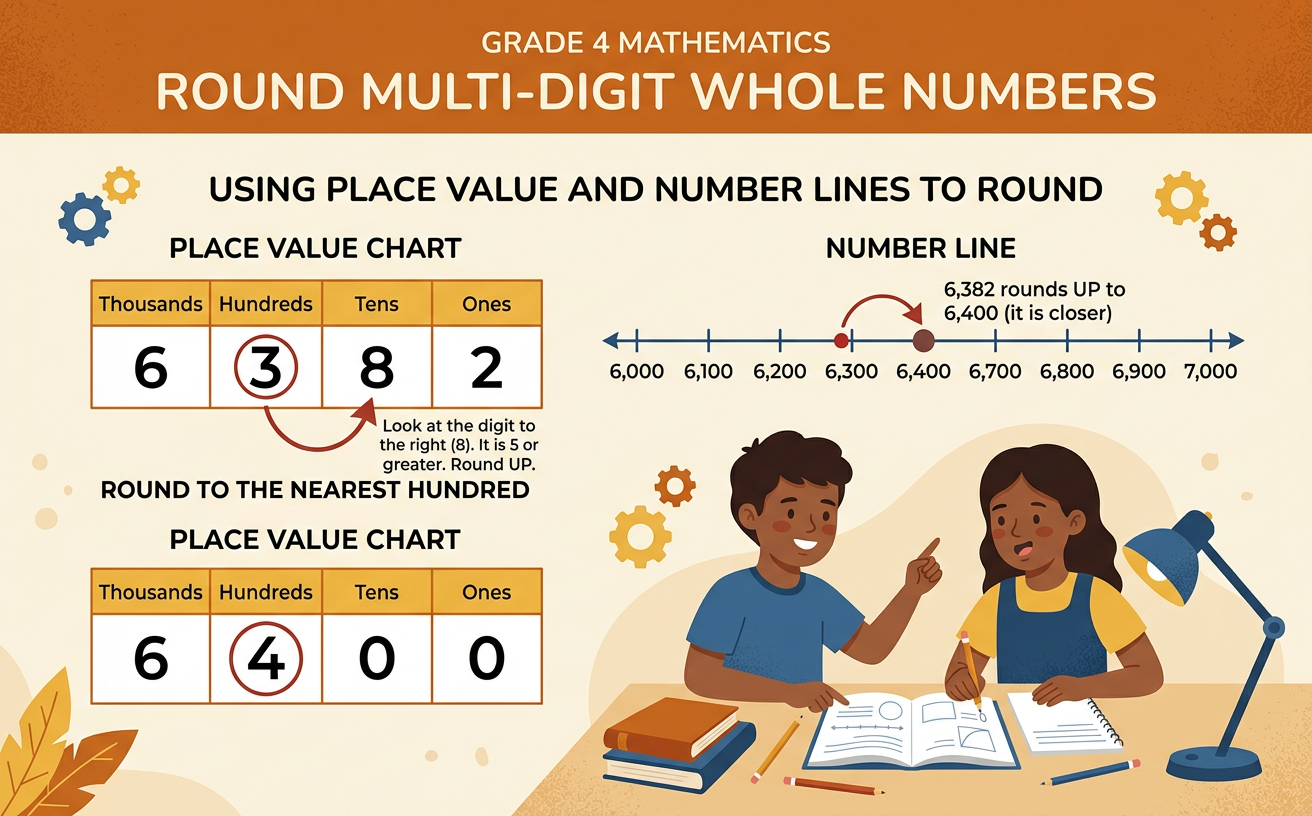
Students use place value and number lines to round multi-digit whole numbers to any specified place.
Illustrations are auto-generated and may be placeholders. They can be refreshed to match the narration.
Review Place Values
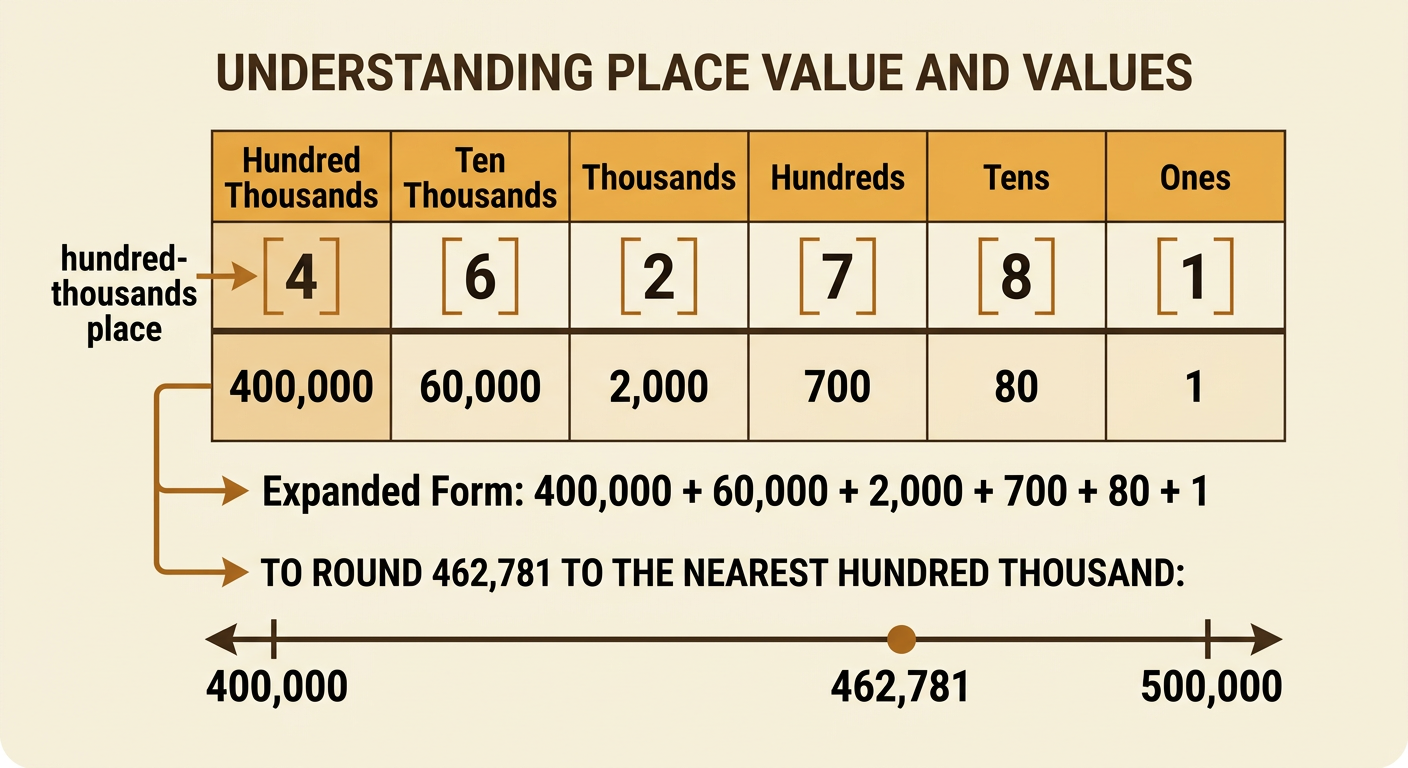
A digit’s value depends on its place in a number. Moving one place to the left makes a digit’s value ten times greater. In 462,781, the 4 is in the hundred-thousands place and has a value of 400,000. The 6 has a value of 60,000, and the 2 has a value of 2,000. To round correctly, first read the number and name each place. You can write the number in expanded form: 400,000 + 60,000 + 2,000 + 700 + 80 + 1. This form makes each digit’s value easy to see. If you round 462,781 to the nearest hundred thousand, you are deciding whether the number is closer to 400,000 or 500,000.
Locate Numbers on a Number Line
A number line helps you see which rounded value is closer to a number. To round 3,672 to the nearest hundred, find the hundreds on either side of it. The lower hundred is 3,600, and the higher hundred is 3,700. Place these values at the ends of a number line. The halfway point is 3,650 because it is 50 away from both endpoints. The number 3,672 lies between 3,650 and 3,700, so it is closer to 3,700. Therefore, 3,672 rounds to 3,700. If a number is exactly at the halfway point, use the rounding rule: round up to the greater neighboring multiple.

Identify the Rounding Place
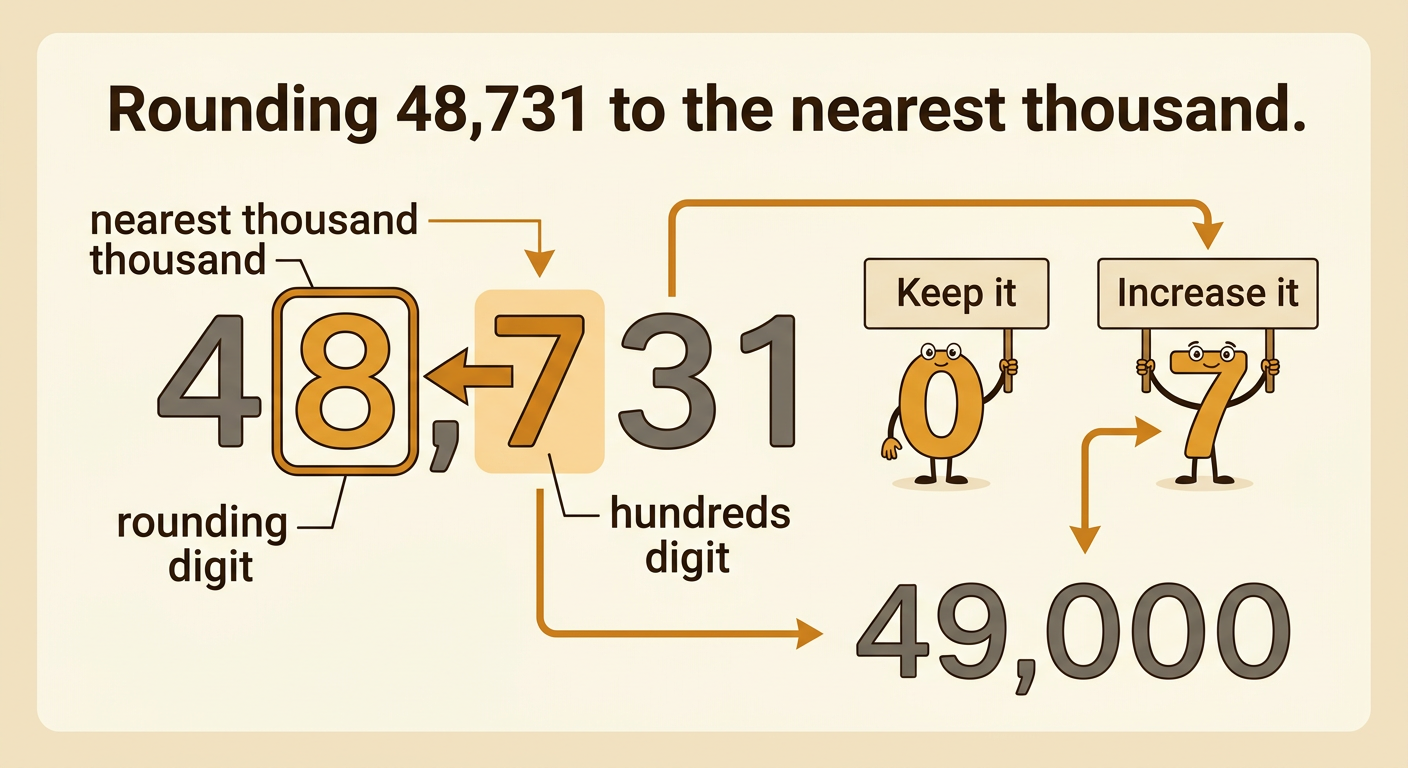
Before rounding, identify the place named in the question. Suppose you must round 48,731 to the nearest thousand. The digit in the thousands place is 8. This is the rounding digit. Next, look one place to its right, at the hundreds digit. The hundreds digit is 7. A digit from 0 through 4 tells you to keep the rounding digit the same. A digit from 5 through 9 tells you to increase the rounding digit by 1. Because 7 is at least 5, increase 8 to 9. Change every digit to the right of the thousands place to zero. Thus, 48,731 rounds to 49,000. Digits to the left of the rounding place remain unchanged.
Round Using Neighboring Multiples
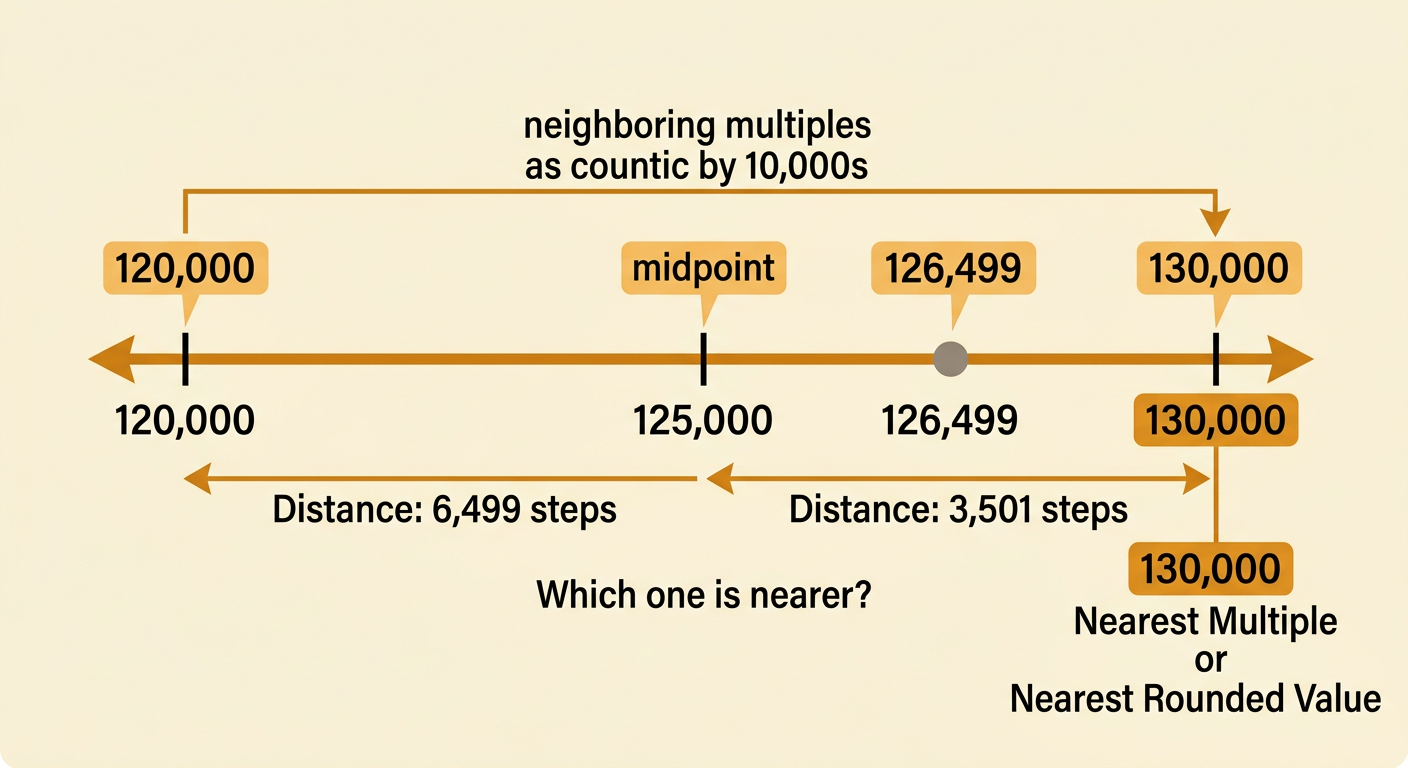
Another reliable method is to find the two neighboring multiples of the rounding unit. To round 126,499 to the nearest ten thousand, find the multiples of 10,000 on either side. They are 120,000 and 130,000. Their midpoint is 125,000. Since 126,499 is greater than the midpoint, it is closer to 130,000. Therefore, 126,499 rounds to 130,000. You can also compare distances: 126,499 is 6,499 away from 120,000 but only 3,501 away from 130,000. The smaller distance confirms the answer. Neighboring multiples work for any place, including tens, hundreds, thousands, ten thousands, and hundred thousands. Always choose the multiple that is nearest to the original number.
Explain and Check Solutions
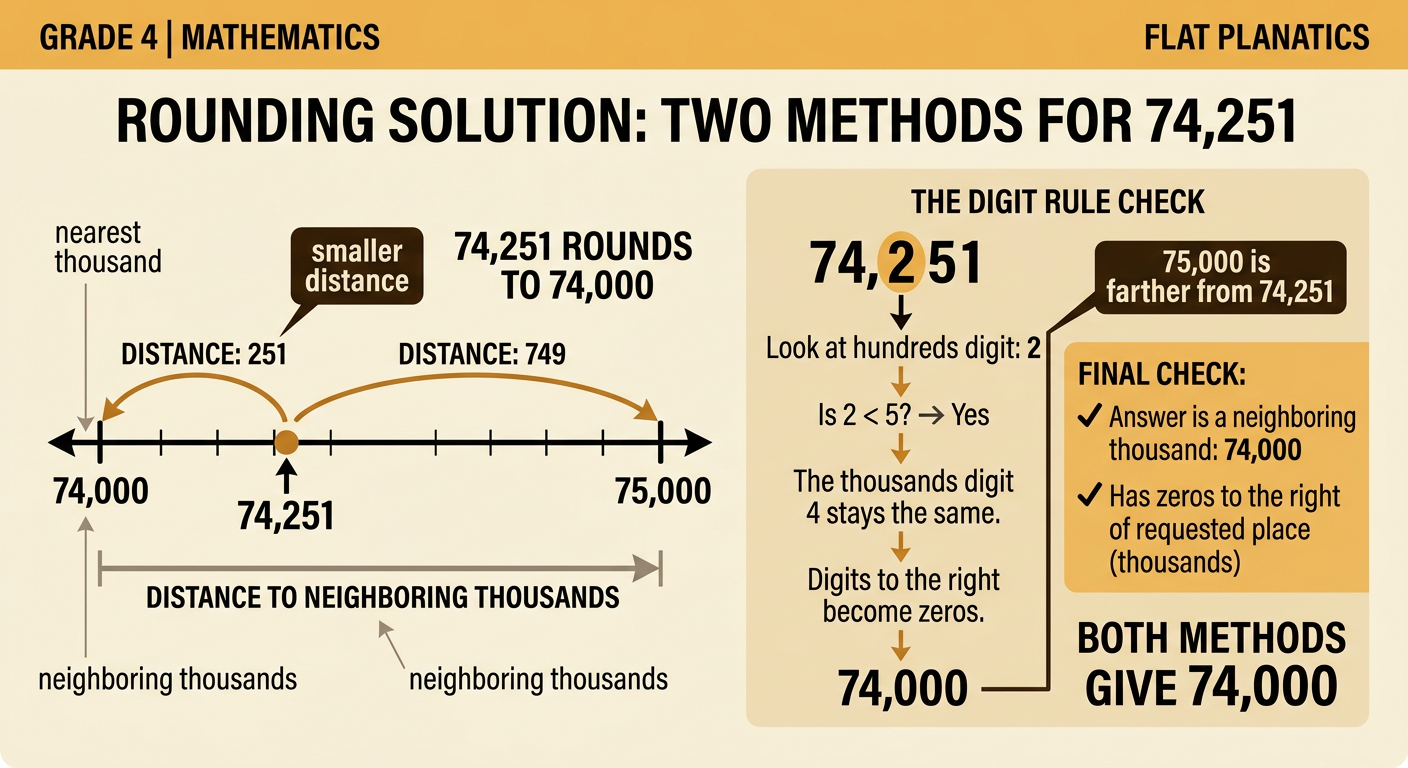
A complete solution names the rounding place, identifies the neighboring multiples, and explains which multiple is closer. For example, round 74,251 to the nearest thousand. The neighboring thousands are 74,000 and 75,000. The number is 251 away from 74,000 and 749 away from 75,000. Since 251 is the smaller distance, 74,251 rounds to 74,000. You can check using the hundreds digit, which is 2. Because 2 is less than 5, the thousands digit stays the same, and the digits to its right become zeros. Both methods give 74,000. Also check that your answer has zeros to the right of the requested place and is one of the two neighboring multiples.