Routing Data Across a Resilient Network
Students simulate packet routing, compare possible paths, and redesign a network so messages can still reach their destination when a connection fails.
Illustrations are auto-generated and may be placeholders. They can be refreshed to match the narration.
Packets, Routers, and Addresses
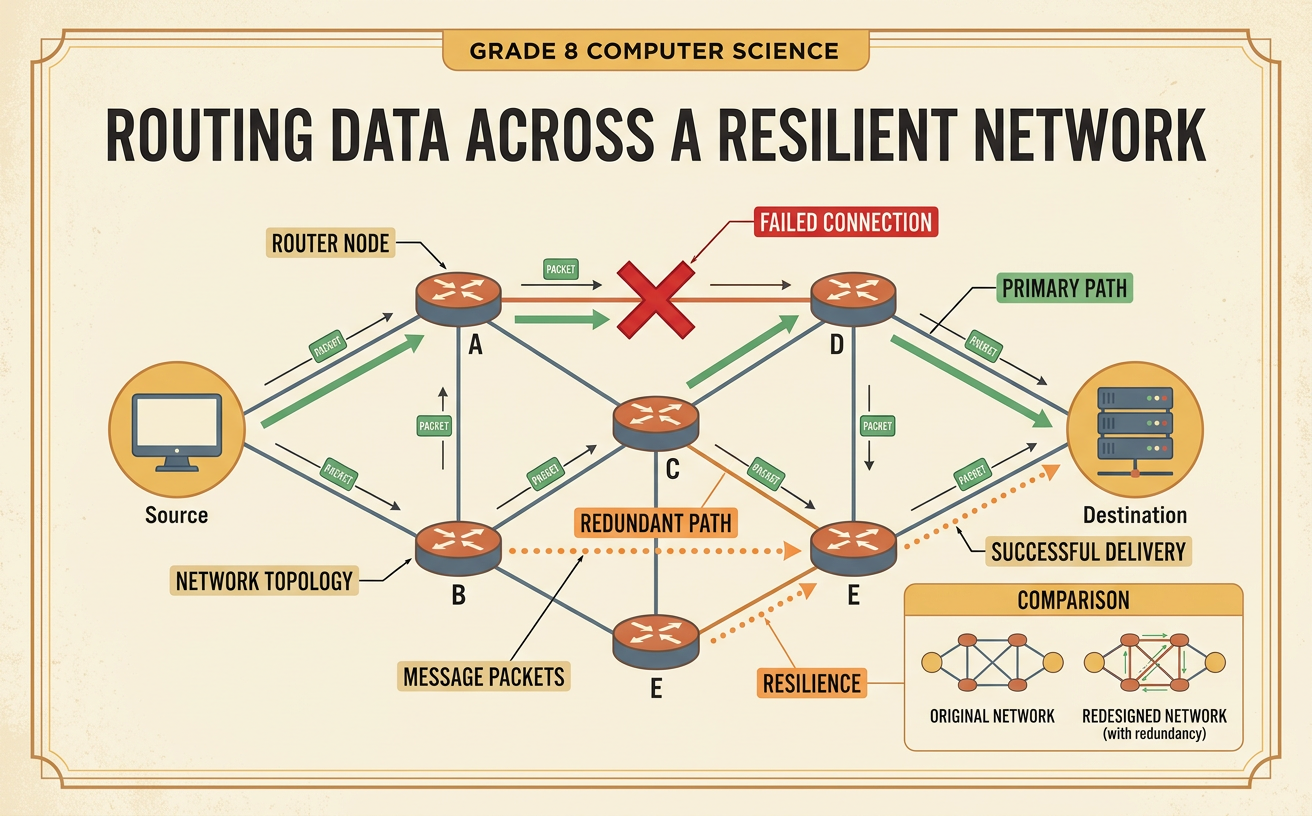
A message sent across a network is divided into small units called packets. Each packet contains part of the message and a header with information such as the destination address, source address, and packet number. Routers are devices that examine destination addresses and forward packets toward their destinations. Imagine that Maya sends the text “Meet at 4” from Computer A to Computer B. The network may divide the text into three packets. Router R1 could send one packet through R2 while another travels through R3. Computer B uses the packet numbers to place the pieces in the correct order. Packets can take different routes because traffic, broken connections, or routing rules may make one path more useful than another. This flexibility helps the internet connect people and communities across great distances.

Simulate a Message Route
Use a network map with six nodes: source computer A, destination computer F, and routers B, C, D, and E. Each line represents a working connection. First, write “A to F” and a sequence number on three paper packets. Place all packets at A. For each turn, move one packet across one connection toward F. Record every node the packet visits and add the connection costs along its route. For example, the route A-B-D-F might have costs of 2, 2, and 3, for a total cost of 7. The route A-C-E-F could have costs of 1, 4, and 1, for a total of 6. Continue until every packet reaches F, then arrange the packets by sequence number. Following these steps carefully models how packets are forwarded and reassembled.

Introduce a Connection Failure
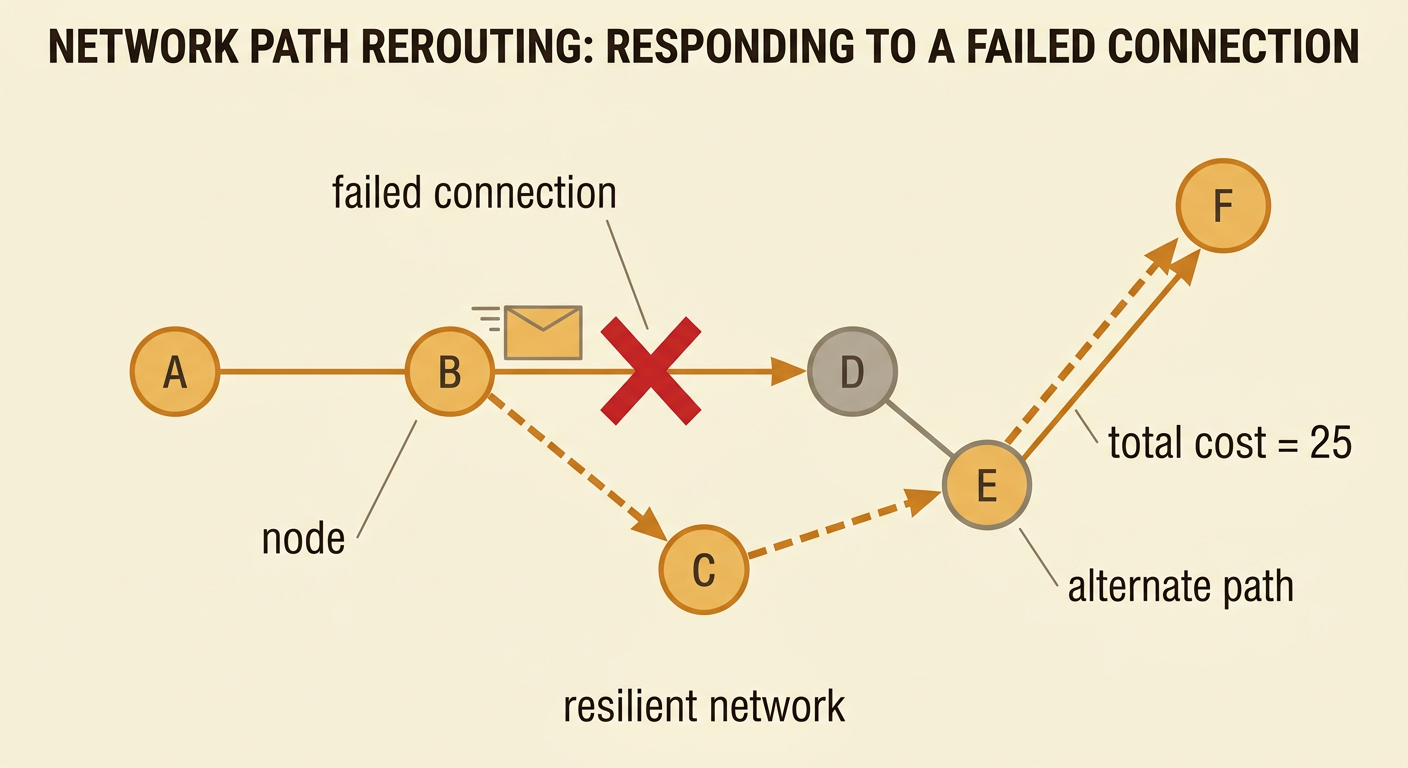
Now test what happens when one connection stops working. On the network map, cover or cross out the line between routers B and D. A packet at B can no longer move directly to D, so the original route A-B-D-F is unavailable. Do not move the packet across the failed line. Instead, check the remaining connections and select another complete path to F, such as B-C-E-F, if those links exist. Record the new route and its total cost. Also note whether delivery succeeds and whether the route takes more steps than before. A resilient network has alternate paths, so one failed connection does not stop all communication. If no alternate path connects A to F, the packet cannot be delivered until a connection is repaired or the network is redesigned.
Compare Routing Solutions
Compare possible routes using shared criteria and constraints. Criteria describe desired results, such as successful delivery, low total cost, few steps, or tolerance of one failed connection. Constraints are limits, such as using only existing connections or allowing a maximum cost of 8. Suppose Route 1, A-C-E-F, costs 6 and uses three connections but fails if C-E breaks. Route 2, A-B-C-E-F, costs 7 and uses four connections, yet it can connect to more alternate paths. Route 1 is more efficient during normal operation, while Route 2 may offer better options during a failure. Create a table and score each route for delivery, cost, number of connections, and backup options. The strongest solution is not always the shortest; it is the one that best satisfies the selected criteria without violating the constraints.

Redesign for Network Resilience
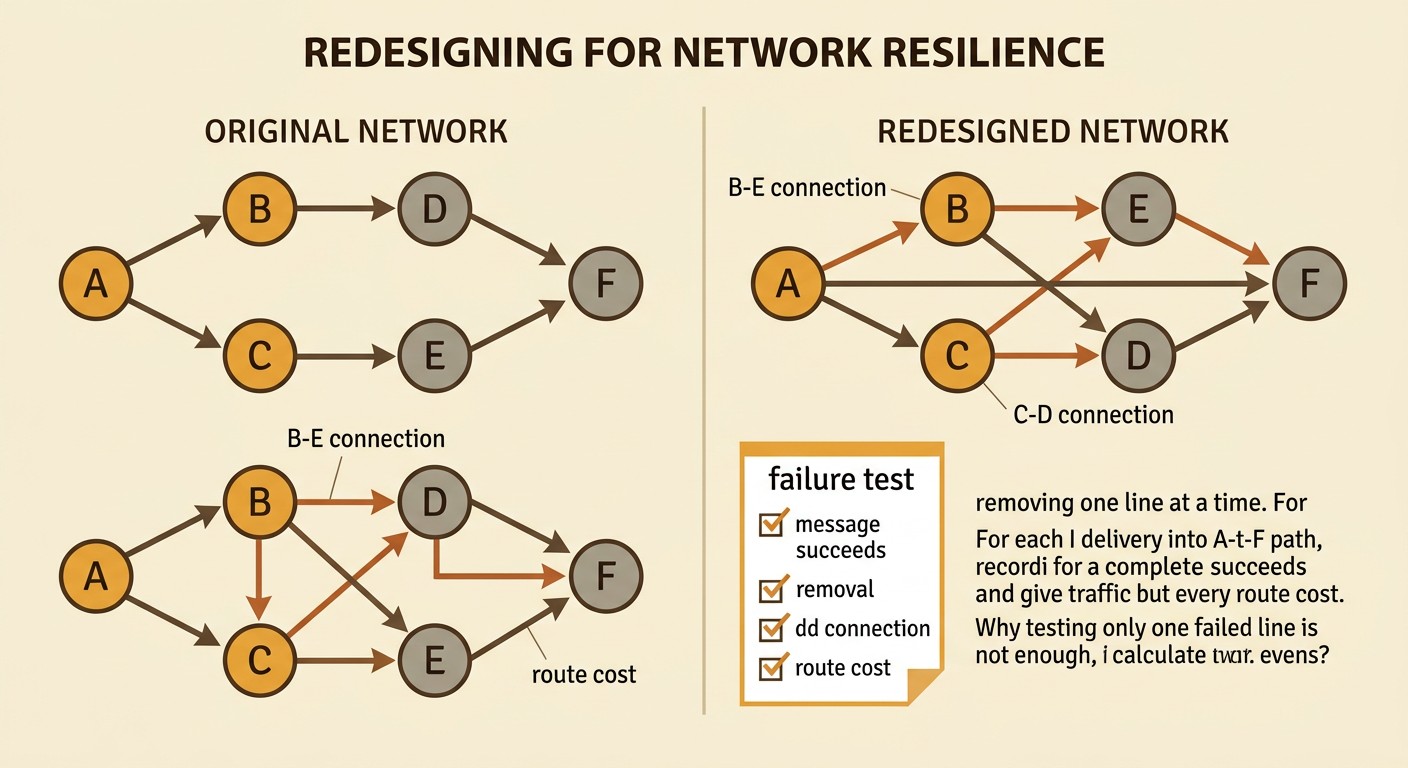
Redesign the network so messages can still travel from A to F after any one connection fails. Add a limited number of new connections, then test each design by removing one line at a time. For example, adding a connection between B and E creates the alternate route A-B-E-F when B-D fails. Adding a C-D connection creates another way around a failure near the center. Choose additions that improve resilience without exceeding a constraint, such as adding no more than two connections. Explain your choice with evidence from failure tests and route costs. Resilient communication networks matter beyond the classroom. Reliable connections can support homes, schools, hospitals, businesses, and emergency services, influencing where people settle. They also help news, scientific knowledge, music, language, and cultural practices spread between communities, even when distance or damaged infrastructure creates barriers.