Salt in the Soil: Farming Challenges in Ancient Sumer
Students use geographic and historical evidence to explain how irrigation supported Sumerian civilization but also contributed to soil salinization and declining crop yields.
Illustrations are auto-generated and may be placeholders. They can be refreshed to match the narration.
Why Sumer Needed Irrigation
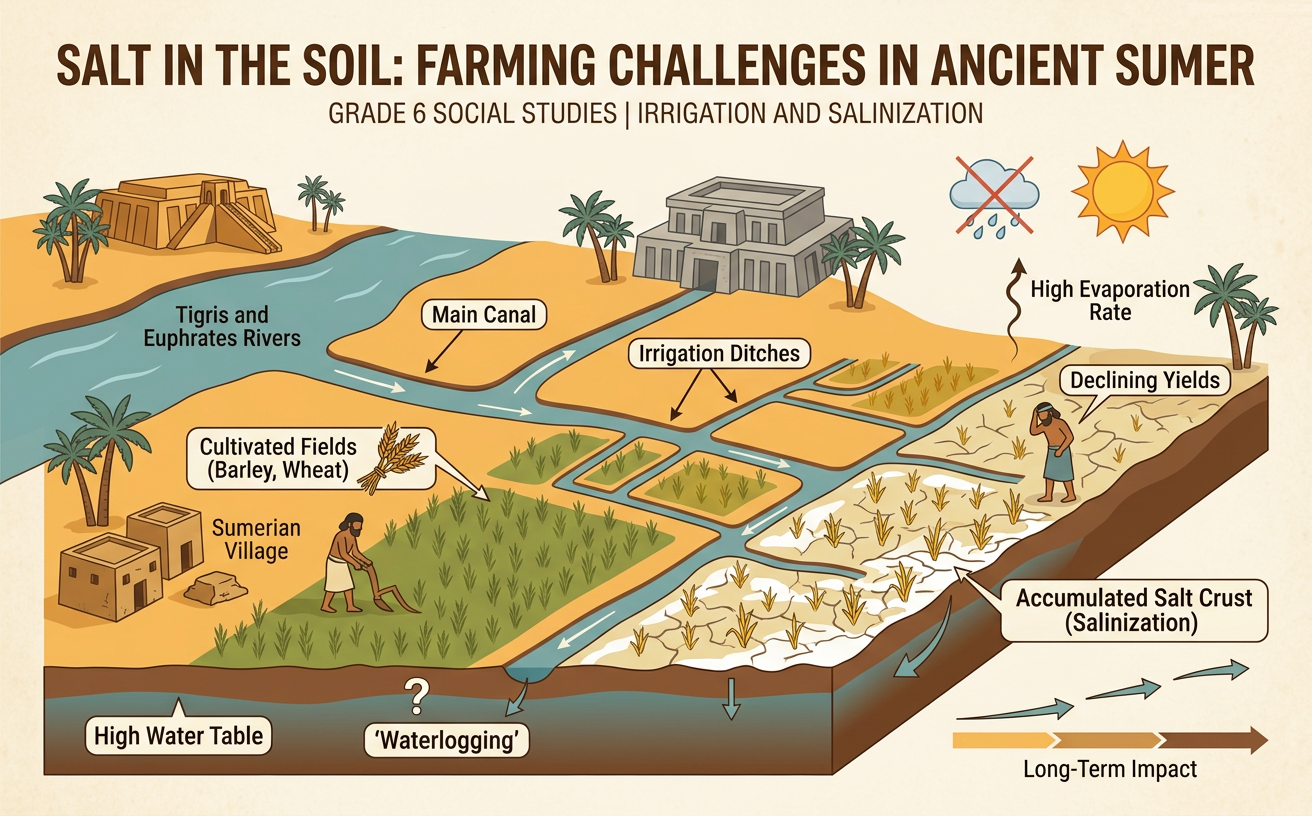
Sumer developed in southern Mesopotamia, on a hot, dry plain between the Tigris and Euphrates Rivers. The region received too little rainfall for farmers to depend on rain alone. Although the rivers sometimes flooded, the water did not always arrive when crops needed it. Sumerians dug canals to move river water to fields and grow wheat, barley, dates, and vegetables. Irrigation helped produce food surpluses that supported cities, specialized workers, and government. For example, farmers near the city of Ur could guide water from the Euphrates through canals to fields beyond the riverbank. Without this planned water supply, many fields would have remained too dry for reliable farming. Geography therefore shaped both Sumerian agriculture and the growth of its civilization.

How Irrigation Systems Worked
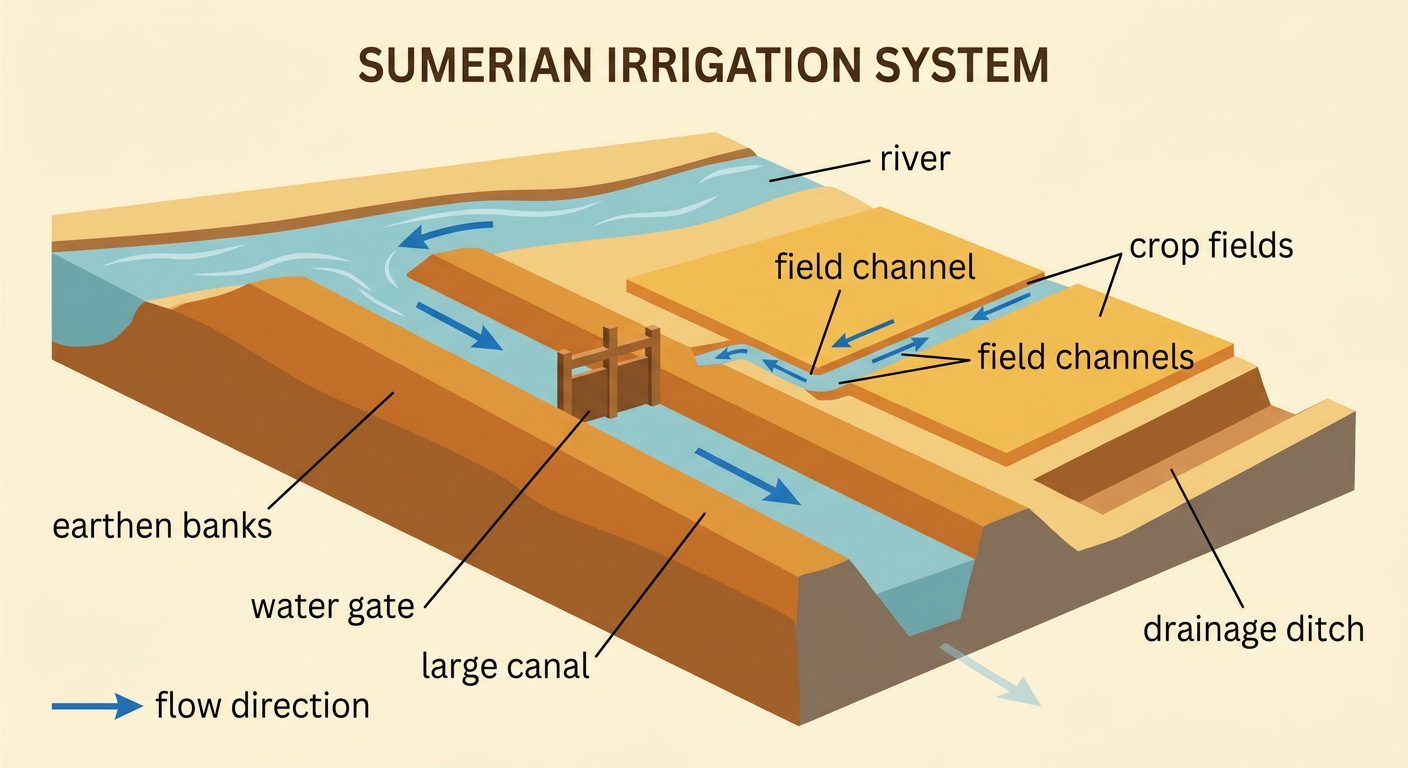
Sumerian irrigation depended on a connected system of canals, gates, ditches, and field channels. Workers diverted water from a river into a large canal. Smaller channels then carried it toward individual fields. Farmers opened or blocked channels to control where the water flowed. Earthen banks helped keep water inside the canals, while drainage ditches carried away some excess water. Building and maintaining this system required cooperation. Canals filled with mud and had to be cleared, and broken banks had to be repaired. For example, if silt blocked a canal serving several farms, workers organized by a temple or local ruler might remove the buildup together. Irrigation increased food production, but it also gave communities new responsibilities and sometimes caused disagreements about access to water.
Salt Buildup in the Soil
Irrigation water naturally contains small amounts of dissolved salts. When water soaks into soil, some of it is used by plants and some rises toward the surface. In Sumer’s hot climate, strong evaporation removes water but leaves the salts behind. Repeated irrigation can therefore cause salt to collect in the upper soil. This process is called soil salinization. Poor drainage makes the problem worse because salty groundwater remains close to plant roots. For example, a field watered year after year may develop a pale, salty crust. Seeds may sprout poorly, and plants may become smaller because their roots have difficulty taking in water. Irrigation did not immediately ruin every field, but long-term salt buildup could lower crop yields, especially in heavily watered or poorly drained areas.

Evidence from Ancient Crop Records
Historians study cuneiform tablets from Sumerian cities to learn about farming. These records list fields, grain deliveries, worker rations, and harvest amounts. Some records show that farmers increasingly planted barley instead of wheat in parts of southern Mesopotamia. Barley can tolerate salt better than wheat, so this change is evidence that farmers may have been responding to saltier soil. Tablets also suggest that harvest results varied among fields and over time. A single tablet cannot prove that salinization caused every decline because war, drought, pests, and poor canal maintenance also affected farming. However, when written records are compared with soil studies and knowledge of irrigation, a stronger explanation develops. For example, a record showing more barley production becomes especially useful when evidence also indicates long-term irrigation and salt buildup in the same region.

Human Choices and Environmental Change
Sumerian irrigation shows how human actions can change both the environment and society. Digging canals turned dry land into productive farmland and helped cities grow. Over time, however, repeated watering, limited drainage, and strong evaporation increased the risk of soil salinization. People responded in several ways. They could clean canals, improve drainage, reduce watering, leave fields unused for a time, or plant more salt-tolerant barley. Governments and temples also organized labor and controlled parts of the water system, affecting who received water and who did the work. For example, a community might choose to extend a canal to create new farmland, gaining larger harvests at first but increasing future drainage problems. The same human decision could therefore bring short-term benefits and long-term costs to the physical and cultural characteristics of a place.

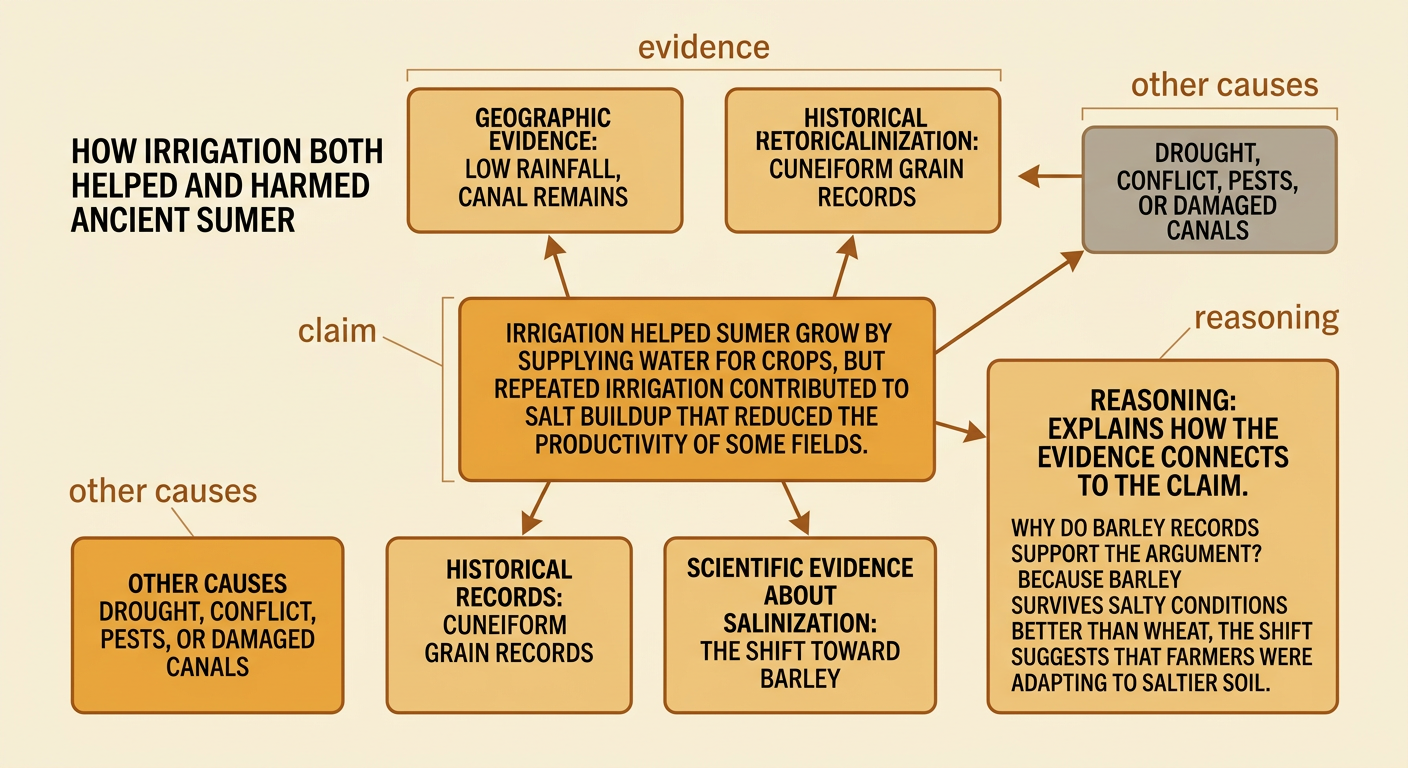
Make an Evidence-Based Claim
An evidence-based claim answers a question and is supported by specific information from sources. Consider this question: How did irrigation both help and harm ancient Sumer? A strong claim might state that irrigation helped Sumerian civilization grow by supplying water for crops, but repeated irrigation contributed to salt buildup that reduced the productivity of some fields. Evidence could include the region’s low rainfall, the remains of canal systems, cuneiform grain records, the shift toward salt-tolerant barley, and scientific knowledge about evaporation. Reasoning must explain how each piece of evidence supports the claim. For example, barley records matter because barley survives salty conditions better than wheat, suggesting that farmers adapted to changing soil. A complete argument should also acknowledge that salinization was not the only possible cause of lower yields; drought, conflict, and damaged canals may also have contributed.