
Same Kind, Different Traits: Comparing Animal Families
Students observe photographs of animal parents and their young, record shared and different traits, and use the evidence to explain that offspring resemble—but are not identical to—their parents.

Illustrations are auto-generated and may be placeholders. They can be refreshed to match the narration.
Notice Animal Family Traits
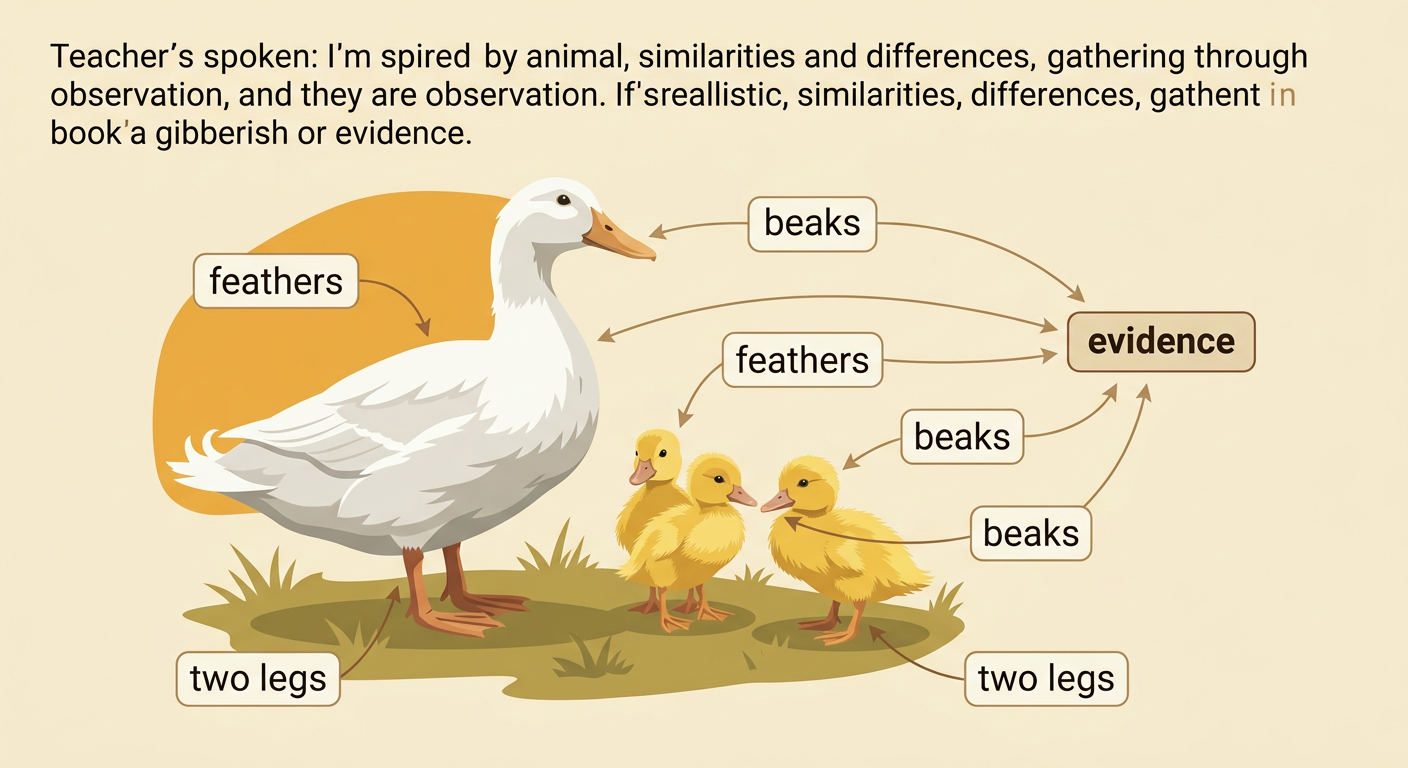
Animals have traits, or features we can notice. Traits include body covering, color, markings, number of legs, ear shape, and tail shape. Look closely at a photograph of an adult duck and its ducklings. The adult and young both have two legs, two eyes, beaks, and feathers. Their feathers are not the same color. The adult may have white feathers, while the ducklings have yellow feathers. Use photographs from a trusted animal book, museum, zoo, or science website. These sources show real animals and help us answer the question, “How are young animals like their parents?” Name only traits you can see in the photograph. Careful observations give us evidence, or information that supports an idea.
Compare Parents and Young
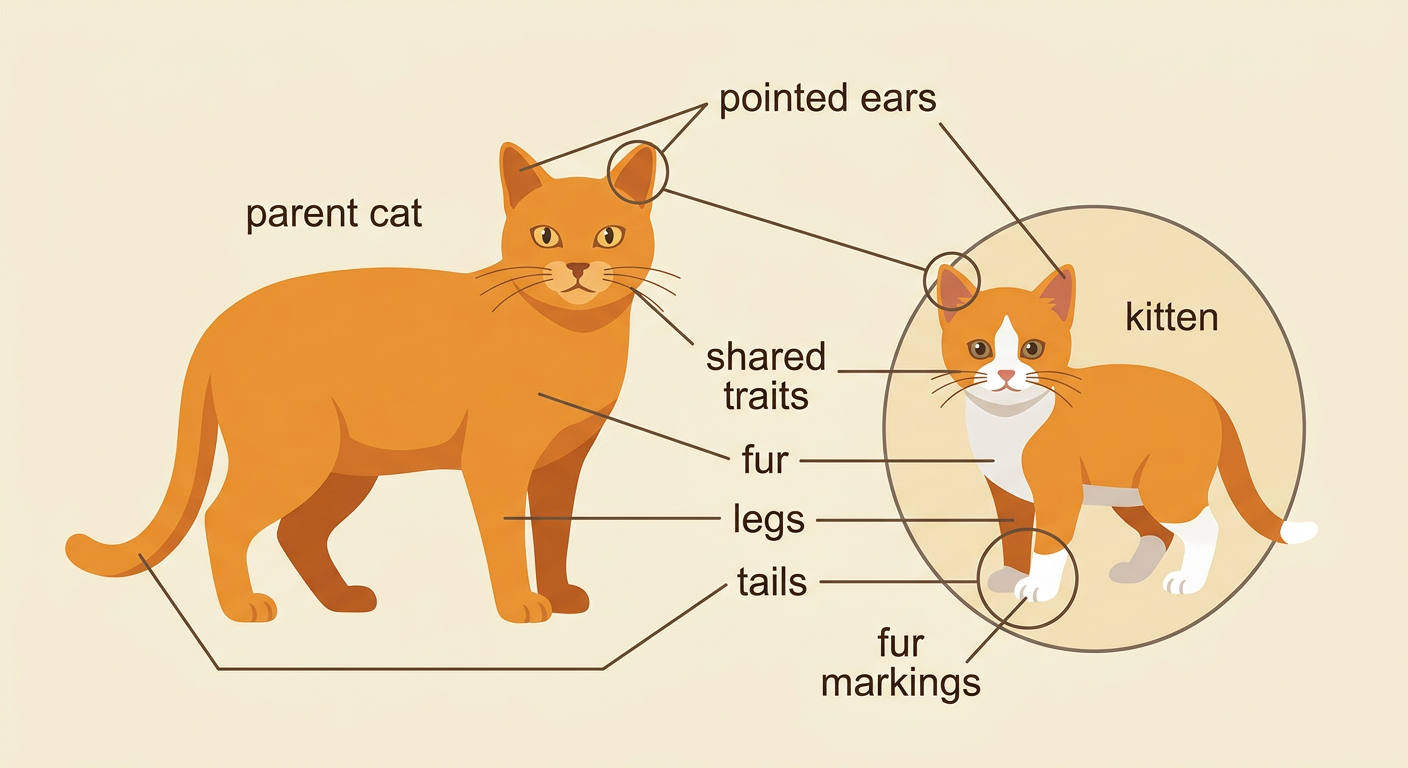
Compare means to look for ways things are alike and different. Study a photograph of a parent cat and one kitten. First, look at one trait at a time. Both cats may have fur, four legs, pointed ears, whiskers, and long tails. These are shared traits. Next, notice differences. The parent may be larger and have solid orange fur. The kitten may be smaller and have orange fur with white paws. Do not use size alone to decide whether animals are alike because young animals usually grow. Record what the photograph shows. You can say, “Both have pointed ears, but their fur markings are different.” This comparison is evidence that a kitten resembles its parent but is not an exact copy.
Sort and Record Trait Evidence
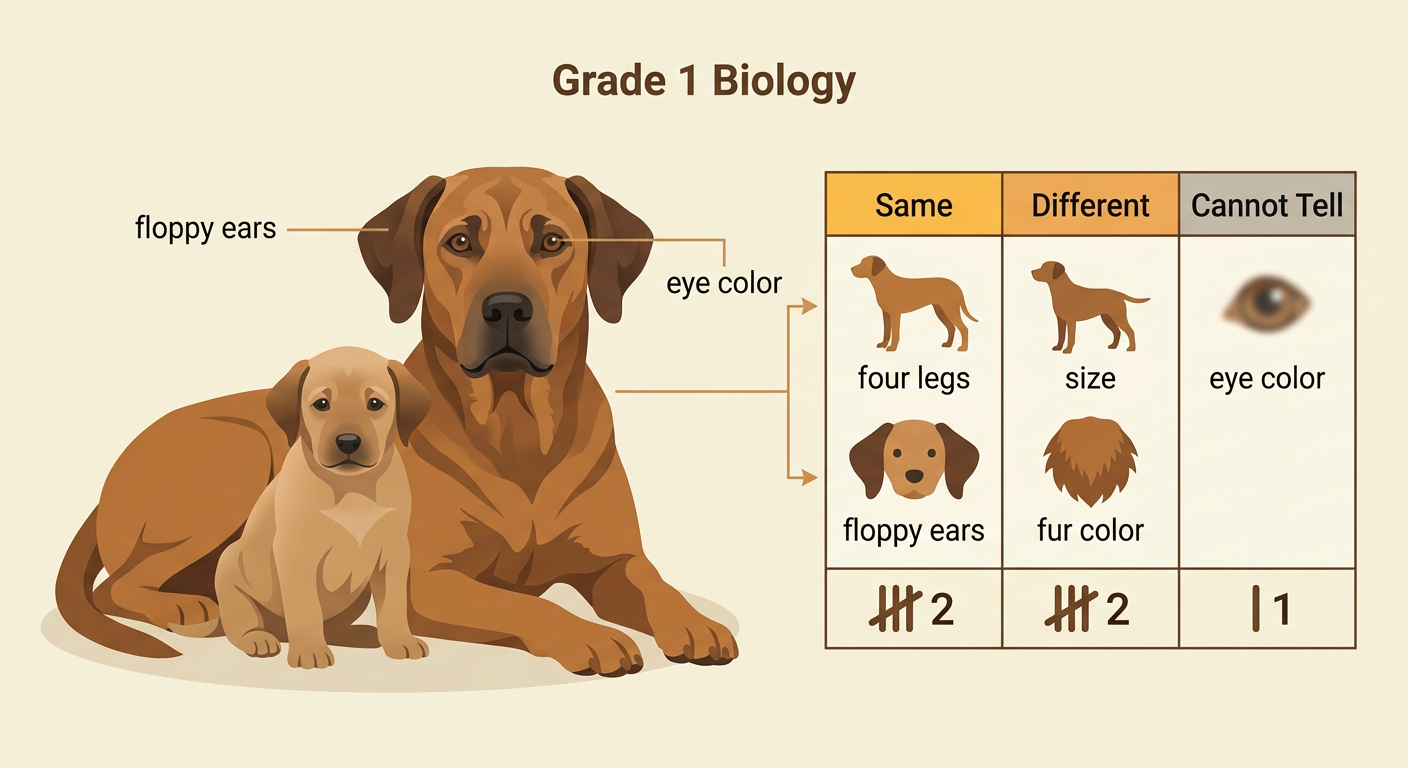
Scientists organize observations so patterns are easier to see. Make a chart with three categories: Same, Different, and Cannot Tell. Observe a parent dog and a puppy in a clear photograph. Put “four legs” and “floppy ears” in the Same category. Put “size” and “fur color” in the Different category if the photograph shows those differences. Put “eye color” under Cannot Tell if the eyes are not clear. Then count the traits in each category. For example, you might record 2 same traits, 2 different traits, and 1 trait you cannot tell. Compare the numbers by asking which category has more, fewer, or the same number. The chart keeps your evidence organized and shows that honest observers do not guess when a source does not provide enough information.
Discuss Similarities and Differences
Share your observations with a partner or the class. Use the photograph and chart as evidence. One student might say, “The foal and parent horse both have four legs, hooves, manes, and tails.” Another student might add, “The foal is smaller, and its mane is shorter.” Listen to each idea and check the source. Ask, “What do you see that makes you think that?” Sometimes classmates notice different traits in the same photograph. Look again together and decide whether each claim belongs in Same, Different, or Cannot Tell. Use respectful words such as “I agree because…” or “I noticed something else.” The goal is not to win an argument. The goal is to use careful observations to explain how a young animal resembles its parent without being exactly the same.

Write an Evidence-Based Conclusion
Use your observations to write a conclusion. A conclusion answers the question and includes evidence. Begin with the main idea: “Young animals are like their parents, but they are not exactly the same.” Then add details from a photograph or chart. For example: “The lamb and parent sheep both have four legs, wool, and similar ears. The lamb is smaller, and its wool is a different shade.” Finish by connecting the evidence to the idea: “This shows that the lamb resembles its parent but is not identical to it.” You may draw and label the two animals before writing. Check that every detail comes from the provided source or your recorded observations. Do not add a trait you could not see. Read your conclusion aloud to make sure it names at least one similarity and one difference.
