
School Then and Now: Clues from Artifacts
Students examine photographs and classroom objects to compare school life in the past with school life today and support their observations with evidence.
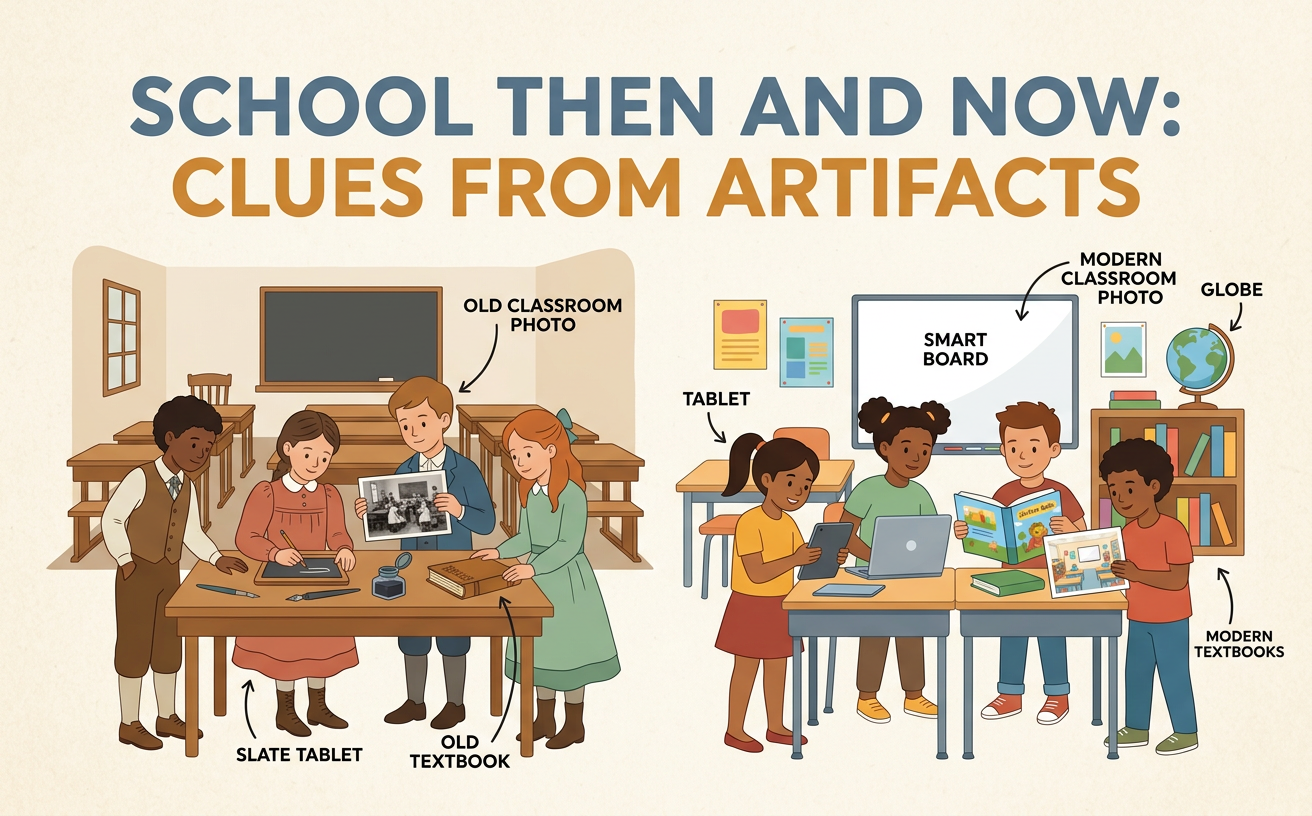
Illustrations are auto-generated and may be placeholders. They can be refreshed to match the narration.
What Is an Artifact?
An artifact is an object made, used, or changed by people. Artifacts can give us clues about how people lived in the past. A slate used for writing, an old wooden desk, or a school bell can be an artifact. Historians study an artifact by looking closely, asking questions, and reading information that comes with it. They might ask, “What is it made of?” “How was it used?” and “Who may have used it?” For example, scratch marks on a small slate may show that a student wrote on it many times. An artifact does not tell a complete story by itself. We combine clues from the object, photographs, labels, and written sources to make a careful conclusion about school life long ago.

Observe School Clues from the Past
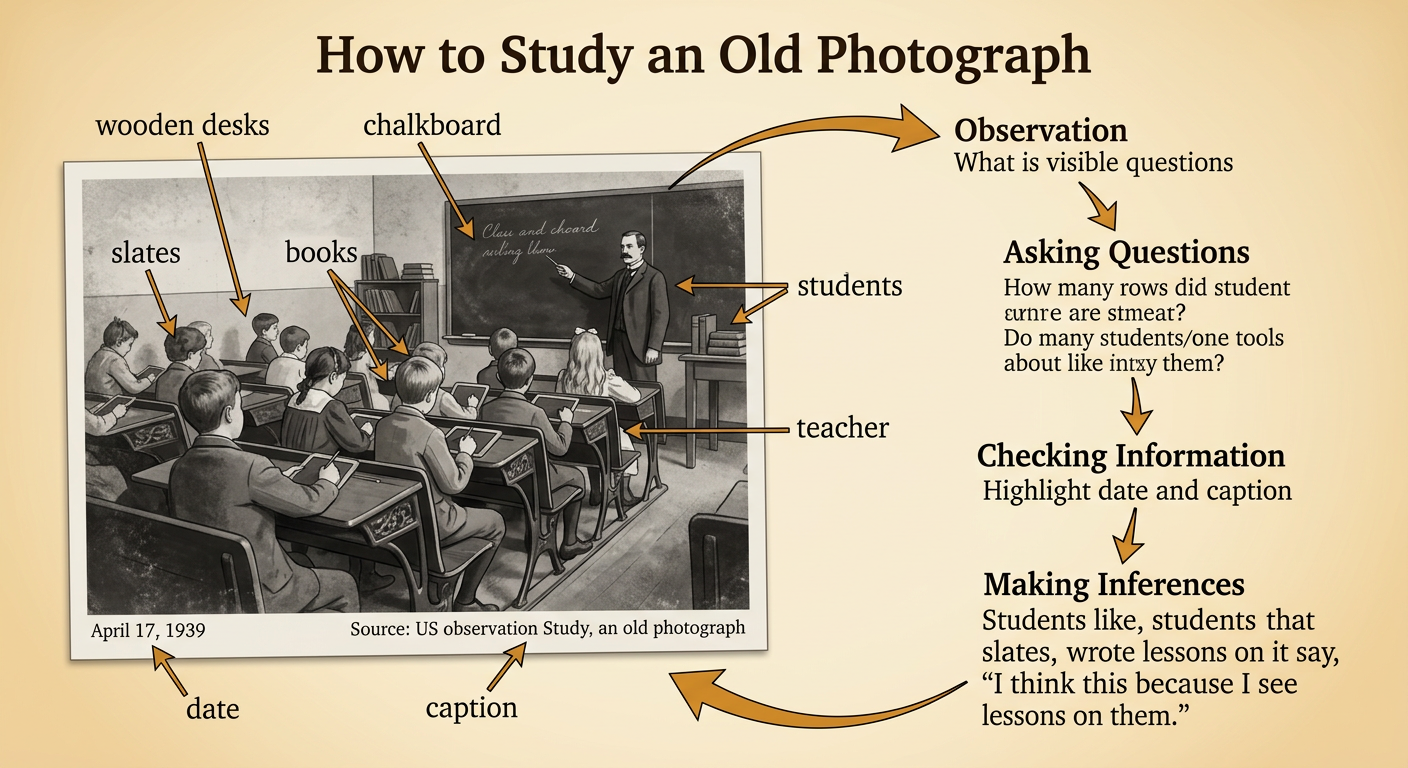
Study an old classroom photograph from left to right and from front to back. First, name only what you can see. You might observe rows of wooden desks, a chalkboard, books, and one teacher standing near the front. Next, ask questions about those details. Why are the desks arranged in rows? What tools are students using? Read the photograph’s date and caption because they provide important evidence. Then make a possible inference, or idea based on clues. For example, if each student has a slate and no computer is visible, you might infer that students wrote lessons on slates in that classroom. Say, “I think this because I see…” Remember that one photograph shows one place and moment. It does not prove that every school in the past looked the same.
Classify the Objects and Materials
Objects can be described and classified by observable properties, which are features we can notice safely. Examine classroom objects without damaging them. Look at color, shape, texture, flexibility, and the material each object is made from. A wooden ruler may be hard, smooth, stiff, and made of wood. A modern plastic ruler may also be hard and stiff, but it is made of plastic and may be clear. Sort sample objects into material groups such as wood, metal, glass, paper, cloth, and plastic. Some objects contain more than one material. For example, an old school desk might have a wooden seat and metal legs. Record what you observe in a chart. Do not guess a material from color alone; look for several properties and use source labels when available.

Compare School Then and Now
To compare means to tell how things are alike and different. Use evidence from an old classroom photograph and a present-day classroom photograph. A Venn diagram can organize your observations. In the “Then” circle, you might record writing slates, a hand bell, and wooden desks in rows. In the “Now” circle, you might record tablets, dry-erase boards, and desks that can be moved into groups. In the overlapping middle, you could record teachers, students, books, writing tools, and places to sit. Materials may have changed too. Some older objects were made mainly from wood, metal, slate, or paper, while many present-day objects include plastic and electronic parts. Base each comparison on visible clues or source information, not on guesses. Different schools in both time periods may have used different objects.

Share Evidence-Based Conclusions
A conclusion tells what you learned after studying the evidence. Begin with a clear answer to a question such as, “How have classroom writing tools changed?” Then name specific evidence from artifacts, photographs, captions, or an observation chart. You might say, “Writing tools have changed over time. In the old photograph, students hold slates, and the artifact label says chalk was used on them. In the current photograph, students use pencils, paper, and tablets.” Explain how the evidence supports your answer: the different tools show that students had different ways to record their work. You can also mention what stayed the same, such as students still writing and sharing ideas. Ask and answer questions about classmates’ conclusions. If new evidence appears, revise your conclusion. Strong historians make careful claims and clearly identify the clues that support them.
