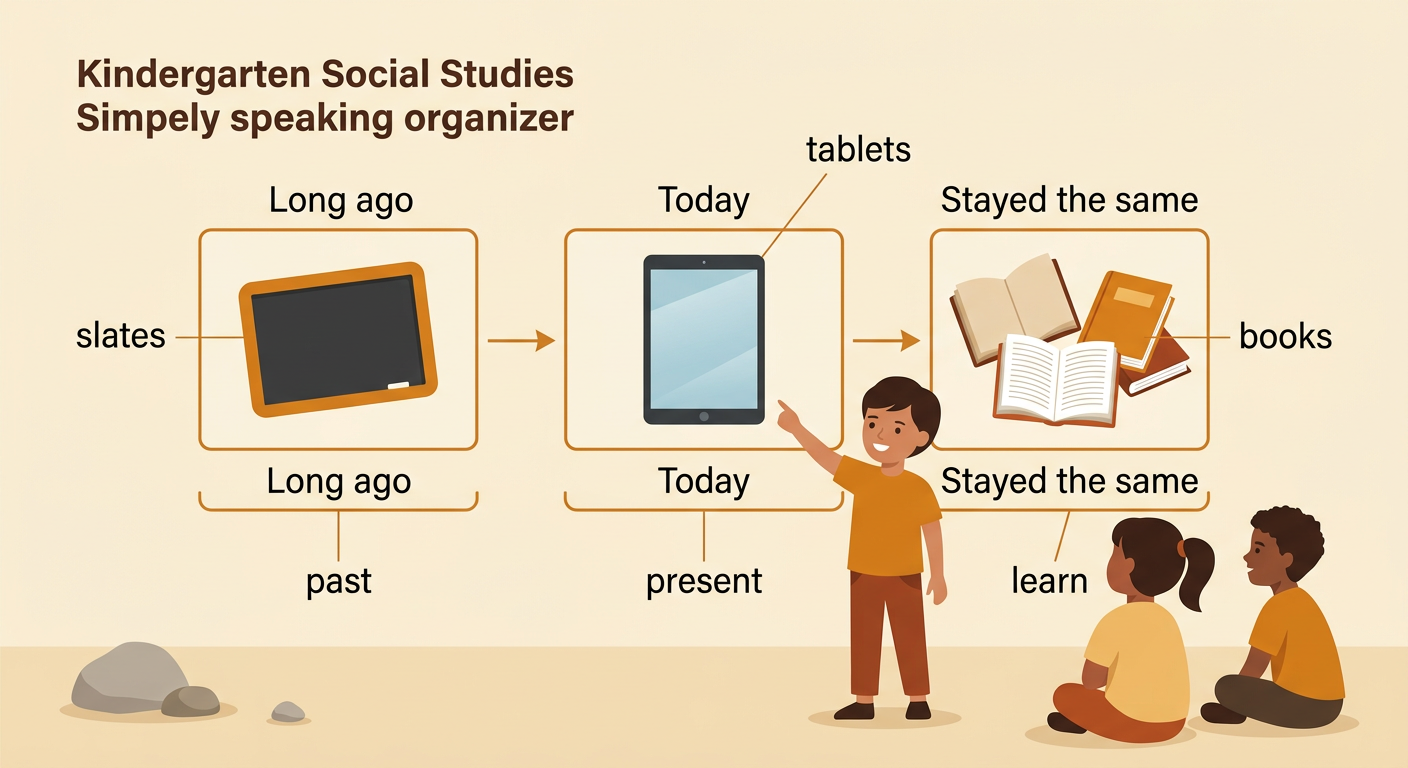
School Then and Now
Students compare school life and classroom tools from the past with those used today and sort examples into past and present groups.
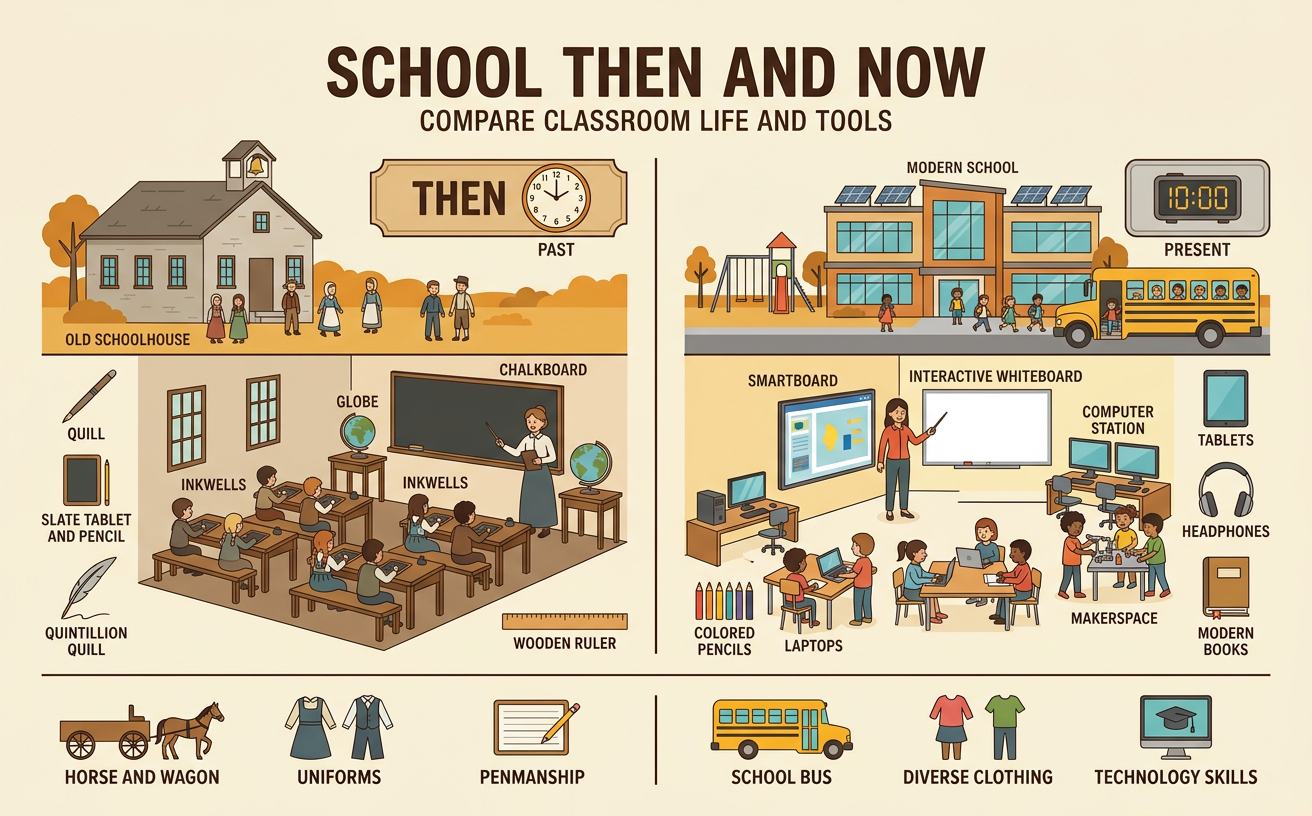
Illustrations are auto-generated and may be placeholders. They can be refreshed to match the narration.
Look at Two Classrooms
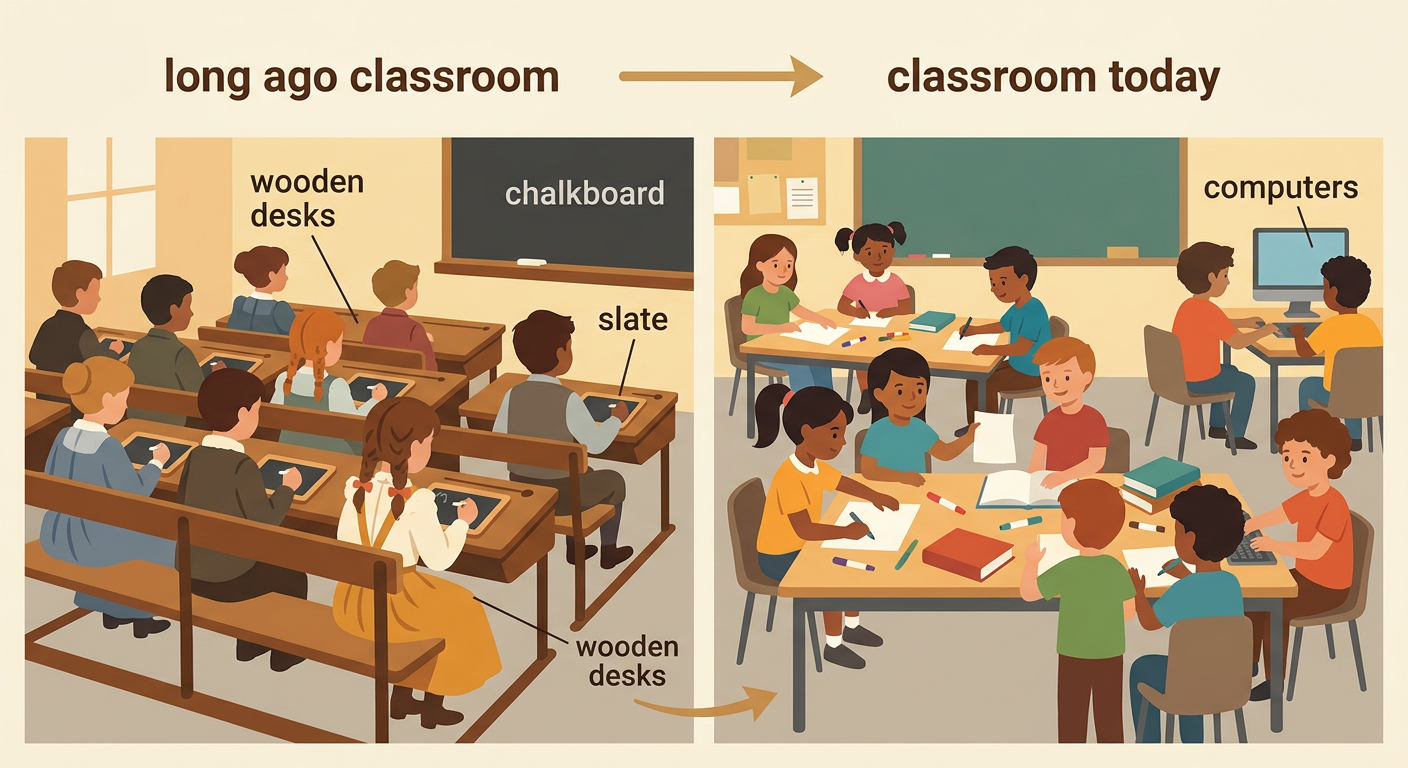
Look closely at pictures of two classrooms. One classroom is from long ago, and one is from today. In the older classroom, students may sit at wooden desks facing a chalkboard. They may write on small slates with chalk. In the classroom today, students may sit at tables or desks and use paper, markers, books, and computers. Ask questions about what you notice. You might ask, “What are the students using to write?” Point to details that help you answer. Both classrooms are places where children learn, listen, practice, and work together. Some things look different, but the purpose of school is still to help children learn.
Read About School Long Ago
Long ago, many children learned in one-room schoolhouses. One teacher sometimes taught children of several ages in the same room. Students often used books, chalk, and small slates for writing practice. Some schoolhouses had a bell that called students inside. Children might help bring in wood or coal to heat the room. Not every school was the same, and not every child had the same chance to attend school. After reading, ask and answer questions with your teacher. Ask, “Why did students use slates?” The text tells us that students wrote on slates and erased them to use again. Use words and picture details from the text to support your answer.

Compare Classroom Tools
A tool helps people do a job or solve a problem. Classroom tools have changed as people have created new solutions. Long ago, a student could write a lesson on a slate with chalk. The slate solved the problem of needing a surface that could be erased and used again. Today, a student might write on paper with a pencil or type on a tablet. A pencil can be erased, and a tablet can save and change words. Compare the tools by asking what each one does. A slate and a tablet look different, but both can show a student’s work. Think about a classroom problem, such as sharing words with the whole class. A chalkboard, whiteboard, or screen can help solve that problem.

Sort Past and Present
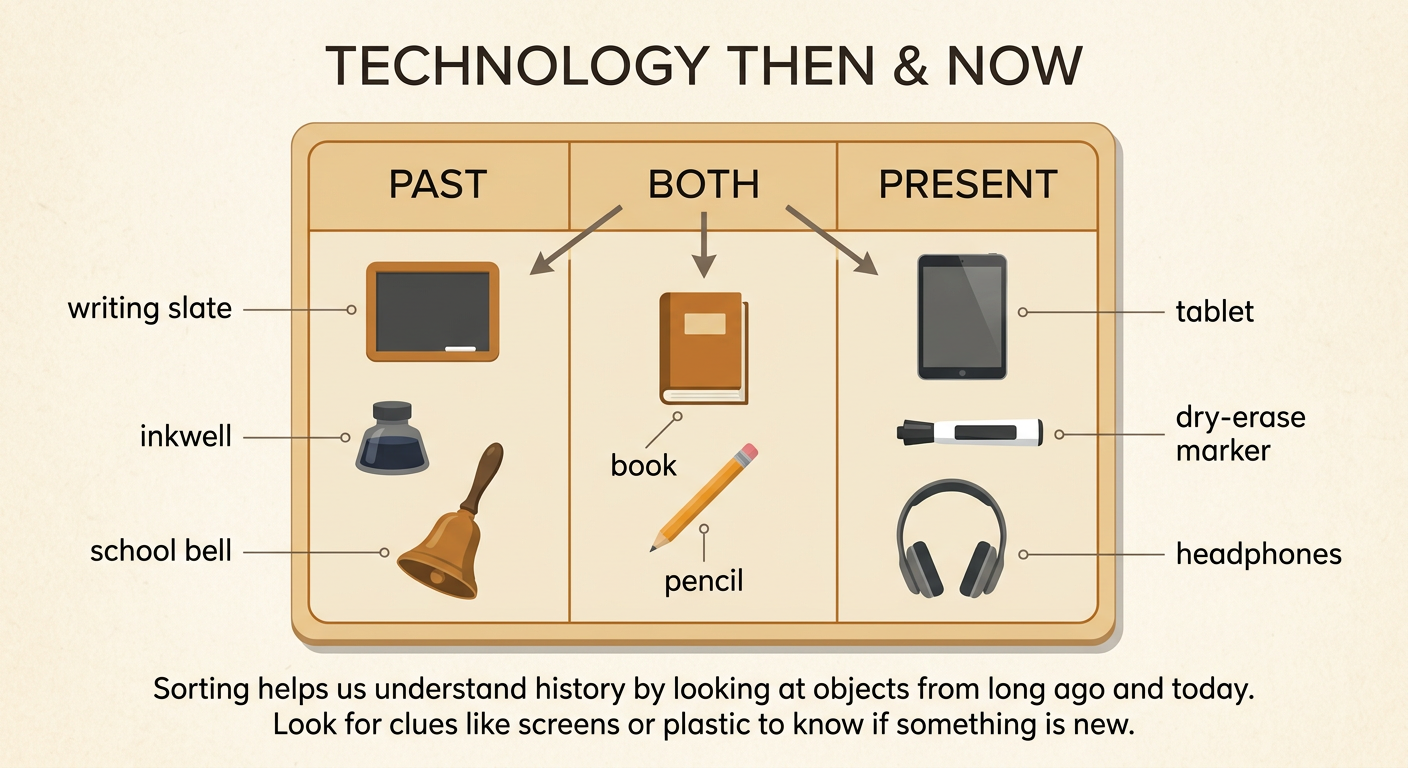
Now sort picture cards into two groups: past and present. The past group is for things commonly used in schools long ago. The present group is for things commonly used in schools today. Place a writing slate, an inkwell, and a school bell in the past group. Place a tablet, a dry-erase marker, and headphones in the present group. Look for clues before placing each card. A cord, screen, or plastic case may be a clue that an object is newer. Remember that some tools, such as books and pencils, can belong in both groups because students used them in the past and still use them today. Explain one choice by saying, “I put the tablet in the present group because students use tablets today.”
Count and Compare the Groups
Count the cards in each group to compare how many there are. Touch each card once as you say the number aloud. Suppose the past group has five cards and the present group has seven cards. Seven is greater than five, so the present group has more cards. Five is less than seven, so the past group has fewer cards. You can match one past card with one present card. After making five pairs, two present cards remain without partners. This shows that the present group has two more cards. If both groups had six cards, the groups would have the same number. Use the words more than, fewer than, or the same as when you compare the groups.

Share What Has Changed
Use your sorted cards and classroom pictures to tell what has changed. Choose one example and speak in a complete sentence. You might say, “Long ago, some students wrote on slates, but today many students write on paper or tablets.” Then tell what stayed the same. You could say, “Students used books in the past, and students still use books today.” Listen while classmates share their ideas, and ask a question if you want to know more. Try asking, “How did that tool help students?” Explain that a tool can change when people find a new way to solve a problem. End by naming one important idea: schools and tools may change over time, but children in the past and present go to school to learn.