Scientific Inquiry: A Flexible Cycle
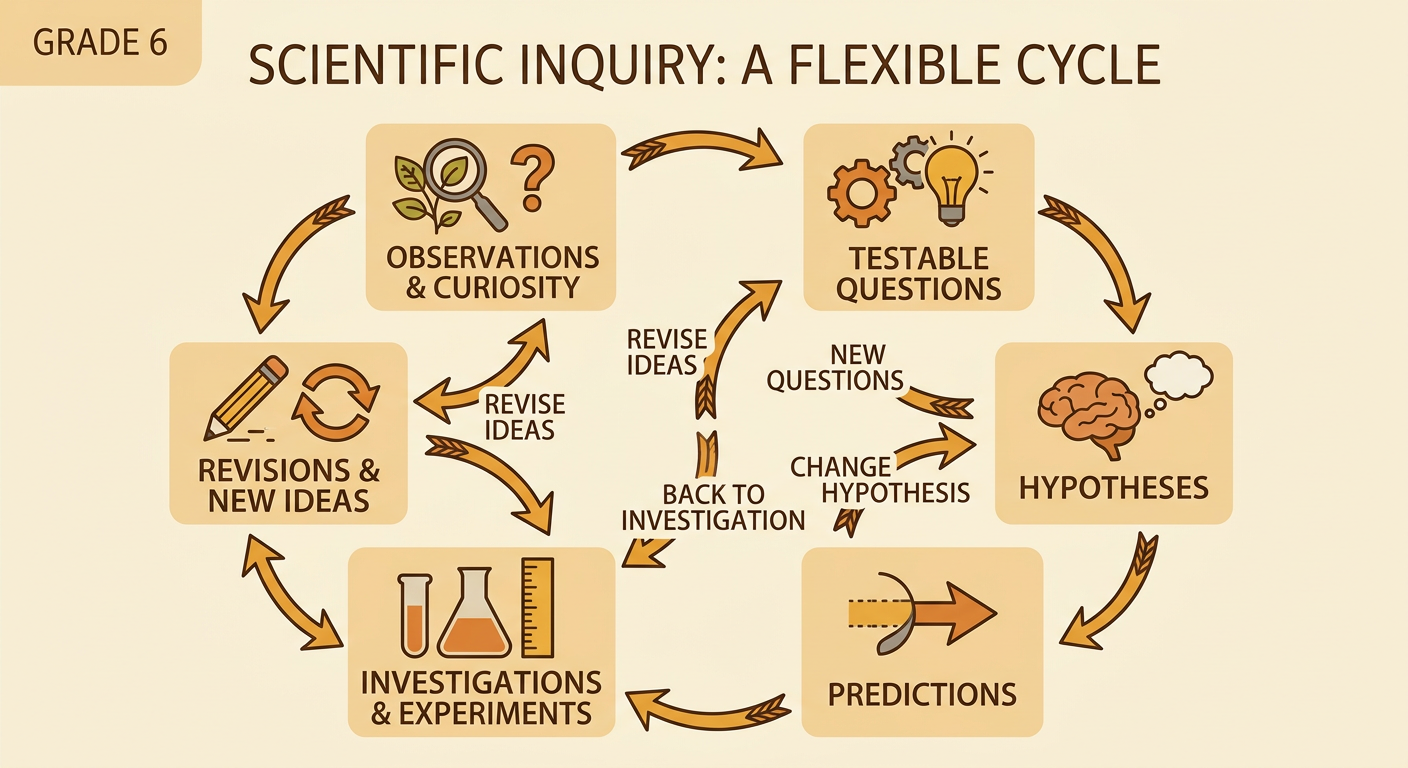
Students examine how scientists move among observations, testable questions, hypotheses, predictions, investigations, and revisions rather than following one rigid sequence of steps.
Illustrations are auto-generated and may be placeholders. They can be refreshed to match the narration.
Observation or Inference?
An observation is information gathered directly with the senses or measuring tools. An inference is a reasonable explanation based on observations and prior knowledge. Suppose you see water droplets on the outside of a cold cup. “Droplets cover the cup” is an observation. “Water vapor in the air cooled and condensed” is an inference supported by scientific knowledge. A fact can be checked with evidence, such as a thermometer reading of 4°C. A reasoned judgment interprets evidence, such as deciding that condensation best explains the droplets. Speculation suggests an idea without enough evidence, such as claiming the cup is leaking without checking it. Scientists clearly separate what they observe from what they conclude. This helps others evaluate whether a claim is well supported or whether more evidence is needed.

Questions Science Can Test
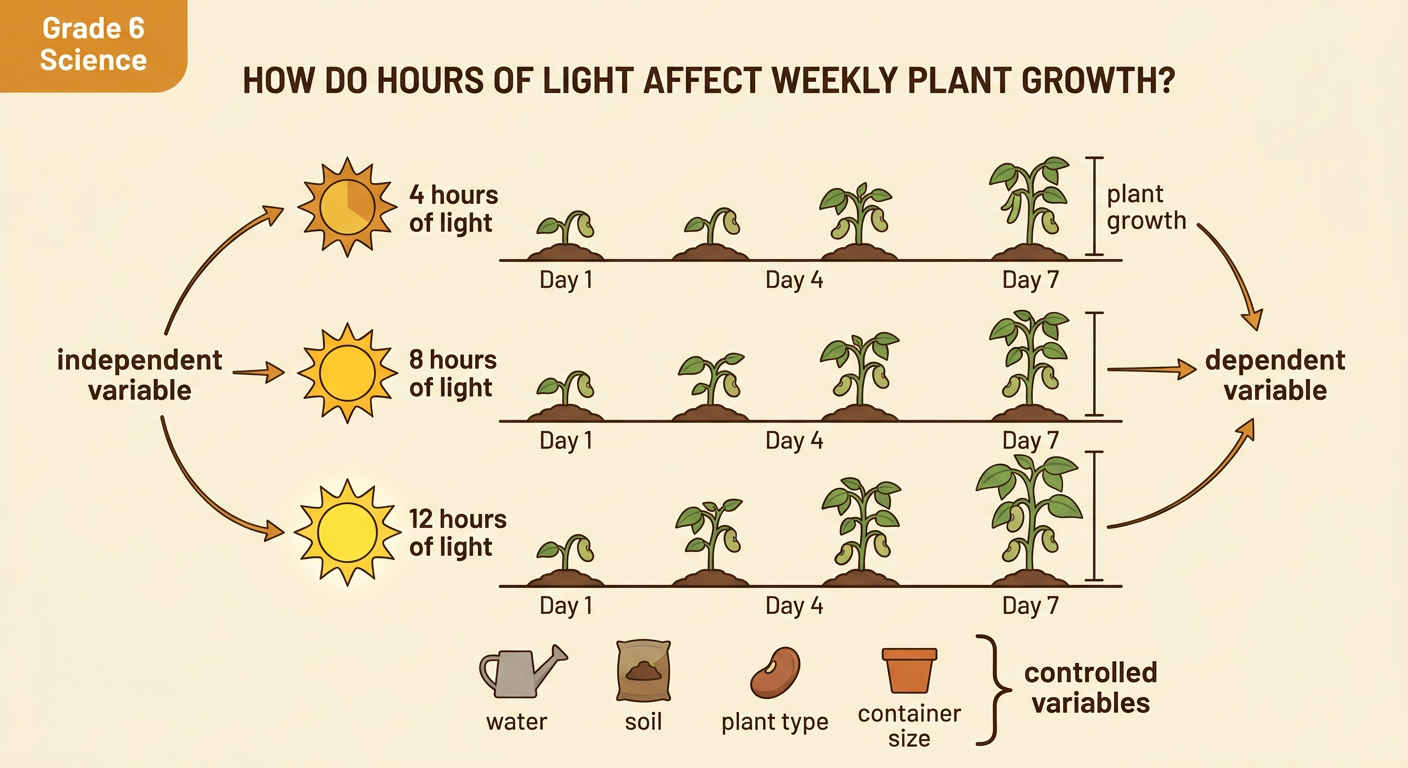
A testable scientific question can be answered by collecting observations or measurements. It identifies something that can be changed, compared, or measured. For example, “How does the number of hours of light affect the weekly growth of bean plants?” can be tested by giving similar plants different amounts of light and measuring their height. Hours of light is the independent variable, and plant growth is the dependent variable. Soil, water, plant type, and container size should be controlled so the comparison is fair. A question such as “Are bean plants the best plants?” is not scientifically testable because “best” is based on opinion unless clear, measurable criteria are given. Good scientific questions are focused, measurable, and safe to investigate. They often grow from observations and may lead to additional questions.
Hypotheses and Predictions
A hypothesis is a testable explanation for an observation or pattern. It should be based on evidence or scientific knowledge, not simply a random guess. A prediction states the expected result if the hypothesis is supported. Imagine that pill bugs are often found under damp logs. A hypothesis might be, “Pill bugs gather in damp places because their bodies lose water in dry conditions.” A related prediction is, “If pill bugs are given a choice between a damp chamber and a dry chamber, then more pill bugs will move into the damp chamber after ten minutes.” The hypothesis explains why the pattern may occur, while the prediction describes a measurable outcome. An investigation can support or fail to support the hypothesis, but it cannot prove an explanation with absolute certainty. New evidence may lead to a revised hypothesis or prediction.

The Scientific Inquiry Cycle
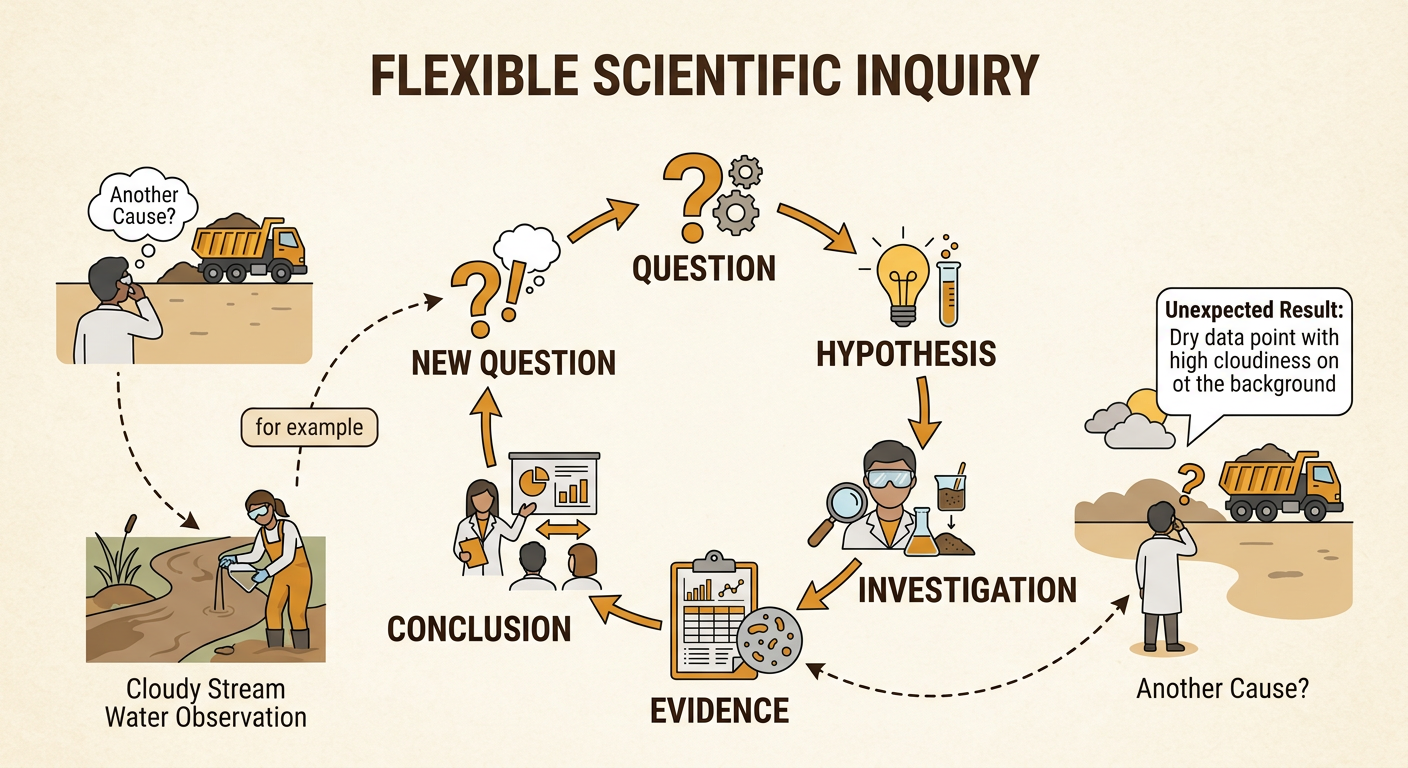
Scientific inquiry is flexible rather than a single rigid list of steps. Scientists may begin with an observation, a question, an unexpected result, or an existing explanation. They develop testable questions, propose hypotheses, make predictions, plan investigations, analyze evidence, and communicate conclusions. However, they often move backward, repeat an investigation, or ask a new question. For example, a scientist may observe cloudy stream water and ask whether recent rainfall increases cloudiness. After measuring rainfall and water turbidity, the scientist might notice that some dry days are also cloudy. That result could lead to a new question about construction near the stream. Communication can also cause revision when other scientists point out missing evidence. The process is a cycle because each conclusion can produce new observations and questions rather than ending the investigation.
Why Scientists Revise Ideas
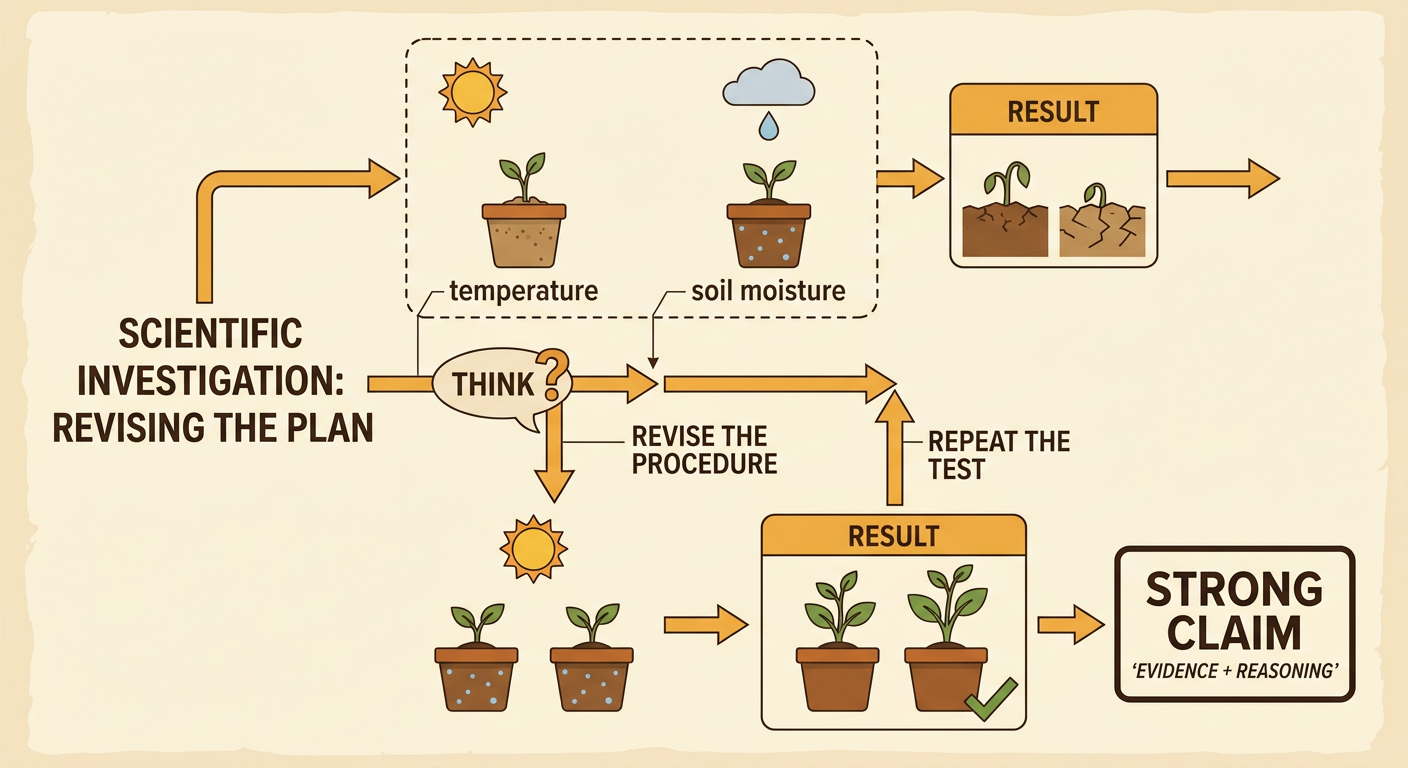
Scientists revise ideas when evidence does not match a prediction, when a method has a problem, or when a better explanation becomes available. Revision is not failure; it is how scientific explanations become more accurate. Suppose students predict that seeds will germinate faster at warmer temperatures. Their warm group germinates slowly, but they discover that its soil dried out more quickly. Because both temperature and water differed, the evidence cannot show which factor caused the result. The students can revise the procedure by keeping soil moisture equal and repeating the investigation. They might also revise the hypothesis if carefully controlled results still disagree with the prediction. A strong scientific claim answers the question and is supported by relevant evidence and reasoning. Speculation may suggest what to test next, but it should not be presented as a conclusion.
Apply the Cycle to a Scenario
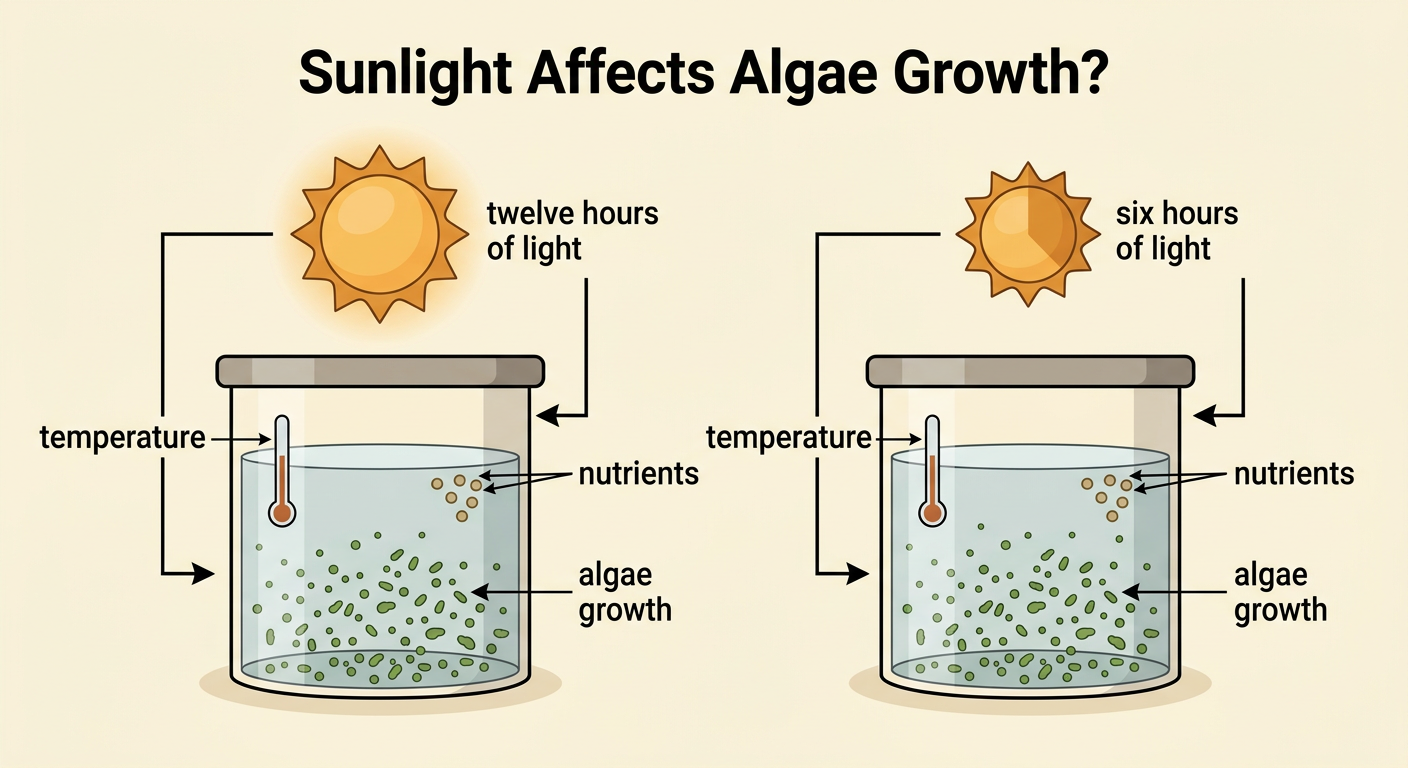
Imagine students observe that one side of a school pond has more green algae than the other. They ask, “Does the amount of sunlight affect algae growth in the pond?” Their hypothesis is that algae grow faster with more sunlight because algae use light for photosynthesis. They predict that samples receiving twelve hours of light each day will develop more algae than samples receiving six hours. To investigate, they place equal amounts of pond water in identical clear containers, keep temperature and nutrients the same, vary only light duration, and measure algae growth using the same method each day. If the twelve-hour samples show more growth, the evidence supports the claim, but other explanations may still be possible. If results vary, students might repeat the test, improve measurement accuracy, or ask whether nutrient levels interact with light. The cycle continues through evidence, revision, and new questions.