
Scientific Inquiry: Designing and Evaluating a Reproducible Investigation
Students develop a testable hypothesis, design a controlled investigation, analyze evidence and uncertainty, and revise conclusions within the iterative scientific inquiry process.
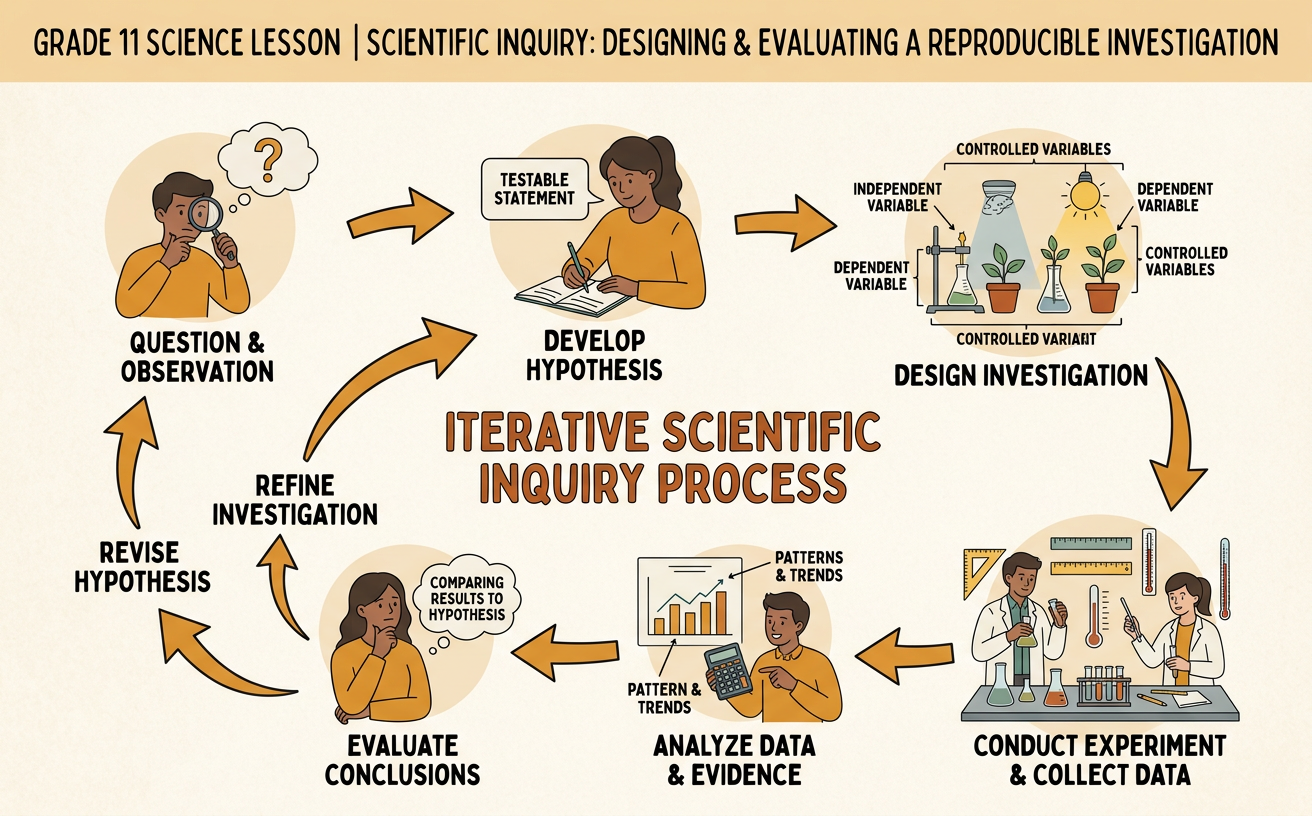
Illustrations are auto-generated and may be placeholders. They can be refreshed to match the narration.
From Questions to Testable Hypotheses
Scientific inquiry begins with a focused question that can be answered using measurable evidence. A testable hypothesis predicts how one variable will respond when another variable changes and gives a scientific reason for the prediction. For example, the broad question “What affects plant growth?” can become “How does daily blue-light exposure affect the weekly height increase of bean seedlings?” A hypothesis might state: “If bean seedlings receive more hours of blue light each day, then their mean weekly height increase will rise because additional light can support more photosynthesis, up to the point when another resource becomes limiting.” This statement identifies a predicted relationship and can be supported or challenged by data. Before testing, researchers should also consider alternative hypotheses, such as the possibility that light duration has no effect or that excessive exposure increases heat stress and slows growth.
Operational Variables and Controls
Variables must be operationally defined so another researcher knows exactly how they are changed or measured. In the seedling investigation, the independent variable is daily blue-light exposure, set at 4, 8, or 12 hours. The dependent variable is weekly height increase in centimeters, measured from the soil surface to the highest growth point. Controlled variables should include plant species, seedling age, soil amount, water volume, pot size, lamp distance, and temperature. A control group receiving a standard 8-hour exposure provides a useful comparison if that condition represents normal practice. Replication is also essential: using several seedlings at each exposure level helps reveal natural variation and reduces the influence of an unusual individual. Randomly assigning similar seedlings to groups limits selection bias. A fair test changes the independent variable systematically while keeping other relevant conditions as consistent as possible.
Designing a Reproducible Procedure
A reproducible procedure gives enough detail for another investigator to repeat the study under comparable conditions. Steps should be numbered, ordered, and specific about materials, quantities, timing, measurement techniques, and data recording. For example, select 15 bean seedlings of similar age, randomly assign five to each light-duration group, and place every lamp 30 centimeters above the soil surface. Give each pot 50 milliliters of water at 9:00 a.m. daily. Measure height with the same metric ruler at the start and after seven days, viewing the scale at eye level to avoid parallax error. Record raw values immediately in a prepared table rather than relying on memory. The procedure should also include safety precautions and criteria for handling unexpected events, such as a failed lamp. A pilot test can reveal unclear steps or impractical timing before the full investigation begins.
Analyzing Data, Error, and Uncertainty
Analysis converts measurements into evidence while preserving information about variation and uncertainty. For each light group, calculate the change in height for every seedling, then find the mean and a measure of spread such as the standard deviation. Plot mean height increase against hours of light, with error bars showing plus or minus one standard deviation. Suppose the means are 1.8, 3.1, and 3.0 centimeters for 4, 8, and 12 hours. These data suggest improvement from 4 to 8 hours but little additional benefit at 12 hours. However, overlapping error bars may indicate that the apparent difference between 8 and 12 hours is small relative to variation. Random error causes unpredictable scatter, while systematic error, such as a ruler with a shifted zero mark, biases all measurements. Outliers should be investigated and reported, not automatically deleted. Claims must reflect the strength and limits of the evidence.
Evidence-Based Conclusions and Revision
A scientific conclusion answers the research question by connecting a precise claim to relevant evidence and reasoning. Based on the example data, a defensible claim is that increasing blue-light exposure from 4 to 8 hours increased mean weekly seedling growth under the tested conditions, but 12 hours did not produce a clear additional increase. The conclusion should cite numerical results, explain how they relate to photosynthesis or resource limitation, and avoid claiming that the hypothesis was “proved.” It should also acknowledge weaknesses and counterclaims. For instance, a small sample, one plant species, overlapping error bars, or uncontrolled lamp heating could provide alternative explanations. Revision is part of inquiry, not a sign of failure. Researchers might measure temperature, increase replication, test more exposure levels, or repeat the study with another species. The revised investigation should prioritize valid measurements and reproducibility while considering trade-offs in time, cost, equipment, and sample size.