
Seed Travelers: How Seeds Move to New Places
Students examine seed structures, test models of seed dispersal, and use evidence to explain how dispersal helps plants reproduce in new locations.
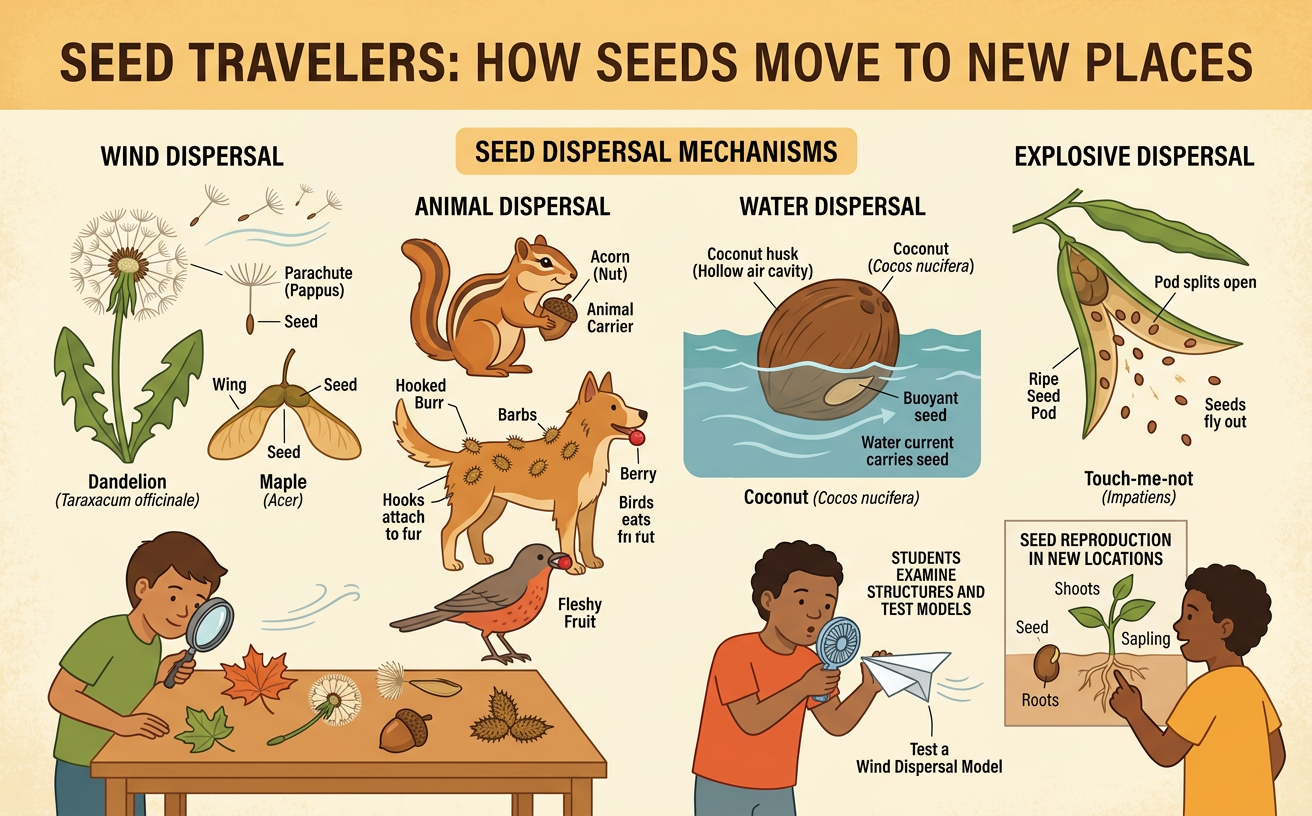
Illustrations are auto-generated and may be placeholders. They can be refreshed to match the narration.
Why Seeds Must Travel
A seed contains a young plant and stored food protected by a seed coat. If every seed fell directly beside its parent plant, the seedlings could become crowded. They might compete with the parent and one another for sunlight, water, nutrients, and space. Traveling to a new location gives some seeds a chance to grow where resources are available. Dispersal also helps plants spread to suitable habitats. For example, a maple seed may spin away from its parent tree and land in a sunny opening. If the seed receives enough water, warmth, air, and light after sprouting, it may grow into a new maple tree. Not every seed survives, but dispersal increases the number of places where new plants might grow and reproduce.

Wind, Water, and Animal Dispersal
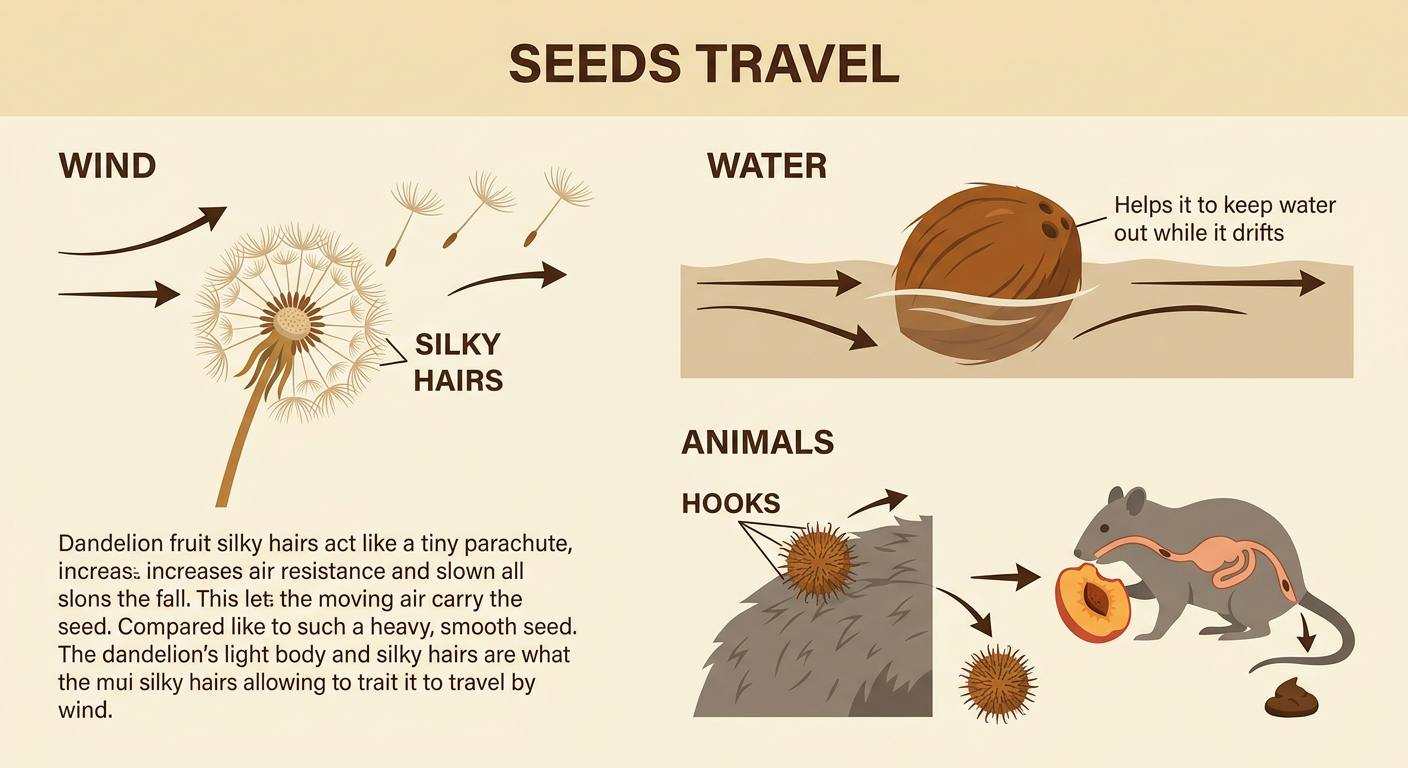
Seeds can travel by wind, water, or animals. Wind-dispersed seeds are often lightweight and have wings or silky hairs that increase air resistance. A dandelion fruit can float on moving air because its hairlike structure acts like a tiny parachute. Water-dispersed fruits or seeds often float and have coverings that resist water. A coconut can drift across ocean water before washing onto shore. Animals move seeds in two main ways. Hooked fruits, such as burdock burs, cling to fur or clothing and later fall off. Animals also eat fleshy fruits and deposit the undamaged seeds elsewhere in their waste. Each method works because a seed or fruit has structures that interact with wind, water, or an animal.
Observe and Classify Seed Structures
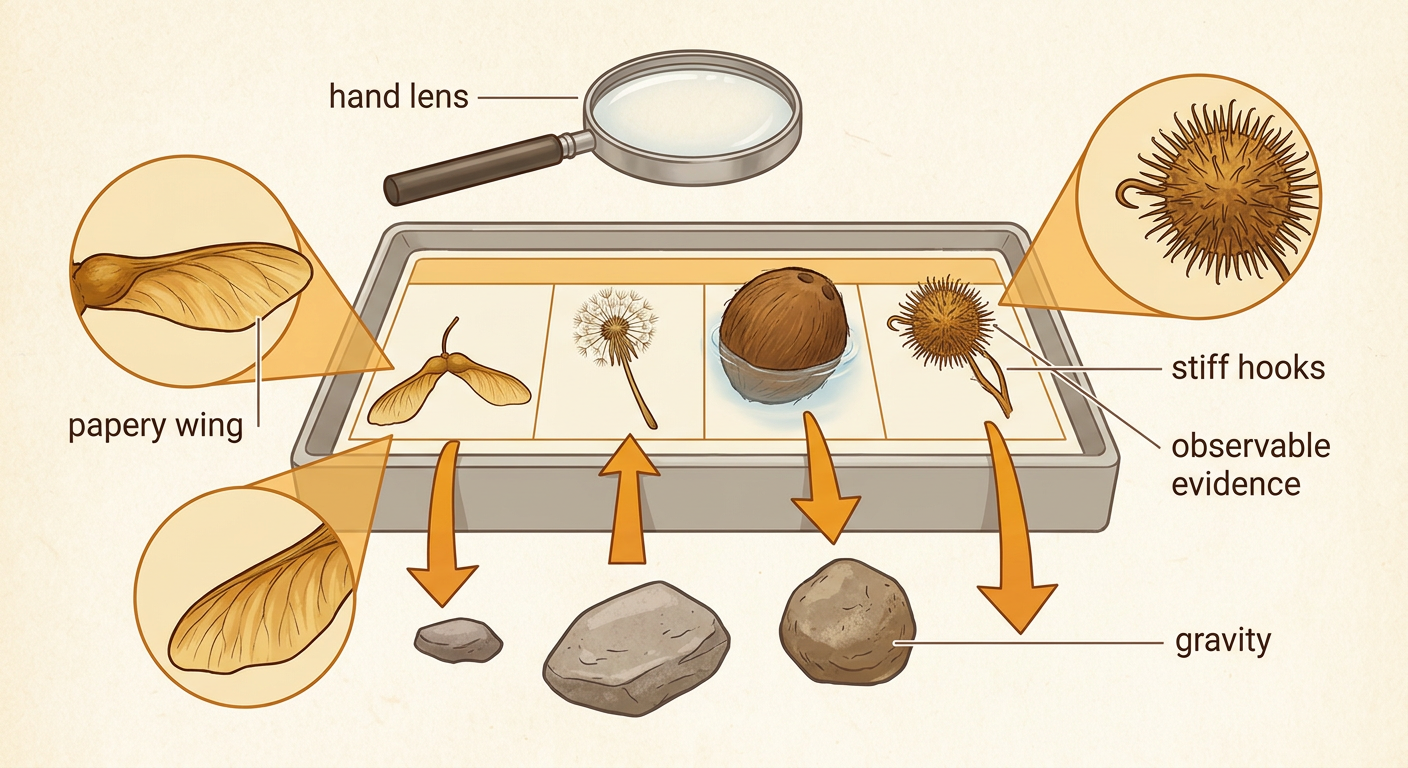
Scientists observe structures closely before deciding how a seed or fruit might travel. Examine each sample with a hand lens, but do not taste it. Record its size, shape, texture, mass, and special parts. Look for broad wings, fluffy hairs, hooks, a waterproof outer layer, or fleshy fruit tissue. Then classify each sample by its most likely dispersal method: wind, water, animal, or gravity. Use observable evidence instead of guessing. For example, a samara from a maple has a thin, papery wing and a heavier seed at one end. Those structures support the claim that it spins and travels through air. A bur has stiff hooks, which is evidence that it can attach to animal fur. Some samples may fit more than one category, so explain your choice.
Test and Measure Model Seeds
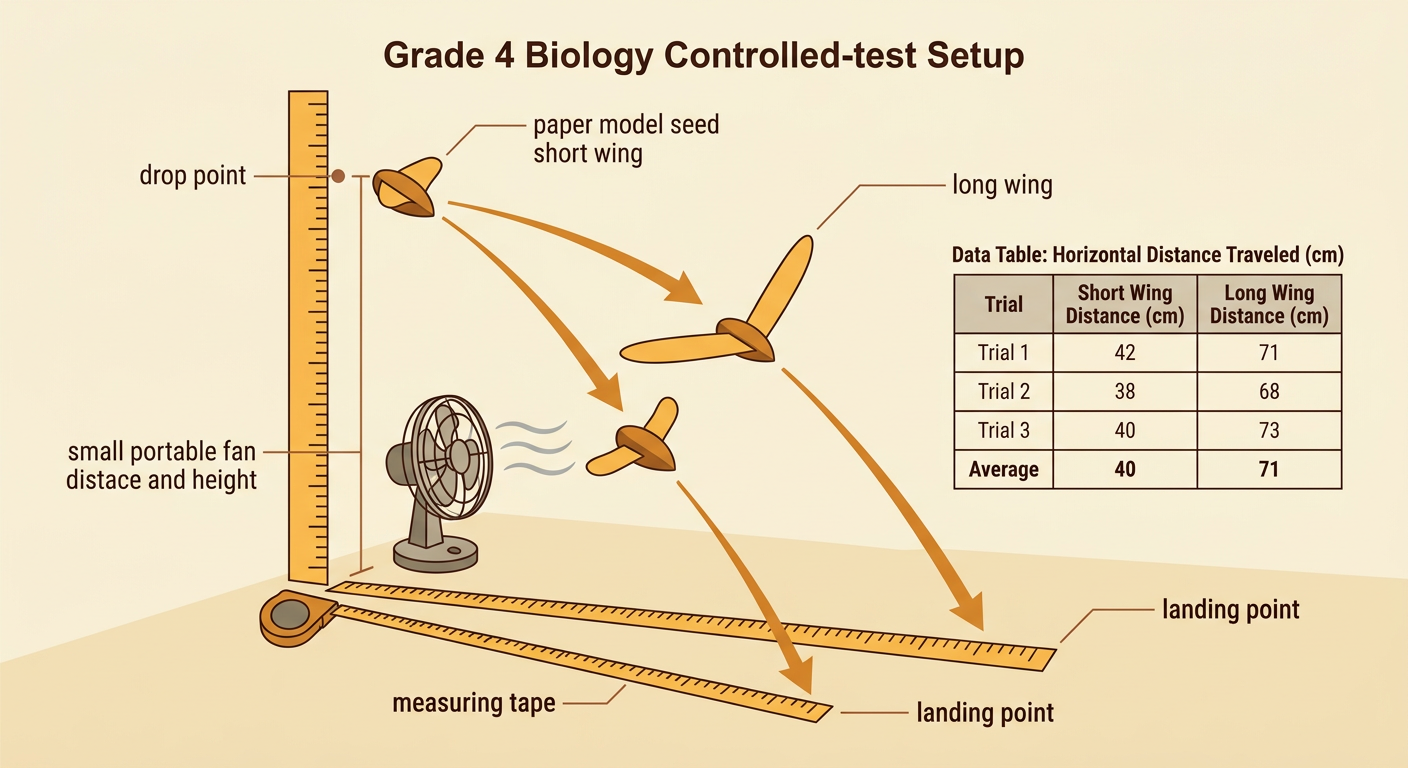
Models can help you test how structure affects movement. Make two paper model seeds that are identical except for one feature, such as wing length. Drop each model from the same height in the same location. If using a fan, keep its speed and position unchanged. Measure the horizontal distance from the drop point to the landing point with a measuring tape. Record the distance in centimeters, and repeat at least three trials for each model. For example, suppose the short-wing model travels 42, 38, and 40 centimeters, while the long-wing model travels 71, 68, and 73 centimeters. The longer wing traveled farther in these trials. Repeated measurements make the evidence stronger, while a fair test helps show that wing length caused the difference.
Map Seed Landing Sites
A map can show where model seeds land and how location relates to environmental conditions. Mark the release point with a star and use a dot for each landing site. Include a title, compass rose, legend, and scale. For example, one centimeter on the map might represent one meter on the ground. Add important features such as a tree, open soil, a puddle, a sidewalk, and the direction of the wind. Then compare the landing sites. Seeds clustered east of the release point may provide evidence that a west wind carried them east. A seed that lands on open, moist soil may have a better chance of sprouting than one that lands on pavement. Measure map or ground distances and use the environmental features to explain which landing locations appear most suitable for growth.

Explain How Structure Supports Reproduction
Use observations, test results, and map evidence to make an argument about seed dispersal. Begin with a clear claim, such as, “A broad wing helps a maple seed disperse by wind and supports plant reproduction.” Give reasons that connect the structure to its function. The wing increases air resistance, slows the fall, and allows moving air to carry the seed. Then cite evidence from your investigation, such as the long-wing model traveling an average of 71 centimeters while the short-wing model averaged 40 centimeters. Map evidence might show that the farther model reached open, moist soil instead of crowded ground near the parent. Finish by explaining that dispersal does not guarantee growth, but it can place offspring where they have enough resources and less competition. This supports the plant's ability to produce a new generation.
