
Seeds on the Move
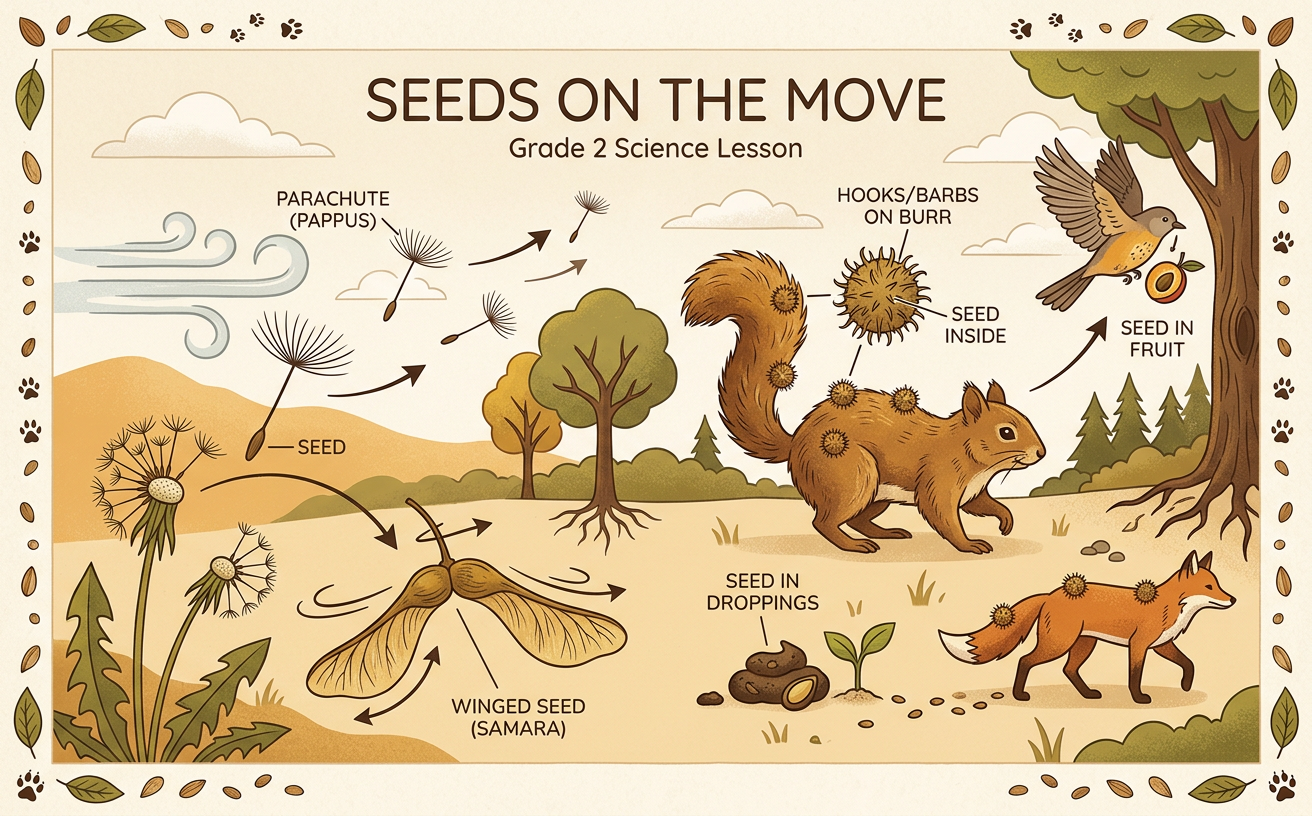
Students observe different seed features and create a simple model showing how wind or animals can move seeds to new places.
Illustrations are auto-generated and may be placeholders. They can be refreshed to match the narration.
Notice Seed Shapes
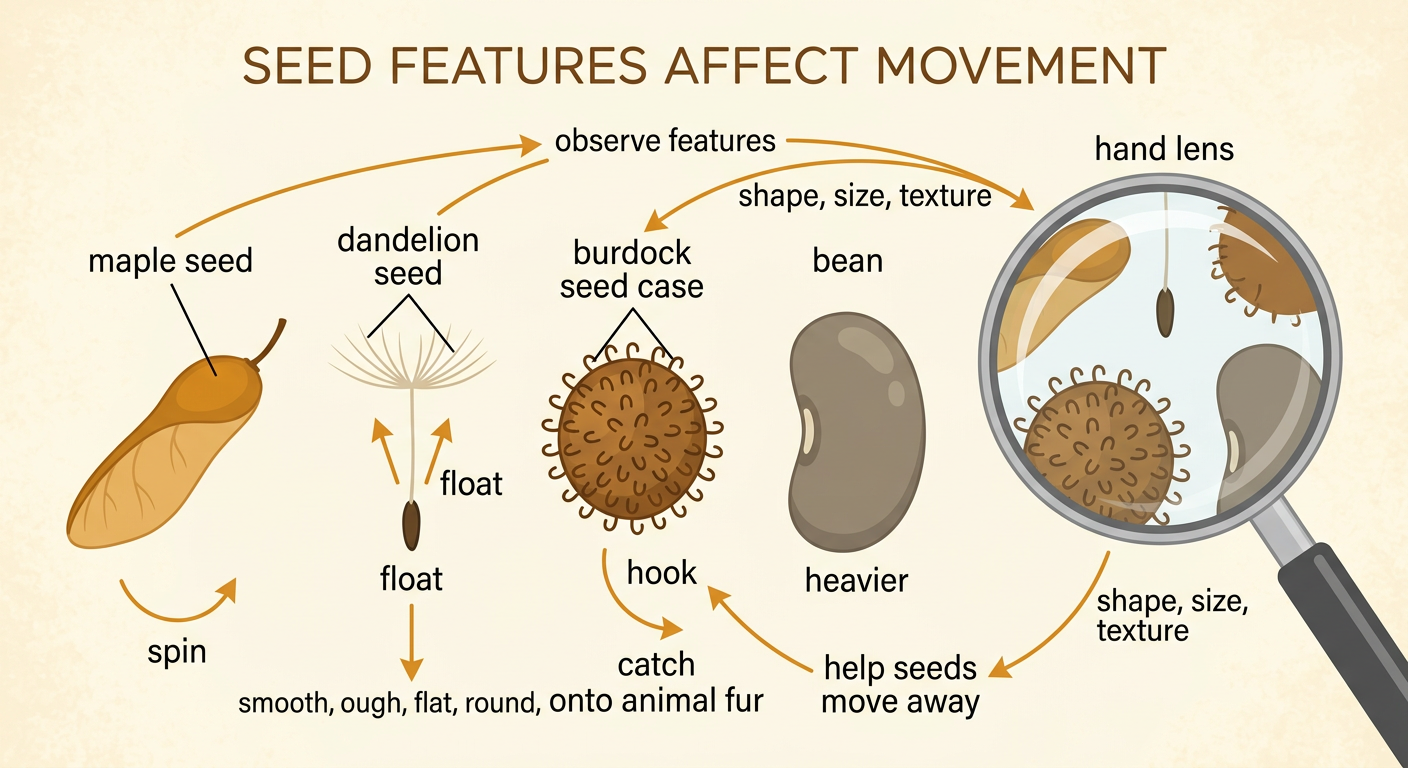
Seeds come in many shapes, sizes, and textures. Look closely at several safe seeds or seed pictures. A maple seed has a thin wing. A dandelion seed has light, fluffy hairs. A burdock seed case has tiny hooks. A bean is smooth and heavier than many wind-carried seeds. These features can help seeds move away from the parent plant. Use a hand lens to observe each seed. Notice whether it is smooth, rough, flat, round, hooked, winged, or fluffy. For example, the hooks on a burdock seed case can catch on an animal’s fur. Draw one seed and write or tell two observations about it. Observing carefully helps scientists ask questions about how each seed might travel.
Explore Ways Seeds Travel
Seeds can travel by wind, water, animals, or gravity. Wind can lift a light dandelion seed and carry it through the air. Water can float a seed downstream or wash it onto a shore. Some animals eat fruits and later leave the seeds in a different place. Other seeds have hooks that cling to fur, feathers, socks, or shoelaces before falling off. For example, a hooked seed may attach to a rabbit’s fur in a field. The rabbit moves to another area, and the seed drops onto the ground. This movement is called seed dispersal. Like people and goods moving from one place to another, seeds have a starting place, a path, and a destination. Dispersal may give a seed space, sunlight, and water away from the parent plant.

Build a Seed-Dispersal Model
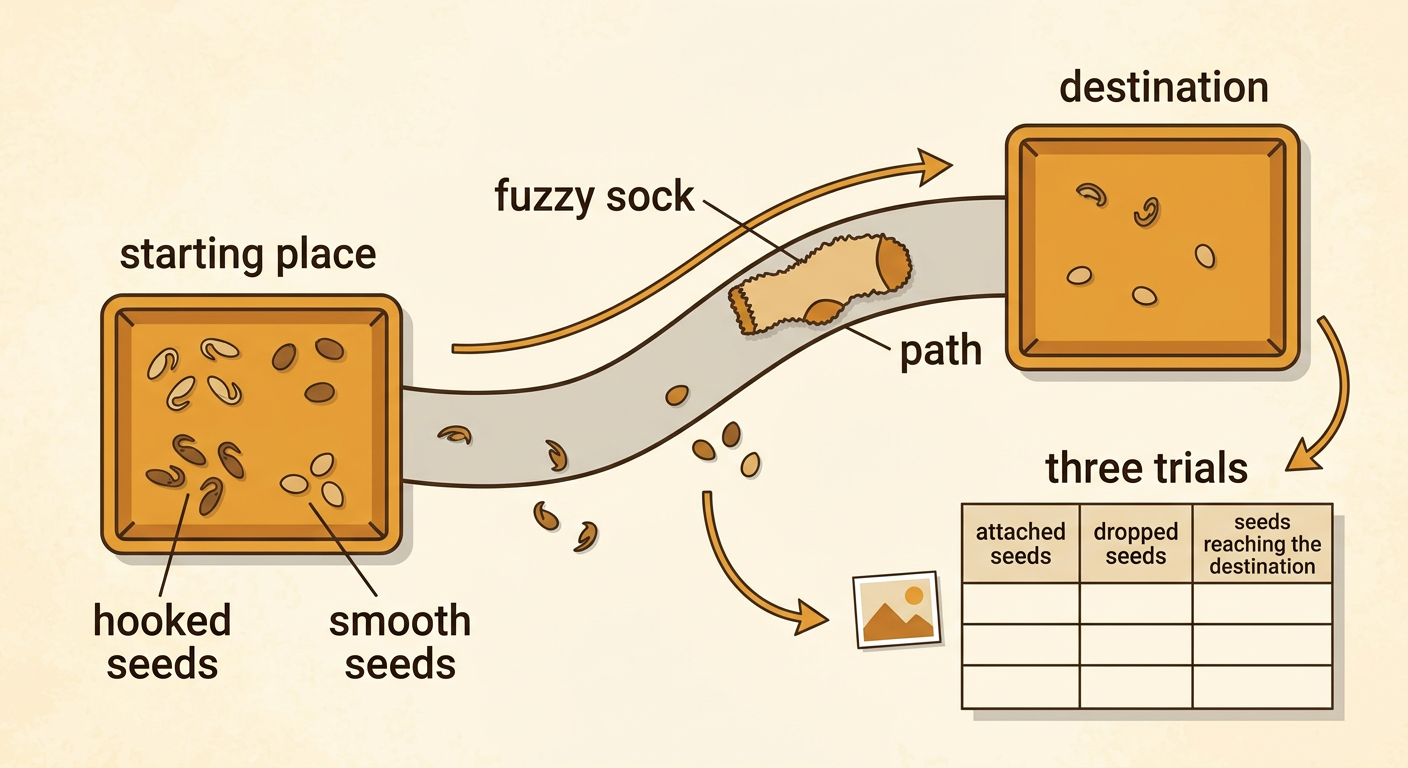
Build a simple model that shows how an animal can carry seeds. Use a fuzzy sock or a piece of craft fur to represent an animal’s coat. Make several paper seeds. Add a small hook-and-loop dot to some seeds to represent hooks. Leave other paper seeds smooth. Spread the model seeds on a tray that represents a field. Gently press or drag the fuzzy material across the tray as if an animal were walking through plants. Then move the model animal to a second tray and shake it gently. For example, a hooked model seed may cling to the fuzzy sock, travel across the table, and drop in the new tray. This model does not copy every detail of nature, but it demonstrates the important function of fur carrying seeds to new places.

Test and Observe the Model
Test the model in the same way several times. First, count how many hooked and smooth model seeds are on the starting tray. Move the fuzzy sock across them using the same path each time. Count how many seeds attach, travel, and drop in the new tray. Repeat the test three times. Keep the distance and movement as similar as possible so the comparison is fair. For example, if four hooked seeds and one smooth seed travel, the model suggests that hooks help seeds cling to fur. Also observe where each seed falls. Did it stay at the starting place, fall along the path, or reach the destination? A model may not work perfectly every time. Repeated tests help scientists notice patterns and find ways to improve a model.
Record and Share Findings
Work with classmates to record what the group observed. Make a simple chart with one row for each trial. Write the number of hooked and smooth seeds that reached the new tray. Add a drawing of the model and arrows to show the seeds’ movement. Then write a shared conclusion. For example: “Hooked model seeds traveled more often because they clung to the fuzzy sock.” Use evidence from the chart to support the conclusion. The group can also describe a change that might improve the model, such as using smaller paper seeds or testing a different fuzzy material. Take turns sharing observations, asking questions, drawing, and writing. Explain the starting place, path, and destination so others understand how the animal model moved seeds from place to place.
