
Segmenting Words into Phonemes
Students break spoken one-syllable words into beginning, middle, and ending sounds.
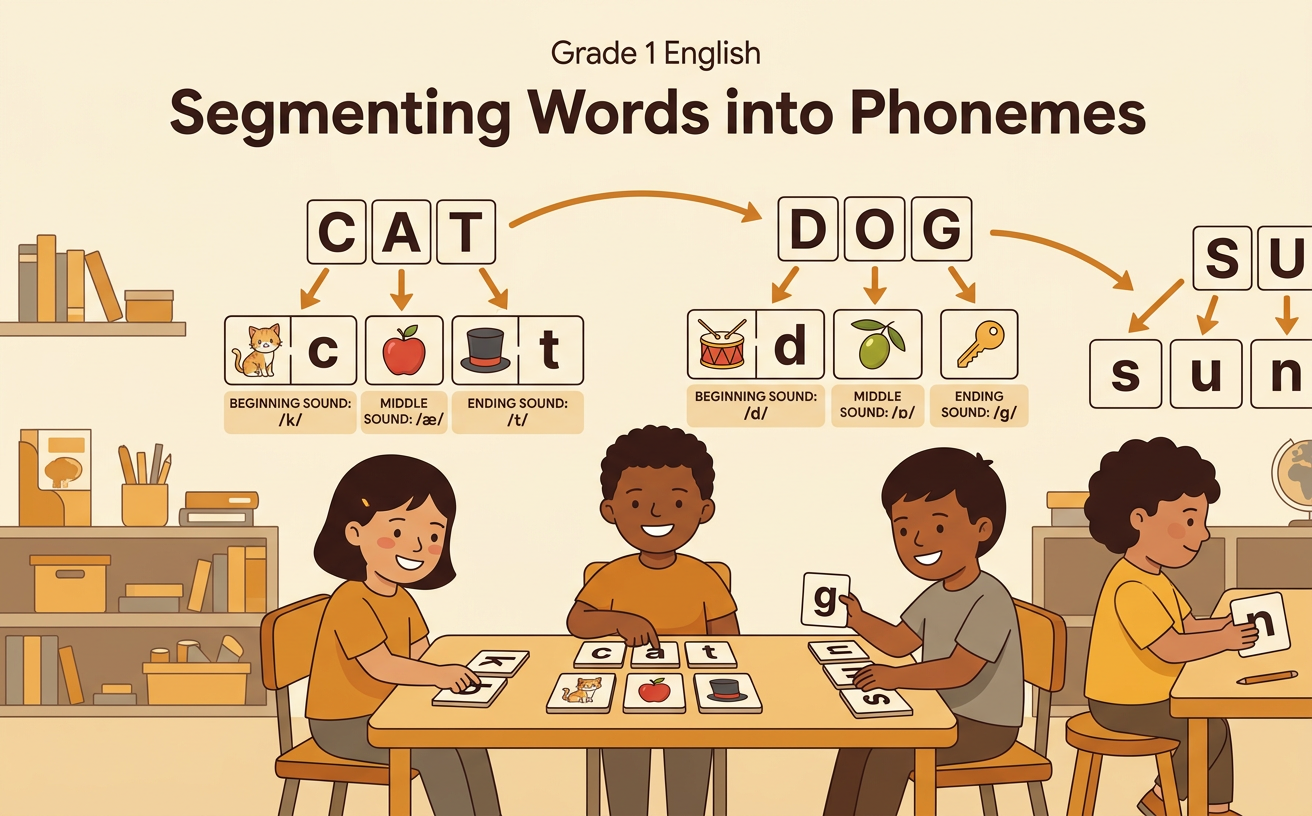
Illustrations are auto-generated and may be placeholders. They can be refreshed to match the narration.
Stretch the Word
Say a one-syllable word slowly so you can hear every sound. Use the word fish. First, say it normally: fish. Then stretch it without adding extra sounds: fff-iii-shhh. Listen as your voice moves from the beginning sound to the middle sound and then to the ending sound. The word fish has three sounds: /f/ /ĭ/ /sh/. The two letters sh work together to make one sound. Stretching a word does not mean adding a sound between its parts. Keep the sounds connected and in the correct order. Try stretching sun: sss-uuu-nnn. Ask yourself, “What sounds do I hear from start to finish?” Careful stretching helps you notice the complete sequence of sounds in a spoken word.

Identify the First Sound
The first sound is the sound you hear when a word begins. Say the word map. Stretch the beginning: mmm-ap. The first sound is /m/. Your lips close when you make /m/, and your voice hums. Do not say the letter name em. Say only the sound /m/. Now compare map and sun. Map begins with /m/, but sun begins with /s/. You can place your finger at the start of an arrow as you say the first sound. Then say the whole word again to check: /m/ /ă/ /p/, map. Remember that we are listening to spoken sounds. Ask, “What sound came out first?” Finding the first sound is the first step in separating all the sounds in a word.

Hear the Middle Sound
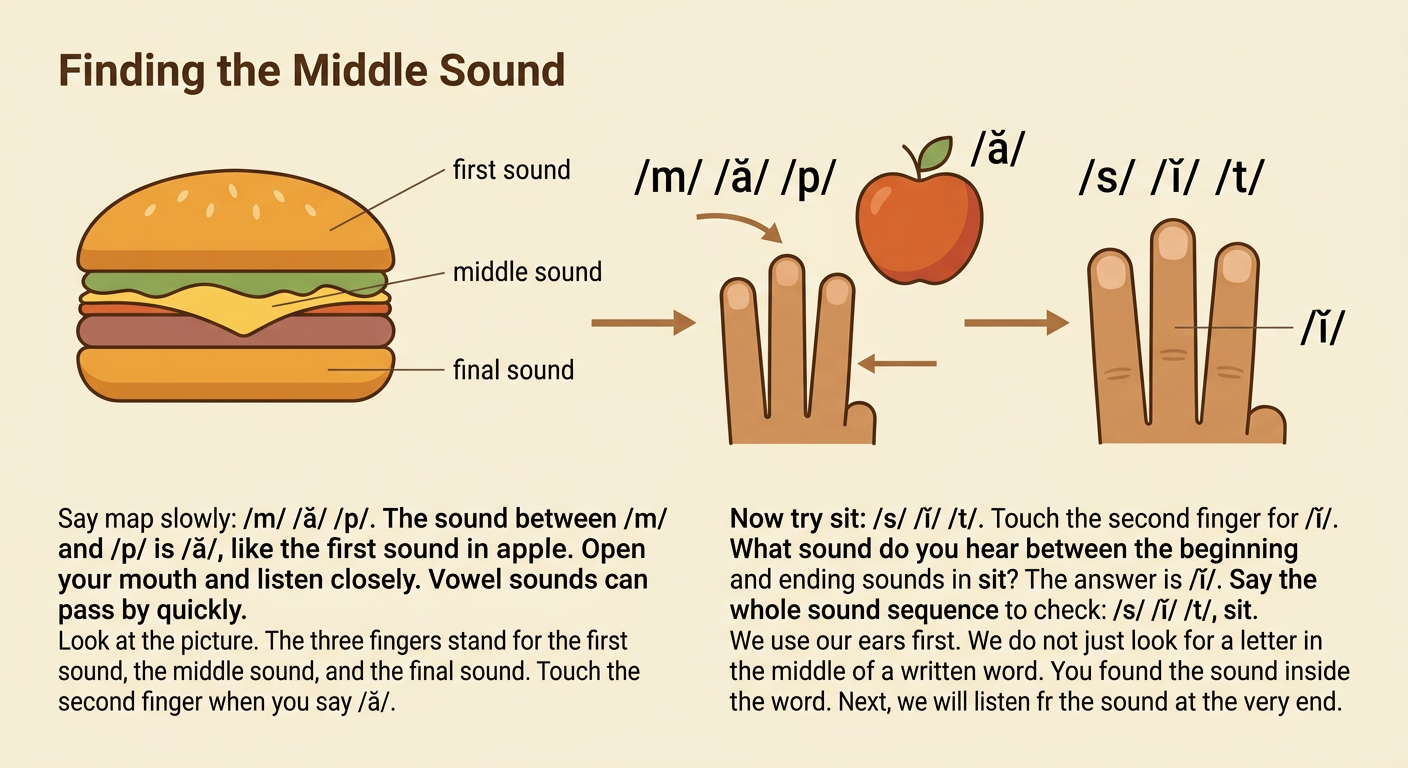
The middle sound comes after the first sound and before the final sound. In many one-syllable words with three sounds, the middle sound is a vowel sound. Say map slowly: /m/ /ă/ /p/. The sound in the middle is /ă/, as in apple. Open your mouth and listen carefully because vowel sounds can be quick. You can hold up three fingers and touch the second finger when you hear /ă/. Try the word sit: /s/ /ĭ/ /t/. Its middle sound is /ĭ/. Do not choose the middle letter by looking at a written word. First listen to the spoken word and separate its sounds. Ask, “What sound do I hear between the beginning and ending sounds?” Then repeat the whole sequence to check your answer.
Identify the Final Sound
The final sound is the last sound you hear before a word ends. Say the word sun and stretch it: /s/ /ŭ/ /n/. The final sound is /n/. Hold the ending sound for a moment: sunnn. Your voice and tongue help make /n/. Now try map: /m/ /ă/ /p/. The final sound is /p/. The /p/ sound is quick, so be careful not to add “uh” after it. Say /p/, not “puh.” Point to the end of a left-to-right arrow as you make the last sound. Ask, “What sound did I hear last?” Then say all the sounds in order and blend them back into the word. Listening for the final sound helps you complete the full sound sequence.

Segment with Sound Boxes
Sound boxes help you show each phoneme, or individual sound, in a word. Say ship. Stretch it slowly: /sh/ /ĭ/ /p/. Draw or look at three boxes, one for each sound. As you say /sh/, push a counter into the first box. Move a second counter into the middle box for /ĭ/. Move a third counter into the final box for /p/. The word ship has three phonemes, even though it has four letters. The letters sh make one sound, so they belong to one sound box. Move from left to right and say the sounds without adding anything: /sh/ /ĭ/ /p/. Finally, sweep your finger under all three boxes and blend the sounds together: ship. Each box must match one sound you hear.
