Selective Breeding: When Humans Choose Traits
Students examine selective breeding as a technology that changes the inheritance of desired traits and compare human-directed selection with natural selection.
Illustrations are auto-generated and may be placeholders. They can be refreshed to match the narration.
Inherited Variation in Populations
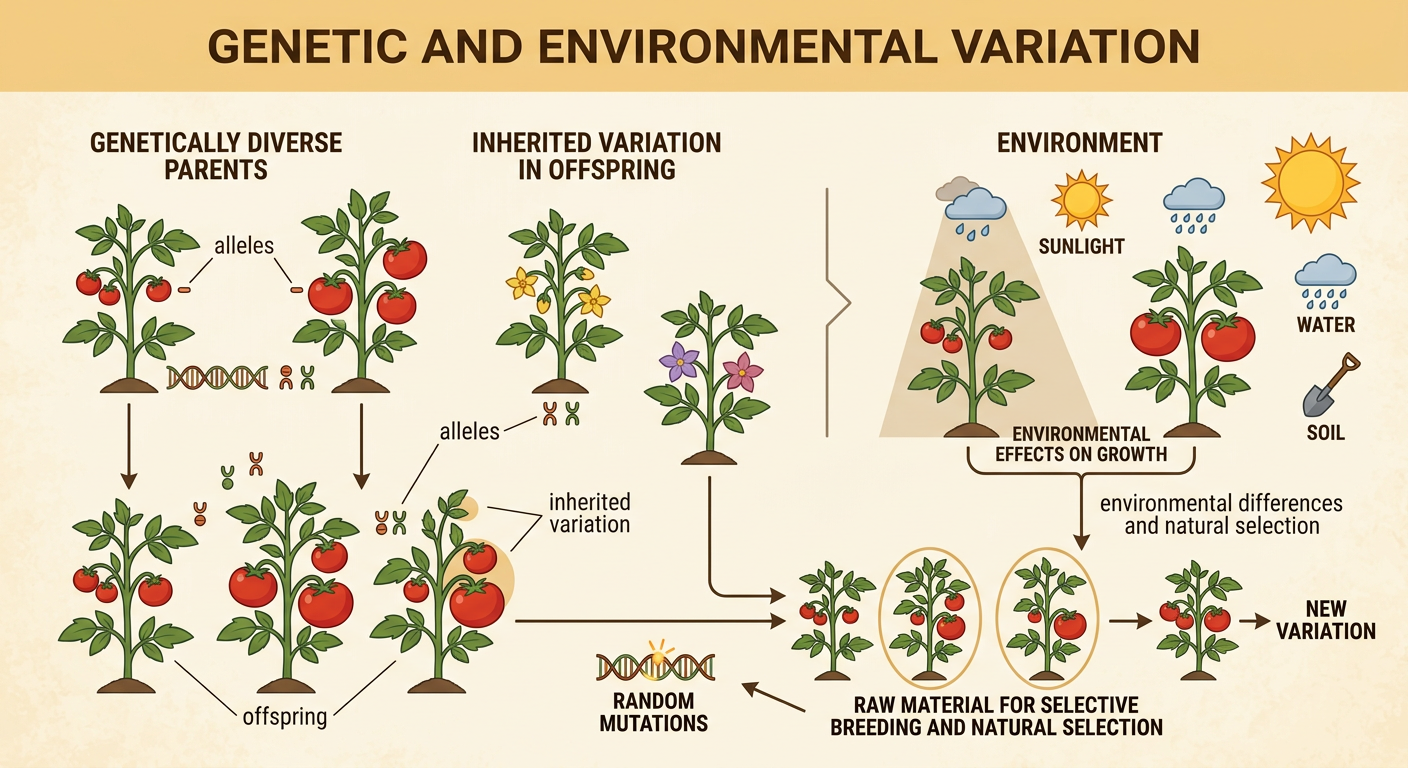
Individuals in a population are not genetically identical. They inherit different versions of genes, called alleles, from their parents. These inherited differences can produce variation in traits such as height, color, disease resistance, or milk production. Environmental conditions can also affect how a trait appears, so not every difference is inherited. For example, tomato plants may inherit alleles associated with fruit size, but water, soil, and sunlight also influence how large the tomatoes grow. Breeders can select inherited variation only when parents can pass the relevant alleles to offspring. Variation already present in a population provides the raw material for both selective breeding and natural selection. New variation can also arise through random mutations, but humans cannot simply make a desired mutation appear by choosing parents.
Selective Breeding as a Technology
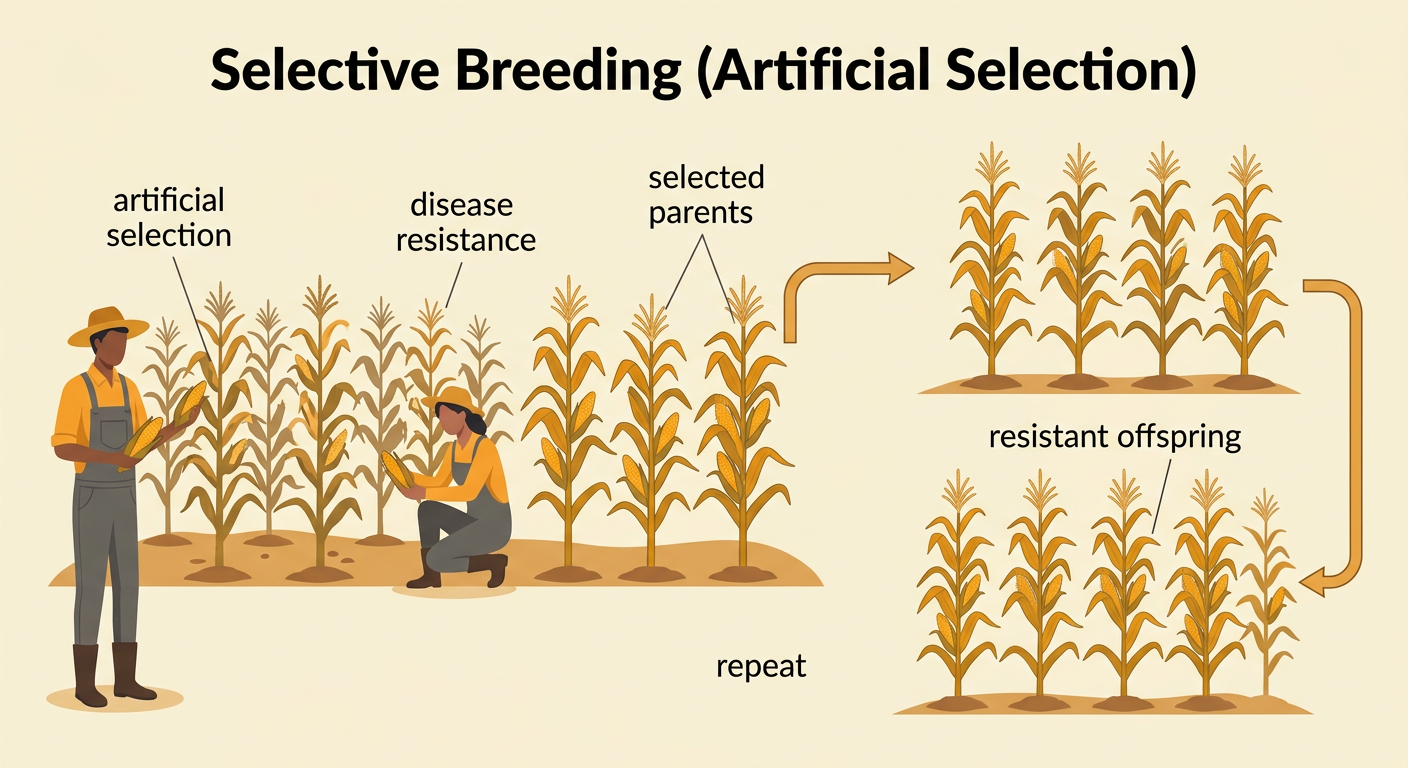
Selective breeding, also called artificial selection, is a technology in which humans choose organisms with desired inherited traits to reproduce. Over many generations, the selected trait may become more common in the population. Suppose farmers want corn plants that resist a certain disease. They identify healthy plants in a disease-exposed field, breed those plants, and grow their seeds. The farmers repeat the process with resistant offspring. Selective breeding does not guarantee that every offspring will have the desired trait, because inheritance involves many allele combinations. It also does not directly edit DNA. Instead, it changes which organisms contribute more genes to future generations. Record keeping, controlled mating, and repeated measurement make selective breeding systematic, but the process can take many generations and may produce unintended traits.
How Humans Choose Breeding Traits
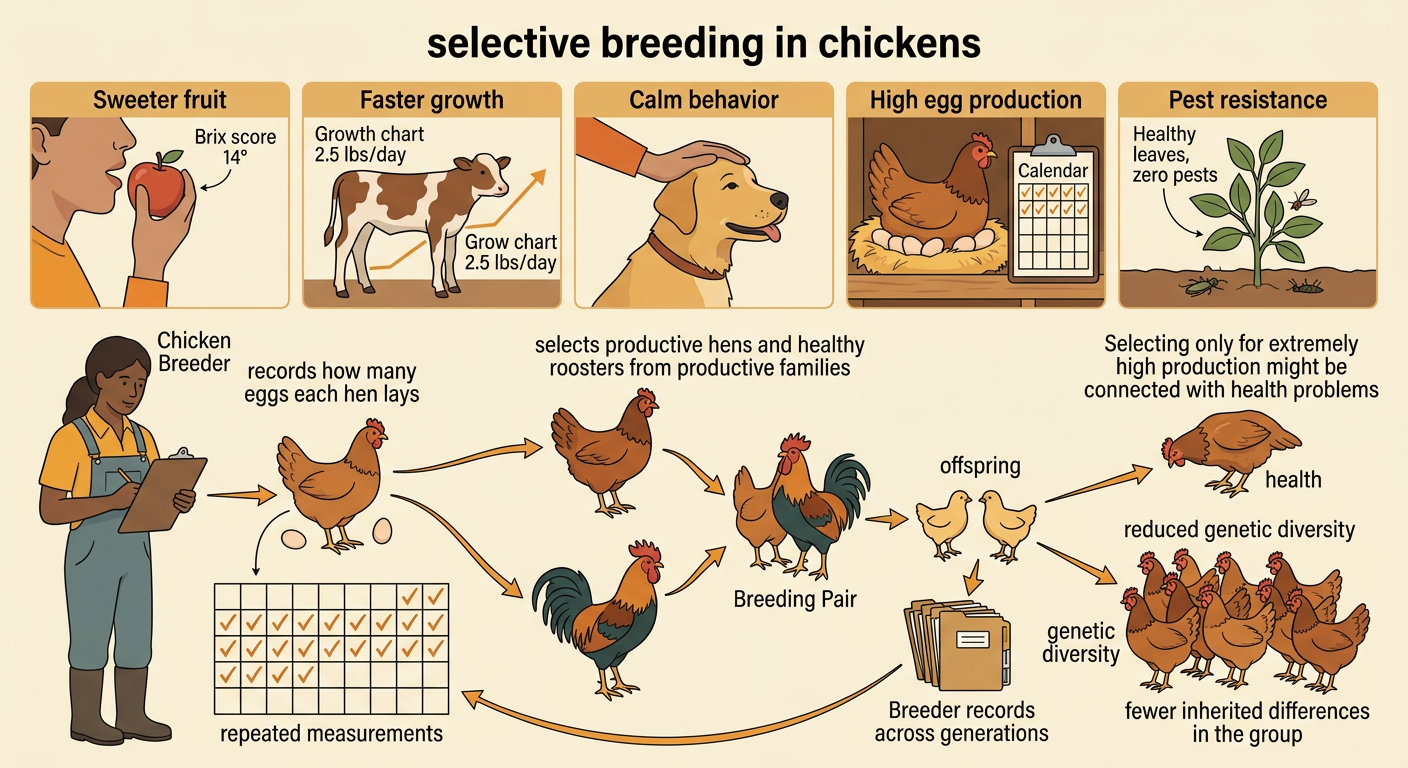
Breeders begin by defining a goal and deciding how to measure it. Useful traits might include faster growth, sweeter fruit, calm behavior, high egg production, or resistance to pests. They observe or test many individuals, select parents with strong versions of the desired trait, and compare their offspring. For example, a chicken breeder may record the number of eggs each hen produces and breed high-producing hens with healthy roosters from high-producing families. The breeder must also monitor other characteristics, because selecting for one trait can affect another. Very high production might be linked with health problems or reduced genetic diversity. Reliable selection requires repeated measurements, large enough groups, and records across generations. Ethical decisions matter as well: a desired appearance should not be favored if it causes pain or prevents normal movement.
Examples in Crops and Animals
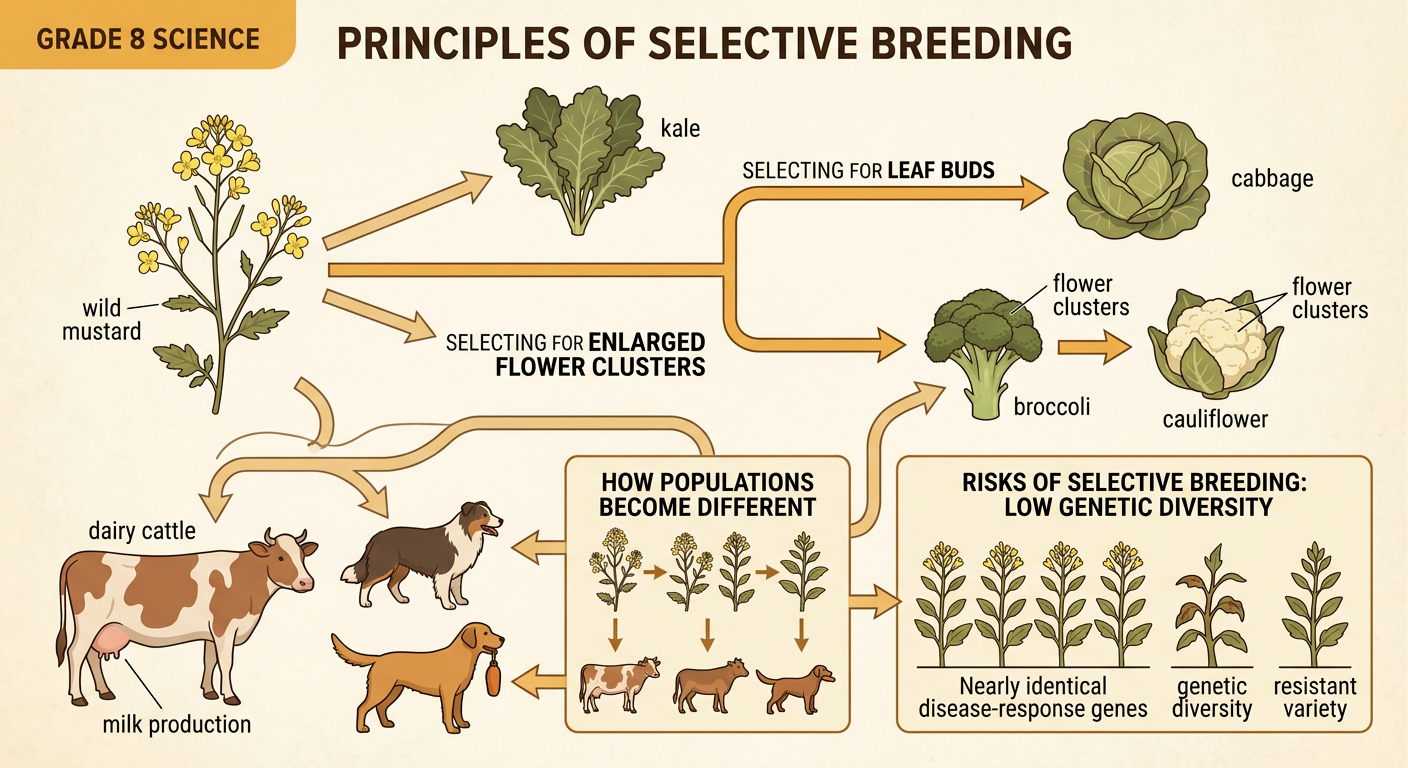
Humans have selectively bred many crops and animals for thousands of years. Wild mustard was bred along different paths to emphasize particular plant parts, producing crops such as cabbage, broccoli, kale, and cauliflower. In one path, breeders repeatedly chose plants with larger flower clusters, eventually producing broccoli and cauliflower varieties. Animal breeding works similarly. Dairy cattle have been bred for increased milk production, while some dog breeds were developed for herding, retrieving, or companionship. These examples show that selection can create major differences within related populations over many generations. However, selecting a narrow group of parents can reduce genetic diversity. A crop variety with very similar disease-response genes may be especially vulnerable if a new pathogen appears. Breeders may cross it with a resistant variety to introduce useful alleles and then continue selecting offspring.
Selective Breeding Versus Natural Selection
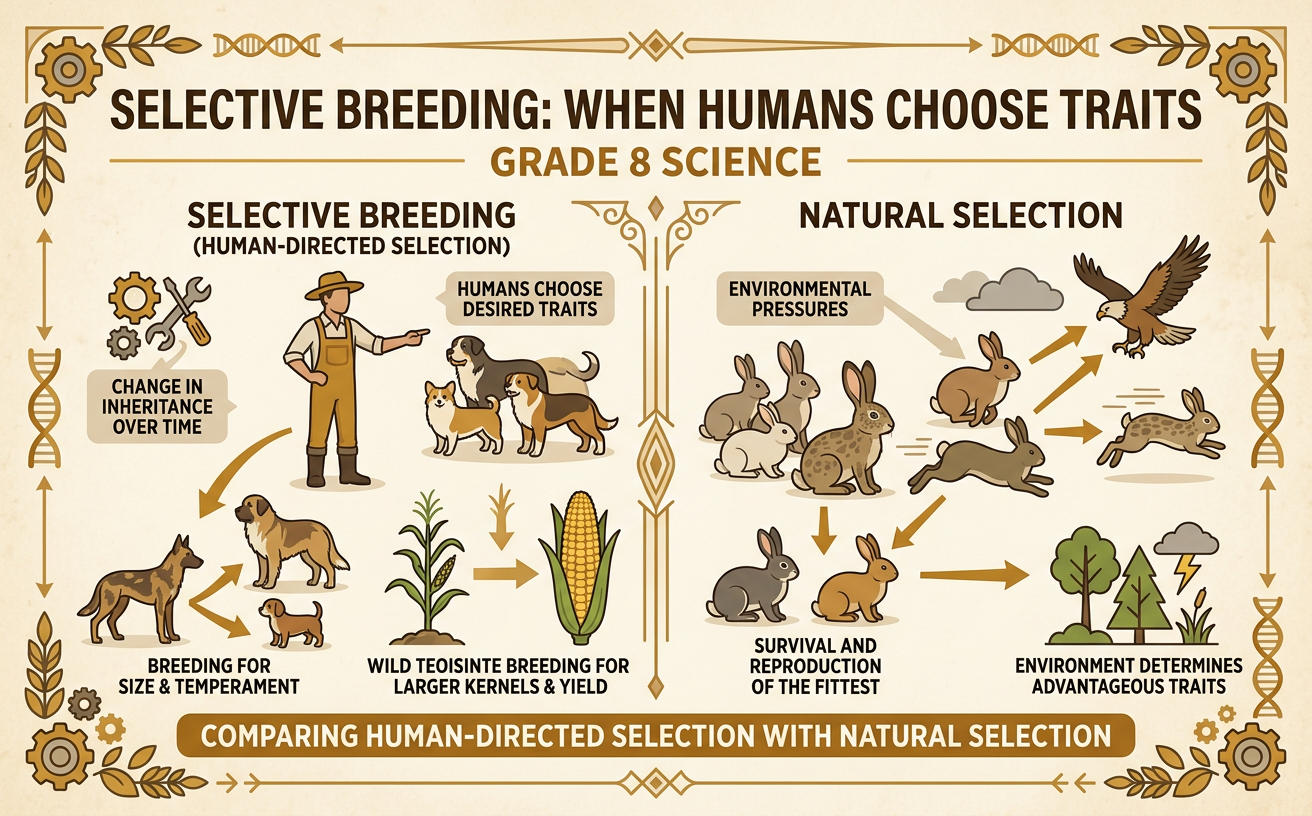
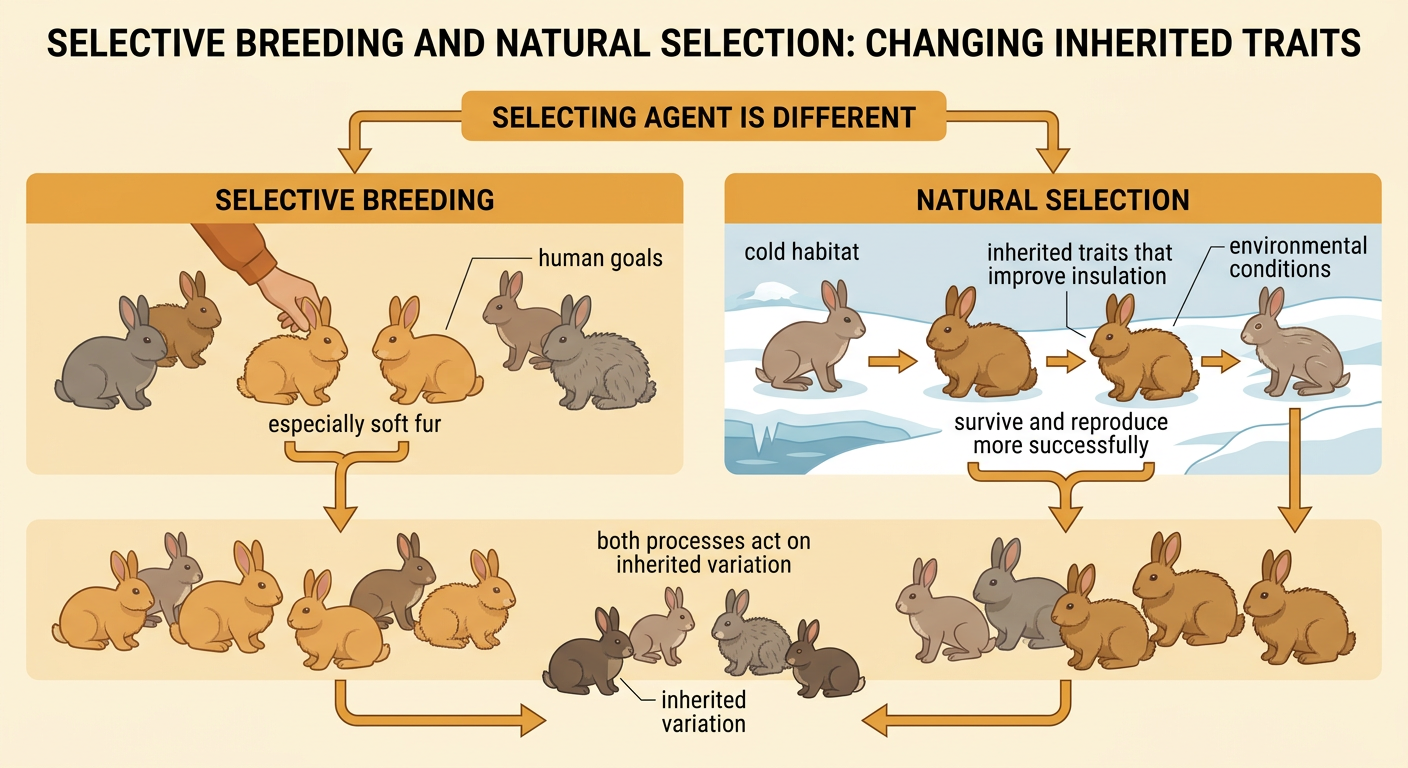
Selective breeding and natural selection both change the frequency of inherited traits across generations, but the selecting agent differs. In selective breeding, humans decide which organisms reproduce based on human goals. In natural selection, environmental conditions affect which individuals survive and reproduce more successfully. For example, a breeder may choose rabbits with especially soft fur, even if softness provides no advantage in the wild. In a cold habitat, however, rabbits with inherited traits that improve insulation may leave more offspring; that is natural selection. Neither process gives individuals traits because they need them. Both act on inherited variation already present or produced by mutation. Selective breeding may be faster because humans tightly control mating, but natural selection can occur in any population. A human-selected trait can also reduce survival if the organism later lives without human care.
Evidence-Based Comparison
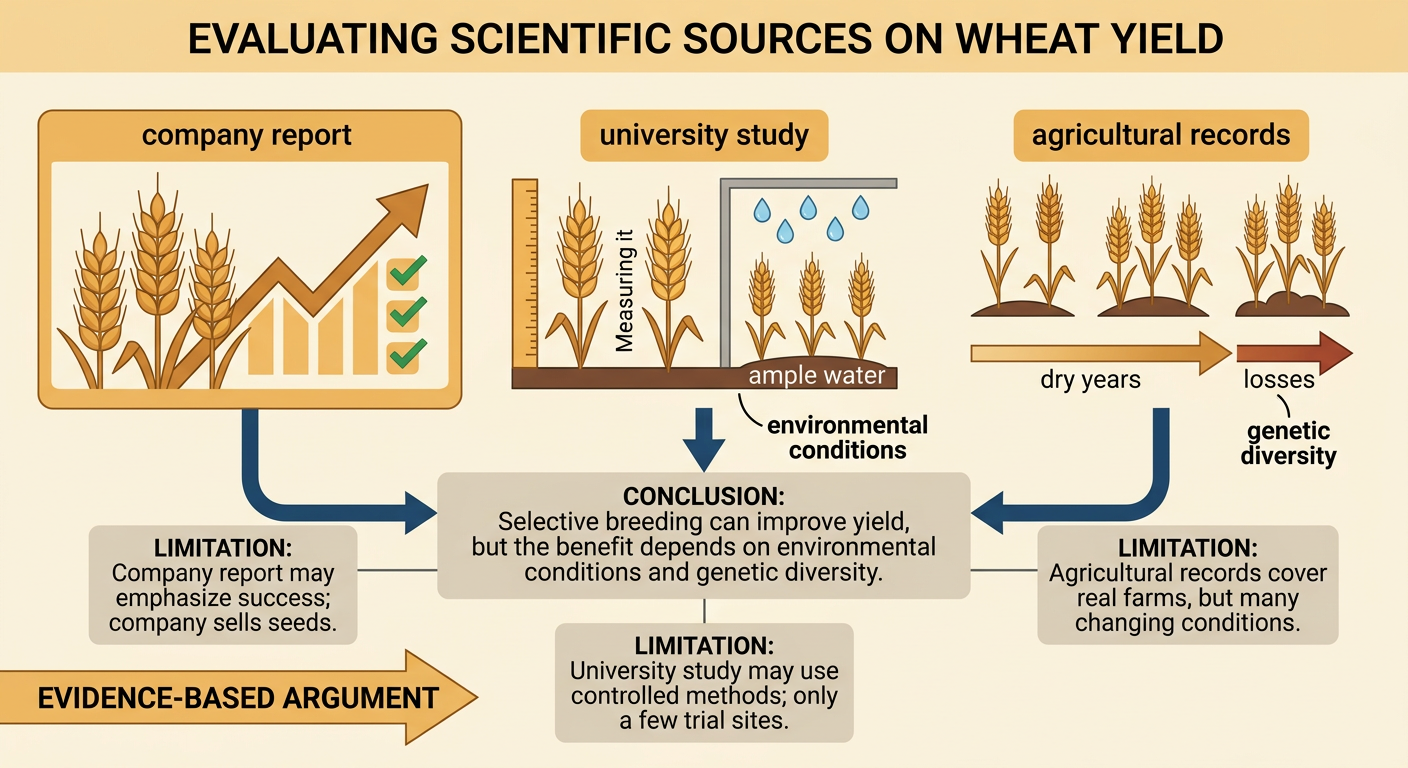
A strong comparison uses information from multiple reliable sources. Imagine that a seed-company report claims selective breeding increased wheat yield, while a university study reports that the new variety performs well only with ample water. Agricultural records might also show reduced losses in dry years when farmers plant several varieties. Together, the sources support this claim: selective breeding can improve a desired trait, but its benefits depend on environmental conditions and genetic diversity. The company report may provide large production records, yet it could emphasize successful results because the company sells seeds. The university study may use controlled methods, but its trial sites may represent only a few climates. An evidence-based argument identifies such strengths and limitations, checks whether sources agree, and explains why the evidence supports the conclusion rather than simply listing facts.