
Send and Decode a Signal Message
Students create a simple code using light or sound signals, send a message to a partner, and decode the message by following an agreed-upon key.

Illustrations are auto-generated and may be placeholders. They can be refreshed to match the narration.
Explore Ways to Send Messages
People can send messages with voices, pictures, light, or sound. A signal is something another person can see or hear. You might wave your hand, tap a drum, ring a bell, or flash a light. Signals are useful when people are too far apart to speak quietly. Work with a partner to compare signals. One partner can stand across the room and clap once. The other partner listens and raises a hand after hearing the clap. Then try one safe flashlight flash aimed at a wall, not at anyone’s eyes. Talk about which signal was easier to notice. Take turns speaking, listen carefully, and agree on whether light or sound will work best in your space.
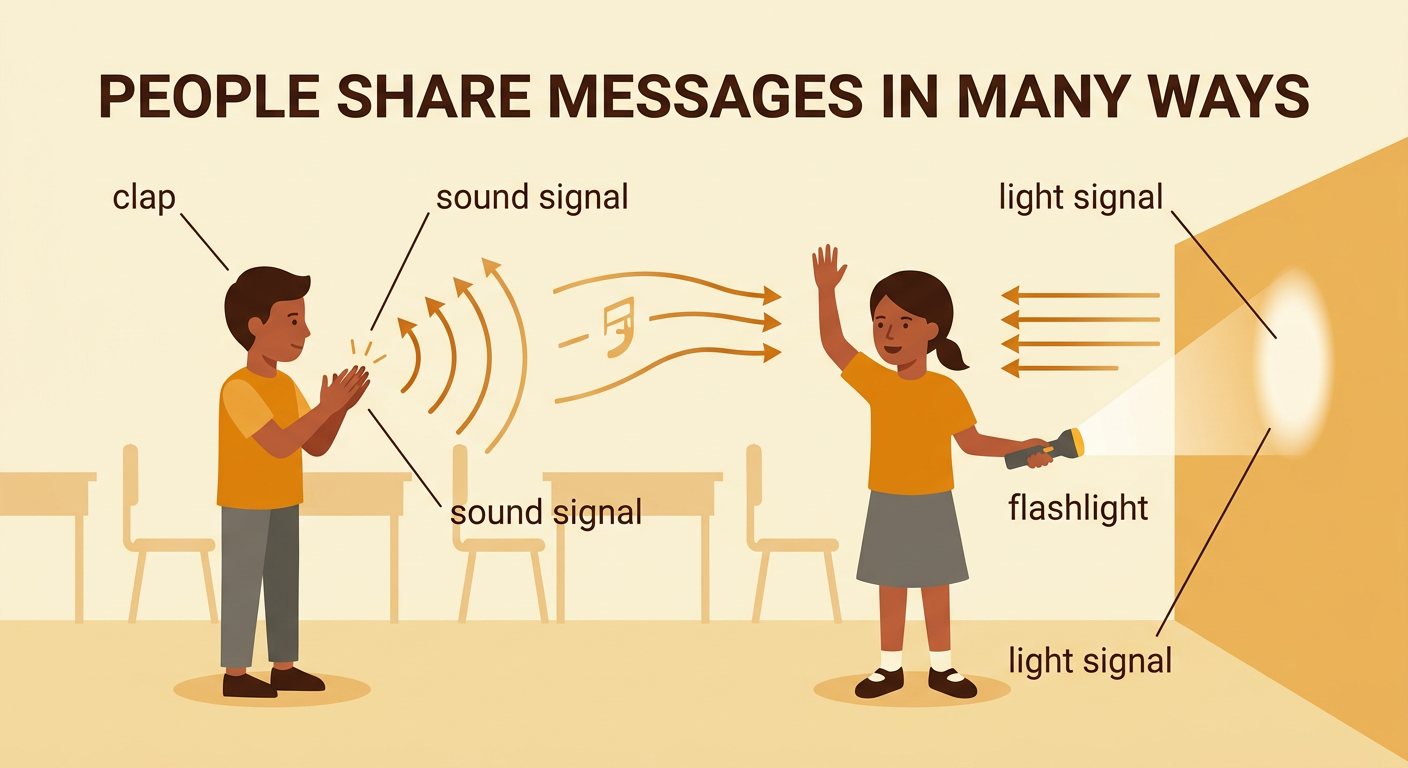
Learn About Signals and Code Keys
A signal can carry meaning when everyone agrees on what it means. A code key tells the meaning of each signal or signal pattern. For example, one short flash can mean “ready,” and one long flash can mean “wait.” The sender makes a signal. The receiver watches or listens, checks the code key, and tells the message. Both people must use the same key. Otherwise, the receiver may misunderstand. Imagine that Mia sees one short flash. She looks at the key and says, “Ready!” She does not guess. She uses the agreed-upon meaning. Before sending messages, partners should read the key together, ask questions, and agree that they understand each signal.

Create a Two-Signal Code
Choose two signals that are easy to tell apart. You might use a short flash and a long flash, or a soft tap and a loud tap. Then combine two signals to make messages. For a light code, short-short could mean “yes,” short-long could mean “no,” long-short could mean “help,” and long-long could mean “done.” Draw or write this key where both partners can see it. Test each signal before you begin. A short flash should be quick. A long flash should last about two slow counts. Work together to choose the meanings, and let each partner share an idea. Use a flashlight only with adult permission, and point it at a wall or tabletop instead of a person.

Send and Decode Partner Messages
Place the sender and receiver several steps apart with the code key between them or give each person a copy. The sender silently chooses one message. Suppose the sender chooses “no.” Using the example key, the sender makes a short flash and then a long flash. The receiver watches the complete pattern, checks the key, and says, “The message is no.” The sender confirms whether the answer is correct. Then partners switch jobs. Send one pattern at a time and pause between messages. The receiver should watch attentively without interrupting. If a signal is unclear, the receiver can politely ask, “Please send it again.” Taking turns, listening, and following the same rules help both partners communicate fairly and successfully.

Test and Improve the Code
A good code should be easy to send, notice, and understand. Test each message several times. Keep a simple record of correct and incorrect answers. For example, if “short-long” is decoded correctly three times but “long-short” is often confused, the two flashes may be too close together. Partners can agree to add a clear pause between signals or make the long flash last longer. Test the changed code again and compare the results. Ask: Could the receiver see or hear every signal? Were the signals different enough? Was the key clear? Each partner should share one observation and listen to the other person. Choose an improvement together. Engineers test and improve communication devices so messages can travel more clearly over a distance.
