
Send It a New Way
Students investigate how a push from different directions can change the path of a rolling ball.

Illustrations are auto-generated and may be placeholders. They can be refreshed to match the narration.
Notice the Ball’s Path
A path is the way an object moves from one place to another. Sit with your group around a smooth, open area. One student gently rolls a ball straight toward a target. Watch where the ball starts, which way it travels, and where it stops. You might see the ball roll in a nearly straight line from a blue tape mark toward a block. Point along the path with your finger without touching the moving ball. Take turns being the roller and the watcher. Before each roll, make sure everyone is ready. Use the same ball and starting place each time. A careful first roll gives your group a path to compare with later rolls.

Predict the New Direction
A direction tells which way an object is moving. Imagine that a ball is rolling forward and a friend gives it a gentle push from the left side. Which way do you think its path will turn? Point to your prediction or draw it in the air. A push from the left side may send the ball more toward the right. A push from the right side may send it more toward the left. Tell your group, “I predict the ball will turn right because the push comes from the left.” Listen while other students share their ideas. The group does not need to choose one correct prediction. Everyone may make a prediction, and the investigation will help you find out what happens.

Push from Different Sides
Now test pushes from different directions. Choose group jobs: one student rolls the ball, one gives a gentle side push, one watches, and one records the path. Switch jobs so everyone gets a turn. First, roll the ball from the same starting line. Gently tap it from the left as it passes a tape mark. Next, repeat the test and tap it from the right. Keep the test fair by using the same ball, starting place, target, and gentle roll. Change only the side of the push. Your group can agree on the job order or draw name cards to decide fairly. Keep hands low, push gently, and wait until the rolling area is clear.

Observe and Compare Paths
Look closely at the paths from your tests. Compare where each ball began, where it was pushed, which way it turned, and where it stopped. You may notice that the ball pushed from the left moved more toward the right. The ball pushed from the right may have moved more toward the left. A push from behind may make the ball move faster in its forward direction. Results can vary if one push is stronger or if the floor is uneven. That is why fair tests are important. Talk with your group using observation words: “I noticed,” “Both paths,” and “The paths were different because.” If a result is unclear, agree to repeat the test with another gentle push.

Draw What Happened
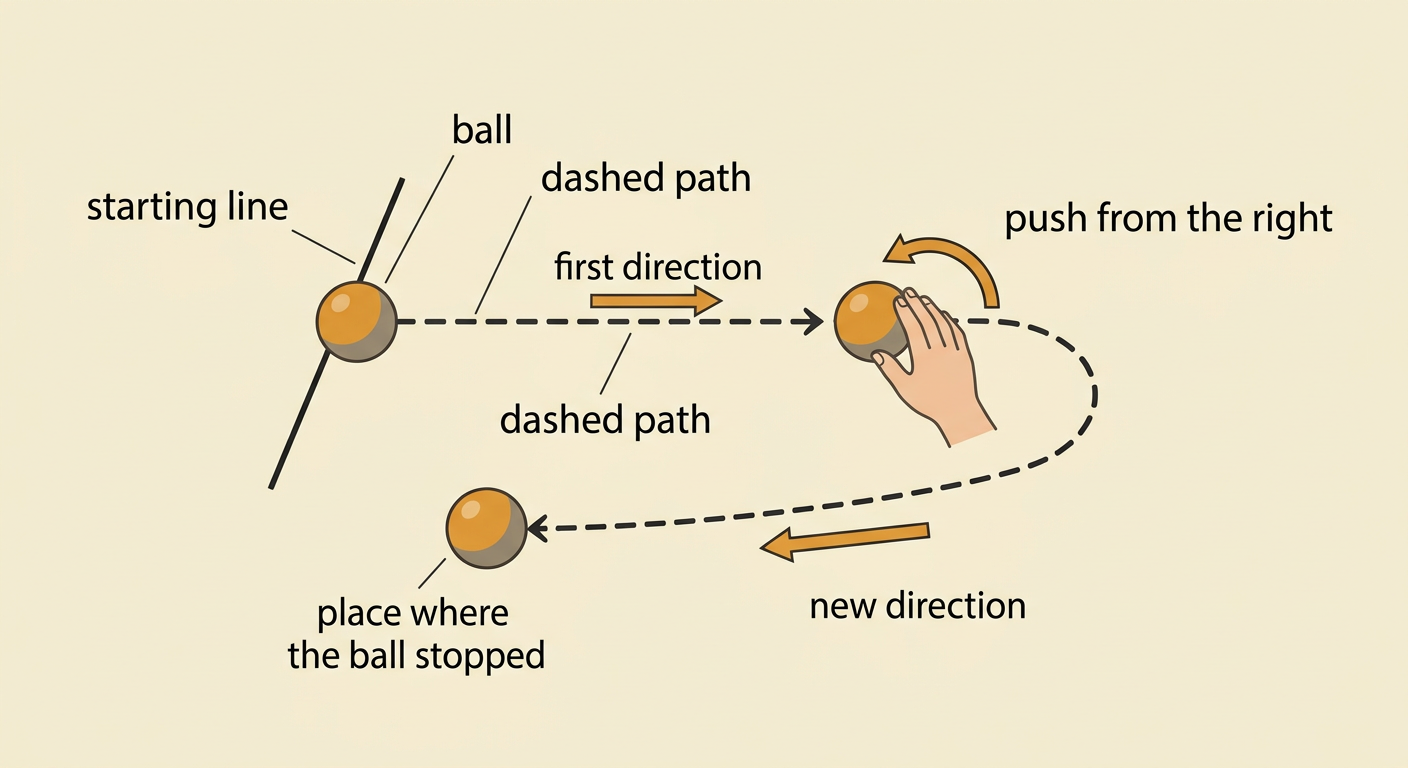
Make a simple picture of one test. Draw the starting line, the ball, the person’s hand, and the place where the ball stopped. Add an arrow to show the ball’s first direction. Then add another arrow to show its direction after the push. For example, if the ball rolled forward and was tapped from the right, your second arrow might point toward the left. Use a dashed line to show the whole path. Your drawing should show what you observed, even if it is different from your prediction. Tell a partner what each arrow means. Your partner can check whether the push side and the new path are easy to understand. Then trade roles and listen to your partner’s explanation.
Share Our Direction Rule
Use your observations to make a class direction rule. A useful rule is: a push can change the direction of a moving ball. The direction of the push helps determine how the path changes. For example, when a rolling ball gets a gentle push from its left side, it begins moving more toward the right. Share one piece of evidence from your group’s test. Take turns speaking, look at the person who is talking, and ask a question if something is unclear. The class can decide on its rule by discussing the evidence and agreeing on words that match most tests. If groups observed different results, compare their procedures and repeat a fair test. Scientists use evidence, careful listening, and fair decisions to build explanations together.
