
Sending Messages with Light Signals
Students design and test a simple light-signal system for communicating a message across a distance.
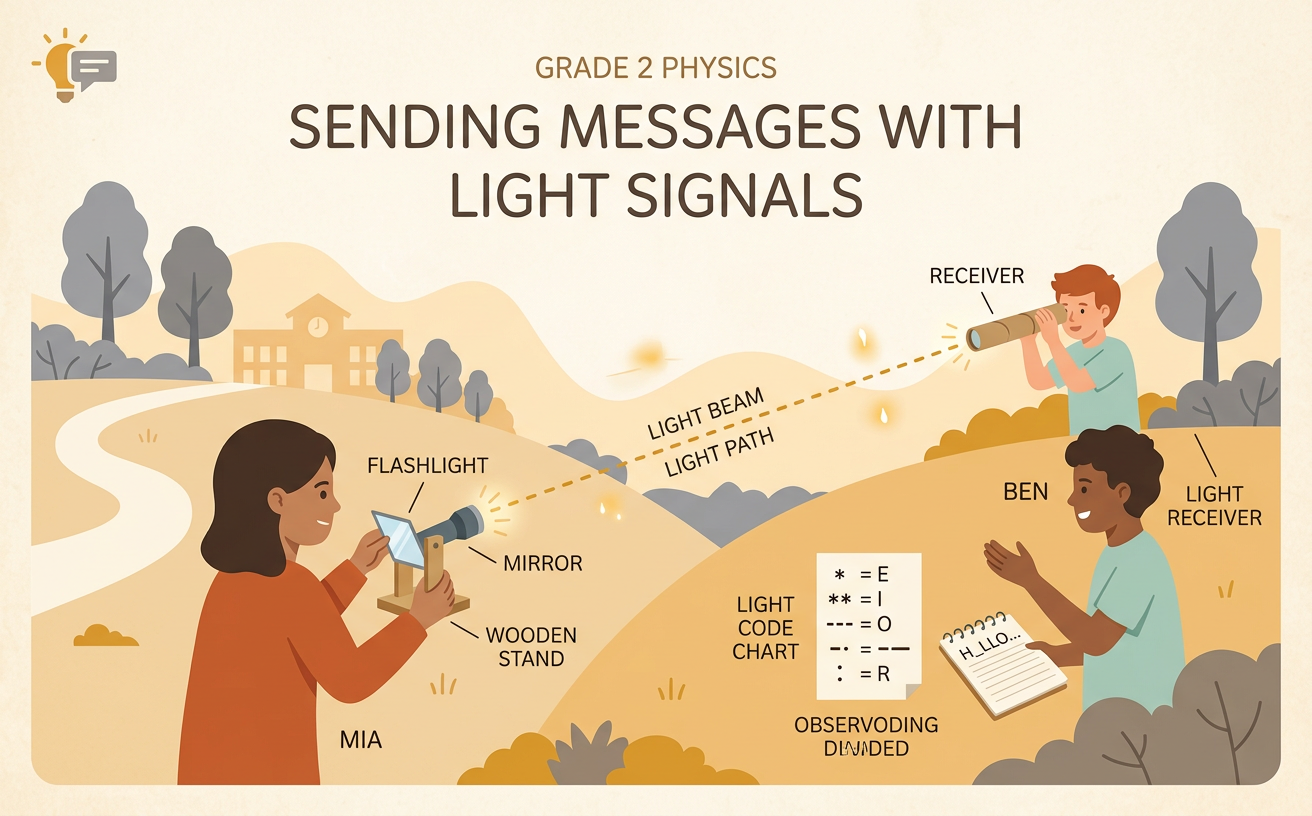
Illustrations are auto-generated and may be placeholders. They can be refreshed to match the narration.
How Can We Send a Message Far Away?
Imagine that your friend is across a large playground. Your voice may be hard to hear, but your friend can still see a bright flashlight. Light can carry a signal across the distance. A signal is an action that stands for information. For example, one quick flash might mean “hello.” Two quick flashes might mean “come here.” Long ago, people used signal fires, lanterns, and other simple tools to send messages. Today, people also use electric lights, phones, and computers. Both past and present systems use agreed-upon signals. A good light-signal device must be easy to see and easy to control. It must also have a code that both the sender and receiver understand. In this lesson, you will design a simple system for sending messages with light.
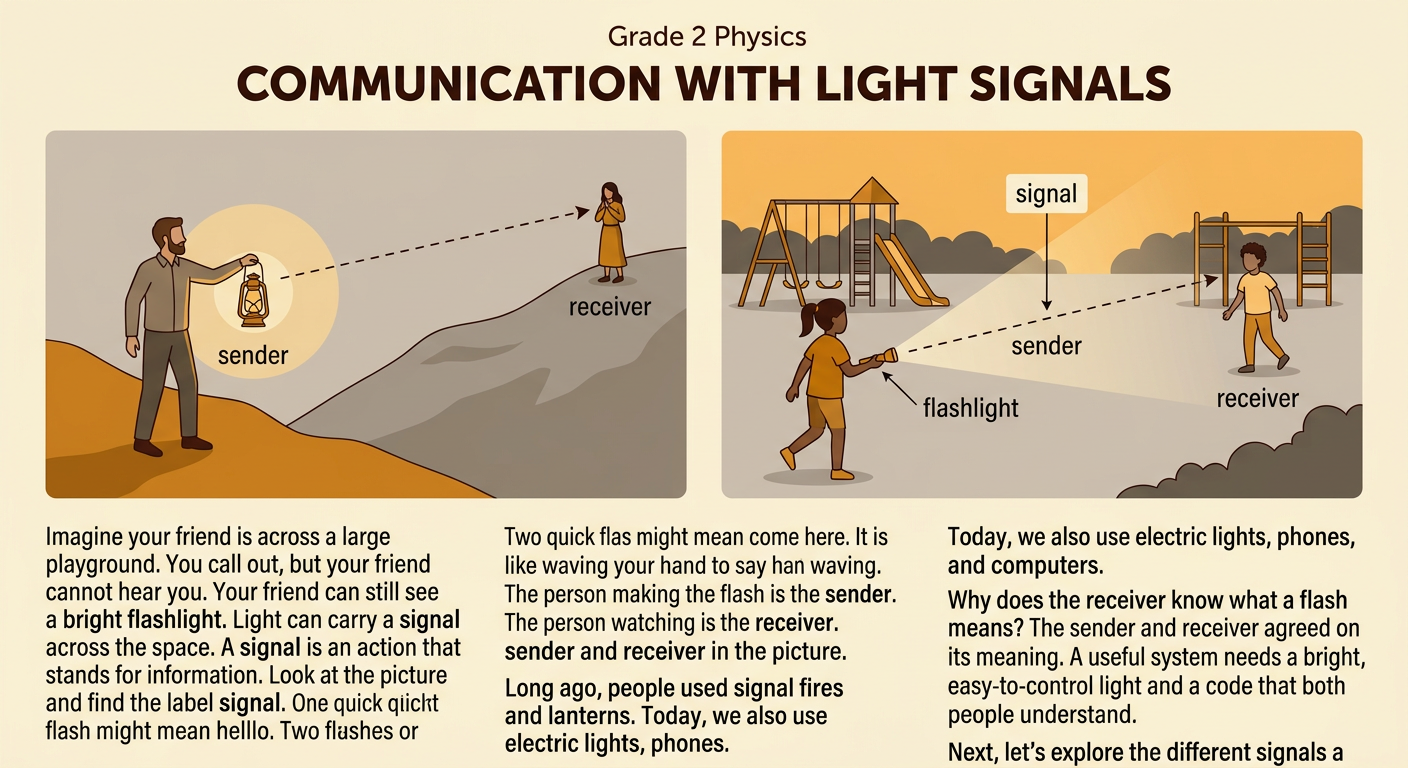
Explore Light Signals
A flashlight can make different kinds of signals. You can turn it on for a short flash or keep it on for a long flash. You can also change the number of flashes or pause between them. Test which signals are easiest to notice. Stand a safe distance from a wall and point the flashlight at the wall. Try one short flash, one long flash, and three short flashes. Compare what you see. A brighter area and a clear pattern can help a receiver understand the signal. Light travels in a straight path from the flashlight, so the receiver needs a clear view. Do not shine a flashlight into anyone’s eyes. Never use a laser pointer for this activity. Talk with your group about which signals look different enough to avoid confusion.

Create a Signal Code
A code is a set of signals with agreed-upon meanings. Work with your group to choose three simple messages. Then match each message to a light pattern. For example, one short flash can mean “hello,” two short flashes can mean “yes,” and one long flash can mean “no.” Record the code on a chart so everyone can remember it. Make each pattern clearly different from the others. If two patterns look almost the same, the receiver may misunderstand the message. Practice making each signal at the same speed. Count quietly to keep the timing steady: one count for a short flash and three counts for a long flash. Listen to your partners’ ideas, take turns speaking, and agree on a code together. Your shared code makes the light useful for communication.

Test Messages with a Partner
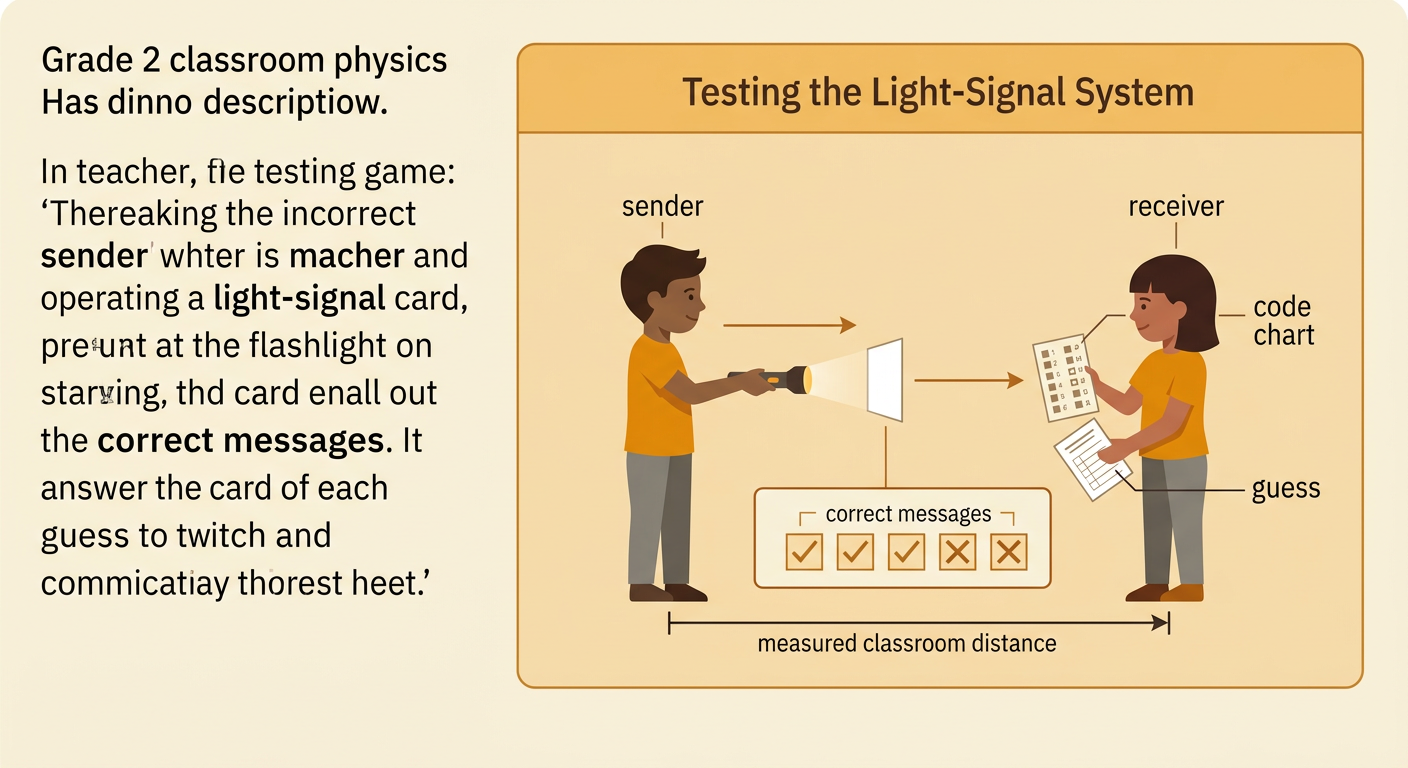
Now test your light-signal system with a partner. One person is the sender, and the other is the receiver. Stand where you can see each other clearly, but leave several steps between you. The sender secretly chooses a message from the code chart and flashes its pattern. The receiver watches, names the message, and records a guess. Then the sender reveals the correct message. Try at least five messages and switch roles. For example, if the sender makes two short flashes, the receiver may answer “yes.” Count how many messages were understood correctly. Talk about the results. Was a flash too quick? Was the light hard to see? Did the receiver lose sight of the flashlight? Take turns, listen carefully, and use kind words when you disagree. Testing helps you learn whether the system works across a distance.
Improve the Signal System
Engineers improve a design after they test it. Look at your message results and find one problem to solve. If short and long flashes looked too similar, make the long flash last longer. If the light was difficult to see, aim it at a white card or test in a slightly darker safe area with adult permission. If signals were sent too quickly, add a clear pause between flashes. Change only one part at a time so you can tell whether the change helps. Then send five more messages and compare the new results with the first results. For example, your group may improve from three correct messages to five correct messages after adding longer pauses. Explain your change to your classmates and listen to their questions. A successful system sends messages clearly, safely, and correctly across the chosen distance.
