Separating Mixtures: Designing a Water Filter
Students use particle size, solubility, and adsorption to compare methods for separating substances in a mixture and evaluate a simple water-filter design.
Illustrations are auto-generated and may be placeholders. They can be refreshed to match the narration.
Pure Substances and Mixtures
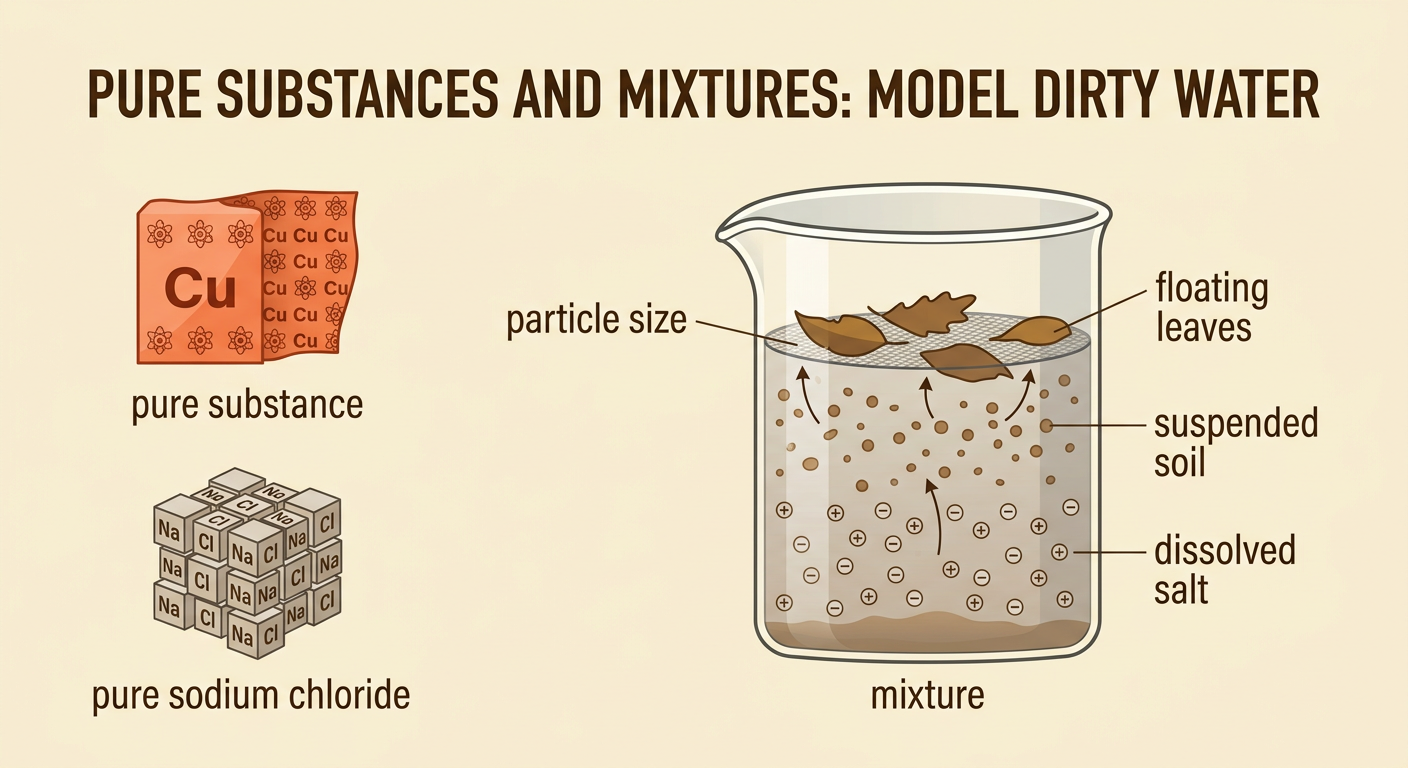
A pure substance contains only one kind of element or compound and has a fixed composition. Copper is an element, while pure sodium chloride is a compound. A mixture contains two or more substances physically combined, so each substance keeps its own properties. For example, model dirty water may contain water, soil, small leaves, and dissolved salt. The leaves may float, soil particles may remain suspended or settle, and salt may dissolve. Because the substances are not chemically bonded, physical methods can separate some of them. The best method depends on properties such as particle size and solubility. A screen can remove leaves, but its openings are too large to catch dissolved salt. Before designing a filter, identify the mixture’s components and predict whether each one is suspended, settled, floating, or dissolved.
How Separation Methods Work
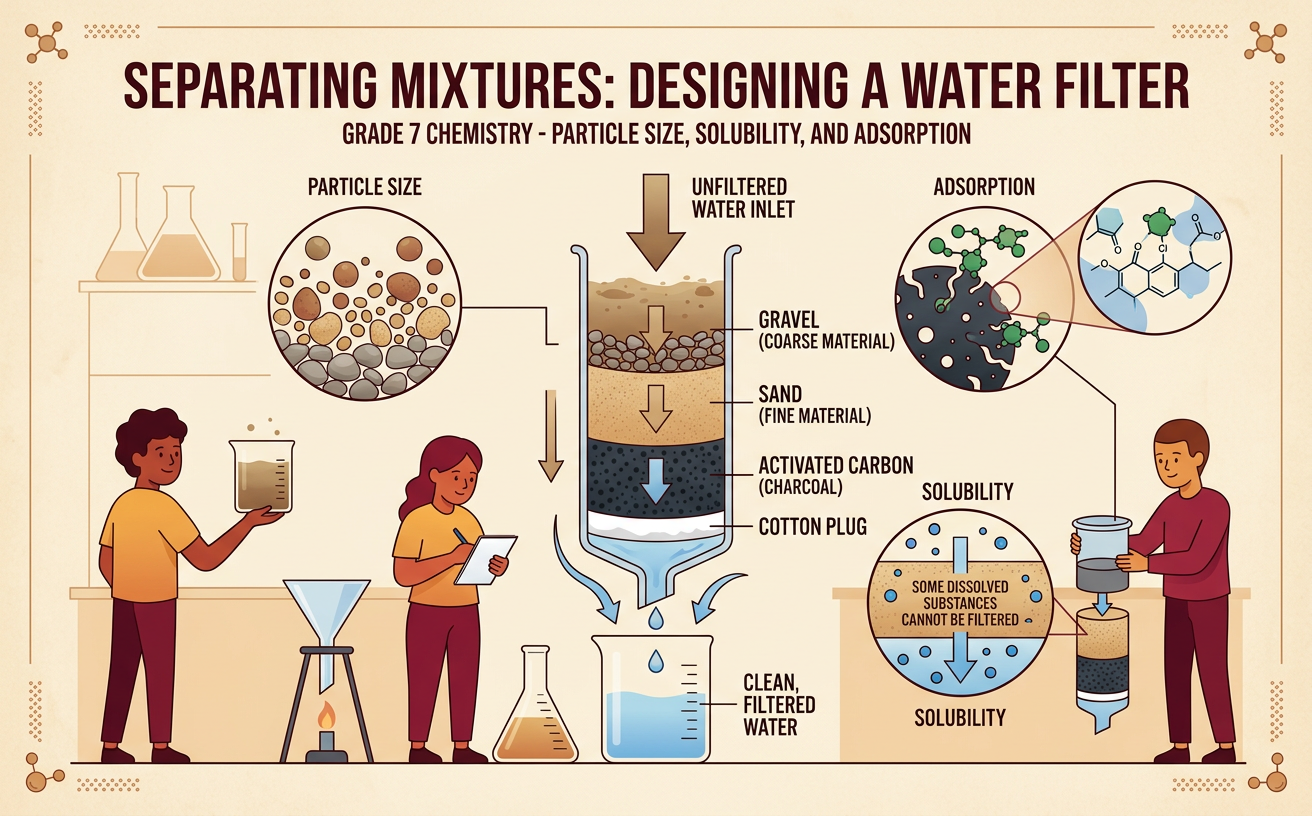
Separation methods use differences in physical properties. Screening and filtration separate materials by particle size: particles larger than a screen or pore are trapped, while smaller particles and water pass through. Settling allows dense suspended particles to sink, and decanting carefully pours off the clearer liquid above them. Solubility describes how well a substance dissolves. Sand does not dissolve in water, so a fine filter can trap it, but dissolved salt passes through ordinary filter pores with the water. Adsorption occurs when certain substances stick to the surface of a material. Activated carbon has many tiny surface spaces and can adsorb some odor-causing or colored substances. For example, a layered filter may trap gravel and soil while activated carbon reduces some color, but no single method removes every contaminant.

Build a Layered Filter
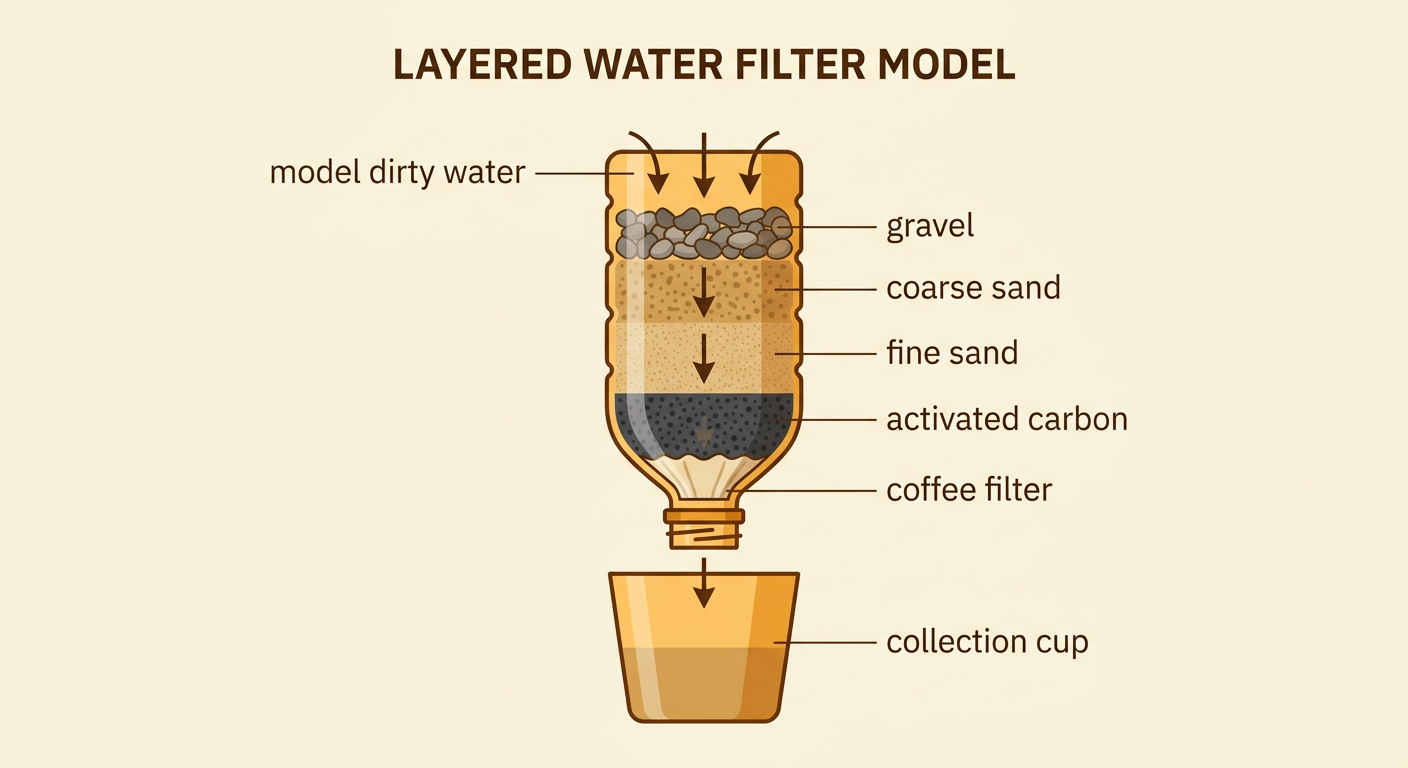
Use only teacher-approved model dirty water, and never drink filtered water. Place the top half of a plastic bottle upside down over a collection cup. Cover the bottle opening with a coffee filter or clean cloth so the filter materials cannot fall out. Add a layer of rinsed activated carbon, then fine sand, coarse sand, and gravel. In this upside-down design, water first enters the gravel at the wide top. Pour the same measured volume slowly into each filter being compared. Gravel catches large debris and spreads the flow. Sand traps smaller suspended particles, and activated carbon adsorbs some dissolved substances. The coffee filter holds the layers in place and catches fine material. Keep layer depths, water volume, and pouring time consistent so the comparison is fair.
Test Water Clarity and Flow Rate
Evaluate each filter with the same procedure. First, measure a fixed volume of model dirty water, such as 200 milliliters. Pour it into the filter and start a timer. Record the volume collected after a set time, or record the time needed to collect a set volume. Flow rate equals collected volume divided by time. If 150 milliliters is collected in 3 minutes, the flow rate is 50 milliliters per minute. Compare clarity by looking through each sample at the same printed symbol under identical lighting. A clarity scale from 1 to 5 can make observations more consistent, with 1 meaning very cloudy and 5 meaning very clear. Repeat trials and calculate an average. A good design should improve clarity without making the flow unreasonably slow.

Compare Cost, Benefits, and Limitations
Engineers compare designs using criteria, constraints, and evidence. Criteria are goals, such as clearer water, a flow rate of at least 40 milliliters per minute, and easy assembly. Constraints are limits, such as a five-dollar budget, available materials, and a ten-minute test period. Create a table listing each design’s clarity score, flow rate, cost, and amount of waste produced. Cost can be represented as a proportional relationship. If filter material costs $2 for enough material to treat 4 liters, the unit cost is $0.50 per liter. A thicker carbon layer might improve color removal but cost more and slow the flow. Economic choices affect families, businesses, and communities because money spent on one solution cannot be spent elsewhere. Select the design that best balances performance, safety, affordability, and environmental impact.

Why Filtration Cannot Remove Everything
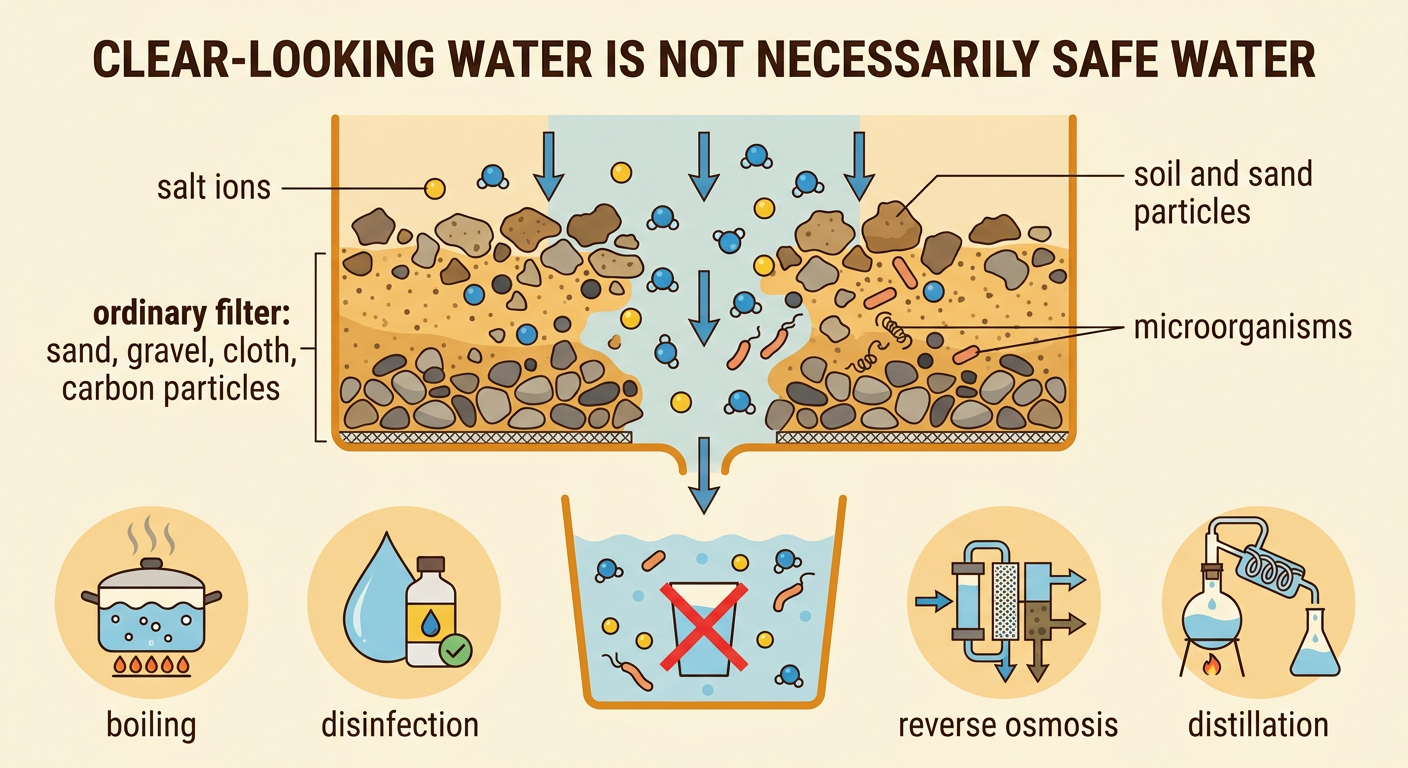
Clear-looking water is not necessarily safe water. Ordinary sand, gravel, cloth, and carbon filters can remove many suspended particles, but dissolved substances are much smaller than the filter openings. For example, salt ions move through the filter with water. Some harmful chemicals may not attach well to activated carbon, and carbon eventually becomes full and loses effectiveness. Disease-causing microorganisms may also pass through or grow in a poorly maintained filter. Specialized treatments are needed for different problems. Boiling or approved disinfection can control many microorganisms, while distillation or reverse osmosis can remove many dissolved substances. These methods also have limitations involving energy, cost, maintenance, and waste. The classroom filter is a model for comparing separation methods, not a device for producing drinking water. Never taste or drink the original or filtered test water.