
Separating Mixtures with Physical Methods
Students use particle size, magnetism, solubility, and evaporation to select and explain effective methods for separating mixtures without creating new substances.

Illustrations are auto-generated and may be placeholders. They can be refreshed to match the narration.
What Is a Mixture?
A mixture forms when two or more substances are combined but do not become a new substance. Each part keeps its own properties, so the parts can often be separated by physical methods. For example, trail mix may contain raisins, cereal, pretzels, and sunflower seeds. You can still identify and remove each ingredient because mixing did not change what it is. Mixtures can contain solids, liquids, or gases. Sand mixed with iron filings is a solid mixture. Salt water contains salt spread evenly through water. Observations such as color, shape, particle size, and attraction to a magnet can help identify the materials. Separating a mixture changes how its parts are arranged, but it does not create new substances.

Useful Properties for Separation
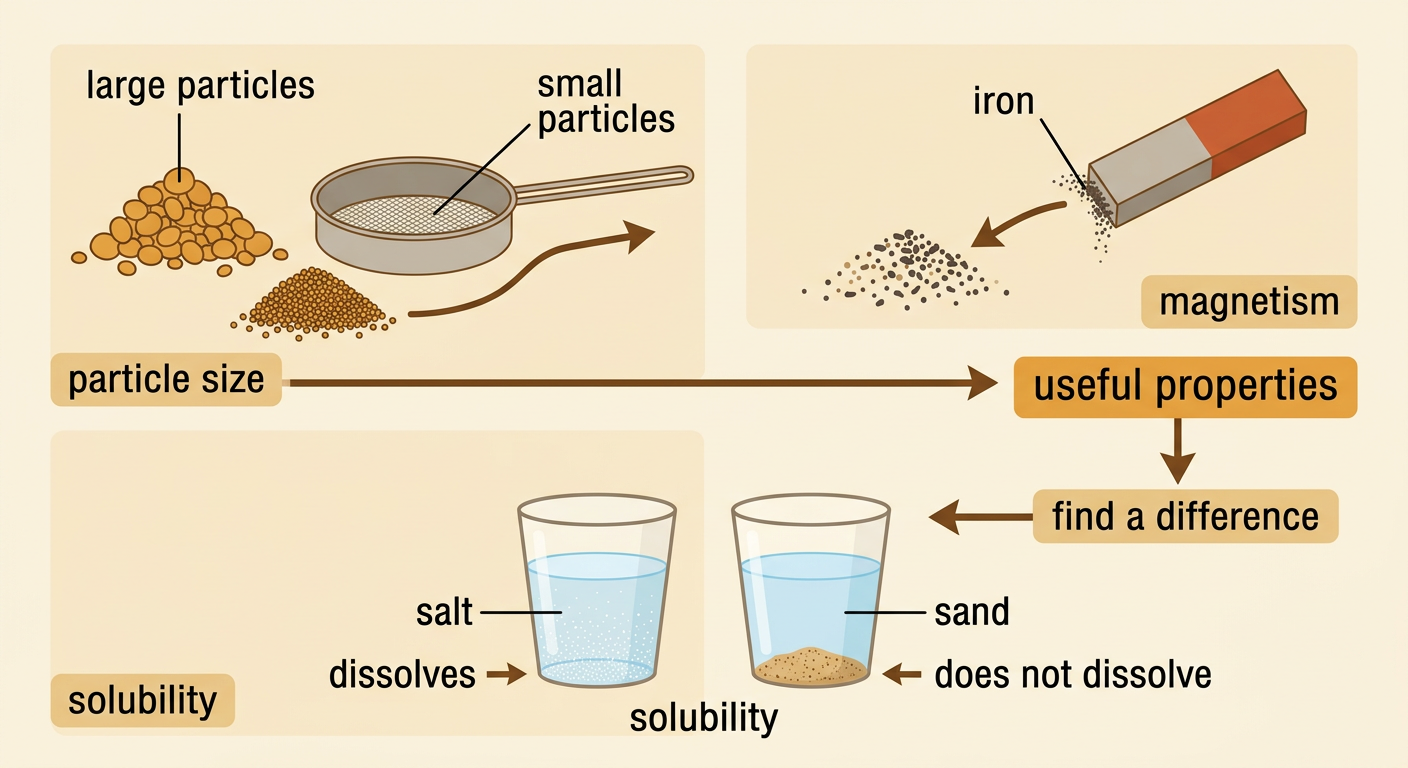
A property is a feature of a material that can be observed or measured. Useful separation properties include particle size, magnetism, and solubility. Particle size tells whether pieces can pass through openings in a sieve or filter. Magnetism tells whether a magnet can attract a material such as iron. Solubility describes whether a substance dissolves in a liquid. For example, salt dissolves in water, but sand does not. If a mixture contains salt and sand, adding water dissolves the salt while the sand remains solid. A filter can then trap the sand. Later, evaporation can separate the dissolved salt from the water. Scientists select a method by comparing the properties of every material in the mixture, not by guessing from only one observation.
Sorting, Sieving, and Magnetism
Sorting works when pieces are easy to recognize and pick apart by hand or with tools. A student could sort buttons by color or remove pebbles from dried beans. Sieving works when particles have different sizes. In a sand-and-gravel mixture, small sand grains pass through the openings of a sieve while larger gravel pieces remain above it. Magnetic separation works when one material is magnetic and the others are not. A magnet wrapped in a plastic bag can pull iron filings from sand; removing the bag releases the filings into a container. These methods do not make new substances. Safety matters: use a tool rather than touching unknown materials, keep strong magnets away from electronics, and avoid breathing dust from fine particles.

Filtering and Evaporation
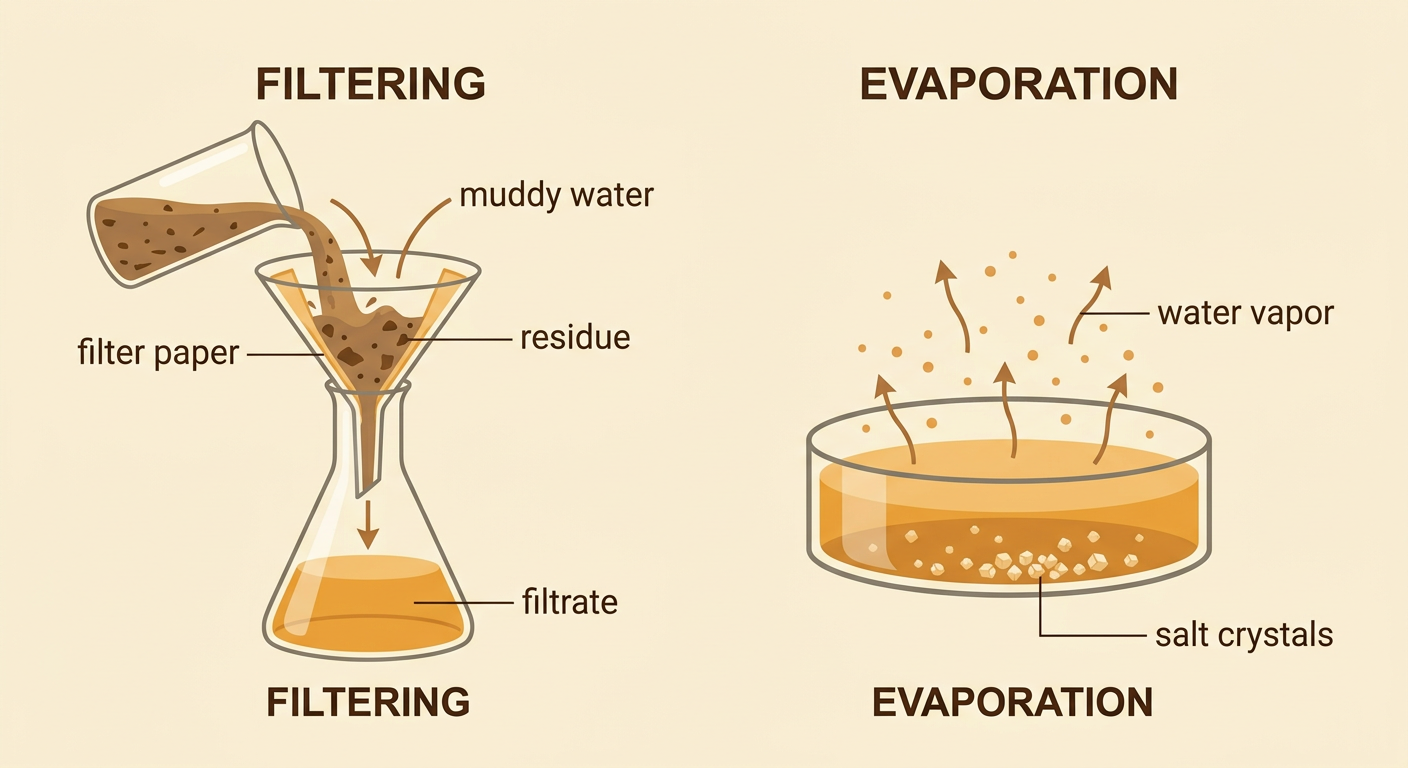
Filtering separates an insoluble solid from a liquid. Insoluble means the solid does not dissolve. When muddy water is poured through filter paper, water and very tiny dissolved materials pass through as the filtrate, while larger soil particles remain as residue. Filtering does not remove salt dissolved in water because dissolved salt particles pass through ordinary filter paper with the water. Evaporation can recover the salt. When salt water sits in a shallow dish or is gently warmed by an adult, liquid water changes into water vapor and enters the air. Solid salt crystals remain in the dish. No new substance forms during either process. Evaporation can be slow and does not collect the water unless special equipment is used, so the goal of the separation matters.
Choosing the Best Separation Method
The best separation method depends on the materials, the goal, and the available resources. First identify useful properties. Then compare each method’s benefits and costs. Hand sorting is simple and inexpensive, but it is slow for tiny pieces. Sieving is fast for dry particles of different sizes, but it fails when the particles are similar in size. A magnet quickly removes iron from nonmagnetic sand, but it cannot attract aluminum or plastic. Filtering is useful for sand and water, yet it cannot remove dissolved salt. Evaporation recovers salt, but it takes time and may require heat energy. For a mixture of paper clips and rice, a magnet is more efficient than hand sorting many pieces. A good choice separates the desired material safely while limiting time, waste, energy use, and cost.

Explain the Evidence
A strong scientific explanation states the method, gives evidence from observations or measurements, and connects the evidence to a material property. Suppose a student separates iron filings from sand. The student could write: “I used a magnet because the dark filings moved toward it, while the tan sand stayed in the dish. After three passes, the mass of filings collected was 12 grams. This evidence shows that the filings were magnetic and the sand was not.” Include the procedure in order, use accurate science words, and report measurements with units. Also describe the result and any limits. A few filings might remain if the magnet does not pass over every area. Conclude by explaining why the selected method was more effective, safer, faster, or less costly than another possible choice.
