
Separating Mixtures with Physical Properties
Students analyze particle size, solubility, density, and boiling point to choose methods for separating components of common mixtures.
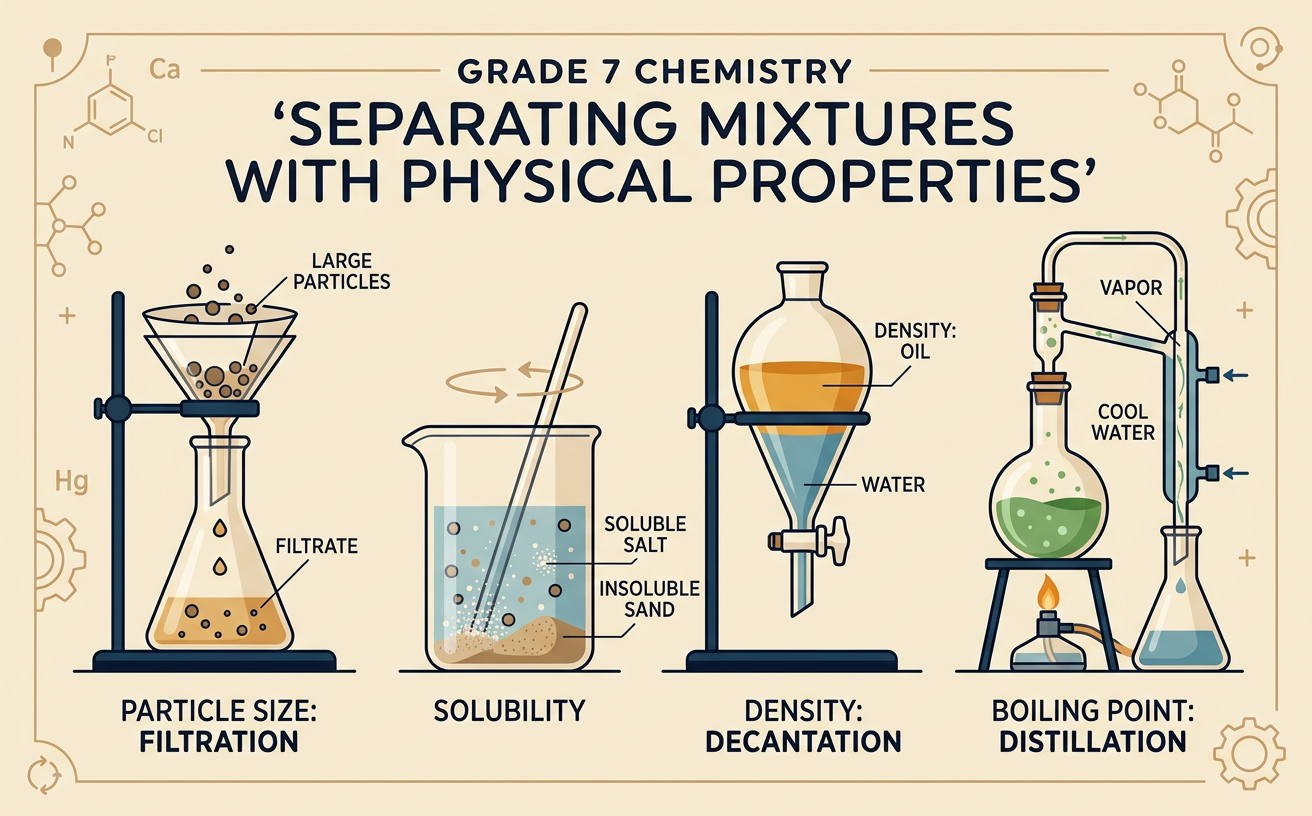
Illustrations are auto-generated and may be placeholders. They can be refreshed to match the narration.
Pure Substances and Mixtures
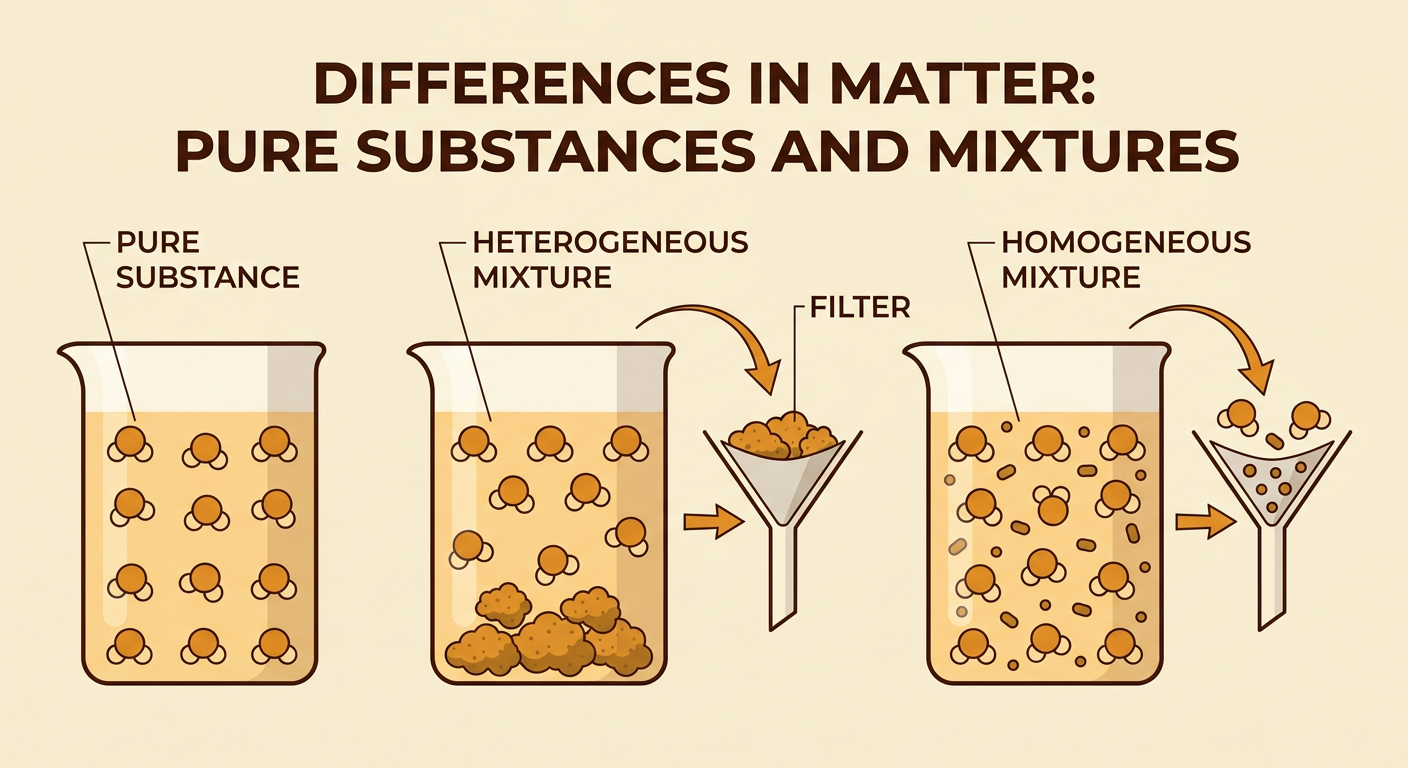
A pure substance is matter made of only one kind of element or compound and has a consistent set of properties. Pure copper is an element, while pure water is a compound. A mixture contains two or more substances that are physically combined, not chemically bonded. Each substance keeps its own properties. In a heterogeneous mixture, such as sand in water, different parts can be seen or sampled. In a homogeneous mixture, such as salt water, the substances are evenly distributed, so the mixture looks uniform. A mixture can often be separated by using differences in physical properties. For example, sand can be trapped by a filter because its particles are large, but dissolved salt passes through with the water. No new substances are formed during this separation.
Properties That Help Separate Matter
Physical properties can be observed or measured without changing a substance into a new substance. Particle size helps separate large solids from smaller particles or liquids. Solubility describes how much of a substance dissolves in a particular liquid at a given temperature. Density is mass divided by volume, and a less dense liquid usually floats on a denser liquid if the liquids do not mix. For example, oil floats on water because oil is less dense and insoluble in water. Boiling point is the temperature at which a liquid becomes a gas. At normal air pressure, water boils at about 100°C, while dissolved table salt does not boil at that temperature. Scientists compare measured property data to decide which difference is large enough to make a separation practical.

Filtration, Evaporation, and Distillation
Filtration separates an insoluble solid from a fluid by passing the mixture through a porous material. When muddy water is poured through filter paper, large soil particles remain as residue, while water and dissolved substances pass through as filtrate. Evaporation can recover a dissolved solid. If salt water is heated, water escapes as vapor and salt crystals remain, but the water is not collected. Distillation can recover the liquid and leave dissolved solids behind. During simple distillation, salt water is heated until water boils. The water vapor enters a cooler condenser, changes back into liquid, and collects in another container. Salt remains in the original flask. Distillation depends on boiling-point differences and requires more energy and equipment than filtration or ordinary evaporation.

Choosing a Separation Method
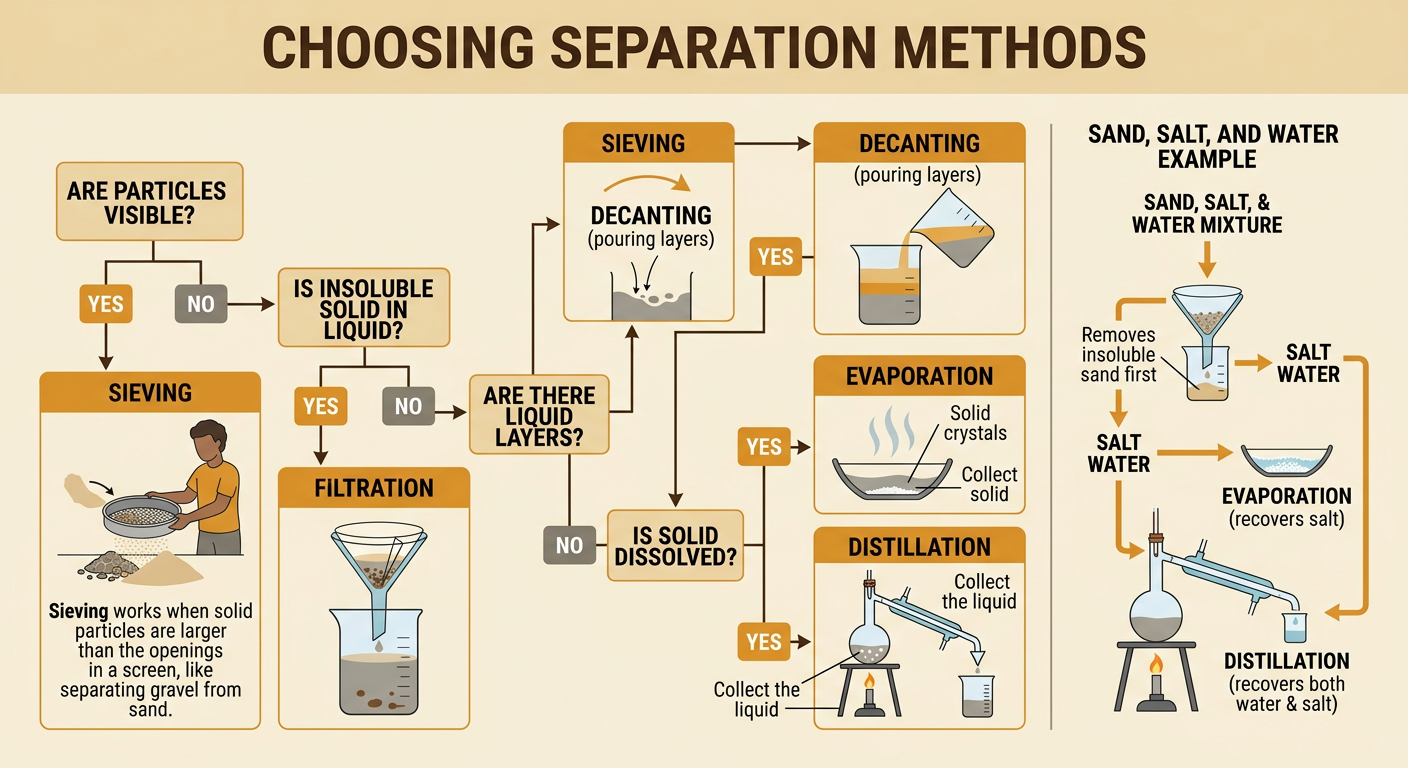
To choose a method, first identify the substances, compare their properties, and decide which component must be recovered. A useful model is a decision chart. If solid particles are larger than openings in a screen, use sieving. If an insoluble solid is suspended in a liquid, use filtration. If two liquids do not mix and have different densities, allow layers to form and carefully drain or pour off one layer. If a solid is dissolved, use evaporation to collect the solid or distillation to collect the liquid. Consider a mixture of sand, salt, and water. Filtration removes the insoluble sand. Evaporation then recovers the salt, while distillation could recover both water and salt. Measurements such as particle diameter, density, and boiling point provide evidence for the chosen sequence.
Water-Treatment Challenge
Imagine that a community must treat water containing leaves, suspended clay, and dissolved salt. A treatment plan should use evidence and consider scientific, economic, environmental, and community needs. Screens can remove leaves because of their large particle size. Settling tanks allow dense particles to sink, and filtration removes much of the remaining suspended clay. Dissolved salt passes through ordinary filters, so distillation could remove it, but heating large amounts of water requires considerable energy. Engineers might compare the volume treated, salt concentration, energy cost, waste produced, and water quality before recommending a system. No single method solves every problem. Real drinking-water treatment also includes testing and disinfection to address microorganisms, which physical separation alone may not remove. Water produced in a classroom investigation should never be consumed.
