
Separating Mixtures with Physical Properties
Students use particle size, solubility, magnetism, and boiling point to select methods for separating mixtures without creating new substances.
Illustrations are auto-generated and may be placeholders. They can be refreshed to match the narration.
Pure Substances and Mixtures
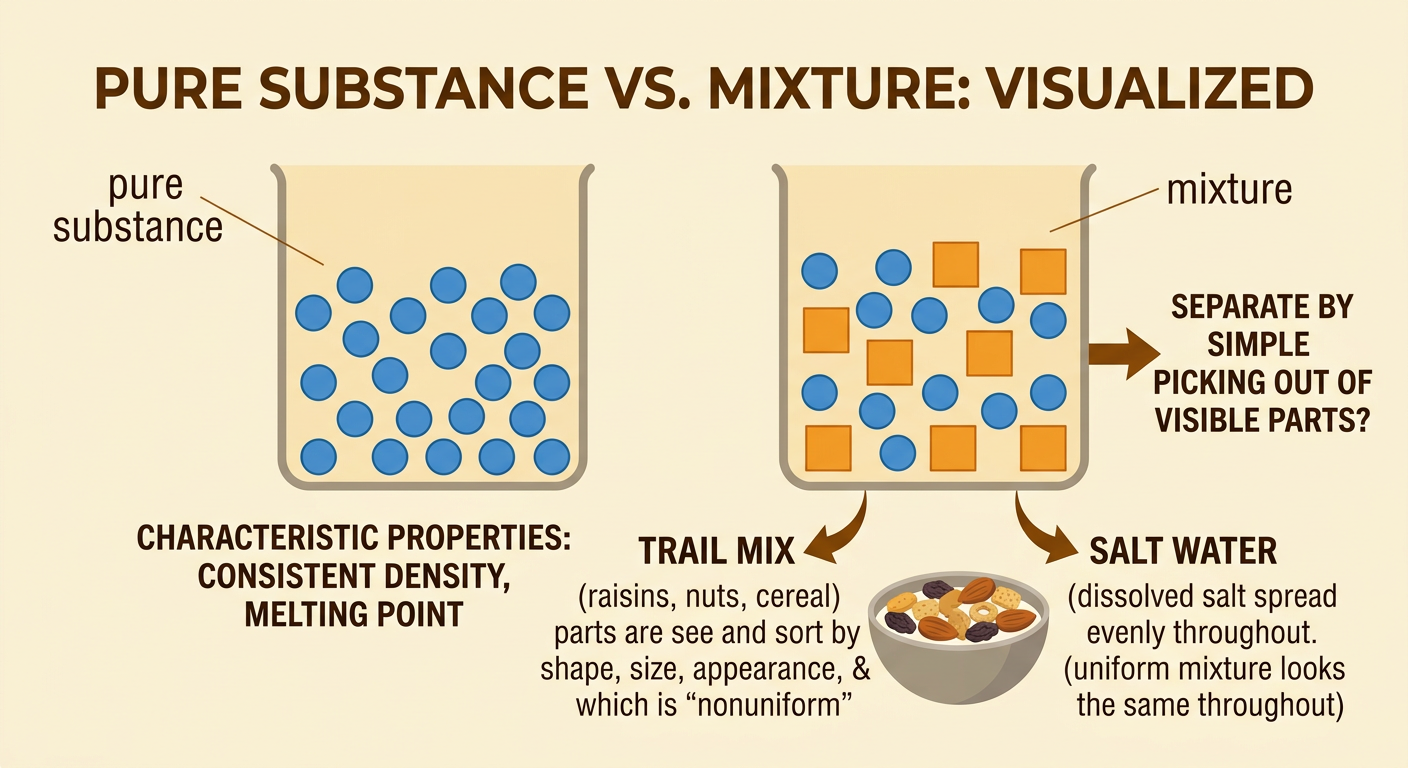
A pure substance contains only one kind of substance and has characteristic properties, such as a specific melting point or density. Elements and compounds can both be pure substances. A mixture contains two or more substances that are physically combined, not chemically joined. Each part of a mixture keeps its own properties, so the parts can often be separated physically without creating new substances. Mixtures may be uniform, like salt water, or nonuniform, like sand mixed with gravel. For example, a trail mix contains raisins, nuts, and cereal pieces. You can separate them by shape, size, or appearance, and each item remains the same substance after separation. Separating a mixture rearranges its components but does not change their chemical identities.
Properties Used for Separation
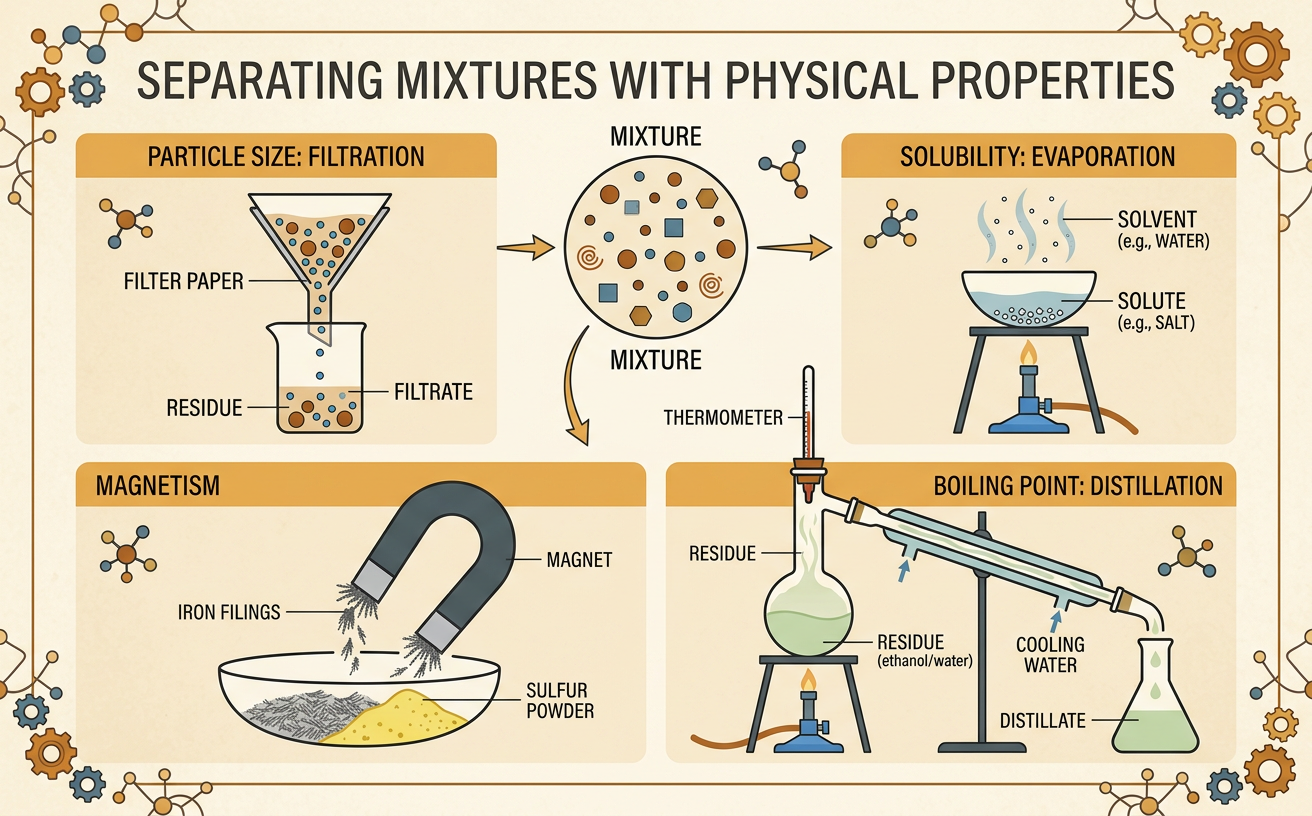
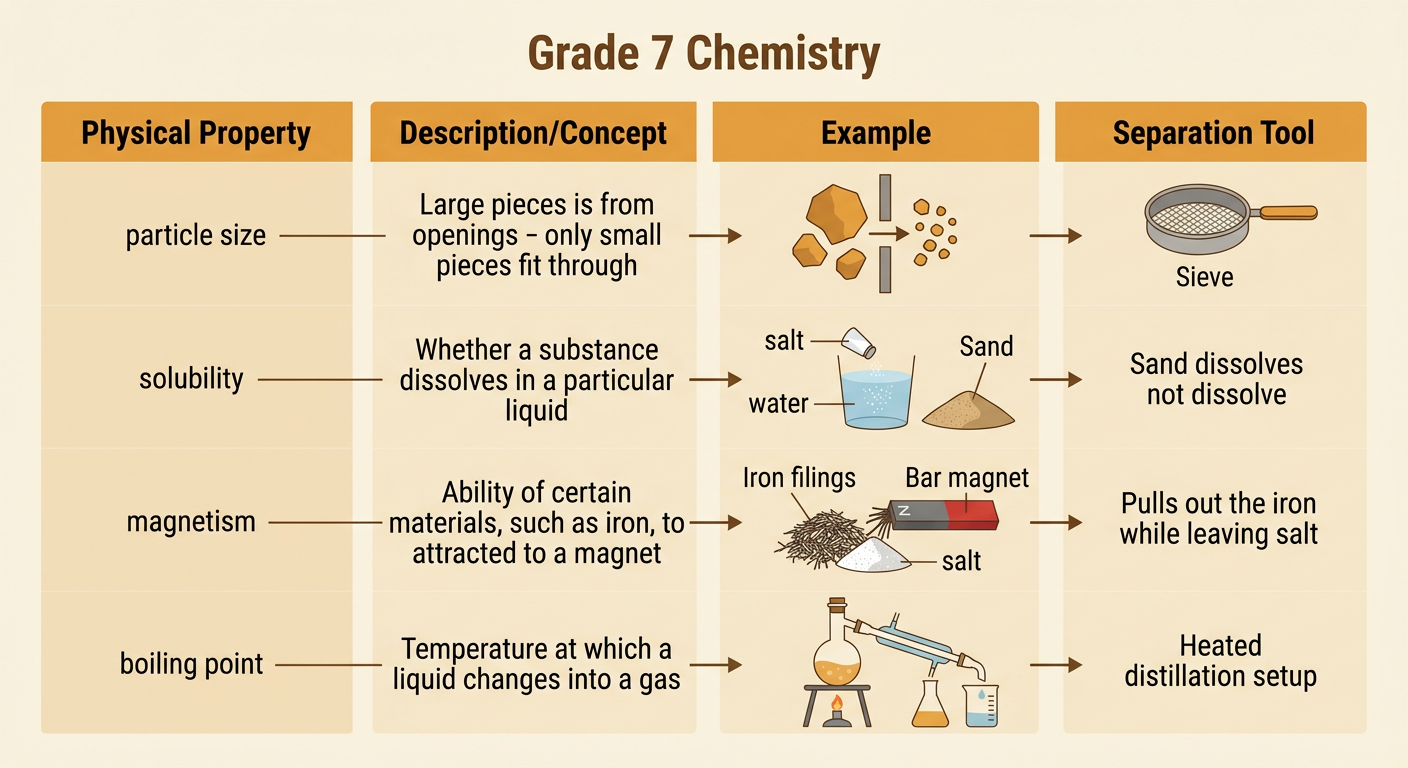
A useful separation method depends on a physical property that differs among the substances in a mixture. Particle size can separate large pieces from small pieces. Solubility describes whether a substance dissolves in a particular liquid. Magnetism allows a magnet to attract materials such as iron while leaving nonmagnetic materials behind. Boiling point is the temperature at which a liquid changes to a gas, so liquids with different boiling points can be separated by careful heating. For example, iron filings and salt look mixed together, but iron is magnetic and salt is not. A magnet can remove the iron without changing either substance. Scientists first identify a property difference, then choose equipment that uses that difference safely and efficiently.
Filtration, Magnetism, and Sieving
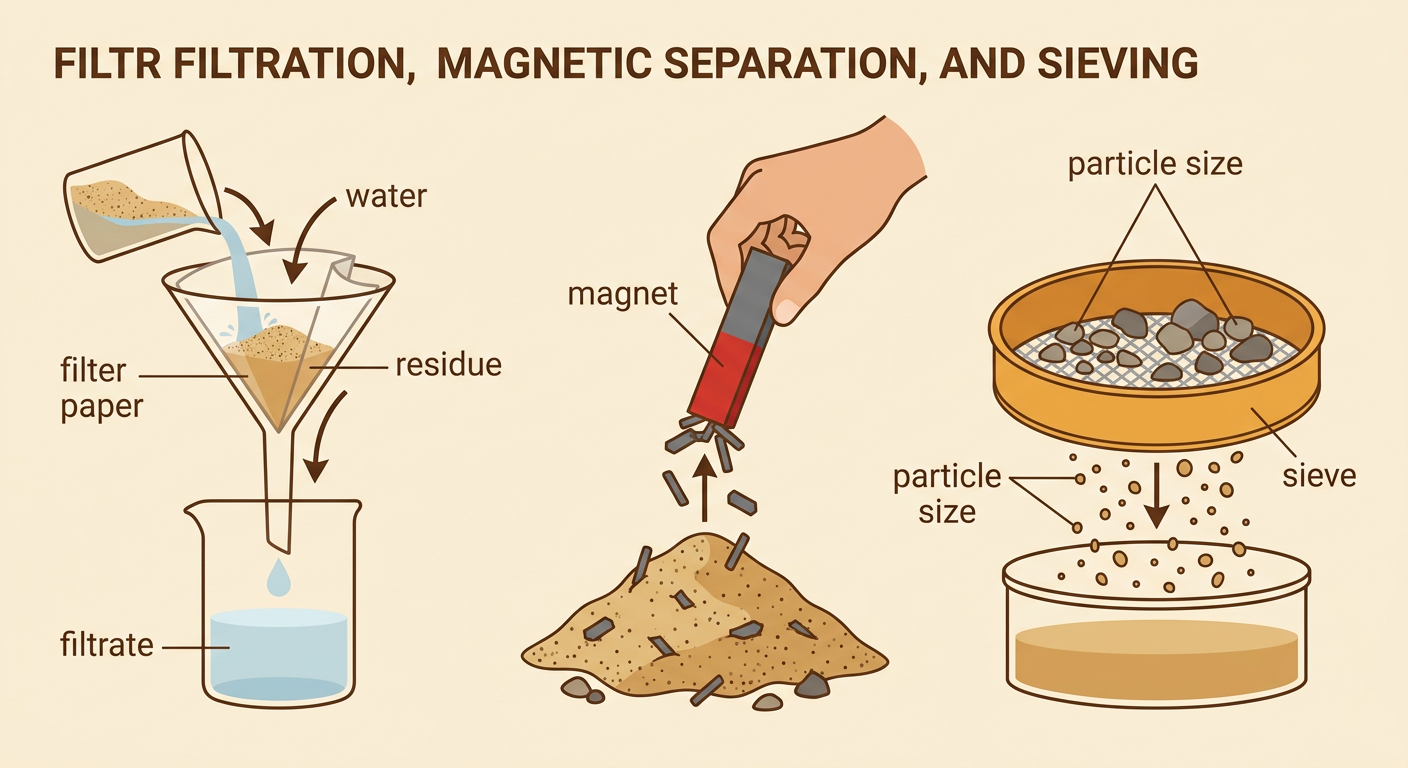
Filtration, magnetic separation, and sieving remove solid materials by using different physical properties. During filtration, a liquid passes through a filter while insoluble solid particles are trapped. For example, pouring a sand-and-water mixture through filter paper leaves sand as the residue and allows water, called the filtrate, to pass through. Magnetic separation uses a magnet to remove magnetic substances, such as iron pieces, from nonmagnetic materials. Sieving separates solids by particle size. Small particles pass through openings in a screen, while larger particles remain above it. A recycling center might use magnets to remove steel cans and screens to sort pieces by size. These methods do not form new substances, and they can reduce the amount of material sent to landfills.
Evaporation and Distillation
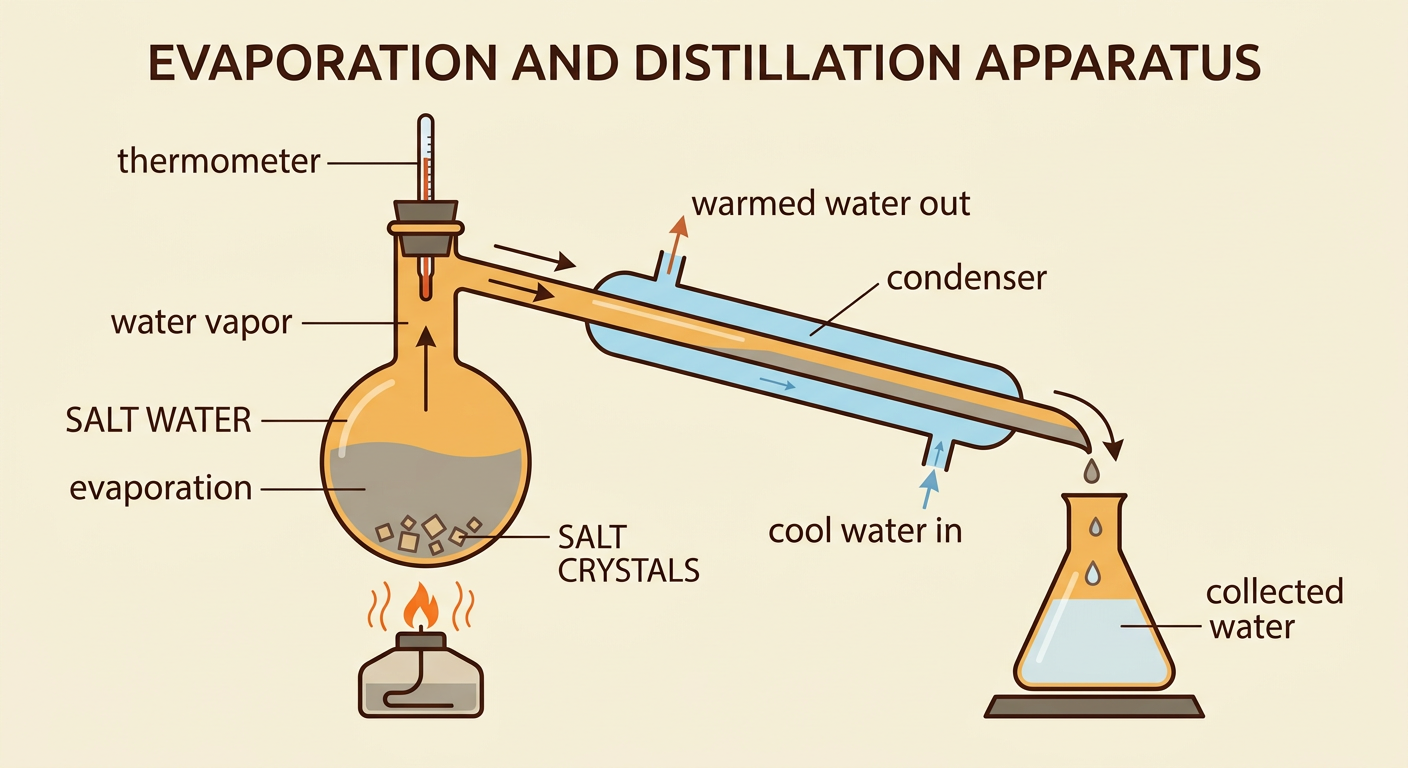
Evaporation can recover a dissolved solid from a solution. When salt water is heated or left in a warm place, water changes into water vapor, but the salt remains and may form crystals. This method collects the salt but usually does not collect the water. Distillation can recover the liquid as well. In simple distillation, a solution is heated until the substance with the lower boiling point becomes a gas. The gas travels into a cooler tube, where it condenses back into a liquid and is collected. For example, distilling salt water produces collected water while salt stays in the heating flask. Heating must be controlled and performed with proper safety equipment. Neither method creates a new substance because the changes of state are physical changes.
Choose a Separation Plan
To choose a separation plan, identify every component, compare its physical properties, and arrange the methods in a safe, logical order. Suppose a mixture contains iron filings, gravel, salt, and water. First, use a magnet to remove the iron. Next, use a sieve to remove the gravel. Then choose evaporation to recover only the salt, or distillation to recover both salt and water. Follow each step in order, record observations, and avoid losing materials during transfers. Also compare costs and benefits. Evaporation needs simple equipment but loses the water and may take time. Distillation recovers water but requires more equipment and energy. In recycling, the best plan balances purity, safety, speed, energy use, equipment cost, and the value of the materials recovered.
